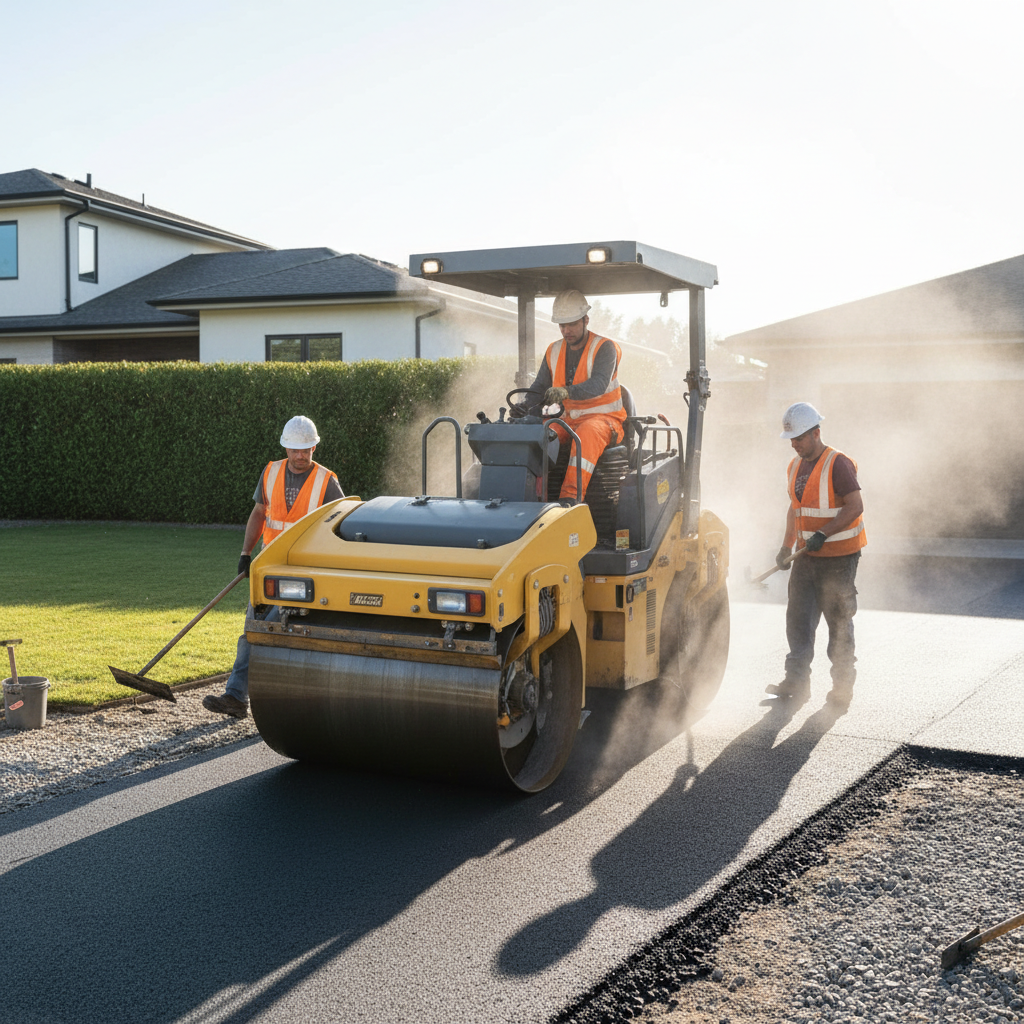
Driveway paving options and costs in County Park
In County Park, Ontario, choosing how to pave your driveway usually comes down to asphalt, interlocking pavers, or concrete—each priced differently because of how they behave through Toronto’s long freeze–thaw seasons. County Park has a small population of 3,367 (Statistics Canada, 2021 Census), and most driveways here serve detached homes and similar private properties. That matters because driveway work is typically full-depth site-prep at one address, not a large subdivision paving push, so access, excavation, and drainage details directly drive the final number. In the Toronto economic region, ground freezing is roughly 3–4 feet, so the granular base and subgrade compaction have to be engineered to resist heaving and cracking when water freezes under the pavement.
Contractor availability also shifts with seasonality: the effective paving window in Ontario is late spring through early fall, and hot-mix asphalt placement needs warm enough air and pavement temperatures (typically above about 10°C). In practice, that compresses scheduling, and spring/early-summer dates can carry a premium—especially for rush projects or when multiple adjacent sites are tearing out old surfaces at once. You’ll also see pricing vary with how much excavation is required, whether your driveway ties into an apron or curb cut, and how much drainage correction the contractor needs before laying new stone and asphalt.
Below are realistic, homeowner-oriented price bands for common driveway approaches in County Park, Ontario. Use these to sanity-check quotes before you compare itemized scopes.
| Material |
Lifespan |
Maintenance |
Best For |
Price per sq ft |
Price Range |
| Asphalt (new installation, proper base) |
15–25 years |
Seal every 3–5 years; crack-fill as needed |
Strong value with good base prep; smooth driving surface |
$8–$14/sq ft |
$3,500–$8,000 |
| Asphalt (overlay on existing gravel base) |
10–18 years |
Seal every 3–5 years; monitor for settlement |
Budget refresh where the old base is stable |
$6–$12/sq ft |
$2,800–$6,500 |
| Interlocking concrete pavers |
25–40 years |
Joint sand top-ups; periodic sealing if desired |
High curb appeal; easier spot repairs |
$18–$28/sq ft |
$9,000–$20,000 |
| Poured concrete (broom finish) |
20–30 years |
Seal if recommended; crack control joints inspection |
Low daily maintenance; modern, clean look |
$14–$22/sq ft |
$6,000–$15,000 |
| Exposed aggregate concrete |
20–30 years |
Seal to protect surface; repair spalls promptly |
Texture and slip resistance; premium appearance |
$16–$26/sq ft |
$7,000–$17,500 |
| Gravel / crushed stone (budget option) |
3–8 years |
Re-grade and top up annually; weed control |
Temporary solution or low-budget start |
$4–$8/sq ft |
$1,500–$4,000 |
Prices are estimates only and vary by project scope, site access and material selection.
What affects the price of paving in County Park
In County Park, you can absolutely get quotes for the “same” driveway that differ by 30–50%, even when the final material looks similar on paper. The difference is usually in the hidden work: how much base excavation is required, how the contractor handles drainage, what subgrade conditions they uncover once the topsoil is stripped, and how much time they spend building the proper frost-resistant section for Toronto’s freeze–thaw climate. In the Toronto economic region, the frost line is about 3–4 feet, which pushes driveway assemblies to be built with a thicker, properly compacted granular base to prevent heaving and cracking. In colder Ontario areas like ours, contractors commonly target deeper base thicknesses—often in the 6–12 inch granular range, depending on soils and how the subgrade is corrected—whereas milder regions can sometimes get away with thinner sections.
Timing also matters. Hot-mix asphalt placement depends on sufficient air temperature (often above 10°C), so the workable paving season compresses into late spring through early fall. When prime dates fill up, rush scheduling and overtime labour can raise your installed cost. That’s why an asphalt driveway might land at the lower end of the $3,500–$8,000 band for off-peak projects, but stretch higher when the job requires extra excavation and a tight schedule.
Concrete costs can move up or down with local conditions too. If you have a soft, water-logged subgrade, poured concrete may require additional base and subgrade stabilization before it’s placed—otherwise cracking risk increases under freeze–thaw movement. On the flip side, a driveway with good drainage and stable soils can let concrete come in closer to mid-range, often nearer the $6,000–$15,000 band. Asphalt, by comparison, is sensitive to mix design for freeze–thaw performance and needs a reliable seal strategy to slow oxidation and surface raveling.
| Price Factor |
Why It Matters |
Cost Impact |
| Driveway area in sq ft — the primary cost driver |
Material, base, and labour scale directly with square footage |
Often the largest portion of the total—commonly 40–70% of cost |
| Base depth required — frost line determines granular thickness |
Deeper, well-compacted base reduces heave and cracking risk |
Can add thousands when excavation depth increases |
| Grading and drainage work — slope or drainage corrections add cost |
Standing water under pavement accelerates freeze damage |
Typical mid-project add-on for regrading and culvert work |
| Tear-out of existing surface — breaking and hauling concrete or old asphalt |
Demolition and disposal aren’t free, and haul time costs labour |
Can shift total cost significantly (especially for thick slabs) |
| Edge restraints and curbing — needed to prevent paver spread |
Proper restraint keeps joints tight and edges from lifting |
Usually a noticeable add-on for pavers or wider driveways |
| Sealing requirement — asphalt must be sealed after 6–12 months |
Sealing protects against oxidation and winter abrasion |
Small compared to replacement, but often budgeted separately |
| Site access — narrow or tight lots slow equipment movement |
Extra labour and repositioning increases installation time |
Can add hours and truck trips, especially in peak season |
| Asphalt mix specifications — freeze-thaw-rated mix costs more |
Toronto-area performance needs mixes engineered for cycling temperatures |
Raises asphalt material cost but typically reduces early failures |
Permits & regulations in Ontario
In Ontario, paving a private driveway within your own property typically does not require a building permit, as long as you’re working on your land and not altering municipal infrastructure. That said, the details matter. Work that usually does require municipal approval (and can trigger permit or application requirements) includes changes in the municipal right-of-way, such as new or modified curb cuts, alterations to boulevard grading, and any changes that affect stormwater drainage (for example, rerouting downspouts or modifying how surface water leaves the property). If your contractor needs to adjust catch basins, modify municipal drainage structures, or connect to anything in the boulevard, that’s where approvals come in.
Here’s how a homeowner in County Park can verify a contractor the right way, step-by-step, even when there’s no “permit” for the driveway itself. First, confirm Ontario licence details (where applicable for the work they’re performing) and ask for the contractor’s current information. Second, request a current certificate of liability insurance naming you as an interested party. Third, ask for proof of WSIB/WCB coverage (or appropriate account status documents). Look for dates and policy numbers on the certificates—don’t rely on verbal assurance. Fourth, if your contractor provides a clearance letter, keep a copy for your records.
Finally, always call for utility locates before excavation (Ontario One Call). If lot grading is regulated locally, confirm setbacks and drainage requirements with your municipality so the finished driveway doesn’t get flagged later.
Asphalt vs pavers vs concrete for County Park driveways
For County Park’s freeze–thaw climate, asphalt, interlocking pavers, and concrete all can work well—what changes is cost, how they flex, and how homeowners handle winter maintenance. Asphalt is usually the lowest upfront choice. It performs well when the base is engineered for frost (with proper drainage and compaction), but it needs sealing after the initial cure period—typically within 6–12 months, then every 3–5 years—so the surface resists salt and winter abrasion. Interlocking concrete pavers have the highest upfront cost, yet they’re extremely homeowner-friendly: if a small section settles or freezes upward, individual pavers can be lifted and reset without ripping out the entire driveway. For Toronto-area curb appeal, that’s why pavers are popular in neighbourhoods with higher visual expectations—particularly around older homes with established landscaping.
Poured concrete usually lands in the mid-range, often around the $6,000–$15,000 band, but Toronto freeze cycles demand good detailing. Concrete should be air-entrained and properly jointed (and planned for drainage), otherwise it’s more prone to hairline cracking and spalling in salted winter traffic paths. Exposed aggregate is similar but more premium in finish; permeable pavers and drainage grids can help if your soil holds water, but they add complexity. As a practical example, if asphalt is quoted at about $5,500 and interlock is quoted at $13,000 for the same size driveway, the price gap can be justified if you expect repairs, want the highest curb appeal, and care about being able to address localized issues rather than replacing whole panels.
Whichever you pick, the local “make-or-break” item is base preparation and drainage. In the Toronto region, that’s what prevents heaving and cracking in all materials—not the surface colour.
| Material |
Frost Resistance |
Curb Appeal |
Repair Method |
Lifespan |
Price Band |
| Asphalt (sealed regularly) |
Good with proper base and freeze-thaw-rated mix |
Medium (clean, modern finish possible) |
Patch and re-tack; seal to blend |
15–25 years |
$3,500–$8,000 |
| Interlocking concrete pavers |
Excellent—flexible bedding layer reduces heave impact |
High (wide colour/pattern options) |
Remove/replace individual pavers and reset bedding |
25–40 years |
$9,000–$20,000 |
| Poured concrete (air-entrained) |
Good with proper joints, thickness, and drainage |
Medium–High (broom finish or upgrades) |
Crack repair and patching; section repairs possible |
20–30 years |
$6,000–$15,000 |
| Exposed aggregate concrete |
Good with correct mix and curing |
Very High (decorative texture) |
Targeted patching; colour-matching can be limited |
20–30 years |
$7,000–$17,500 |
| Permeable pavers (drainage grid) |
Excellent where drainage is the main issue |
High (clean layout; modern drainage look) |
Lift/replace affected sections; inspect drainage media |
25–40 years |
$10,000–$22,000 |
| Chip seal / tar-and-chip |
Moderate—less suited if drainage is poor or traffic is heavy |
Low–Medium (richer texture than gravel) |
Spot re-chip patches |
5–12 years |
$2,000–$5,500 |
How to choose a paving contractor in County Park
Choosing a paving contractor in County Park is mostly about verifying documentation and getting clarity in the scope—because in Toronto’s freeze–thaw environment, small construction shortcuts can show up fast as heaving, cracking, or edge failure. Start by verifying the contractor’s Ontario licensing (ask for the relevant registration information if they claim a specific category of work). Then request a current certificate of liability insurance; it should be valid for the project timeframe and list your home address as an additional interested party when available. Finally, confirm WSIB/WCB coverage—ask for proof, and check that it’s active. If the contractor can’t provide documents promptly, treat that as a serious red flag.
Next, get 2–3 itemised written quotes. The best quotes break down labour and materials (excavation, granular base, geotextile if included, asphalt or concrete placement, compaction, and disposal). Don’t accept vague “surface prep included” language—ask what’s excluded: permit pull, utility locate costs, disposal of old concrete/asphalt, grading corrections, and whether an apron/curb tie-in is part of the scope. Make sure the quote specifies the thickness and compaction approach for the granular base, since Toronto frost depth drives real material quantities.
Warranty should be written and specific: workmanship warranty length, what product/manufacturer warranty covers, and whether it transfers if you sell. For payment, never pay more than 10–15% upfront; hold back a meaningful portion until completion and cleanup. For timing, require a start date and completion estimate in writing—peak-season delays happen, but you should still have a clear schedule.
- Confirm Ontario licence/registration details applicable to the work they’ll perform.
- Request active liability insurance and verify the coverage dates match the job.
- Confirm WSIB/WCB coverage with a current clearance or proof document.
- Get 2–3 itemised quotes (labour + materials), not lump sums.
- Ask what base depth and compaction standard they’re using for frost resistance.
- Verify drainage plan: slope, ditch ties, and any subdrain/pipe work.
- Clarify tear-out scope and disposal: old asphalt/concrete hauling included?
- Check if edging/restraints are included (especially for pavers and wide drives).
- Ask how joints/cracks are handled (concrete jointing, asphalt crack-fill plan).
- Confirm asphalt sealing responsibility and timing (seal within 6–12 months).
- Define warranty terms in writing and what maintenance actions void coverage.
- Use a payment schedule: 10–15% max upfront; holdback until final walk-through.
Red flags to watch for in County Park: (1) quotes with no mention of base thickness, compaction, or drainage; (2) refusal to provide insurance/WSIB/WCB proof; (3) “we’ll pave no matter the temperature” without weather safeguards; (4) no written scope for tear-out, disposal, or grading; and (5) large upfront payments (bigger than 10–15%) without a signed holdback plan.
Frequently asked questions — paving in County Park
Can asphalt be laid in cold weather in County Park?
In Ontario, asphalt can sometimes be placed near chilly conditions, but successful paving is about more than “temperature on the day.” For County Park (Toronto area), hot-mix asphalt placement typically needs air temperatures high enough to ensure the mix can be laid, compacted, and cooled correctly without trapping moisture or preventing proper compaction. If the air and pavement temperatures are too low—especially in late fall and early spring—work may need to pause until conditions are right. A competent contractor will also protect the base from freezing and ensure drainage remains functional so water doesn’t sit under the pavement and expand during freeze–thaw cycles. If you’re getting quoted, ask about their weather policy and whether they’ll schedule around the paving window. As a reference point, a well-built asphalt driveway often sits in the $3,500–$8,000 range depending on scope and base preparation.
What is a driveway apron and do I need one in County Park?
A driveway apron is the transition area where your driveway meets the road/boulevard—often involving a curb cut or a shaped concrete/asphalt section that helps guide water and vehicles smoothly from the municipal road grade to your private property. In County Park, whether you “need one” depends on your existing curb/boulevard condition and how the driveway ties into the right-of-way. If your contractor is changing anything in the boulevard (like a new curb cut, boulevard grading changes, or storm drainage modifications), approvals are usually required through the municipality, and that can affect cost and timelines. If you’re simply repaving your private driveway surface within your property limits, you may not need apron work. Ask your contractor to clearly state in the quote whether an apron tie-in is included, and whether any right-of-way elements are part of the scope.
How do I maintain my driveway through County Park winters?
Winter maintenance in Ontario is mostly about preventing moisture damage and minimizing surface wear. For an asphalt driveway, start with regular crack filling and sealing (seal after the recommended cure window, often within 6–12 months, then every 3–5 years). During winter, avoid aggressive scraping that gouges the surface; use proper plow blades and keep chemicals like de-icing salt from pooling—salt + moisture accelerates deterioration and can worsen edge lift. For pavers, focus on keeping the joint sand in place and clearing snow/ice in a way that doesn’t dislodge blocks. For concrete, air-entrained mixes and good jointing reduce freeze-thaw stress, but you still want to remove slush and avoid heavy salt accumulation on the same spots. If drainage is correct at installation, your winter performance improves noticeably because less water migrates under the pavement.
Is it worth sealing a new driveway right away in County Park?
In County Park and across Ontario, sealing a brand-new asphalt driveway “right away” is usually not the best idea because the asphalt needs time to cure and release moisture. Most contractors recommend sealing after the initial cure window—often within 6–12 months—when the surface is stable and ready to accept sealer. Sealing too early can trap moisture and shorten service life. That said, sealing is typically worth it because it protects the asphalt from oxidation and helps it stand up to winter abrasion and salt exposure. When you’re budgeting, remember sealing is a maintenance step that supports the lifespan of your original installation, whether your driveway is closer to the lower end of the $3,500–$8,000 asphalt band or higher due to excavation and drainage corrections. Ask for the sealer type and the contractor’s sealing schedule in writing.
What is a chip seal driveway and is it suited to County Park?
Chip seal (tar-and-chip) is a roadway-style surface: a binder is applied and topped with aggregate chips, then rolled. It’s sometimes used as an economical option where you can accept a shorter lifespan and a rougher finish than asphalt. For County Park’s Toronto-area freeze–thaw cycles, chip seal can work, but it’s more sensitive to drainage and base stability. If water can get trapped under the surface, freeze expansion can loosen chips and accelerate wear. It’s also more likely to look patchy over time compared with asphalt or pavers. If you have heavy winter plowing or you expect frequent turning traffic, it may not be the best long-term value. For pricing context, chip seal is sometimes quoted in the low end (often around the $2,000–$5,500 band), but you should ask what base prep and binder specs they use to match our climate.
How much does driveway crack repair cost in County Park?
Crack repair in County Park typically depends on the crack width, whether water is moving through it, and how much prep the contractor needs (cleaning, routing, and sealing). For fine hairline cracks, contractors may start with crack cleaning and filling; for wider cracks or areas with settlement, you may need targeted patching over the affected section to stop freeze–thaw movement. Costs can vary, but many homeowners budget a few hundred dollars for localized repairs. If the crack is widespread and the base is moving, repair may only be a temporary fix and the driveway may need broader resurfacing. As a quick budgeting reference, sealing and repair work often falls into the smaller add-on ranges (for example, sealing & repair commonly sits around $300–$1,500 for minor interventions), while larger patch programs can climb quickly with labour and surface prep. Ask for photos, measurements, and a plan that addresses drainage if the cracks are recurring.