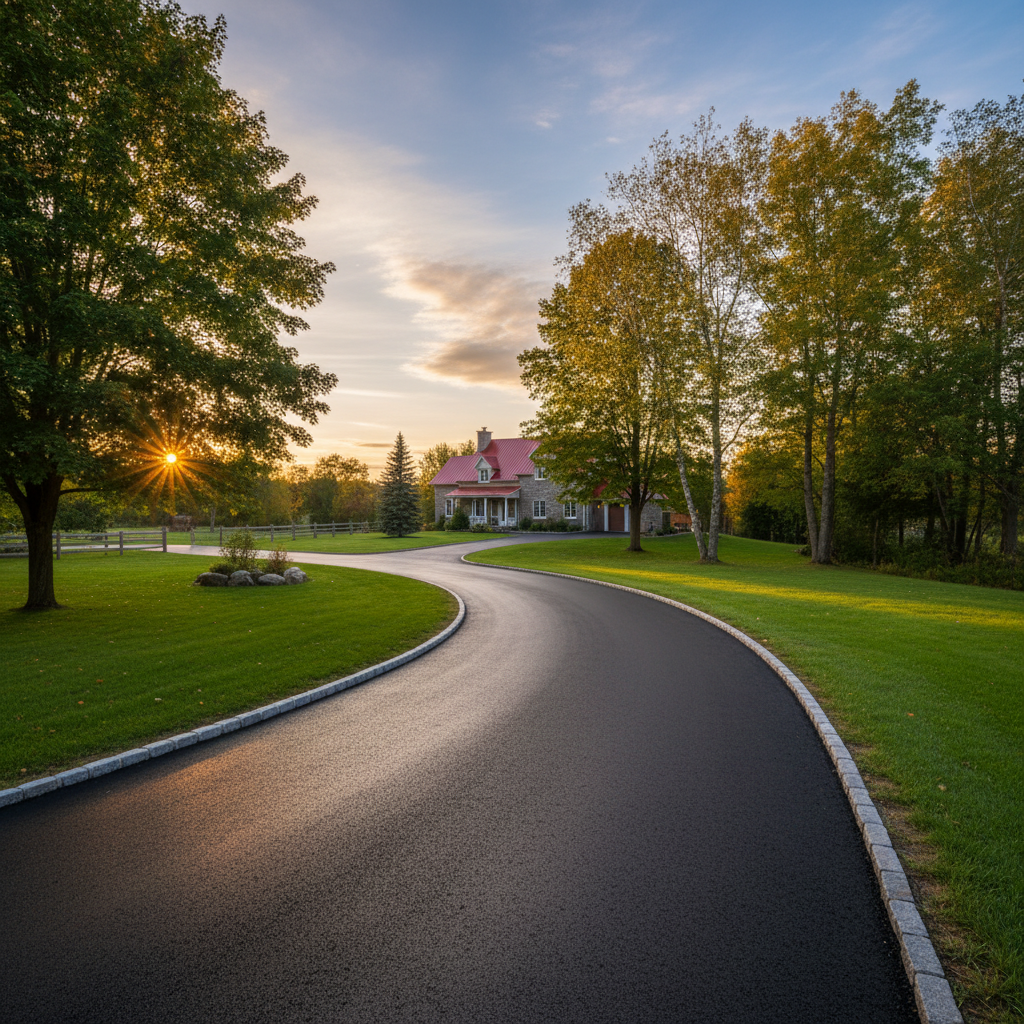
Driveway paving options and costs in Neebing
Neebing homeowners have a straightforward—but weather-driven—set of driveway choices: asphalt, interlocking pavers, and concrete. Because Neebing’s housing stock is overwhelmingly single-detached (98.9% of dwellings) and most households are owner-occupied (885 homeowner households, 94.1%), paving demand is concentrated on private driveways attached to detached homes, not shared lanes. The median household income is about $94,000, so value and longevity matter as much as initial cost.
In the Northwest economic region, pricing is shaped by deep frost penetration and aggressive freeze–thaw cycles. The local reality is thicker granular bases, careful grading, and reliable drainage to keep water from sitting under the pavement. Work also has to fit a shorter paving season; hot-mix asphalt generally needs favourable temperatures (often above 10°C) for proper compaction, so scheduling premiums are common in spring and early summer when crews are stretched.
In Neebing, you tend to see the most frequent upgrades in areas around the village core where driveways are common access points and winter maintenance (plowing, sanding and some de-icing) stresses the surface. If you’re comparing options for a typical replacement or major rework, the table below gives realistic per-square-foot ranges and typical service life expectations for a properly built system with proper base, not “thin-over-gravel” installs.
| Material |
Lifespan |
Maintenance |
Best For |
Price per sq ft |
| Asphalt (new installation, proper base) |
15–25 years |
Sealcoat every 3–5 years; spot crack repair |
Lowest upfront cost with long-term planning |
$7–$14 |
| Asphalt (overlay on existing gravel base) |
10–18 years |
Sealcoat every 3–5 years; patching as needed |
Smaller budgets where base can be stabilized |
$7–$12 |
| Interlocking concrete pavers |
25–35 years |
Weed control; replace individual stones if needed |
Repairable surface and strong curb appeal |
$18–$35 |
| Poured concrete (broom finish) |
20–30 years |
Caulking at joints; periodic sealing |
Clean look and simple maintenance |
$14–$28 |
| Exposed aggregate concrete |
20–30 years |
Sealer upkeep; manage small surface chips |
Slip-resistant texture and premium appearance |
$16–$30 |
| Gravel / crushed stone (budget option) |
3–8 years |
Regrade; top up annually; weed management |
Short-term solution or low-traffic areas |
$3–$7 |
Prices are estimates only and vary by project scope, site access and material selection.
What affects the price of paving in Neebing
In Neebing and across Northwestern Ontario, you can see 30–50% quote swings for what seems like the “same” driveway because contractors price the subgrade and drainage as much as the surface. Asphalt might look comparable on paper, but one contractor includes full granular base rebuild and proper thickness for frost protection while another only “levels and paves.” In a region with deep frost penetration and frequent freeze–thaw, that difference is what determines whether you’ll be budgeting for crack repairs and resurfacing sooner or later.
Frost line depth and freeze–thaw cycles are decisive cost factors. In the Northwest, we commonly work with a thicker compacted granular base on the order of about 4 feet of frost protection thinking as a minimum, and in colder/poorer subgrade cases designs can push toward roughly 5–6 feet in extreme scenarios. Practically, that means more excavation, more hauling, and more base material. For comparison, coastal areas with lighter frost often need less base depth. That’s why winter performance in Neebing usually requires higher build-up costs.
The shorter paving season also matters. Hot-mix asphalt requires adequate air temperature for placement and compaction; when weather and scheduling tighten, crew mobilization and overtime can raise costs. Concrete has its own cold-weather challenges; air entrainment and winter curing practices can add expense.
Concrete examples: (1) an older home area where the existing subgrade is soft or clay-heavy typically needs additional granular replacement, which can push concrete closer to the $14,XXX – $28,XXX range; (2) a driveway with poor drainage—standing water after melt—often forces added grading and a better swale or underdrain plan, which affects both asphalt and concrete. If your driveway currently sits on gravel, a real base stabilization can move asphalt from “budget paving” into the $7,XXX – $14,XXX band for longer-term performance.
| Price Factor |
Why It Matters |
Cost Impact |
| Driveway area in sq ft |
Most labour and material scale directly with square footage |
Highest impact (often 50–70% of total) |
| Base depth required |
Frost protection drives granular thickness and compaction passes |
Can add major costs if excavation expands |
| Grading and drainage work |
Proper slope and drainage prevent water from saturating the base |
Moderate to high depending on site issues |
| Tear-out of existing surface |
Breaking, hauling, and disposing old asphalt/concrete adds work |
Moderate to high; affects schedule |
| Edge restraints and curbing |
Prevents paver spread and asphalt edge failure |
Moderate; often required for pavers |
| Sealing requirement |
Asphalt typically needs sealcoat after installation and later |
Low per year; higher if you delay early sealing |
| Site access |
Narrow lots and long pushes slow trucks and compactors |
Moderate; can increase labour hours |
| Asphalt mix specifications |
Freeze–thaw-rated mixes can cost more than basic blends |
Low to moderate per sq ft, but crucial for durability |
Permits & regulations in Ontario
In Ontario, paving a private driveway within your own property typically does not require a building permit. Most work like asphalt placement, interlocking paver installation, concrete slabs, and ordinary re-grading on private land is handled as a private improvement. However, permit and approval requirements can apply when work affects the municipal right-of-way or storm drainage infrastructure.
In practical terms, the work that DOES usually require municipal approval includes: installing or changing a curb cut (where it ties into municipal road surfaces), altering boulevard areas, and making changes that affect stormwater flow patterns (for example, modifications to catch basins, drainage in the ditch line, or routing that impacts municipal drainage). The work that typically does NOT require a permit includes: tearing out and replacing the driveway surface on private property, installing base layers under the driveway on private land, and pouring concrete or setting pavers strictly within your driveway footprint.
Before excavation in Neebing, always arrange utility locates through Ontario One Call. Then, verify your contractor’s credentials. Step-by-step: (1) check the contractor’s Ontario licensing/registration information through the appropriate online registry channel available for your trade; (2) request a current certificate of insurance naming you (or your property as appropriate) and confirm coverage amounts for general liability; (3) ask for WSIB/WCB proof—many contractors will provide a clearance letter or equivalent proof document. Make sure these are current before the first shovel goes in, and keep copies for your records.
Asphalt vs pavers vs concrete for Neebing driveways
For Neebing’s freeze–thaw climate, asphalt, interlocking pavers, and concrete can all perform well—but they succeed with different expectations. Asphalt usually offers the lowest upfront cost and, with a properly built granular base, can last 15–25 years. The trade-off is maintenance: sealcoat is typically needed every 3–5 years, plus crack filling as soon as small cracks appear. In the Northwest, those small failures often start from water movement and frost action, so the base and drainage design are non-negotiable.
Interlocking concrete pavers generally cost more up front, but they’re the most forgiving when repairs are needed. Individual stones can be lifted and reset without tearing out the whole driveway—useful when a utility repair or localized settling occurs. That repairability can matter in older areas where soil conditions vary. Pavers often land in the $18,XXX – $35,XXX price band, which can be justified if you want curb appeal and the ability to address future problem spots selectively.
Poured concrete sits mid-range and can look excellent for a long time, especially with proper joints and air-entrained mix design to resist freeze-related scaling and cracking. Concrete is still more susceptible to cracking from movement and de-icing practices if the mix isn’t right and if joints aren’t managed.
Where the price difference is justified: if your driveway area is small and you mainly want a quick, cost-controlled upgrade, asphalt at roughly the $7,XXX – $14,XXX range can be the smart value. If you anticipate heavier plowing impacts, prefer easier spot repairs, and want maximum visual “finish,” pavers may outperform despite the higher installed price.
| Material |
Frost Resistance |
Curb Appeal |
Repair Method |
Lifespan |
Price Band |
| Asphalt (sealed regularly) |
Good with thick base and drainage |
Good (clean, black top; limited variety) |
Crack fill and patch sections |
15–25 years |
$7–$14 |
| Interlocking concrete pavers |
Very good when bed is built and compacted correctly |
Excellent (multiple patterns and edges) |
Lift-and-reset individual units |
25–35 years |
$18–$35 |
| Poured concrete (air-entrained) |
Good with proper joints and air-entrained mix |
Good to excellent (straight lines, clean finish) |
Patch limited areas; larger cracks may require repair/section work |
20–30 years |
$14–$28 |
| Exposed aggregate concrete |
Good if base and curing are done right |
High-end look with texture |
Targeted patching and sealing touch-ups |
20–30 years |
$16–$30 |
| Permeable pavers (drainage grid) |
Very good for managing meltwater where soils allow |
Good (practical look) |
Replace affected units; inspect drainage layer |
25–35 years (if drainage system performs) |
$22–$40 |
| Chip seal / tar-and-chip |
Moderate; surface performance varies in freeze–thaw |
Utility/road-like appearance |
Aggregate top-ups and surface maintenance |
5–12 years |
$6–$10 |
How to choose a paving contractor in Neebing
Choosing the right contractor matters in Neebing because workmanship and base preparation drive your winter performance. Start with Ontario credentials. Ask for the contractor’s Ontario licensing/registration details relevant to paving and site work, then request liability insurance and WSIB/WCB coverage proof. To check: (1) look for the contractor’s licensing/registration information on the relevant online registry; (2) request a certificate of insurance and verify it’s current and that coverage limits are appropriate for driveway construction; (3) ask for WSIB/WCB proof (commonly a clearance letter or current account status document). Don’t proceed if documents are missing, expired, or “available later.”
Next, get 2–3 itemised written quotes—not just a lump sum. A strong quote breaks out labour, excavation/tier disposal, base materials, geotextile (if needed), compaction, surface course, and any required sealcoat for asphalt. Read exclusions carefully: is disposal included? Is permit/municipal approval time included if your driveway ties into a curb cut? Does it include saw cutting, jointing for concrete, or edge restraints for pavers?
Warranty should be clear and written: workmanship warranty length (often 1–2 years), product or manufacturer warranty details, and whether the warranty transfers to future owners. For payment schedule, never pay more than 10–15% upfront; use progress payments and hold back until the job is fully complete and cleaned up. Get a written start date and a completion estimate that accounts for the shortened Northwest season.
- Confirm Ontario licensing/registration for the work being performed.
- Verify liability insurance is current and request a certificate copy.
- Obtain WSIB/WCB clearance proof before work begins.
- Require an itemised quote (labour + materials + disposal).
- Ask for base thickness and compaction method details.
- Ensure drainage/grading is included, not assumed.
- Check whether utility locates are responsibility of the contractor or homeowner.
- Confirm tear-out scope (what is removed and hauled away).
- Ask if geotextile or separation fabric is recommended for your soil.
- For pavers, confirm edge restraints and bedding sand specs.
- For asphalt, confirm sealcoat timing (initial sealing after install, then every few years).
- Agree on payment schedule: small deposit, progress payments, holdback at completion.
In Neebing, common red flags include quotes that don’t specify base thickness, promises of “paving over whatever is there,” no written drainage plan, missing insurance/WSIB proof, and a payment request that asks for most money upfront. Also watch for vague warranty wording (“we stand behind it”) without a written term and limits.
Frequently asked questions — paving in Neebing
What is a chip seal driveway and is it suited to Neebing?
A chip seal driveway is a surface treatment that uses asphalt binder sprayed over the base, then topped with stone chips to lock the texture in place. It’s commonly used on roads and some low-volume rural driveways where the goal is a quick, economical improvement rather than a long-lived finish. In Neebing and other Northwest areas, chip seal can work for certain properties, but freeze–thaw and plowing can knock loose chips faster than on milder pavement environments. If you’re facing deep frost and standing meltwater, performance depends heavily on base prep and drainage. For context, chip seal typically lands around the lower end of the driveway paving spectrum (often near the $6–$10 per sq ft range). If you want a driveway that stays neat and resists winter abrasion, asphalt with a proper base or pavers are usually a safer bet.
How much does driveway crack repair cost in Neebing?
Crack repair costs in Neebing usually depend on crack type (hairline vs. widened), length, and whether water has started to undermine the base. Small, surface-level cracks are commonly addressed with crack filling/sealing—meant to stop water migration—so you can often expect a relatively low per-locations cost. For more involved repairs (routing and re-filling, small patch areas, or stabilizing a failing edge), pricing increases because the contractor must clean, prepare, and sometimes remove a portion of asphalt or concrete. As a planning reference, sealing and repair work commonly falls in the $1–$4 per sq ft range, but extensive patching and tear-out can push beyond that. If your driveway is repeatedly cracking after melt and freeze cycles, the real fix is usually drainage and base correction, not just filling.
What base thickness do I need for pavers in Neebing?
For pavers in Neebing, base thickness is driven by frost penetration, subgrade condition, and drainage. In a deep-frost, freeze–thaw region like the Northwest, you should plan for a substantial compacted granular base rather than a thin layer. While exact thickness depends on soil and the design of the frost protection system, the practical rule we follow is that Neebing driveway pavers need a properly built foundation to prevent heaving and differential settling—especially if you have clay or poor drainage. That usually means excavation to reach suitable soil (or replacing unsuitable material) and then building up dense, compacted granular layers before you place bedding sand and paver units. If drainage is corrected and compaction is consistent, pavers tend to tolerate winter maintenance well; if not, you’ll see rocking and edge failures.
How do I get the most accurate paving quote in Neebing?
To get the most accurate quote in Neebing, ask for a site visit and a quote that’s itemised—not a single number. The contractor should assess subgrade condition, existing surface condition, drainage patterns, and the current thickness/condition of any base material. Request a written breakdown for excavation/tier disposal, granular base depth, compaction, drainage/grading work, edge restraints (especially for pavers), and the finish course. For asphalt, ask whether the mix design is appropriate for freeze–thaw performance and whether sealcoat is included for the first season. For concrete, confirm air entrainment and jointing plans. Also ensure utility locates are addressed before digging. The more precise the scope and base design, the less likely you’ll get the kind of quote swings that happen when one contractor includes the real foundation work and another doesn’t.
How much does it cost to pave a driveway in Neebing?
Driveway paving in Neebing is priced higher than southern Ontario in many cases because of the shorter working season, deeper frost protection expectations, and added mobilization for crews and aggregate haul. For budgeting, use the local price bands as a guide: asphalt driveway paving commonly falls around $7,XXX – $14,XXX for typical projects depending on thickness, base rebuild, and access, while interlocking pavers often run $18,XXX – $35,XXX when including proper restraint and base. Concrete is often in the mid-range around $14,XXX – $28,XXX, again depending on excavation, base, and finish choice. If your driveway needs tear-out and drainage fixes, expect the higher end. Sealing and repair budgeting is separate, but it’s part of the lifecycle for asphalt in freeze–thaw climates.
Asphalt vs interlocking pavers vs concrete — which is best in Neebing?
In Neebing, the “best” choice depends on what you value most: lowest upfront cost, maximum curb appeal, or easiest future repairs. Asphalt usually wins for cost-effectiveness—if it’s built on a properly compacted granular base and you plan for sealcoat every few years. Interlocking pavers are often the most durable-looking option long term because individual stones can be removed and reset, which helps when you eventually need spot repairs or when settling happens. Poured concrete can be excellent when it’s air-entrained, properly jointed, and placed on a frost-safe base, but it can crack if movement isn’t controlled. With Northwest freeze–thaw and winter maintenance (plowing and sand/salt use), all three can perform well when the base and drainage are done right; the surface material alone doesn’t solve frost heave or water issues.