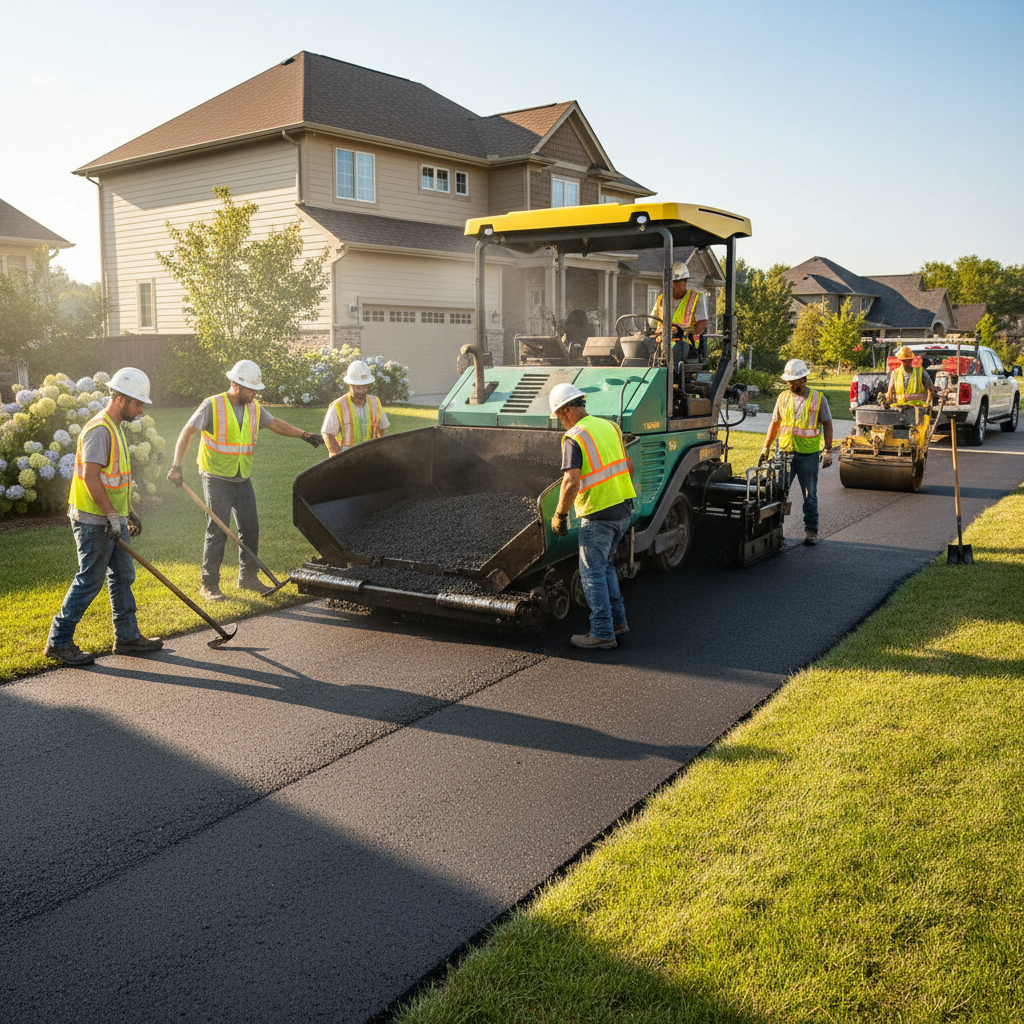
Driveway paving options and costs in Guelph
In Guelph, homeowners typically choose driveway paving based on a mix of budget, winter demands, and how much disruption they can tolerate during excavation and installation. With 37,095 homeowner households in the city (Statistics Canada, 2021 Census) and single-detached houses making up 48.6% of dwellings, there’s a steady need for driveways that can handle repeated freeze-thaw without heaving or cracking. That winter stress is why the Kitchener–Waterloo–Barrie corridor often costs more than milder climates: frost depth and freeze-thaw cycles are major cost drivers, so contractors rely on deeper, well-compacted granular base with reliable drainage. The paving season also runs shorter here; hot-mix asphalt generally requires air temperatures above 10°C, which compresses scheduling and can increase labour and plant availability costs when crews are busy.
In Guelph, demand is especially strong in established residential pockets like the south end and older neighbourhoods near Hanlon Parkway and Wellington Street corridors, where many driveways date back decades. If your driveway was built before 1981, you’re more likely to see mixed base performance and moisture-related settlement, which usually increases excavation and regrading scope before the final surface goes down.
Below is a practical cost comparison you can use as a baseline before you request itemised quotes. Your final price will depend on measured square footage, base condition, access for equipment, and whether you need tear-out, new drainage, or edge restraints.
| Material |
Lifespan |
Maintenance |
Best For |
Price per sq ft |
Price Range |
| Asphalt (new installation, proper base) |
15–25 years |
Seal coat every 3–5 years |
Best value when base/drainage are corrected |
$8.50–$14.00 |
$3,500–$7,000 |
| Asphalt (overlay on existing gravel base) |
8–16 years |
Seal coat every 3–5 years |
Budget path when grading is still sound |
$7.00–$12.50 |
$3,200–$6,400 |
| Interlocking concrete pavers |
25–35+ years |
Spot replace stones as needed |
High curb appeal; easy repairs |
$18.00–$30.00 |
$12,000–$22,000 |
| Poured concrete (broom finish) |
20–30 years |
Minor crack patching as needed |
Low visual maintenance; clean lines |
$14.00–$22.00 |
$9,000–$16,000 |
| Exposed aggregate concrete |
20–30 years |
Seal (where specified) and crack repair |
Better texture for traction in winter |
$16.00–$26.00 |
$10,500–$18,500 |
| Gravel / crushed stone (budget option) |
3–10 years (varies) |
Top up annually; re-level periodically |
Short-term driveway or low-traffic uses |
$4.50–$8.00 |
$2,000–$4,000 |
Prices are estimates only and vary by project scope, site access and material selection.
What affects the price of paving in Guelph
In Guelph and the wider Kitchener–Waterloo–Barrie market, two quotes for the same driveway can differ by 30–50% because the “same job” on paper often hides different base preparation, drainage correction, and tear-out scope. A contractor who finds a weak, moisture-prone subgrade might need deeper excavation and a bigger granular rebuild to handle Ontario’s freeze-thaw movement. Another might propose an overlay, but if the base isn’t stabilized, the life of the asphalt drops and the overall value can weaken quickly.
Frost line depth and freeze-thaw cycles are decisive cost factors here. In colder Ontario conditions, the pavement structure needs a thicker compacted granular base (typically in the 6–12 inch range) to reduce heaving and settlement. That means more aggregate, more compaction passes, more trucking, and more grading time. Paving season constraints also matter: hot-mix asphalt needs air temperatures above 10°C, so contractors often schedule tightly from spring through fall. When crews are busy, pricing can move toward the higher end of the asphalt band (for example, approaching $7,000 for a properly reconstructed driveway). Concrete projects can also price higher when additional reinforcement or drainage improvements are required, particularly on older properties built before 1981 where underlying base performance varies.
For concrete, local conditions can both raise and lower cost. If your slope already drains well, broom-finished concrete can come in closer to the mid-range (often near the $9,000 – $16,000 band). If you need significant regrading to manage runoff toward a proper discharge point, you’ll pay more. The same is true for pavers: they can be premium-priced in the $12,000 – $22,000 range, but where repairs are expected, the ability to lift and replace individual stones can justify that cost for homeowners planning long-term use.
| Price Factor |
Why It Matters |
Cost Impact |
| Driveway area in sq ft |
Material and compaction are priced by surface area |
High (often 50%+ of total) |
| Base depth required |
Frost resilience depends on enough granular thickness and compaction |
High (deeper base adds excavation + aggregate) |
| Grading and drainage work |
Slope corrections and proper drainage reduce water infiltration and failure |
Medium to high |
| Tear-out of existing surface |
Breaking concrete or removing old asphalt/gravel affects labour and disposal |
Medium to high |
| Edge restraints and curbing |
Prevents paver spread and protects asphalt from raveling at edges |
Medium |
| Sealing requirement |
Asphalt sealing after installation (often 6–12 months) protects from moisture and oxidation |
Low to medium (adds a future line item) |
| Site access |
Narrow lots or tight turns slow equipment and increase labour time |
Low to medium |
| Asphalt mix specifications |
Freeze-thaw rated mix and proper binder content can increase material cost |
Low to medium |
Permits & regulations in Ontario
In Ontario, paving a private driveway within your own property usually does not require a building permit. However, permits or municipal approvals can apply when the work affects the municipal right-of-way. In practice for Guelph homeowners, the work that typically does require municipal approval includes: creating or changing a curb cut or driveway entrance across a boulevard, altering storm drainage patterns (like adjusting catch basins or connecting to drainage infrastructure), and any changes involving grade within the municipal corridor. Even if no “permit” is called out as a building permit, you should still expect municipal review for right-of-way impacts and lot grading.
Work that typically does not require a permit is paving limited to your private property footprint—such as asphalt or concrete installation on your lot, provided you’re not changing the municipal curb/boulevard access or affecting municipal drainage. Some municipalities also have lot-grading bylaws that restrict how close you can bring hard surfaces to property lines or restrict how runoff is directed.
Before excavation, do the basics every contractor should do: call Ontario One Call for utility locates so you can avoid underground services. Then verify contractor compliance step-by-step: (1) confirm the contractor’s Ontario licence/registration details through the appropriate online registry for trades/contractors where applicable; (2) review the certificate of insurance and ensure liability coverage is active and includes the job address; (3) confirm WSIB coverage (or the equivalent clearance documentation where provided) and ask for proof—don’t accept verbal assurances. A reputable paving company will hand you copies and answer questions without pressure.
Asphalt vs pavers vs concrete for Guelph driveways
For Guelph driveways, the real comparison isn’t just material price—it’s how each option performs through Ontario freeze-thaw, how it tolerates de-icing salts and ploughing, and how easily it can be repaired after a hard winter. Asphalt is usually the lowest upfront option and performs well when installed over a properly compacted base with good drainage; it also needs sealing regularly (commonly every 3–5 years) to reduce moisture damage. Interlocking concrete pavers cost the most upfront, but they’re highly flexible: if a section settles or a utility is repaired later, stones can be lifted and reset without demolishing the whole driveway. Poured concrete sits mid-to-high in price, but it can crack if the base isn’t right or if it’s not adequately air-entrained for freeze-thaw exposure and salt exposure during winter.
In the Kitchener–Waterloo–Barrie market, frost resilience pushes costs for all materials because you need a deeper, well-compacted granular base and drainage details that prevent water from sitting under the driveway. Asphalt and concrete both rely on a stable base to avoid heaving and settlement—pavers rely on base stability too, but their top layer can be serviced. Under a typical winter routine in Guelph (plowing, plus salt/sand use), asphalt’s surface protection through seal coating matters; concrete’s air-entrainment and finishing method matter; and pavers’ edge restraints and joint sand maintenance matter.
Here’s where the price difference is justified. If one quote for asphalt lands near the typical $3,500–$7,000 band but you expect long-term wear and possible spot repairs, a paver job in the $12,000–$22,000 band can pay off by keeping future maintenance localized. If you want the lowest disruption and good value, asphalt is often hard to beat—just budget for sealing. If you prefer a clean, uniform surface and can accept minor patching over time, concrete can be a strong fit.
| Material |
Frost Resistance |
Curb Appeal |
Repair Method |
Lifespan |
Price Band |
| Asphalt (sealed regularly) |
Good when base + drainage are engineered |
Medium |
Patch and re-compact; re-seal as needed |
15–25 years |
$3,500–$7,000 |
| Interlocking concrete pavers |
Very good with proper restraint and bedding |
High |
Lift/replace affected stones or sections |
25–35+ years |
$12,000–$22,000 |
| Poured concrete (air-entrained) |
Good to very good when properly air-entrained |
Medium |
Crack patching; localized repairs |
20–30 years |
$9,000–$16,000 |
| Exposed aggregate concrete |
Good to very good with correct mix + finishing |
High |
Patch or replace affected panels |
20–30 years |
$10,500–$18,500 |
| Permeable pavers (drainage grid) |
Very good when base supports infiltration |
High (unique look) |
Remove/reset stones; clean or adjust drainage layer |
20–30 years (system-dependent) |
$13,000–$24,000 |
| Chip seal / tar-and-chip |
Fair to good; works best on well-prepared bases |
Low to medium |
Spot chip additions; re-seal treatments |
6–12 years |
$4,000–$8,000 |
How to choose a paving contractor in Guelph
Choosing the right paving contractor in Guelph is mostly about proof, not promises. Start by verifying Ontario licensing/registration where applicable for the contractor and trade involved, then confirm liability insurance is current and active for the job address. Ask for their certificate of insurance and read the dates and coverage limits—don’t just accept a document that’s clearly expired. Next, confirm WSIB coverage (or provide clearance documentation where offered): request proof and ask whether it covers the specific crew and subcontractors used on your site. A reputable contractor will provide these items quickly and in writing.
Then get 2–3 itemised written quotes that separate labour and materials and clearly list what’s included. You should see line items for excavation, base preparation, compaction, drainage/grading corrections, geotextile (if used), asphalt/concrete/paver supply, delivery, and edge restraints. Avoid “lump sum” quotes that don’t specify disposal (haul-away), because tear-out and disposal can change pricing. Also confirm whether permits (if needed for right-of-way impacts) are included, and if they handle municipal approvals and utility locates.
Look at warranty terms carefully. Ask: what is the workmanship warranty length, does it include base issues or only surface workmanship, and is it tied to required maintenance like asphalt sealing? Product/manufacturer warranties can be separate from labour coverage—clarify whether a warranty is transferable to a future owner. Keep the payment schedule reasonable: never pay more than 10–15% upfront, and hold back a portion until the job is complete and deficiencies are corrected. Finally, request a start date and completion estimate in writing—if a contractor can’t provide a timeline for scheduling around frost and weather windows, you’ll feel it in delays.
- Ask for proof of Ontario licensing/registration (where applicable) before scheduling.
- Review certificate of insurance with active dates and coverage limit.
- Confirm WSIB coverage/clearance in writing for the crew doing the work.
- Get 2–3 quotes with measured sq ft and clear quantity take-offs.
- Confirm scope includes utility locate calling and any potholing/excavation precautions.
- Insist on itemised tear-out, disposal/haul-away, and base rebuild costs.
- Check that grading and drainage fixes are listed (slope, catch point, and outlet plan).
- For asphalt, ask when sealing will occur (often after 6–12 months) and whether it’s included.
- For pavers, confirm edge restraints, bedding sand, and compaction method are specified.
- Ask for base thickness targets and compaction requirements (not just “proper base”).
- Verify warranty: workmanship length, what’s covered, and exclusions for poor maintenance.
- Use a payment schedule with a holdback until final inspection and clean-up are done.
In Guelph, common red flags include: vague scopes like “as required” for base depth and drainage, quotes that skip disposal/haul-away costs, refusal to provide insurance/WSIB proof, no written timeline for the paving season window, and warranties that only cover materials while excluding workmanship entirely.
Frequently asked questions — paving in Guelph
How long before I can drive on new asphalt?
In Guelph, you’re usually able to drive on new asphalt the same day or within 24–48 hours, depending on weather and mix temperature. Crews typically let the surface cool and set so it won’t mark from vehicle weight. If it’s very warm and dry, curing can be faster; if it’s cool or there’s lingering moisture, expect longer. The bigger factor is protecting the surface during the first period: keep turning movements light, avoid parking heavy loads over the first few days, and don’t disturb edges. Regardless of when you can drive, plan for asphalt sealing later—often after 6–12 months—so the driveway can better resist moisture damage and Ontario freeze-thaw cycling (Statistics Canada, 2021 Census).
What causes potholes and how are they repaired?
Potholes in Guelph are commonly caused by water getting under the pavement, then expanding and contracting through Ontario freeze-thaw cycles. A weak spot in the base, poor drainage slope, or small edge failures can let water migrate and soften the subgrade. Over time, the asphalt loses support and breaks down, turning into potholes. Repair usually starts with locating the failed area, then removing the distressed asphalt and cutting back to a sound layer. The contractor then rebuilds compacted granular base where needed, re-compacts, and places new asphalt in lifts. A proper repair should match the existing thickness and address the drainage issue; otherwise, the same spot can fail again.
How do I prepare for a paving project?
Preparation is mostly about access, utilities, and clearing the site. Before the crew arrives, move vehicles and plan for equipment access—tight driveways in older Guelph neighbourhoods can slow work and add cost if they aren’t passable. Make sure you know where services run and ask your contractor to include utility locate calling through Ontario One Call before any excavation. Remove planters, decorative stone, and items stored at the driveway edges, and confirm where waste materials will be staged for removal. If you have a lot of snow storage plans or seasonal parking constraints, tell the contractor ahead of time so they can schedule within the paving season. Finally, review the written scope to confirm disposal and any grading corrections are included.
How do I compare paving quotes fairly?
Compare quotes the way you’d compare apples to apples: square footage, base depth, drainage scope, and disposal should be specified the same way. Ask each contractor for an itemised breakdown (labour and materials) rather than a single lump-sum number. Check whether tear-out is included and whether haul-away/disposal is priced. Confirm edge restraints/curbing are in the plan, especially for pavers. For asphalt, ask whether the quote includes sealing (or at least plans for sealing after installation), because sealing is a lower-cost maintenance step that protects your surface. It also helps to map the quote to typical bands—if someone’s asphalt price lands far below the typical $3,500–$7,000 range, ask what they’re excluding, such as base rebuild or drainage.
Can asphalt be laid in cold weather in Guelph?
Asphalt in Guelph depends on temperature and weather conditions. Hot-mix asphalt generally needs air temperatures above about 10°C for reliable paving and compaction. If it’s cold or damp, the mix may not compact properly, which can lead to early raveling and moisture issues that accelerate deterioration during freeze-thaw cycles. Some contractors can place asphalt near the edges or on smaller repairs when conditions are borderline, but for a full driveway you should expect scheduling within the workable season. Ask the contractor what criteria they use for paving day go/no-go decisions and how they handle night temperatures. A firm schedule matters here because the paving season is tighter in Ontario than milder regions, and asphalt quality is tied to season timing.
What is a driveway apron and do I need one in Guelph?
A driveway apron is the transition area where your driveway meets the sidewalk/boulevard/roadside portion. In Guelph, whether you “need” an apron depends on how your driveway ties into the curb line and whether you’re changing the municipal connection. If you’re only repaving the private footprint with no right-of-way changes, you may not need a full apron. If you’re creating or altering access across a boulevard/curb area, or if the transition is failing (settling, pooling water, or crumbling edges), an apron is often part of a proper drainage and edge-restraint solution. Because work in the municipal right-of-way can require approvals, confirm with your contractor whether your scope triggers municipal approval. For context, some maintenance items like sealing or minor repairs often sit around $250–$1,500, but structural transitions (apron/edges) are usually part of the main installation scope.