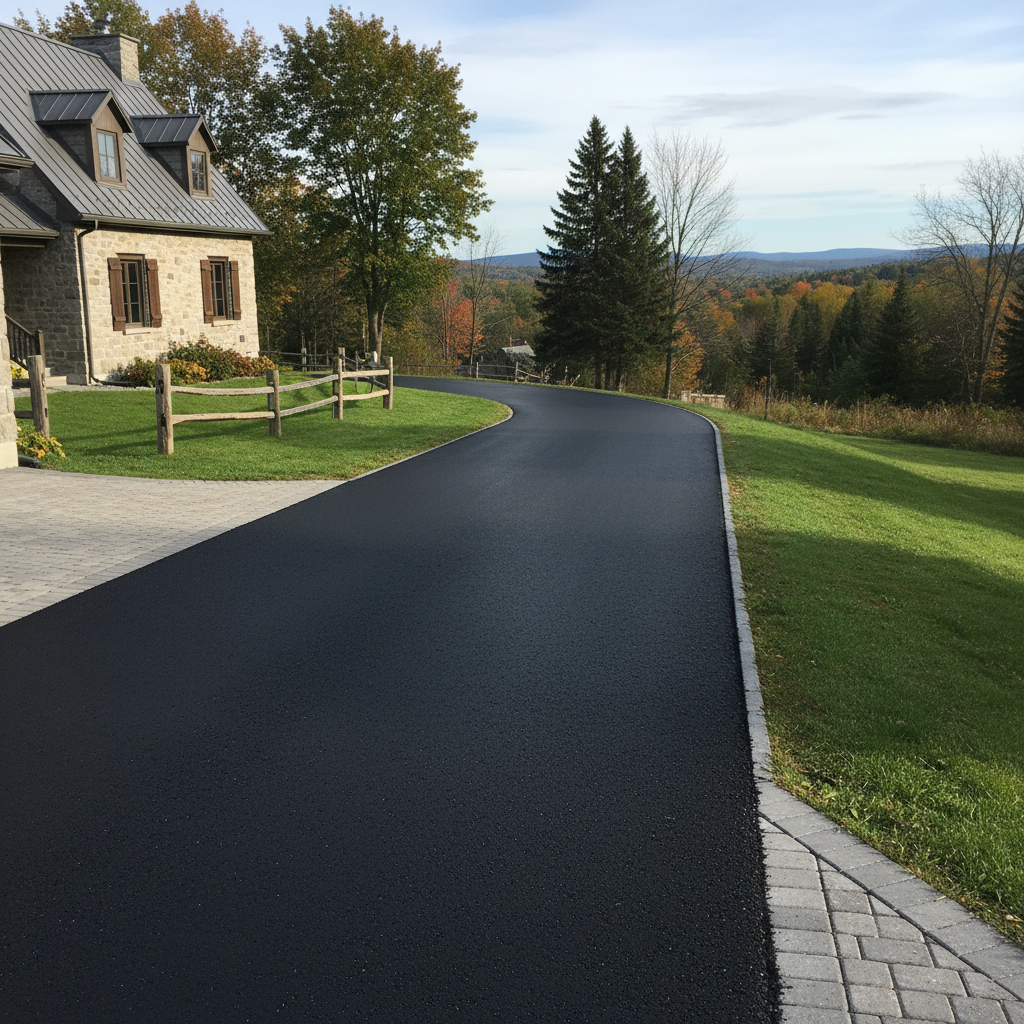
Driveway paving options and costs in Geraldton
Geraldton homeowners typically choose their driveway material based on three things: upfront cost, how well it survives our freeze–thaw winters, and how quickly they can get work done in the short paving season. With a population of 1,761 (Statistics Canada, 2021 Census), Geraldton is a smaller market, so contractor scheduling can be tighter than in larger centres like Thunder Bay. Most private drives are tied to detached homes, and that matters because driveway sizes and access conditions vary a lot from property to property. In town areas near the core—around the Highway 17 corridor—there’s also consistent demand from people replacing older surfaces that have started to break up after winter.
In Northwestern Ontario, deep frost penetration and aggressive freeze–thaw cycles push costs up compared with milder regions. Even a “simple” asphalt driveway depends on subgrade preparation and a thicker compacted granular base to reduce frost heave and surface cracking. When crews have to mobilize, haul aggregates farther, and work within colder air-temperature windows for paving and curing, pricing often sits toward the higher end of Ontario’s ranges. If your site has clay or poor drainage, you may need upgraded base and better drainage details—both add labour and materials but protect the finished surface.
Below is a practical comparison you can use when reviewing quotes for Geraldton. Use it to sanity-check whether a proposal is built on a proper base, correct thickness, and the right drainage approach—then compare price per square foot and expected maintenance.
| Material |
Lifespan |
Maintenance |
Best For |
Price per sq ft |
| Asphalt (new installation, proper base) |
12–20 years |
Seal coat every 3–5 years |
Most cost-conscious driveways with correct granular base and drainage |
$7 – $14 |
| Asphalt (overlay on existing gravel base) |
8–15 years |
Seal coat every 3–5 years |
When the old base is stable and you want to improve the surface without full rebuild |
$8 – $16 |
| Interlocking concrete pavers |
20–30 years |
Spot repairs as needed; re-sand joints periodically |
High curb appeal, easier repair, and better tolerance for localized movement |
$18 – $35 |
| Poured concrete (broom finish) |
20–30 years |
Minimal routine maintenance; seal optional |
Heavier-use drives where you want a solid, clean look |
$14 – $28 |
| Exposed aggregate concrete |
20–30 years |
Periodic seal to maintain appearance and reduce staining |
Better traction and a more decorative finish |
$18 – $32 |
| Gravel / crushed stone (budget option) |
3–7 years |
Re-grade and top up 1–3 times per season |
Temporary solution or low-budget areas with slower vehicle use |
$4 – $8 |
Prices are estimates only and vary by project scope, site access and material selection.
What affects the price of paving in Geraldton
Two quotes for the same driveway in Geraldton can easily diverge by 30–50% because the “real” scope isn’t always the same—base thickness, drainage correction, and tear-out depth are often where money changes hands. In the Northwest economic region, frost protection and freeze–thaw resilience dominate design. When contractors must build to deeper frost conditions, you typically need a thicker compacted granular base than you’d see in coastal areas; locally, a driveway that’s underbuilt will fail faster and push you toward premature resurfacing. That means some proposals that look expensive are actually doing the work that keeps the surface tight for years.
Another pricing driver is the short paving window in colder parts of Ontario. Hot-mix asphalt generally requires suitable air temperatures (often above about 10°C), and crews schedule around curing time and weather. Because demand concentrates into late spring through early fall, mobilization, overtime, and scheduling premiums can raise asphalt costs. Concrete also needs cold-weather planning; ensuring proper curing and using air-entrained mixes helps it resist freeze–thaw damage.
In Geraldton, a few site conditions frequently add cost: clay soils that hold water, flat sites that don’t shed meltwater, and driveways with soft shoulders that need base “daylighting” beyond the paved edge. On the other hand, you can lower your quote if the existing base is stable, drainage is already good, and the job has straightforward access—especially on the highway-facing side streets where equipment staging is easier. As a rule of thumb, an asphalt driveway commonly lands in the $7–$14 per sq ft band when the base and drainage are done right, while interlocking pavers often fall into the $18–$35 per sq ft band because of higher material and labour intensity.
| Price Factor |
Why It Matters |
Cost Impact |
| Driveway area in sq ft |
The total paving and base quantities scale directly with square footage. |
Large drives tend to reduce unit cost; small drives can cost more per sq ft due to minimum mobilization. |
| Base depth required |
Frost line conditions drive granular thickness needed to prevent heaving and cracking. |
More depth typically adds significant material and compaction labour. |
| Grading and drainage work |
Correct slope and under-drainage move meltwater away from the structure. |
Installing swales, culverts, or regrading can add notable costs but protects longevity. |
| Tear-out of existing surface |
Breaking and hauling old asphalt or concrete affects time and disposal fees. |
Concrete tear-outs usually cost more than asphalt removal. |
| Edge restraints and curbing |
Restraints keep pavers from spreading and asphalt from raveling at the edge. |
Adds materials and layout time; usually worth it in freeze–thaw conditions. |
| Sealing requirement |
Asphalt needs a seal coat to slow oxidation and protect from winter water intrusion. |
Homeowners should budget for periodic sealing (often every 6–12 months initially, then every few years). |
| Site access |
Narrow approaches or difficult turning slow equipment movement. |
Can increase labour time and equipment minimums. |
| Asphalt mix specifications |
Freeze–thaw-rated mixes and appropriate binder selection resist rutting and cracking. |
Higher-spec mixes can raise per-ton costs compared with basic asphalt. |
Permits & regulations in Ontario
In Ontario, paving a private driveway on your own property usually does not require a building permit, as long as you’re not altering municipal infrastructure. Where permits and approvals can come in is when work touches the municipal right-of-way—think new curb cuts, changes to the boulevard, modifications near storm drainage, or any reconfiguration that affects how water flows through the street area. If your plan changes how meltwater and runoff leave the site, confirm the approach with the municipality first. Some towns also enforce lot-grading rules that restrict how close hard surfaces can sit to property lines or how grading must be handled to prevent water from draining onto neighbouring lots.
Step-by-step, here’s how a Geraldton homeowner can verify a contractor and stay compliant:
1) Before excavation, require utility locates through Ontario One Call and make sure the marked locations match the proposed work zone. 2) Ask for the contractor’s Ontario business details and confirm their licensing/registration where applicable. 3) Request a current certificate of insurance showing general liability coverage (and ensure the name matches the legal entity on the quote). 4) Confirm they have WSIB coverage (where required) and ask for the WSIB clearance letter or coverage evidence. 5) Get the scope in writing: whether permits are included (if needed), whether disposal is included, and how drainage will be restored.
Keeping these items clear upfront helps avoid stop-work delays and protects you if something changes once excavation starts.
Asphalt vs pavers vs concrete for Geraldton driveways
For Geraldton’s freeze–thaw climate, the three most common driveway choices—hot-mix asphalt, interlocking pavers, and poured concrete—each have a “best fit” depending on what you value most: upfront cost, appearance, or repairability. Asphalt usually costs the least to install and can produce a smooth, quiet surface, but it relies on good base preparation and needs sealing to reduce water penetration. Without sealing, asphalt oxidation accelerates and winter moisture gets under the surface, which contributes to cracking.
Interlocking concrete pavers typically cost more upfront, but they handle localized movement better because individual units can be lifted and reset. If you get a settling spot in the base or a drainage issue shows up later, pavers are far easier to repair without tearing out the whole driveway—one reason they’re popular near busier parts of Geraldton where aesthetics matter. Poured concrete lands in the mid-range and gives you a durable slab, but it still needs proper base and (for best performance) air-entrained concrete to manage freeze–thaw stress and protect against scaling from salt and moisture.
In Northwestern Ontario, base preparation is not optional. Whether you choose asphalt or pavers, contractors typically build to frost-protection requirements with adequate granular depth and compaction, plus drainage that sheds meltwater away from the driveway structure. A well-drained design holds performance across winter plowing and salt routines.
Example: if your driveway estimate is near the asphalt band of $7 – $14 per sq ft, and the paver option comes in around $18 – $35 per sq ft, the price gap is often justified when you want long-term curb appeal and the ability to do targeted repairs instead of full resurfacing. If your priority is lowest upfront cost and you’re comfortable budgeting for sealing every few years, asphalt is usually the most practical choice in Geraldton.
| Material |
Frost Resistance |
Curb Appeal |
Repair Method |
Lifespan |
Price Band |
| Asphalt (sealed regularly) |
Good with proper granular base and drainage; seal is important for water control |
Medium (clean, modern look) |
Cut and patch; full resurfacing if widespread failure |
12–20 years |
$7 – $14 |
| Interlocking concrete pavers |
Excellent when bedding sand and base are built correctly |
High (many patterns/colours) |
Remove and replace individual pavers; re-sand joints |
20–30 years |
$18 – $35 |
| Poured concrete (air-entrained) |
Good with air entrainment and proper base; can still crack with movement |
Medium to high (clean lines) |
Crack repair and patch; sometimes panel replacement |
20–30 years |
$14 – $28 |
| Exposed aggregate concrete |
Good when properly finished and cured; traction helps in winter |
High (textured finish) |
Patch repairs are visible but localized |
20–30 years |
$18 – $32 |
| Permeable pavers (drainage grid) |
Very good for water management when installed with the correct drainage layer |
High (modern look) |
Spot repair; clean/restore drainage layers if needed |
20+ years |
$22 – $40 |
| Chip seal / tar-and-chip |
Moderate; performance depends heavily on binder and aggregate quality |
Low to medium (functional) |
Top-up or re-surface with localized patching |
6–10 years |
$6 – $10 |
How to choose a paving contractor in Geraldton
Choosing the right paving contractor in Geraldton is mostly about confirming three things: proof of coverage, a written scope you can measure, and realistic scheduling for our short paving season. Start with licensing/registration (where applicable in Ontario) and ask for a certificate of general liability insurance. Then confirm workers’ compensation coverage—WSIB for eligible work in Ontario—by requesting their clearance letter or coverage evidence. A reputable contractor will provide these documents quickly and won’t pressure you to skip details.
Next, get 2–3 itemised written quotes. You want a breakdown of labour and materials (excavation, disposal, base materials, compaction, asphalt or concrete supply, and any seal coat). Request line items so you can compare like-for-like: base thickness, drainage work, curb/edge restraints, and whether the contractor includes permit work if the project touches municipal right-of-way.
Read exclusions carefully. Ask: is disposal included? Is crack filling included? Are saw cuts included for concrete joints? Is a prime coat or tack coat included under asphalt? Then check warranty terms: workmanship warranty length, whether it covers base settlement issues (often limited), and whether there’s a separate product/manufacturer warranty and how claims are handled. Ask if the warranty is transferable if you sell your home.
For payment, don’t pay more than 10–15% upfront. Hold back a portion until the final walk-through and cleanup are done. Finally, insist on a start date and completion estimate in writing—delays can happen when weather shuts down compaction and curing, and you want that communicated up front.
- Confirm their insurance certificate lists your property address and legal business name correctly.
- Ask for WSIB clearance evidence (where required in Ontario) before work starts.
- Verify the quote includes all removals: full tear-out depth or only surface milling.
- Require a stated base thickness and compaction method, not just “proper base”.
- Confirm drainage details: slope to daylight, ditch/culvert tie-ins, and under-drain if needed.
- Check whether disposal and haul-away are included (dump fees can surprise people).
- Ensure edge restraints are specified (curb or equivalent) to prevent spreading.
- For asphalt, confirm tack/prime requirements and the planned seal-coat timing.
- For concrete, confirm air-entrainment and cold-weather curing plan.
- Ask what’s excluded: sod replacement, landscaping reinstatement, fencing adjustments.
- Confirm warranty length for workmanship and whether the contractor stands behind it in writing.
- Set a payment schedule with a holdback until the final inspection and documentation are complete.
Red flags I often see in Geraldton: quotes that won’t specify base thickness, refusing to provide WSIB/insurance documents, “all-in” lump sums with no line items, vague timelines (“as soon as weather allows” with no start/completion estimate), and contractors who want large upfront payments before any soil/base testing or measurements are done.
Frequently asked questions — paving in Geraldton
How much does driveway crack repair cost in Geraldton?
In Geraldton, the cost to repair a crack depends on whether it’s a hairline surface crack or a wider, water-driven opening that needs more than sealant. For asphalt, small cracks are commonly addressed with cleaning, crack sealing, and sometimes a patch at the distressed area; for budgeting, many repairs land in the same order of magnitude as the sealing/repair pricing band of $1–$4 per sq ft for basic work. If the crack has heaved due to frost penetration or drainage failure, the contractor may recommend localized base correction and hot-mix patching, which can cost substantially more than a simple seal. If you’re seeing repeated cracks after winters, treat it as a base/drainage issue, not just a cosmetic one, because the same water pathway will reopen the crack.
What base thickness do I need for pavers in Geraldton?
For pavers in Geraldton, the base design should be driven by frost protection needs and how your subgrade behaves (especially drainage and clay content). Because Northwestern Ontario experiences deep frost and freeze–thaw cycling, installers generally build a thicker compacted granular base than you’d see in milder areas. In practice, many designs come out closer to deeper Ontario frost-protection builds than “light duty” residential bases. A proper quote should specify granular layer thicknesses and compaction targets, not just a generic statement. If your soil holds water or you have low spots that trap meltwater, expect the base may need upgraded granular material and improved drainage. The best quotes also reference how they’ll keep the paver bedding sand thickness consistent so the units lock properly.
How do I get the most accurate paving quote in Geraldton?
To get an accurate quote in Geraldton, start by having the contractor visit the site and measure the driveway area, grade, and any existing pavement condition. Ask for an itemised estimate that lists base thickness, removal depth, drainage correction work, and disposal. For asphalt, request details on the mix type and whether the proposal includes tack/prime and seal-coat timing. For concrete, ask about air entrainment and how they’ll handle curing in our shorter paving season. Include your access realities—narrow gate, long driveway haul, or limited staging—because equipment time changes the labour cost. Finally, compare quotes only after confirming the scope matches: if one contractor assumes “overlay” and another assumes full tear-out, that alone can explain large price differences.
How much does it cost to pave a driveway in Geraldton?
Driveway paving cost in Geraldton is usually priced per square foot, with asphalt typically landing in the $7–$14 per sq ft band when base and drainage are done properly. Concrete commonly falls in the $14–$28 per sq ft range depending on finish and prep. Interlocking pavers often come in higher—$18–$35 per sq ft—because of labour-intensive installation and the need for precise base, bedding sand, and edge restraints. Your total cost will depend on driveway size, how much tear-out is needed, and whether you need drainage correction to handle meltwater. If your existing surface is failing due to poor base support, the cheaper-looking “resurface” approach can cost more later once you factor in repeating repairs or premature resurfacing.
Asphalt vs interlocking pavers vs concrete — which is best in Geraldton?
In Geraldton, there isn’t one “best” material for everyone—each matches a different homeowner priority. Asphalt is usually the best for lower upfront cost within the $7–$14 per sq ft band, especially if you’re disciplined about sealing and the contractor builds a frost-resistant granular base with proper drainage. Interlocking pavers are often the best choice for curb appeal and repairability; even though they’re commonly in the $18–$35 per sq ft band, you can replace affected units without rebuilding the whole driveway when localized settlement happens. Poured concrete is a solid mid-range option in the $14–$28 per sq ft band, but it needs air-entrained concrete and a well-prepared base to manage freeze–thaw cracking and salt exposure. The “best” option is whichever one gets the correct base and drainage design for your property.
How long does a paved driveway last in Geraldton?
With correct base construction and drainage, a paved driveway in Geraldton can last well beyond the first few winters—but lifespan depends heavily on maintenance and whether water is being managed. Asphalt typically lasts about 12–20 years when it’s sealed on schedule; without sealing, it can age faster and develop cracking earlier due to water intrusion during freeze–thaw cycles. Interlocking pavers often last 20–30 years because individual units can be reset if the base or bedding sand shifts. Poured concrete also commonly targets 20–30 years, particularly when air-entrained and built on a proper granular base. If you’re in a spot with clay or drainage issues, even strong materials will struggle, so getting drainage right is often the difference between “works for a decade” and “holds up for decades.”