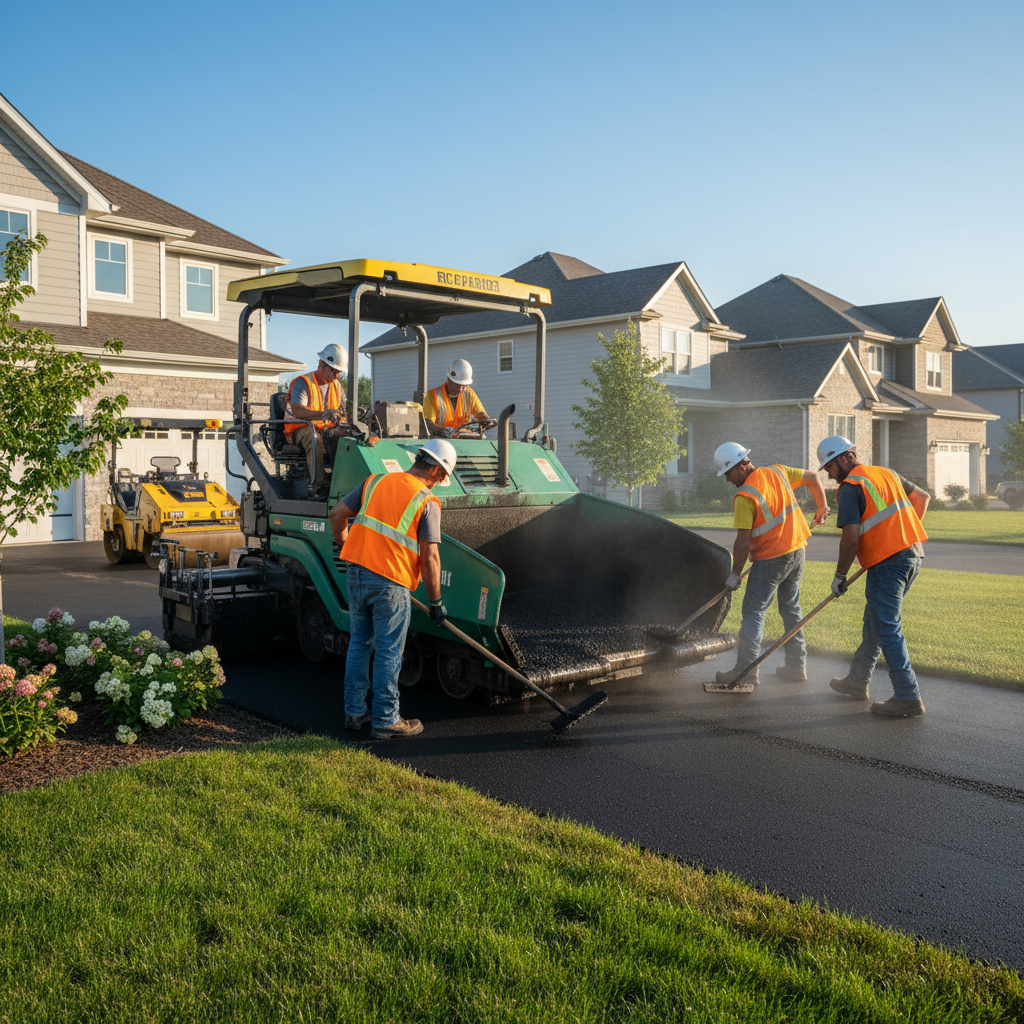
Driveway paving options and costs in Grimsby
Grimsby homeowners typically have a straightforward decision to make: asphalt, interlocking pavers, or concrete—each behaves differently under Southern Ontario’s freeze–thaw swings. With 28,883 residents and 9,415 homeowner households (82.6% of households own), driveway upgrades are a common home-improvement project, especially in neighbourhoods with older housing stock—42.2% of homes were built before 1981. In places like Beamsville Avenue and parts of the east-end where driveways tend to be longer and older, paving contractors see steady demand because many existing surfaces are already showing fatigue cracks or base breakdown.
In the Hamilton–Niagara Peninsula market, pricing is shaped by the climate as much as the material. The region generally expects frost penetration in the 1.2–1.5 m range, and contractors design for reliable drainage and a deeper granular base to resist frost heave and cracking. That base + drainage portion can represent 35–45% of a residential driveway budget. Also, the paving season here is essentially April–October; asphalt requires warm air and proper compaction, so scheduling pressure in spring and early summer can push costs toward the upper end of price ranges.
Below is a practical comparison of common driveway choices in Grimsby, assuming proper excavation, compaction, and a drainage-minded base where needed. Use it as a budgeting starting point, then match the option to your lot conditions and maintenance tolerance.
| Material |
Lifespan |
Maintenance |
Best For |
Price per sq ft |
| Asphalt (new installation, proper base) |
12–20 years |
Seal coat every 3–5 years; spot patch as needed |
Most cost-effective option with good flexibility under freeze–thaw |
$5.50–$9.50 |
| Asphalt (overlay on existing gravel base) |
8–15 years |
Seal coat when needed; patching if base is marginal |
When the existing base is sound and you want to minimize excavation |
$4.50–$8.00 |
| Interlocking concrete pavers |
20–30 years |
Re-leveling minor areas; replace individual pavers |
Curb appeal, easier localized repairs, and preferred aesthetics |
$12.00–$20.00 |
| Poured concrete (broom finish) |
20–30 years |
Limited; watch for de-icing damage and scaling in harsh winters |
Clean, uniform look; durable surface when well designed |
$10.00–$18.00 |
| Exposed aggregate concrete |
20–30 years |
Minimal; occasional cleaning and targeted repair |
Slip resistance and premium curb appeal |
$14.00–$22.00 |
| Gravel / crushed stone (budget option) |
3–8 years |
Annual top-ups; regrading; weed control |
Lowest upfront cost and temporary improvement |
$2.50–$4.75 |
Prices are estimates only and vary by project scope, site access and material selection.
What affects the price of paving in Grimsby
In Grimsby and across the Hamilton–Niagara Peninsula, you can see quotes for the “same” driveway that vary by 30–50%—even with similar dimensions. The main reason is that a driveway’s true cost is often driven by what happens below the surface: excavation, base thickness, drainage corrections, and tear-out. One contractor might price a like-for-like lift of asphalt over an existing base, while another assumes the subgrade needs rebuild to handle frost and water movement. When you’re comparing proposals, the material line item is only part of the story—base preparation and drainage typically decide whether the pavement performs or fails early.
Freeze–thaw cycles are decisive cost factors here. Deeper frost requires a thicker compacted granular base (often 6–12 inches of properly compacted Granular A/B in Ontario-style designs) to prevent heaving and cracking. On top of that, the paving season is shorter in colder regions: hot-mix asphalt needs favourable air temperature (often above 10°C for best compaction conditions), which concentrates demand into spring and summer and raises scheduling pressure. Mix design also matters; asphalt should be specified for local freeze–thaw performance, and that premium can be reflected in the unit rates.
Concrete examples that raise cost in Grimsby include replacing failed underdrain lines or removing and rebuilding soft clay spots before placement. Costs can drop when a lot already has stable grades, good drainage away from the driveway, and minimal rework—those conditions keep projects closer to mid-band pricing such as concrete in the $7,000–$18,000 range or asphalt in the $3,000–$8,000 band.
Older driveways (and the 42.2% of older homes built before 1981) often mean buried services, undersized base, and more time for careful excavation and hauling. That is why two homeowners in the same street can get very different numbers.
| Price Factor |
Why It Matters |
Cost Impact |
| Driveway area in sq ft |
Most costs scale directly with surface area and material quantity |
Often the biggest driver; can swing 20–40% project-to-project |
| Base depth required |
Frost line depth determines granular thickness needed to resist heaving |
Extra inches can add substantial excavation, stone, and compaction |
| Grading and drainage work |
Slope correction and drainage fixes keep water from undermining the base |
Common “hidden” cost; can add thousands when drains are inadequate |
| Tear-out of existing surface |
Breaking/hauling concrete or removing old asphalt adds labour and disposal |
Can change pricing by 10–25% depending on depth and conditions |
| Edge restraints and curbing |
Prevents paver spread and maintains clean edges for asphalt transitions |
More labour and material; usually a worthwhile cost for longevity |
| Sealing requirement |
Asphalt sealing protects against oxidation, water ingress, and winter damage |
Scheduling and product cost; typically planned after initial curing |
| Site access |
Narrow lots slow equipment movement and increase manual labour |
Can add labour time and small equipment mobilization costs |
| Asphalt mix specifications |
Freeze–thaw-rated mix design can cost more but improves performance |
Material premium; often improves the “fit” for Ontario winters |
Permits & regulations in Ontario
In Ontario, paving a private driveway within your own property usually does not require a building permit. That said, municipal approvals can be required if your driveway work affects anything in the municipal right-of-way. In practice, that’s most often the case when you need a new or modified curb cut, change the boulevard or approach within the road allowance, or alter storm drainage patterns that relate to municipal services. Grimsby homeowners should also be aware that some municipalities enforce lot-grading or drainage-related by-laws that restrict how close a hard surface can be to property lines or how grading can redirect water. Even when no permit is required, contractors should still follow local drainage expectations to avoid ponding and surface runoff issues.
Before anyone digs, confirm utility locates through Ontario One Call. This step is non-negotiable because driveway reconstruction frequently involves services such as hydro, telecom, and sometimes drainage connections. Here’s a simple contractor verification process you can do before signing: (1) ask for their Ontario business/licence details and confirm they are active for paving work; (2) request a current certificate of liability insurance (make sure it covers the work at your address); and (3) confirm coverage for workplace safety: in Ontario that’s typically WSIB clearance (ask for proof/clearance letter). If the contractor can’t provide these documents quickly and clearly, that’s a red flag.
Asphalt vs pavers vs concrete for Grimsby driveways
For Grimsby’s freeze-thaw climate, asphalt, interlocking concrete pavers, and concrete each have a “best fit” based on your priorities and how your driveway is built. Asphalt is usually the lowest upfront option and performs well under winter movement because it’s flexible; the trade-off is routine maintenance—sealing every 3–5 years helps protect the surface from oxidation and water penetration. Interlocking concrete pavers typically cost the most upfront, but they shine when you want curb appeal and a repairable surface: individual stones can be lifted and reinstalled if drainage or base issues appear. Poured concrete is often mid-range in cost and can look great, but it is more sensitive to cracking if joints and base support aren’t designed correctly for Ontario winters and freeze-thaw cycling—especially with de-icing salts and inadequate air entrainment.
Across the Hamilton–Niagara Peninsula, the deciding factor is usually the base and drainage. With frost penetration expectations in the 1.2–1.5 m range, driveways typically need a deeper, well-compacted granular base and proper slope to carry water away from the pavement. When drainage is handled correctly, asphalt and pavers both handle minor movement better; concrete can still last a long time, but it needs correct subbase compaction, proper thickness, and thoughtful joint spacing.
Here’s a concrete example: if a 600 sq ft driveway costs around $4,200–$6,000 for asphalt but $9,000–$14,000 for interlocking pavers, the paver upgrade is justified if you value curb appeal and want the ability to repair localized sections without tearing up the entire slab. If you’re mainly focused on cost and you’re willing to budget for sealing, asphalt often holds up best for most Grimsby homeowners.
| Material |
Frost Resistance |
Curb Appeal |
Repair Method |
Lifespan |
Price Band |
| Asphalt (sealed regularly) |
Good when base + drainage are engineered for Ontario freeze–thaw |
Attractive, clean finish; limited decorative options |
Patch and overlay small areas |
12–20 years |
$3,000–$8,000 |
| Interlocking concrete pavers |
Excellent with proper bedding sand and restrained edges |
High—premium look and colour/layout flexibility |
Lift and replace individual pavers |
20–30 years |
$9,000–$20,000 |
| Poured concrete (air-entrained) |
Good when properly designed for freeze–thaw and salt exposure |
Medium to high; clean, modern look |
Crack repair/patching; sometimes section repairs |
20–30 years |
$7,000–$18,000 |
| Exposed aggregate concrete |
Good; surface texture can hold up well with correct base |
Very high—gravel-like finish and slip resistance |
Surface patching and controlled repairs |
20–30 years |
$10,000–$20,000 |
| Permeable pavers (drainage grid) |
Excellent for water management when design is correct |
High specialty look; great for drainage-sensitive sites |
Targeted repairs; reset affected units |
20+ years |
$12,000–$22,000 |
| Chip seal / tar-and-chip |
Moderate; more maintenance-sensitive in heavy traffic zones |
Low to medium; functional finish |
Resurface with additional chip seal |
6–12 years |
$2,500–$6,500 |
How to choose a paving contractor in Grimsby
Choosing the right contractor in Grimsby is mostly about proof and clarity. For Ontario work, verify that the company is properly registered to operate, provides liability insurance for the job, and can supply a WSIB clearance (or proof of coverage) for workers. Ask directly for a certificate of insurance and a current WSIB clearance letter—don’t accept verbal confirmation. You should also request their written scope and line-item pricing so you can see whether excavation and base depth are included.
Get 2–3 itemised written quotes, ideally with a labour + materials breakdown (asphalt tonnage, base stone type, bedding sand if pavers, concrete mix/air-entrainment, and drainage components). A proper quote explains what’s included and what’s excluded: disposal for old concrete/asphalt, any required saw-cutting, geotextile use, compaction testing (if provided), and whether permit/municipal approval tasks for curb/boulevard changes are included.
Warranty should be clear on two fronts: workmanship and materials/manufacturer. Workmanship warranties often start at the completion date; product warranties can be separate and may not cover installation. Confirm whether the warranty is transferable if you sell the home.
Finally, payment matters. In Ontario residential paving, a common safe practice is to avoid paying more than 10–15% upfront. Hold back a portion until the job is complete and you’ve received as-built details for drainage/grades if applicable. Ask for a start date and a completion estimate in writing, and understand that spring weather can impact asphalt scheduling due to compaction requirements.
- Ask for Ontario liability insurance and verify coverage limits on the certificate.
- Request WSIB clearance/proof of coverage before work starts.
- Confirm the quote is itemised (excavation, base, asphalt/concrete, aggregate, compaction).
- Check whether the scope includes proper granular base depth for freeze–thaw performance.
- Verify drainage/grading is addressed (slope away from house, ditches/downspout tie-ins).
- For pavers, confirm edge restraints and bedding/sand specification.
- Ask how tear-out and disposal are handled and whether contaminated material is expected.
- Confirm topsoil restoration is included if excavation disturbs lawns.
- Require a schedule and weather contingency plan for April–October season constraints.
- Clarify sealing timing for asphalt (initial curing period before sealing).
- Get warranty details in writing, including who honours it and what it covers.
- Use a payment schedule with a holdback until the final inspection/walkthrough.
Red flags in Grimsby: a contractor who will not show insurance/WSIB paperwork, quotes that are “lump sum” with vague base thickness, skipping drainage/grading corrections, refusing to discuss asphalt sealing timing, or pressuring you for large upfront payments before any site prep begins.
Frequently asked questions — paving in Grimsby
How much does it cost to pave a driveway in Grimsby?
Cost in Grimsby depends mainly on driveway size (sq ft) and how much work is needed under the pavement—excavation, base depth, and drainage. For many residential driveways, asphalt pricing typically lands in the Ontario band of $3,000–$8,000, while interlocking pavers often fall into $9,000–$20,000. Concrete is commonly budgeted around $7,000–$18,000. In our Hamilton–Niagara Peninsula climate, deeper frost and frequent freeze–thaw cycles mean a reliable granular base can be a major portion of the budget; if your subgrade is weak (common in older neighbourhoods—42.2% of homes built before 1981), expect higher excavation and rebuild costs.
Asphalt vs interlocking pavers vs concrete — which is best in Grimsby?
There isn’t one “best” for every Grimsby driveway—there’s a best fit. Asphalt is usually the top choice for homeowners who want the lowest upfront cost and are willing to plan a seal coat every 3–5 years; it tolerates freeze–thaw movement well when the base and drainage are done right. Interlocking concrete pavers are best when curb appeal and repairability matter—if a section needs attention, stones can be reset without replacing the whole surface. Poured concrete can perform well with proper air-entrainment and joint design, but it’s less forgiving if the base is inconsistent or if de-icing practices are harsh. If your driveway sees heavy plowing and salt, asphalt or pavers often make maintenance planning simpler.
How long does a paved driveway last in Grimsby?
In Grimsby’s moderate-to-cold Southern Ontario climate, lifespan depends on base quality, drainage, and maintenance. Asphalt typically lasts about 12–20 years when installed over a proper granular base and sealed regularly; skipping sealing accelerates water penetration and winter deterioration. Interlocking pavers often last 20–30 years because localized repairs are practical if minor base issues appear over time. Concrete commonly reaches 20–30 years when designed for freeze–thaw and properly jointed, but cracking risk rises if the subgrade shifts or drainage is poor. The key takeaway: two driveways with the same finish can perform very differently if the granular base and slope weren’t engineered for Ontario freeze penetration and meltwater drainage.
When is the best time of year to pave in Grimsby?
The practical paving window in Grimsby is generally April through October. Asphalt crews need warm conditions for air temperature and compaction, so early spring work can be delayed if nights are still too cold. Scheduling is often busiest from late spring into summer, so booking early helps. If you’re planning concrete or pavers, you still benefit from longer dry stretches because base installation and bedding sand placement must stabilize properly. Avoid pushing work into deep fall if you can—water management and compaction after placement become more difficult as temperatures drop, and it increases the risk of early winter damage before the surface fully performs.
How deep should the base be for Grimsby's frost?
For Grimsby, base depth is driven by frost penetration expectations and site drainage. While exact requirements depend on subgrade conditions and soil type, a common Ontario driveway approach is a deeper, well-compacted granular base—often in the 6–12 inch range of compacted granular material (Granular A/B) as part of a frost-resistant build-up. On tougher soils or where drainage corrections are required, you may need additional depth and granular replacement to create a stable, water-managed foundation. Contractors should also address slope and underdrain options where water tends to pool. If your lot has soft spots or clay/silty subsoils, deeper base rebuilds are usually the cost-effective choice over patching later.
How often should I seal my asphalt driveway?
For asphalt in Grimsby, sealing should typically start after the driveway has had time to cure—often after the initial season—then continue on a cycle of about every 3–5 years. The exact timing depends on weather exposure, traffic, and how much winter salt and sand the driveway takes. Sealing is especially important in a freeze–thaw climate because it helps limit water getting into the surface and joints, reducing the risk of cracking and raveling during spring thaw. If you want a budgeting anchor, asphalt projects often land in the $3,000–$8,000 band, and planning for sealing maintenance helps protect that investment over the long term.