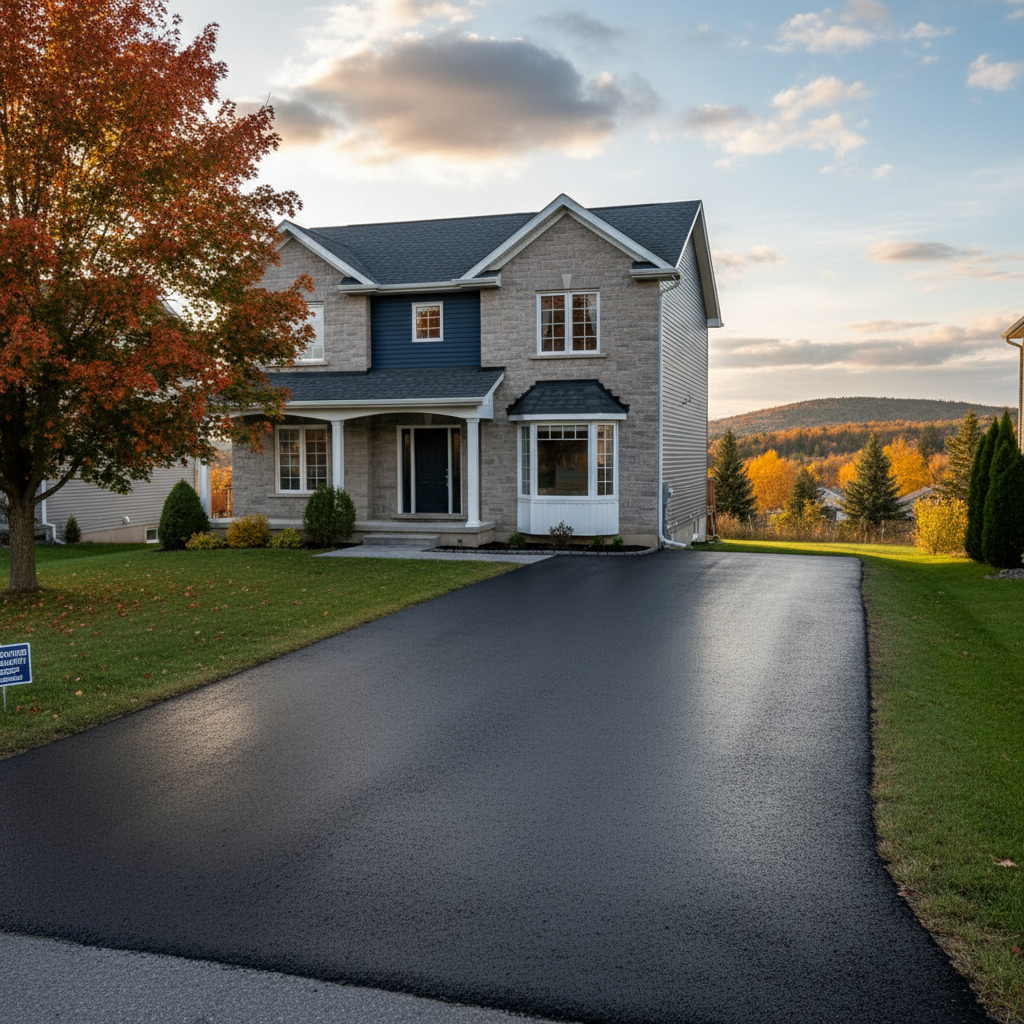
Driveway paving options and costs in Hawkesbury
In Hawkesbury, homeowners usually plan their driveway surfacing around one big reality: most homes here are detached, and the majority of private driveways serve single-detached properties. With single-detached houses making up 35.8% of dwellings and homeowner households at 2,615 (51.5% of households own) (Statistics Canada, 2021 Census), there’s steady demand for new asphalt, interlocking, and concrete work—especially in established neighbourhoods where driveways were built out decades ago. If your property is in or near the older core areas around downtown Hawkesbury, it’s common to see driveways that have settled unevenly or developed ruts from winter traffic and ploughing.
Cost is shaped heavily by the Ottawa economic region’s frost and freeze–thaw cycles. Frost is commonly modelled around 1.8 m locally, so contractors in Hawkesbury typically build a deeper, well-compacted granular base and focus on drainage away from the slab or asphalt edge. The paving season is also shorter here: hot-mix asphalt placement requires air temperatures above 10°C, so spring/summer scheduling is tighter and pricing tends to firm up when demand peaks. That’s one reason you can see the same style of driveway quote range widely if the excavation depth, base design, and drainage details differ.
Below is a practical side-by-side look at typical lifespan, maintenance expectations, and realistic cost bands in Hawkesbury—use it to compare quotes before you call for an inspection.
| Material |
Lifespan |
Maintenance |
Best For |
Price per sq ft |
| Asphalt (new installation, proper base) |
15–25 years |
Seal every 3–5 years |
Balanced cost and performance for Ottawa-area freeze–thaw |
$7–$14 |
| Asphalt (overlay on existing gravel base) |
8–15 years (depends on base) |
Seal every 3–5 years; monitor for reflection cracking |
When existing base is sound and you want a shorter upfront disruption |
$5–$10 |
| Interlocking concrete pavers |
25–40 years |
Periodic joint sand top-up; replace individual stones if needed |
Homeowners prioritizing curb appeal and easy spot repairs |
$11–$20 |
| Poured concrete (broom finish) |
20–30 years |
Seal (if desired); manage minor cracking with patching |
Durability with a clean, uniform look |
$12–$22 |
| Exposed aggregate concrete |
25–35 years |
Seal/maintain surface finish as recommended; patch spalls quickly |
High-end look and skid resistance |
$14–$26 |
| Gravel / crushed stone (budget option) |
5–10 years |
Re-grade and top up every 2–4 years; control washboarding |
Lower initial cost while you plan a future paved upgrade |
$4–$7 |
Prices are estimates only and vary by project scope, site access and material selection.
What affects the price of paving in Hawkesbury
In Hawkesbury and the broader Ottawa area, two contractors can quote the “same” driveway and still land 30–50% apart. The reason is usually not the surface material—it’s the design choices that control how the driveway performs under Ottawa-region frost depth and repeated freeze–thaw cycles. When the foundation is undersized, asphalt raveling, joint movement, and cracking show up earlier, and you end up paying twice. In this region, asphalt and paver projects commonly need a deeper compacted granular base and better drainage detailing to stay below the frost zone around the driveway footprint.
Frost line depth is a decisive cost factor. While coastal areas may get away with a thinner base, deeper frost commonly requires thicker granular sections and more excavation in places like Hawkesbury—often translating to significantly more hauled stone and labour. In practice, base depth for Ontario typically means heavier, well-compacted layers to reduce heaving; that’s one reason a well-built new asphalt driveway tends to fall in the wider Ottawa-tier range (for example, $4,500 – $9,000 for asphalt paving depending on scope). The paving season is also shorter: hot-mix asphalt requires suitable air temperature (commonly above 10°C), so spring/summer demand concentrates into a tighter window, which affects contractor availability and scheduling.
Concrete examples show the same pattern. If your driveway sits on older fill or has poor surface runoff, drainage corrections and subgrade stabilization can add cost; however, if you already have clean grading and a stable base, an overlay or a standard base rebuild can be more economical. Housing-stock age matters too—60.1% of homes built before 1981 (Statistics Canada, 2021 Census) often means more legacy driveway drainage issues and settled subgrades.
| Price Factor |
Why It Matters |
Cost Impact |
| Driveway area in sq ft — the primary cost driver |
Materials and labour scale directly with surface area |
Large increases in both rock haul and paving tonnage |
| Base depth required — frost line determines granular thickness |
Deeper frost needs thicker compacted granular base to limit heaving |
More excavation and more crushed stone |
| Grading and drainage work — slope or drainage corrections add cost |
Water must flow away to protect the granular layers |
Extra excavation, forming, and possible drain elements |
| Tear-out of existing surface — breaking and hauling concrete or old asphalt |
Underside preparation affects lifespan |
Demolition labour plus disposal fees |
| Edge restraints and curbing — needed to prevent paver spread |
Edges fail first if not restrained |
Additional concrete/steel and forming time |
| Sealing requirement — asphalt must be sealed after 6–12 months |
Sealer protects asphalt from oxidation and surface damage |
Small added cost now; big protection later |
| Site access — narrow or tight lots slow equipment movement |
Traffic control and smaller equipment increase labour time |
Higher hourly costs and longer on-site hours |
| Asphalt mix specifications — freeze-thaw-rated mix costs more |
Ottawa-region freeze–thaw stresses require appropriate mix design |
Higher material cost but better performance |
Permits & regulations in Ontario
In Ontario, paving a private driveway within your own property typically does not require a building permit. The exceptions are when the work affects the municipal right-of-way or triggers stormwater and drainage changes that the municipality must approve. In Hawkesbury, that usually means you may need municipal approval if you’re doing things like creating or changing a curb cut, altering the boulevard, modifying municipal storm drainage connections, or reworking catch basins and ditches near the road.
Also note that some municipalities have lot-grading and drainage rules. Those restrictions can limit how close a hard surface may sit to property lines and may require you to maintain proper slope and water routing so runoff doesn’t impact neighbouring properties.
Before excavation, complete utility locates through Ontario One Call. Step two is contractor verification: ask to see their proof of Ontario licence (as applicable for the work they’re performing), liability insurance certificate, and WSIB/WCB coverage. Here’s how to check: request the insurance certificate and confirm coverage limits and that the worksite address is insured; look for a WSIB/WCB clearance letter or account proof; and use official online registries where available to confirm the contractor’s standing and business information. Doing this up front protects you from uninsured subcontractors and jobsite delays.
Once you have the scope in writing—especially what touches drainage—permits and approvals become straightforward to plan rather than last-minute surprises.
Asphalt vs pavers vs concrete for Hawkesbury driveways
For Hawkesbury driveways, the right choice comes down to how you want the driveway to behave through Ottawa-region winters. Asphalt typically has the lowest upfront cost in this market and is often the fastest to install, but it needs maintenance: plan on sealing every 3–5 years to slow oxidation and protect the surface from freeze–thaw raveling. Interlocking concrete pavers usually cost more up front (in the local tier, that’s commonly $6,000 – $15,000), yet they offer excellent curb appeal and easier repairs—if a section settles or heaves, contractors can lift and re-level that area without tearing out the whole driveway. Poured concrete sits in the middle on cost and can look great, but it is susceptible to cracking if it’s not properly air-entrained and detailed for freeze–thaw and de-icing salt. The key is base prep and drainage design for all three.
With frost depth commonly modelled around 1.8 m, each material still depends on a thicker, well-compacted granular base and proper water management away from the driveway footprint. In practice, if your driveway has weak drainage or historical ponding, asphalt and concrete both can fail earlier because water undermines the granular layers. Pavers can tolerate spot rework better, which is why they’re popular in older Hawkesbury neighbourhoods where regrading and edge restraint are often needed.
A concrete example: if one contractor offers asphalt at the low end ($4,500 – $9,000) with a shallow base, the short-term savings may not be justified if your subgrade is unstable. Spending more on correct base depth and drainage can be the difference between a driveway that looks good for years and one that shows cracking and edge breakdown soon after winters.
| Material |
Frost Resistance |
Curb Appeal |
Repair Method |
Lifespan |
Price Band |
| Asphalt (sealed regularly) |
Good with proper base and drainage |
Medium (smooth, dark finish) |
Patch and mill-and-overlay sections |
15–25 years |
$4,500 – $9,000 |
| Interlocking concrete pavers |
Very good with engineered base and restraint |
High (colour and pattern choices) |
Lift/re-level and replace individual pavers |
25–40 years |
$6,000 – $15,000 |
| Poured concrete (air-entrained) |
Good with air-entrainment and proper detailing |
Medium to high (clean, uniform look) |
Crack repair and patching; panel replacement if needed |
20–30 years |
$7,000 – $16,000 |
| Exposed aggregate concrete |
Good with correct mix and base |
Very high (textured premium finish) |
Localized patching with matching finish |
25–35 years |
$8,500 – $18,000 |
| Permeable pavers (drainage grid) |
Good when drainage design matches soil conditions |
High (modern look) |
Spot replace; maintain infill and joints |
20–35 years |
$9,000 – $20,000 |
| Chip seal / tar-and-chip |
Fair to good; sensitive to base quality |
Low to medium (textured surface) |
Re-blast/re-apply; patching for failures |
7–12 years |
$3,500 – $7,000 |
How to choose a paving contractor in Hawkesbury
Choosing a paving contractor in Hawkesbury should start with proof of coverage and legitimacy. First, verify Ontario licensing where applicable to the work being performed—then confirm liability insurance with a current certificate of insurance showing adequate limits for driveway-scale projects. Next, ensure they have WSIB/WCB coverage (or the appropriate clearance documentation). Ask directly for the certificate of insurance and a WSIB/WCB clearance letter or proof of coverage, and confirm the expiry dates before work starts. You can also cross-check business details using official online registries where available.
Second, request 2–3 itemised written quotes, not just a lump sum. A good quote breaks down labour and materials (excavation and hauling, granular base layers, geotextile if used, asphalt tons or concrete volume, drainage/grading work, saw cuts, edges/curbs, and disposal). Ask what’s included and excluded: is permit work included if you need it, is disposal included for broken concrete/asphalt, and does the scope include cleaning and surface preparation for the final lift?
Third, check warranty terms. Look for a workmanship warranty (commonly tied to settlement, surface defects, and workmanship issues) and separate product/manufacturer warranty where applicable. Ask whether warranties are transferable if you sell the home.
Finally, insist on a sensible payment schedule—never more than 10–15% upfront. Hold back the remainder until the job is complete, graded properly, and cleaned. Get a start date and a completion estimate in writing, because Ottawa-area seasonality can affect asphalt and concrete scheduling.
- Confirm WSIB/WCB coverage (request clearance proof) before they mobilize.
- Ask for liability insurance certificate and verify project address is covered.
- Request an Ontario licence/business number where applicable and confirm it matches the quote.
- Get 2–3 itemised quotes (labour + materials), not one-number estimates.
- Ensure the quote states base thickness and compaction expectations, not just “crushed stone.”
- Confirm whether geotextile and edge restraints are included for pavers.
- Ask about drainage and grading: where runoff goes, and how ponding is prevented.
- Verify tear-out and disposal are priced (concrete/old asphalt removal can be significant).
- Check warranty length and what defects are covered versus cosmetic only.
- Confirm product warranties and whether they’re tied to contractor installation.
- Require written start/completion dates and weather/temperature conditions for asphalt pours.
- Use a payment schedule with a holdback; avoid large deposits.
Red flags to watch for in Hawkesbury: a quote that skips base depth and compaction details, pressure to pay most of the total upfront, vague scope language like “we’ll fix what’s needed” without quantities, no written warranty terms for workmanship, and refusal to provide proof of insurance and WSIB/WCB coverage before starting.
Frequently asked questions — paving in Hawkesbury
When is the best time of year to pave in Hawkesbury?
The best time to pave in Hawkesbury is during the warmer, drier window when contractors can place and compact asphalt properly and concrete can cure without freezing. For asphalt, hot-mix placement generally needs air temperatures above about 10°C, which is why spring openings can be busy and quotes firm up as conditions allow. In freeze–thaw country like Ottawa, Cornwall, and the Hawkesbury area, it’s risky to rush paving right before cold snaps because poor curing and early moisture can lead to premature raveling and cracking. Most homeowners do better booking late spring through summer for asphalt and for concrete jobs that depend on proper curing. If you’re planning a project, aim to have site prep and excavation scheduled first so the surface placement happens quickly once temperatures are right.
How deep should the base be for Hawkesbury's frost?
Base depth is driven by the frost depth and how well your driveway can drain. In the Ottawa economic region, frost penetration is commonly modelled around 1.8 m, so engineered driveways rely on thicker, well-compacted granular base and good drainage to stay below the frost-active zone. There isn’t one “magic number” for every lot, because driveway base thickness depends on subgrade condition, soil type, existing settlement, and how close the water table or runoff issues are. That said, your contractor should specify base layers and thickness in writing and tie them to the driveway’s build-up, not just “some stone.” If you’re comparing quotes in Hawkesbury—especially within the $4,500 – $9,000 asphalt tier—make sure the deeper base design is actually included, because that’s a major cost and performance driver.
How often should I seal my asphalt driveway?
For Hawkesbury driveways, sealing is typically scheduled after the asphalt has had time to cure—often once between 6 and 12 months after installation—then every 3 to 5 years depending on traffic, weather exposure, and how quickly the surface oxidizes. In Ottawa-area freeze–thaw conditions, sealing helps protect against surface raveling and helps slow water penetration into the asphalt layer. If you use de-icing products or sand heavily, you may see faster wear, which can influence your sealing cycle. When you get a quote, ask whether sealing is included or priced separately; sealing & repair commonly runs in the $400 – $2,000 range depending on driveway size and condition. The goal is to treat sealing as a planned maintenance item, not a “wait until it’s bad” fix.
Why does my driveway crack and heave in winter?
Cracking and heaving are usually symptoms of water and frost interacting with the driveway structure. In Hawkesbury and the Ottawa region, repeated freeze–thaw cycles can lift the surface if the base is undersized, improperly graded, or if drainage is limited. Common contributors include poor slope toward the street, ponding near garage entrances, fines pumping up through stone, and edge areas that lack restraint (especially on pavers). If your driveway was built before modern frost-detailed base design—many homes here are older (60.1% built before 1981) (Statistics Canada, 2021 Census)—you may find settled subgrade or legacy drainage problems. The fix often isn’t just patching the surface; it’s correcting the drainage route and rebuilding the granular layers so water can’t sit under the asphalt or concrete.
Do I need a permit to pave my driveway in Ontario?
In most cases, paving a private driveway within your own property in Ontario does not require a building permit. The situations that commonly require municipal approval include work affecting the municipal right-of-way—such as new or changed curb cuts, altering boulevard areas, or modifications that impact storm drainage connections and ditch lines. Hawkesbury homeowners should also be aware that lot-grading rules can restrict how water is managed and how close certain hard surfaces can sit relative to property lines. Before excavation, arrange utility locates through Ontario One Call. When you hire a contractor, ask them to confirm whether any municipal approvals are needed based on your driveway layout—especially if the project includes drainage corrections. A detailed scope in the written quote will clarify what the contractor handles versus what the homeowner must arrange.
How long before I can drive on new asphalt?
For new asphalt in Ontario, many contractors allow light vehicle traffic once the surface has cooled and reached adequate stability, but the exact timing depends on weather, mix type, and thickness of the lift. Typically, homeowners can drive on it sooner than they can pave right after placement, but you should confirm the specific “time to drive” guidance from your contractor in writing. Avoid sharp turns or parking heavy vehicles too early because freeze–thaw temperatures later in the year can worsen early damage if the surface was disturbed. If your contract includes sealing, remember sealing usually happens later—often 6 to 12 months after installation—so plan for that maintenance window. If you’re budgeting, sealing & repair can fall in the $400 – $2,000 range depending on size and condition.