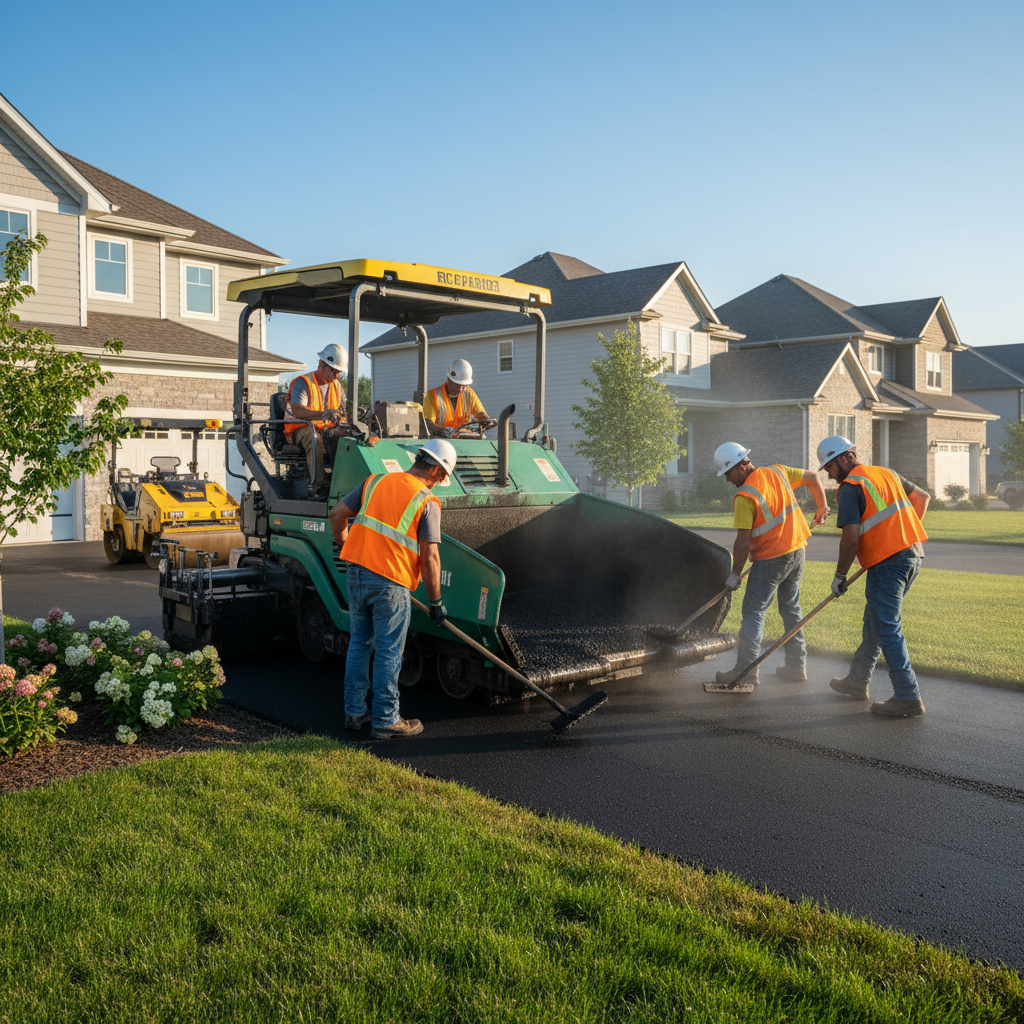
Driveway paving options and costs in Brant
In Brant, you’ll see homeowners weighing driveway paving options almost every year—especially in neighbourhoods like West Brant and in the older, tree-lined parts of Brantford Road corridors where many properties were built long before modern driveway specs. With 12,570 homeowner households in the area and 80.9% of dwellings being single-detached, private driveways are a big part of local paving demand (Statistics Canada, 2021 Census). That’s important because most driveway work here is tied to excavation, base reconstruction, and drainage corrections—not just the surface.
The Hamilton–Niagara Peninsula climate shapes both cost and scheduling. Brant sits in a moderate-to-cold Southern Ontario zone with frequent freeze–thaw cycles, so contractors plan for a frost line penetration around 1.2–1.5 m. Practically, that means a deeper, well-compacted granular base (often 6–10 in / 150–250 mm in residential driveways) and reliable drainage. Those base and drainage items can represent roughly 35–45% of a typical residential driveway budget, and they’re one reason quotes for the “same-looking” driveway can land far apart.
Asphalt remains popular because it tolerates temperature swings better than rigid surfaces, but it still needs sealing after installation or overlay to protect from moisture and oxidation. Concrete and interlock can look excellent on day one, but they rely heavily on jointing, restraint, and base quality to avoid movement and cracking.
Use the table below as a realistic starting point for Brant, Ontario—then compare contractor scopes, not just prices, before you book your season.
| Material |
Lifespan |
Maintenance |
Best For |
Price per sq ft |
Price Range |
| Asphalt (new installation, proper base) |
15–25 years |
Seal every 3–5 years |
Most Brant homes wanting solid value with flexible performance |
$6.50–$10.50 |
$3,000–$8,000 |
| Asphalt (overlay on existing gravel base) |
8–15 years |
Seal every 3–5 years; monitor settlement |
When the subgrade is sound and only the surface needs upgrading |
$5.50–$8.50 |
$2,600–$6,500 |
| Interlocking concrete pavers |
25–35 years |
Occasional re-leveling of small areas |
Driveways where curb appeal and patchability matter |
$14.50–$22.50 |
$9,000–$20,000 |
| Poured concrete (broom finish) |
25–30 years |
Seal optional; manage cracking with repairs |
Low-profile look and long-term durability with proper air-entrainment |
$12.00–$20.00 |
$7,000–$18,000 |
| Exposed aggregate concrete |
20–30 years |
Seal periodically to keep finish consistent |
Premium appearance and improved traction |
$14.00–$23.50 |
$8,500–$19,500 |
| Gravel / crushed stone (budget option) |
3–7 years |
Top up 1–2 times per year; re-grade |
Short-term solution or low-traffic areas |
$2.50–$5.50 |
$1,200–$4,500 |
Prices are estimates only and vary by project scope, site access and material selection.
What affects the price of paving in Brant
In Brant and across the Hamilton–Niagara Peninsula, it’s common to see quotes for the “same” driveway vary by 30–50%. The surface may look similar from the street, but the real cost is in the parts you can’t see: excavation depth, granular base specification, drainage correction, haul distance, and how the contractor handles freeze–thaw risk in a Southern Ontario climate. Even labour and equipment mobilization can swing pricing because spring demand concentrates into April–October, and contractors can be booked quickly during peak months.
Freeze–thaw cycles are decisive cost drivers. When water in the subgrade freezes repeatedly, expansion can trigger frost heave and cracking unless the base and drainage are built to resist movement. In deeper-frost areas, driveways generally need a thicker compacted granular base (often 6–12 in in Ontario/Alberta practice) to reduce upward frost energy and keep the roadway stable; coastal zones can sometimes get away with thinner sections. In Brant, contractors also typically assume frost penetration around 1.2–1.5 m, so the excavation and base depth matter a lot to whether a driveway lasts.
Concrete examples in Brant: (1) a poured slab over poor clay often needs more granular replacement to avoid early cracking, pushing the job toward the higher end of the $7,000–$18,000 band; (2) if the property has existing asphalt that’s failing at the edges, a proper tear-out and rebuild can cost more than an overlay, but it can still land closer to the $3,000–$8,000 asphalt range when base depth is optimized. Conversely, a clean, well-draining site on a newer property can lower excavation and keep pricing near the lower end.
| Price Factor |
Why It Matters |
Cost Impact |
| Driveway area in sq ft |
Most materials and paving time scale directly with square footage |
Highest driver; typically biggest line-item swing |
| Base depth required |
Frost line risk in Southern Ontario drives compacted granular thickness |
Can add major cost when deeper excavation is needed |
| Grading and drainage work |
Proper slope and drainage prevent water pooling and freeze–thaw damage |
Often 10–20%+ of budget on older lots with drainage issues |
| Tear-out of existing surface |
Breaking/hauling concrete or removing failed asphalt increases labour and disposal |
Can move a quote up sharply vs. “overlay” assumptions |
| Edge restraints and curbing |
Restraints keep pavers and asphalt from spreading under freeze–thaw movement |
Moderate cost, big payback for longevity and appearance |
| Sealing requirement |
Asphalt needs sealing after installation or shortly after cure to protect binder |
Ongoing maintenance cost; usually a planned add-on |
| Site access |
Narrow driveways slow equipment and may increase labour time and multiple trips |
Small to moderate, but can be significant on tight urban lots |
| Asphalt mix specifications |
Freeze–thaw-rated mixes and proper binder content reduce premature raveling and cracking |
Can increase material cost, improving long-term performance |
Permits & regulations in Ontario
In Ontario, paving a private driveway within your own property typically doesn’t require a building permit—especially when you’re replacing or resurfacing the driveway surface and staying wholly inside the property limits. Where permits and approvals often come into play is work that touches the municipal right-of-way or affects how stormwater is managed. For Brant homeowners, that generally includes new or modified curb cuts, any changes to boulevard grading, alterations to municipal drainage/storm connections, and modifications that affect how water drains near the street or sidewalks. If you need to change the driveway apron at the street line or adjust how runoff reaches drains, call your municipality before the first shovel goes in.
Step-by-step, here’s how to verify your contractor and keep it compliant:
- Check the contractor’s Ontario business registration/licence details (use their official site or the appropriate provincial listings for contractors where applicable).
- Request a Certificate of Insurance for general liability. Confirm the coverage amount and that it lists you (or your property) as an additional insured if offered.
- Verify WSIB coverage (or WCB status if they operate under a different work coverage framework). Ask for a clearance letter and the relevant employer number.
- Ask for proof of current experience: project photos from Brant/Brantford/St. George area driveways, not just generic galleries.
- Confirm disposal/haul details in writing so you’re not paying extra for dump fees or trucking later.
Finally, don’t ignore utility locates—always have Ontario One Call (formerly 1-800-DIG-RITE) arranged before excavation, and confirm any lot-grading bylaw restrictions with the municipality if you’re changing slopes near property lines.
Asphalt vs pavers vs concrete for Brant driveways
For Brant driveways, the “best” material is usually the one that fits how your property deals with water, salt, and freeze–thaw. Asphalt is the lowest upfront option for most homeowners and it performs well under Ontario temperature swings because it stays flexible; the trade-off is maintenance—plan on sealing about every 3–5 years. Interlocking concrete pavers cost more up front, but they’re the most forgiving in repairs: you can lift and replace a section without demolishing the entire driveway. Poured concrete sits in the middle on cost and can last decades, but it’s more sensitive to base quality and jointing; without proper air-entrainment and correct slab design, freeze–thaw and winter de-icing can accelerate cracking.
In the Hamilton–Niagara Peninsula, base preparation is non-negotiable for all three. Typical practice assumes frost penetration risks around 1.2–1.5 m, so contractors build a thicker, well-compacted granular base with good drainage—especially where clay or silty subsoils are present in the region. That’s also why drainage design (proper slope, water routing, and avoiding pooling near garage corners) strongly affects longevity.
Which holds up best to winter routines? If you regularly plough in deep snow, asphalt and pavers tend to handle minor movement better, provided restraints and base are correct. Concrete can be fine if built correctly, but once cracking starts, water infiltration can worsen it.
Example of where price differences are justified: if your asphalt quote lands in the $3,000–$8,000 band but your paver quote is in the $9,000–$20,000 band, pavers are worth it when you want curb appeal, ease of patching, and long-term aesthetics—especially on front-facing driveways where appearance matters year-round.
| Material |
Frost Resistance |
Curb Appeal |
Repair Method |
Lifespan |
Price Band |
| Asphalt (sealed regularly) |
Good when base and drainage are correct |
Moderate (clean, uniform finish) |
Mill/patch or overlay localized areas |
15–25 years |
$3,000–$8,000 |
| Interlocking concrete pavers |
Very good with proper restraints and jointing sand |
High (variety of patterns/colours) |
Lift-and-replace affected units |
25–35 years |
$9,000–$20,000 |
| Poured concrete (air-entrained) |
Good when designed and constructed for freeze–thaw |
Moderate to high (depends on finish) |
Crack repair/patch; occasionally spot replacement |
25–30 years |
$7,000–$18,000 |
| Exposed aggregate concrete |
Good with correct base and curing |
Very high (premium texture) |
Surface patching with matching finish |
20–30 years |
$8,500–$19,500 |
| Permeable pavers (drainage grid) |
Very good for managing water infiltration |
High (modern look) |
Replace grid sections/units as needed |
20–30 years |
$12,000–$22,000 |
| Chip seal / tar-and-chip |
Moderate (performance depends on grading and binder) |
Low to moderate (utility look) |
Spot re-seal and chip top-ups |
5–12 years |
$2,000–$6,500 |
How to choose a paving contractor in Brant
Choosing a paving contractor in Brant is mostly about verifying you’re hiring a company that can build the base and manage winter risk—not just lay surface material. Start with Ontario licensing and insurance. Ask for your contractor’s Ontario licence/business information (where applicable), and request Certificate of Insurance for general liability. Confirm the insurer, coverage limits, and that the certificate is current. Next, verify workers’ coverage: ask for WSIB coverage details and/or a clearance letter (not just a “we’re insured” statement). If they can’t provide documentation quickly, that’s a problem.
Then get 2–3 itemised written quotes. You want a breakdown that separates labour from materials and includes excavation, base (Granular A/B or equivalent), compaction, drainage/grading, geotextile (if used), disposal, delivery/haul, and the paving surface. Avoid quotes that only say “pave and done” because exclusions can lead to budget blowouts.
Read the scope carefully: is a permit required and included where applicable (for right-of-way or curb cut work)? Is disposal included in the price? What does the warranty cover—workmanship only, or also materials? Confirm the warranty length, whether it’s transferable to new owners, and whether failures due to improper subgrade prep are excluded.
Finally, schedule and payment: never pay more than 10–15% upfront. Hold back a portion until completion and final grading checks. Get the start date and completion estimate in writing, since spring demand can affect scheduling.
- Ask for recent Brant/Brantford project addresses and references.
- Confirm WSIB coverage with a clearance letter number/date.
- Request a current insurance certificate and verify liability limits.
- Get an itemised quote: excavation, base, drainage, haul, and surface.
- Confirm granular type and compaction specs (not “generic fill”).
- Clarify whether they will core sample/assess subgrade conditions.
- Ask if geotextile and/or separation fabric will be used and where.
- Ensure edge restraints/curbing are included (especially for pavers).
- Get details on disposal and trucking distances/assumptions.
- Verify asphalt sealing plan (time of cure and seal timing).
- Confirm warranty length for workmanship and surface performance.
- Use a written payment schedule with a holdback until final acceptance.
Red flags in Brant: vague quotes with no base specification, contractors who skip utility locates/field verification, pressure to pay the full amount upfront, no written warranty details, and crews that can’t explain drainage or frost-protection steps for Ontario freeze–thaw.
Frequently asked questions — paving in Brant
What is a driveway apron and do I need one in Brant?
A driveway apron is the paved section at the street line that transitions from the municipal area to your private driveway—often tied to the curb cut and how the apron handles runoff, wheels, and ploughing. In Brant, whether you “need” an apron depends on your existing setup: if your driveway currently connects to the road with gravel, a damaged edge, or an uneven transition, upgrading to a properly built apron is usually recommended for safety and to reduce water washout. If your work involves modifying the curb cut, changing boulevard/grading, or altering storm drainage connections near the street, you typically need municipal approval (right-of-way work). When you request quotes, ask if apron replacement and any required approvals are included.
How do I maintain my driveway through Brant winters?
Winter maintenance in Brant is about reducing water infiltration and minimizing surface binder damage. For asphalt, avoid dragging metal blades across the surface; use plough shoes when possible and keep initial snow removal gentle. Spread sand rather than excessive salt when you can—salt accelerates deterioration and can worsen fine cracking over time. If you have pavers, keep joint sand topped up so units stay level and resist freeze–thaw movement. After storms, check for pooling at the edges or garage corners; that’s often a grading/drainage issue that will lead to failure. A basic plan is: light, frequent clearing; no de-icing overuse; and quick patching of small cracks so they don’t open up during repeated freeze–thaw cycles.
Is it worth sealing a new driveway right away in Brant?
In Brant, sealing is usually worth planning—timing matters more than “right away.” Asphalt needs time to cure so the binder isn’t trapped under the seal coat. Most quality asphalt jobs are sealed after the appropriate cure period (often within the same season when conditions allow), and then resealed on a cycle of about every 3–5 years to protect against moisture and oxidation. If your driveway is in the typical Southern Ontario freeze–thaw environment, sealing helps slow moisture penetration into the surface and joints, which reduces the chance of potholes and raveling that can otherwise start after winter. If you’re comparing options, sealing is part of the long-term cost story even if your upfront price lands in the $3,000–$8,000 asphalt range.
What is a chip seal driveway and is it suited to Brant?
Chip seal (tar-and-chip) is a surface treatment where a binder is sprayed and topped with crushed stone. It can be a cost-effective way to improve traction and protect a base, but it’s usually best suited to low-to-moderate traffic areas and where the base is already strong and properly graded. In Brant’s freeze–thaw climate, performance depends heavily on binder quality, the stone application rate, and drainage—otherwise chips can loosen and the surface can age faster during winter cycles. If your goal is a long-lasting “main driveway” surface for daily vehicle traffic and ploughing, asphalt or interlock often provide better durability. That said, some homeowners consider chip seal as a shorter-horizon option, and pricing can fall into the lower end of driveway surface work (commonly within the $2,000–$6,500 band).
How much does driveway crack repair cost in Brant?
Crack repair cost in Brant depends on crack type, length, and whether it’s a surface-only issue or signs of base movement. For small, clean cracks in asphalt, contractors typically do crack cleaning and sealing or patching; for wider cracks, they may need a routed seal or small cold-mix patch. If the driveway is already failing with edge breaks or settlement, repairs can be limited in value until the base/drainage problem is fixed. As a homeowner-friendly guide, sealing and repair budgets commonly run from about $400–$2,000 for typical residential crack repairs, not full driveway replacement. Get itemised quotes so you can see if they’re just sealing the crack or also addressing water pathways that cause it to re-open.
What base thickness do I need for pavers in Brant?
For pavers in Brant, base thickness is driven by frost-protection needs and drainage—because Ontario freeze–thaw cycles can lift weak subgrades. A common residential approach in Southern Ontario is to excavate and build a properly compacted granular base (often in the 6–10 in range for many driveways), with additional thickness if the subgrade is poor or if water drainage is an issue. Many contractors also use edge restraints and the right bedding sand thickness so the interlock system stays stable under winter loading from ploughing and vehicle traffic. If your home is on older soil conditions (and about half of local homes were built before 1981, Statistics Canada, 2021 Census), base replacement or drainage corrections may be needed, which can affect pricing significantly. Ask your contractor to specify granular type, depth, and compaction targets in writing.