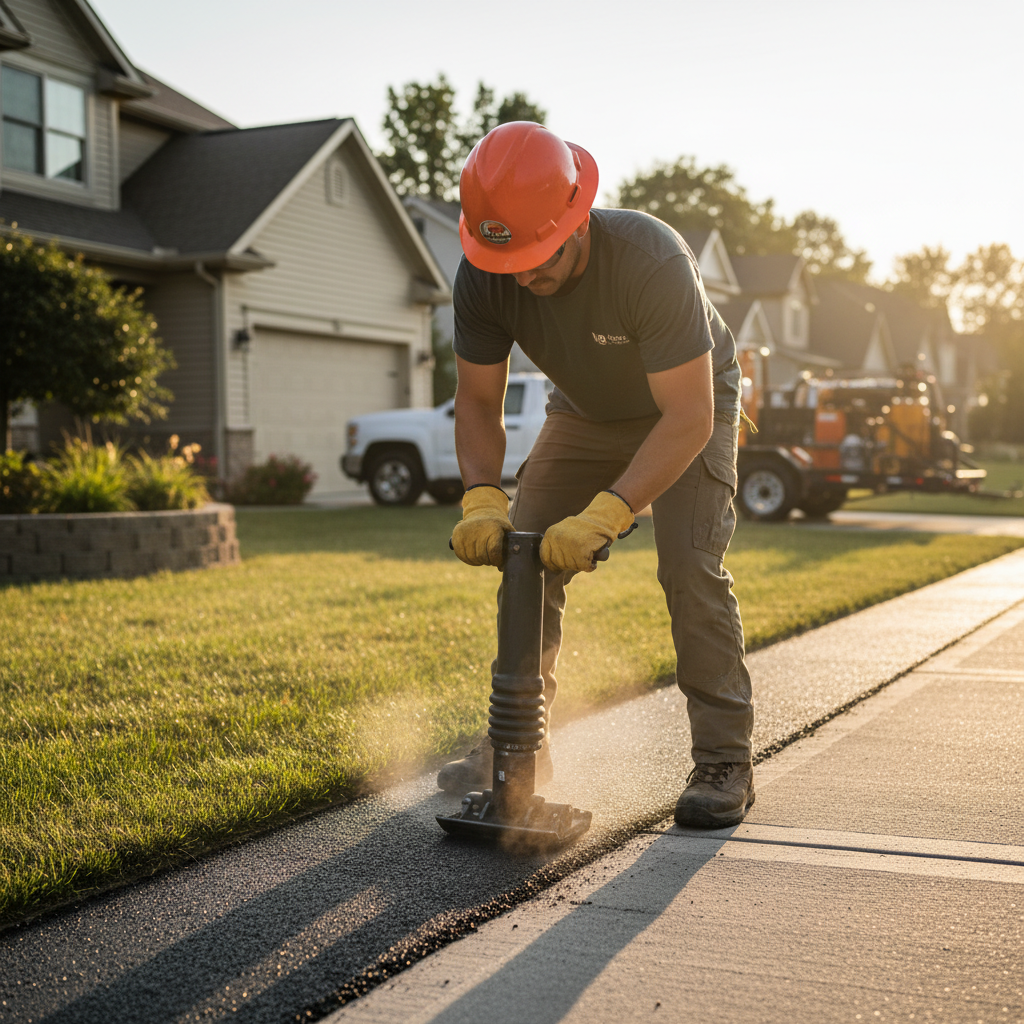
Driveway paving options and costs in Bluewater
In Bluewater, choosing the right driveway paving option comes down to balancing upfront cost, winter performance, and how often you want to touch up the surface. Most local driveways belong to detached homeowners—single-detached houses make up 82.5% of dwellings—so this is a large, steady market for full-depth repairs, overlays, and new builds. With 83.5% of households owning their home, many owners prefer solutions that reduce long-term cracking and lift from winter freeze–thaw.
In the Stratford–Bruce Peninsula economic region, costs are shaped by cold-climate ground conditions and a compressed paving season. The frost line in Southern Ontario is roughly 1.2 m (about 4 ft), so bases must resist heaving above that depth. If the soil is clayey or silty (common in parts of the region), it holds water and increases the risk of frost expansion—meaning more excavation, deeper granular base, and careful drainage detailing. That’s why two quotes for the “same” driveway can differ sharply: one contractor may plan for drainage and a thicker base, while another may try to match a lower-budget scope.
Contractor availability also tightens around late spring and summer (often late May through September for full-depth work), and weather downtime gets priced in. In Bluewater’s more traffic-prone residential areas—particularly along the main approach roads leading into the community—driveway work tends to be in demand because access and curb protection matter year-round.
Use the table below to compare typical options and realistic per-square-foot pricing for Bluewater, then we can match the right system to your soil and winter maintenance habits.
| Material |
Lifespan |
Maintenance |
Best For |
Price per sq ft |
| Asphalt (new installation, proper base) |
15–25 years |
Seal every 3–5 years; crack repair as needed |
Value with good performance when base/drainage are right |
$6 – $10 |
| Asphalt (overlay on existing gravel base) |
8–15 years |
Seal and patch within first 1–3 seasons |
Budget refresh when the existing base is stable |
$5 – $8 |
| Interlocking concrete pavers |
25–30+ years |
Re-level and replace individual stones as needed |
Curb appeal and easier targeted repairs |
$18 – $28 |
| Poured concrete (broom finish) |
20–30 years |
Occasional crack sealing; consider surface protection |
Straightforward, smooth finish with strong edge support |
$14 – $22 |
| Exposed aggregate concrete |
20–30 years |
Crack sealing as needed; occasional surface treatments |
Slip resistance and upgraded appearance |
$16 – $26 |
| Gravel / crushed stone (budget option) |
3–7 years |
Top-ups, grading, weed control; re-compaction |
Short-term access while planning a hard surface |
$3 – $6 |
Prices are estimates only and vary by project scope, site access and material selection.
What affects the price of paving in Bluewater
In Bluewater and across the Stratford–Bruce Peninsula region, it’s not unusual to see paving quotes for a similar driveway vary by 30–50% for reasons that have nothing to do with “brand” and everything to do with design for cold weather. One contractor might assume the existing base is stable; another will price excavation, a thicker compacted granular base, and upgraded edge drainage to manage moisture before it freezes. In clay-leaning soils, that difference in subgrade preparation is often what protects the surface through the worst freeze–thaw seasons.
Two cost drivers dominate here: frost depth and the freeze–thaw cycle. With a Southern Ontario frost line of about 1.2 m, the granular base thickness needs to be designed so saturated subgrade doesn’t freeze and lift the pavement. In colder inland regions like this one, that usually means deeper granular construction—often more like 6–12 inches of properly compacted base (plus select subbase and drainage detailing), rather than a minimal base. In addition, the paving window is shorter: hot-mix asphalt generally needs air temperatures above about 10°C. When the season is tight (late May through September), scheduling pressure concentrates demand, and contractors price in weather downtime risk.
Concrete and pavers can also shift up or down in cost based on local site conditions. For example, a driveway that needs significant grading to fix slope and ponding can add labour and stone/drainage work, pushing a concrete driveway toward the higher end of the $14,000 – $22,000 style band for typical projects. Conversely, if soil is well-draining and the existing subbase is solid, asphalt can stay closer to the $6 – $10 per-square-foot range because the scope is mainly surface construction and sealing.
Local housing stock matters too: with 60.5% of homes built before 1981, more driveways have older drainage patterns, buried clay pockets, or inconsistent base thickness—issues that show up after winter. Fixing those costs money once, but it prevents the recurring “patch-and-crack” cycle that drives long-term expenses.
| Price Factor |
Why It Matters |
Cost Impact |
| Driveway area in sq ft |
All materials, base work, and paving thickness scale directly with area |
Largest driver (often determines the total price line-by-line) |
| Base depth required |
Frost line design determines granular thickness and compaction needs |
More excavation and stone can add a major percentage to cost |
| Grading and drainage work |
Proper cross-slope and away-from-building drainage prevent water pooling and freeze risk |
Can increase job cost significantly if regrading or drainage is required |
| Tear-out of existing surface |
Removing old asphalt/concrete includes breaking, hauling, and disposal |
Often adds time and equipment costs; disposal fees vary |
| Edge restraints and curbing |
Limits movement and prevents paver spread or concrete edge failures |
Cost rises with added restraints/curb reconstruction needs |
| Sealing requirement |
Asphalt needs sealing after curing (commonly 6–12 months) to reduce water intrusion |
Additional cost, but supports longer asphalt service life |
| Site access |
Narrow driveways and tight turns slow equipment movement and raise labour time |
Can add setup time and extra handling |
| Asphalt mix specifications |
Freeze–thaw-rated mixes and correct binder content resist Ontario’s winter stresses |
Higher mix requirements can raise material costs per batch |
Permits & regulations in Ontario
In Ontario, paving a private driveway within your own property usually does not require a building permit. For most homeowners in Bluewater, replacing an asphalt surface, pouring new concrete, or installing interlocking pavers entirely inside the property line is typically handled as private works (subject to the contractor following provincial and municipal requirements, plus any site plan rules). The situation changes when work affects the municipal right-of-way, which includes the boulevard area between the curb/road allowance and your property.
Work that typically DOES require municipal approval includes things like new or altered curb cuts, changes to drainage tied into the municipal storm system, modifications that affect boulevard elevations, and any adjustments that influence how water flows toward the road or catch basins. Some municipalities also have lot-grading bylaws that restrict how close hard surfaces and grading can be to property lines, and they may require drainage to be directed properly away from neighbouring properties and foundations.
Before excavation, confirm utility locations by calling Ontario One Call. Then, when you’re hiring a contractor, verify three items in a straightforward sequence: (1) Ontario licence/registration information where applicable via the contractor’s listing and any posted trade credentials; (2) liability insurance—ask for a current certificate of insurance naming you as additional insured if available; and (3) WSIB/WCB coverage confirmation (or a clearance letter when applicable). Finally, review the written contract for disposal, backfill/topsoil, and any required inspections tied to right-of-way changes.
Asphalt vs pavers vs concrete for Bluewater driveways
For Bluewater driveways, asphalt, interlocking pavers, and concrete all can perform well—provided the base and drainage are designed for Ontario’s freeze–thaw climate. Asphalt is usually the lowest upfront option, but it relies on a properly built granular base and needs sealing every 3–5 years to reduce water penetration. In the Stratford–Bruce Peninsula region, that matters because repeated cycling around winter thaws can fatigue asphalt and open cracks; once water enters, freeze expansion accelerates deterioration.
Interlocking concrete pavers typically have the highest material and labour cost, but they’re also the most forgiving to “spot repair.” If one area heaves due to a local soil pocket or poor drainage, pavers can be lifted, corrected, and reset without tearing out the whole driveway—an advantage when older homes (60.5% built before 1981) may have legacy drainage patterns. Pavers also score well on curb appeal, which is a big reason many Bluewater homeowners choose them for a long-lasting front elevation.
Poured concrete is often a mid-range cost and durable, but it’s more susceptible to cracking when freeze–thaw and de-icing salt are involved without air-entrainment and correct reinforcement/jointing. With Ontario winters and snow operations, concrete needs a strong edge system and properly timed crack sealing to keep moisture out.
A concrete example: if your driveway is priced near the asphalt range ($6 – $10 per sq ft), moving to pavers can jump toward $18 – $28 per sq ft. That premium is often justified when you want high curb appeal, easier repairs, or you expect future utility work. If you want the best value and you’re comfortable with maintenance, properly installed asphalt plus a sealing plan is usually the strongest budget-to-performance trade-off in Bluewater.
| Material |
Frost Resistance |
Curb Appeal |
Repair Method |
Lifespan |
Price Band |
| Asphalt (sealed regularly) |
Good with designed base and drainage; sealing reduces water intrusion |
Medium |
Patch/rout and re-surface; local crack sealing |
15–25 years |
$6 – $10 |
| Interlocking concrete pavers |
Very good due to flexible segmented system when base is correct |
High (varied patterns/colours) |
Lift and replace individual pavers |
25–30+ years |
$18 – $28 |
| Poured concrete (air-entrained) |
Good when air-entrained and joints are properly planned |
Medium–High |
Crack sealing and patching; full replacement if widespread |
20–30 years |
$14 – $22 |
| Exposed aggregate concrete |
Good with proper base, joints, and sealing strategy |
High (textured, slip-resistant surface) |
Targeted patching and surface re-treatment as needed |
20–30 years |
$16 – $26 |
| Permeable pavers (drainage grid) |
Very good when designed to manage water down through the system |
High (modern look) |
Remove/rebuild sections; clean and maintain infiltration layer |
20–30 years |
$20 – $32 |
| Chip seal / tar-and-chip |
Fair; best for lower-traffic areas or as a renewal surface |
Low–Medium |
Chip loss patching and periodic re-sealing |
5–12 years |
$5 – $8 |
How to choose a paving contractor in Bluewater
Start with proof, not promises. In Ontario, confirm the contractor’s ability to legally do the work in your area (ask for Ontario business details and any trade credentials they list), then verify liability insurance—request a current certificate of insurance and check expiry dates and coverage limits. Next, confirm WSIB/WCB coverage (or obtain a clearance letter where appropriate). If they can’t provide documentation or they pressure you to “just trust us,” that’s a hard stop.
Then request 2–3 itemised, written quotes. You want line items that show excavation depth assumptions, base material and thickness, compaction/testing expectations, asphalt/concrete thickness, drainage/grading scope, edge restraints, and what happens to existing material (breaking and hauling concrete, or asphalt removal and disposal). Ask if the quote includes utility locates, permit pull if right-of-way approval is needed, and any surface restoration. Avoid lump-sum quotes that don’t explain what you’re actually paying for—especially in a climate where improper base thickness can cause heaving.
Warranty matters too: confirm the workmanship warranty length, whether it applies to subgrade conditions, and whether product/manufacturer warranty is included. Also ask if warranties are transferable if you sell the home. Payment should be controlled—never more than about 10–15% upfront. Hold back a portion until completion and final surface checks. Finally, get the start date and completion estimate in writing so schedule changes don’t become an unplanned delay.
- Ask for proof of insurance (liability) with certificate expiry dates.
- Confirm WSIB/WCB coverage or clearance letter documentation.
- Verify licensing/registration details relevant to paving work in Ontario.
- Get 2–3 itemised quotes with labour + materials breakdown.
- Require base depth and thickness spelled out (and compaction expectations).
- Confirm drainage/grading scope, including cross-slope requirements.
- Clarify tear-out extent: full-depth vs partial milling/overlay.
- Confirm edge restraints: saw-cuts, rebar/joints (concrete), or paver edging/curb (pavers).
- Specify asphalt mix type and how it’s selected for freeze–thaw conditions.
- Ask what disposal and haul-away are included.
- Review warranty terms: workmanship length, exclusions, and transferability.
- Use a schedule: no large upfront deposits; retain holdback until final sign-off.
Red flags in Bluewater include quotes that don’t mention base thickness or drainage, contractors who won’t provide insurance/WSIB documentation, “same-day” start dates without weather contingency for the short paving window, vague warranties that exclude freeze–thaw performance, and pricing that assumes an overlay without inspecting the existing base condition.
Frequently asked questions — paving in Bluewater
How do I get the most accurate paving quote in Bluewater?
To get an accurate quote in Bluewater, ask for a site visit and a base-and-drainage assessment, not just a measurement of your driveway. Because the Stratford–Bruce Peninsula region has a frost line around 1.2 m and intense freeze–thaw cycles, the biggest differences in pricing come from excavation depth, soil moisture risk, and how cross-slope and edge drainage are handled. Request itemised pricing that shows base depth, compaction plan, and whether it’s a full-depth replacement or an overlay. If you want asphalt, confirm the contractor’s plan for proper curing and the sealing timeline (commonly after 6–12 months). Finally, confirm they’ll account for disposal, equipment access, and any right-of-way approvals if your driveway ties into a municipal curb cut or drainage system.
How much does it cost to pave a driveway in Bluewater?
Cost in Bluewater depends mainly on driveway area (square feet), the amount of excavation, and how much granular base and drainage work are needed to manage winter heave. For planning, asphalt paving typically lands around $6 – $10 per sq ft when installed over a proper base. If you choose interlocking concrete pavers, budgeting closer to $18 – $28 per sq ft is common due to the higher material and labour content. Poured concrete often falls in the $14 – $22 per sq ft band depending on finish and jointing requirements. In older neighbourhoods with more pre-1981 housing stock (60.5% of homes built before 1981), expect more frequent drainage or base corrections—those can move the final number toward the higher end.
Asphalt vs interlocking pavers vs concrete — which is best in Bluewater?
There isn’t one “best” material for Bluewater; the best choice matches your winter routine, curb appeal goals, and tolerance for maintenance. Asphalt is usually best for homeowners wanting the lowest upfront cost and are willing to seal every 3–5 years—when the base and drainage are done correctly, it performs well through Ontario freeze–thaw. Interlocking pavers are ideal if you value curb appeal and want repair flexibility; if a section heaves due to a localized soil pocket, pavers can be lifted and reset without replacing the entire driveway. Poured concrete can be strong and long-lasting, but it must be air-entrained and properly jointed to manage cracking from freezing cycles and de-icing salt. If you plow close to the edges often, make sure edge restraints are included regardless of material.
How long does a paved driveway last in Bluewater?
In Bluewater, expected lifespan depends on base construction, drainage, and whether you follow recommended maintenance. Asphalt on a properly prepared base often lasts about 15–25 years, but sealing in the first 6–12 months and then every 3–5 years helps prevent water from weakening the system during repeated thaw periods. Interlocking pavers commonly last 25–30+ years because repairs are localized and the segmented system can better tolerate minor movement. Poured concrete often lands around 20–30 years when air-entrained and constructed with appropriate joints and edge support. If your driveway suffers from ponding or water can’t drain away from the slab or surface edges, all three materials can fail early—typically around the same time you notice cracking patterns after a harsh winter.
When is the best time of year to pave in Bluewater?
The best time for paving in Bluewater is during the full paving window for cold-climate projects—often late May through September—when temperatures are consistently suitable for placing and compacting asphalt and when concrete finishing and curing are more reliable. Asphalt generally requires warm conditions (air temperatures typically above 10°C) to achieve proper compaction and long-term performance. In the Stratford–Bruce Peninsula region, the season is compressed, so booking earlier helps reduce delays caused by cool, wet shoulder-season days. If you’re planning full-depth replacement, aim for the driest weeks within that window. For repairs or sealing schedules, coordinate with your contractor so asphalt gets sealed after the proper curing period instead of too early.
How deep should the base be for Bluewater's frost?
Base depth in Bluewater isn’t one fixed number because it depends on soil type, moisture conditions, and how the contractor designs to manage frost. However, because Southern Ontario’s frost line is roughly 1.2 m (about 4 ft), the driveway must be built so saturated subgrade above that depth won’t freeze and lift the pavement. In colder inland Ontario projects, that commonly means deeper, properly compacted granular construction—often in the range of 6–12 inches of granular base (with additional layers or select subbase where conditions require) plus drainage/grading corrections. If you have clayey or silty soils or you’ve seen water ponding, the required build-up usually increases. The most accurate approach is for the contractor to explain their base design in the quote (thickness and materials) after a site assessment.