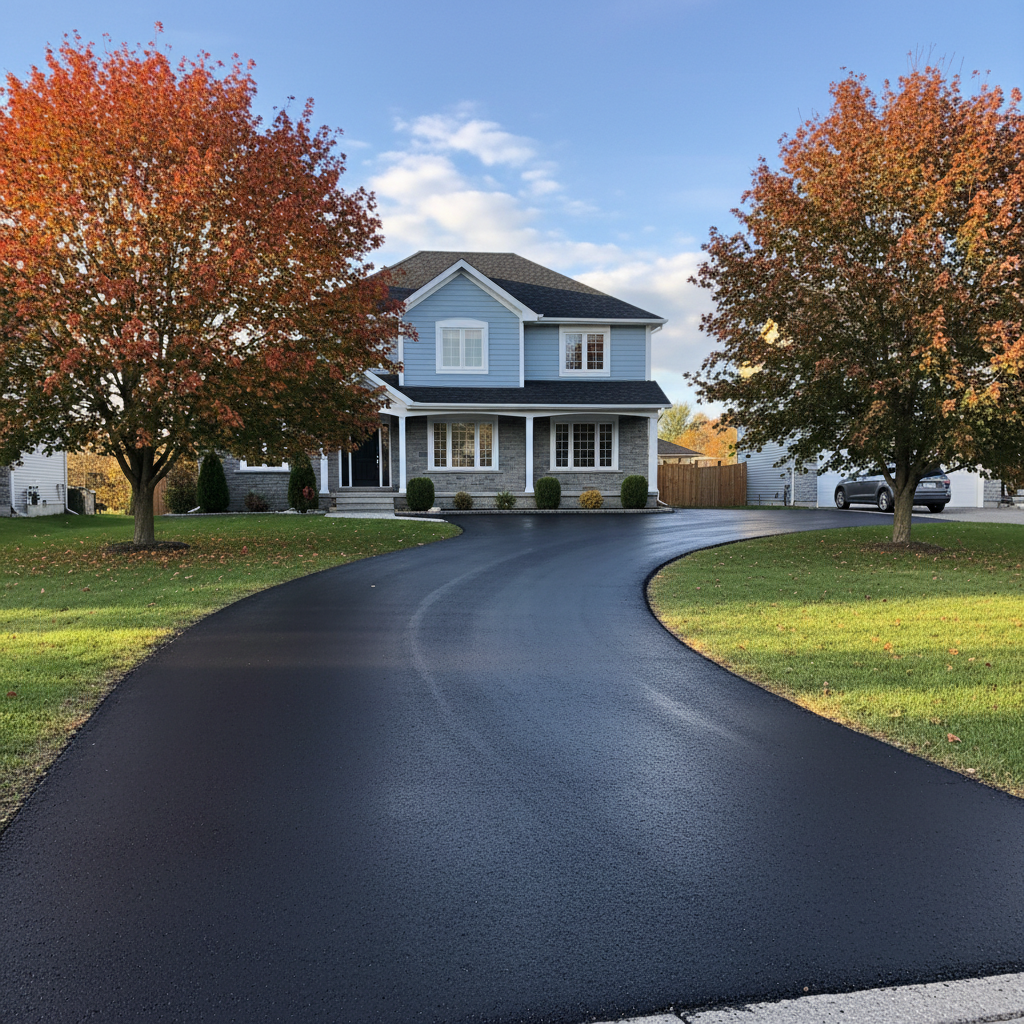
Driveway paving options and costs in Bancroft
Bancroft homeowners typically have a clear driveway decision to make—because the right material in town depends heavily on how freeze–thaw works on local soils. In Bancroft, a large share of housing is single-detached (71.9% of dwellings), which means most paving jobs are attached to detached homes and driveways that see regular plowing and spring runoff. With 60.0% of homes built before 1981, you also see plenty of older driveways where the base was never brought down to modern frost-depth expectations. (Statistics Canada, 2021 Census)
In the Kingston–Pembroke region, paving costs swing more than people expect because frost penetration is commonly around 4 feet (about 1.2 m) in much of Southern and Eastern Ontario, and the area’s freeze–thaw cycles are hard on thin bases. Contractors often have a shorter paving window—hot-mix asphalt needs warm air temperatures (generally above 10 °C)—so scheduling gets tight in spring and early summer. Rural access, clay pockets, and the need for proper drainage ditching or swales around Bancroft properties can also push excavation and aggregate hauling costs.
You’ll notice this demand especially in neighbourhoods around Bancroft’s west end and along older residential stretches where lots are on natural grade and drainage is inconsistent. Once the base and drainage are sorted, you can compare the most common options below.
| Material |
Lifespan |
Maintenance |
Best For |
Price per sq ft |
Price Range |
| Asphalt (new installation, proper base) |
15–25 years |
Sealcoat every 3–5 years |
Most value-focused driveways with strong base prep |
$6.00–$10.50 |
$4,500–$9,000 |
| Asphalt (overlay on existing gravel base) |
10–18 years (depends on base condition) |
Sealcoat as needed; patching early ravel areas |
When the base is solid and only surface needs upgrading |
$5.50–$9.25 |
$4,000–$7,500 |
| Interlocking concrete pavers |
25–35 years |
Re-sand joints as needed; individual paver repairs |
High curb appeal and repairability for freeze–thaw |
$12.00–$20.00 |
$6,500–$14,000 |
| Poured concrete (broom finish) |
20–30 years |
Occasional patching; protect from de-icing salt |
Clean modern look and long-term slab stability |
$11.00–$19.00 |
$7,000–$15,000 |
| Exposed aggregate concrete |
20–30 years |
Seal (optional) and spot repairs when needed |
Slip resistance and premium finish in snow seasons |
$13.00–$21.00 |
$8,000–$16,000 |
| Gravel / crushed stone (budget option) |
3–8 years (often shorter under heavy plowing) |
Top up annually; re-grade after thaw/freeze |
Short-term or lowest upfront cost with drainage fixes |
$3.00–$6.00 |
$2,500–$6,000 |
Prices are estimates only and vary by project scope, site access and material selection.
What affects the price of paving in Bancroft
In Kingston–Pembroke, it’s common to see quotes for the “same driveway” land 30–50% apart, even when the homeowner picks the same finish. The reason is usually not the asphalt or pavers themselves—it’s the depth and quality of the base, the drainage plan, and how much excavation and hauling is required to get below frost influence. Two driveways can both be 600 sq ft, yet one has stable granular material while the other sits over clay pockets that hold water and heave in spring.
Frost line depth and freeze–thaw cycles are decisive cost factors here. In much of Southern/Eastern Ontario, contractors commonly design around roughly a 4-foot frost penetration, which means thicker compacted granular base and a well-built subgrade system. Practically, that turns into additional granular layers, more compaction lifts, and more import aggregate when the existing soils aren’t suitable. Asphalt also has to meet freeze–thaw-rated mix requirements; in colder regions, the mix design and placement conditions matter. On top of that, the paving window is shorter—hot-mix asphalt typically needs air temperatures above 10 °C—so labour crews may be booked tightly in spring, which can raise scheduling costs.
Concrete can be affected by local conditions too. For example, poured concrete may cost on the higher end if you need deeper excavation and subgrade stabilization to reduce future cracking, especially on slopes or where ditching/swales don’t drain away from the driveway. Conversely, if a homeowner already has excellent drainage and a well-graded base, asphalt and paver installs can come in closer to the lower end of the region’s typical ranges (for instance, new asphalt often lands within the $4,500–$9,000 band; interlocking pavers often track within $6,500–$14,000). With older homes (60.0% built before 1981), you may also pay more for tear-out and disposal when old base material is contaminated or too shallow. (Statistics Canada, 2021 Census)
| Price Factor |
Why It Matters |
Cost Impact |
| Driveway area in sq ft |
Most materials and production time scale directly with square footage |
Typically the largest single variable |
| Base depth required |
Frost protection depends on compacted granular thickness and subgrade quality |
Can add major cost when extra excavation/aggregate is needed |
| Grading and drainage work |
Proper slope and ditching/swales reduce water pooling and freeze damage |
Often increases excavation and equipment hours |
| Tear-out of existing surface |
Breaking concrete or removing old asphalt/gravel includes labour and hauling |
Frequently a mid-to-high cost jump in older neighbourhood driveways |
| Edge restraints and curbing |
Pavers and asphalt need restraint to prevent lateral spread and raveling |
Adds materials and installation time but improves longevity |
| Sealing requirement |
Asphalt needs sealcoat to slow oxidation and keep water out |
Year 2–3 maintenance planning affects total cost over time |
| Site access |
Narrow lanes or steep grades slow equipment movement and raise crew time |
Can add labour and equipment mobilization costs |
| Asphalt mix specifications |
Freeze–thaw-rated mixes and correct binder content cost more and require right placement |
Small unit cost increase with better performance in winter |
Permits & regulations in Ontario
In Ontario, paving a private driveway within your own property typically does not require a building permit, as long as you’re not changing how stormwater is managed in a way that affects the municipal right-of-way. Where permits and approvals can apply is the “public infrastructure” side of the job: work within the municipal right-of-way such as new curb cuts, changes to the boulevard, adjustments to ditches, or modifications that alter storm drainage patterns usually need municipal approval.
Also check for lot-grading or property-drainage rules. Many municipalities have bylaws that restrict how close a hard surface can be to property lines or how runoff can be directed—especially where it could affect neighbours or public drainage systems. In Bancroft, that often shows up practically when a driveway ties into existing ditching, swales, or natural grade.
Step-by-step, here’s how a homeowner can verify a contractor in Ontario before excavation:
- Call Ontario One Call (formerly 1-Call/locates through the provincial system) and confirm utilities are located before any digging.
- Ask for the contractor’s Ontario registration/licence information and confirm it matches what they present on their proposal/invoices.
- Request a certificate of insurance showing liability coverage for the project scope.
- Request proof of WSIB coverage (or a clearance letter if applicable) and verify the coverage is current.
- Confirm whether any municipal permit/approval is required for curb/boulevard/drainage changes, and who pulls it.
If a contractor can’t provide insurance and WSIB details or won’t clearly state who handles approvals, that’s a red flag.
Asphalt vs pavers vs concrete for Bancroft driveways
For Bancroft driveways, asphalt, interlocking pavers, and concrete all can work—but they behave differently under freeze–thaw, plowing, and winter maintenance. Asphalt is usually the lowest upfront cost and it’s fast to install, but it depends on a properly built granular base and requires sealcoating every 3–5 years to slow aging and prevent water intrusion. Interlocking concrete pavers cost more upfront, yet they’re highly repairable: if you ever need to dig for a drain or utility fix, individual units can be lifted and reset without replacing the entire surface. Poured concrete sits in the middle price-wise, but it can be susceptible to cracking in freeze–thaw conditions if air entrainment, finishing, and jointing aren’t handled correctly—and salt exposure from winter can accelerate surface deterioration.
Because Kingston–Pembroke commonly sees frost penetration around 4 feet, all three materials need deeper, well-compacted granular base and strong drainage. The base is what keeps water from staying under the pavement during thaw periods. In areas with poorer drainage or older, compacting foundations (common in homes built before 1981), the driveway can heave or settle—turning into cracks in concrete or raveling in asphalt. With pavers, the joint system can accommodate small movements better, which is why they’re popular where plowing is frequent and drainage is challenging.
When you’re maintaining with plows and typical winter sanding/salting, pavers often hold up well visually, while asphalt’s longevity depends on timely sealing and patching. A real-world example: if a 600 sq ft driveway comes in at roughly $4,500–$9,000 for new asphalt but would be $6,500–$14,000 for interlocking pavers, the difference can be justified when you want curb appeal plus the option to repair sections without full replacement—especially in older Bancroft areas where base conditions vary. (Statistics Canada, 2021 Census)
| Material |
Frost Resistance |
Curb Appeal |
Repair Method |
Lifespan |
Price Band |
| Asphalt (sealed regularly) |
Good when built on a deep, compacted base and sealed |
Moderate |
Patch and tack coat; seal after repairs |
15–25 years |
$4,500–$9,000 |
| Interlocking concrete pavers |
Very good due to segmental system and joint flexibility |
High (variety of patterns/colours) |
Replace individual pavers and re-sand joints |
25–35 years |
$6,500–$14,000 |
| Poured concrete (air-entrained) |
Good with proper air entrainment, joints, and drainage |
Moderate to high |
Crack/patch repairs; full replacement only if severe |
20–30 years |
$7,000–$15,000 |
| Exposed aggregate concrete |
Good; surface can resist wear with correct mix and finish |
High (textured premium look) |
Spot patch or full area repair depending on cracking |
20–30 years |
$8,000–$16,000 |
| Permeable pavers (drainage grid) |
Very good for managing water at the surface and base layer |
High (modern look) |
Replace individual units; serviceable base system |
20–30 years |
$7,500–$15,500 |
| Chip seal / tar-and-chip |
Moderate; relies on consistent base and surface adhesion |
Lower |
Spot chip loss repair; re-surface when needed |
6–12 years |
$4,000–$8,000 |
How to choose a paving contractor in Bancroft
Choosing the right paving contractor is mostly about proof: proof they’re licensed/registered for their work, insured properly, and set up to manage Ontario jobs safely. First, verify Ontario licensing/registration information matches what they provide in writing (many reputable contractors list it clearly on proposals). Next, request a current certificate of insurance for liability—confirm the coverage matches the type of work (excavation, trucking aggregate, paving/placing material). Then verify WSIB: ask for a WSIB clearance letter or proof of coverage so you know you’re not exposed if there’s an on-site incident.
Get 2–3 itemised written quotes with a breakdown that separates labour, base excavation/haul, granular layers, drainage work, forms/finishing (for concrete), and material costs. You don’t want “one number” pricing when frost protection and drainage are the real cost drivers. Carefully read what’s excluded: permit pulls, disposal fees, restoring landscaping, sawcutting/jointing, and any ditching/swale improvements should be stated line-by-line.
Warranty matters too. Ask for the workmanship warranty length and whether there’s a product/manufacturer warranty for mix/materials. Confirm if the warranty is transferable to future owners. Payment schedules should protect you: typically keep upfront payments to about 10–15%, then hold back a portion until base inspection and final completion. In colder areas around Bancroft, also ensure the timeline is realistic—get the planned start date and completion estimate in writing.
- Ask for their most recent local projects and photos from Kingston–Pembroke.
- Confirm the exact base build-up they propose (granular type, thickness, compaction lifts).
- Require a drainage plan (ditching/swale/French drain notes if needed).
- Get liner/edge restraint details for pavers/asphalt so edges don’t spread.
- Ask how they handle utility locates and confirm they won’t dig without locates.
- Confirm disposal/haul-out for tear-out materials is included.
- Request concrete jointing plan (control joints) and curing/finishing steps.
- For asphalt, ask when sealcoat is recommended and who applies it (or plan for it).
- Check warranty wording: workmanship vs materials and what triggers a claim.
- Ensure insurance certificate shows project coverage and correct dates/limits.
- Verify WSIB clearance letter/proof is current before the first shovel goes in.
- Confirm equipment access and traffic control plan for your driveway approach.
If a contractor gives vague answers, refuses to show WSIB/insurance, offers “cheap” pricing without explaining base thickness, skips drainage details, or pressures you for large upfront deposits, treat it as a major concern for Bancroft winter performance.
Frequently asked questions — paving in Bancroft
Why does my driveway crack and heave in winter?
In Bancroft and across Ontario’s Kingston–Pembroke region, cracking and heaving are usually the result of water + freeze–thaw working on a weak base. If the granular layers weren’t deep enough for local frost conditions (roughly a 4-foot frost penetration is common in much of Southern/Eastern Ontario) or if compaction was insufficient, moisture can sit under the pavement during thaw periods and expand when temperatures drop. That movement shows up as heaving, then cracking (especially in poured concrete) or surface raveling (often in asphalt). Older driveways—more common where many homes were built before 1981 (Statistics Canada, 2021 Census)—often need drainage corrections and proper excavation to perform well. A correct fix starts with drainage and base reconstruction, not just surface patching.
Do I need a permit to pave my driveway in Ontario?
Usually, paving within your own property on private driveway areas in Ontario doesn’t require a building permit. Where permits/approvals often come up is when the work affects the municipal right-of-way—such as a new or modified curb cut, changes to the boulevard, or alterations to storm drainage/ditching connected to municipal infrastructure. Also, some municipalities regulate lot grading, including how runoff is directed and how close hard surfaces can be to property lines. For Bancroft homeowners, the simplest way to verify is to ask the contractor whether any right-of-way work is involved and then confirm with the municipality. Regardless, make sure the contractor has utility locates done (Ontario One Call) before digging. Good quotes should clearly note whether permit/approval steps are included.
How long before I can drive on new asphalt?
Typical guidance is that you should avoid driving on fresh asphalt for at least a short curing period so the surface can cool and the lift can set properly. In practice, many homeowners can drive on it the same day once temperatures drop and the surface isn’t overly soft, but contractors often want to keep traffic off longer if there are weather changes or if the job includes thicker sections, tack coat, or multiple lifts. In Bancroft’s shoulder seasons, crews are careful because moisture and cool air slow proper set. If your quote is in the asphalt band (for example $4,500–$9,000 for new installation with a proper base), ask your contractor for a specific “drive-on” timeline based on the day’s weather and mix placement. Also confirm when sealcoat should happen (commonly after 6–12 months).
What causes potholes and how are they repaired?
Potholes form when water gets into the asphalt and undermines the base. In Ontario’s freeze–thaw environment, that trapped water expands, breaks down the pavement, and then traffic accelerates the damage. Sometimes potholes start from small raveling areas where the sealant is late or missed; other times the underlying issue is drainage or a base that wasn’t built deep/compacted enough for frost protection. Repairs are usually done by cutting out to sound material, cleaning and drying, then placing new asphalt with proper tack coat and compaction, sometimes followed by a patch stabilization strategy for larger failures. If you’re planning repairs in a sealed-driveway cycle, budget for maintenance—sealing/repair for small issues can fall in the general $400–$1,800 range depending on scope. A proper quote should explain whether drainage is addressed or it’s only a surface fix.
How do I prepare for a paving project?
Preparation helps prevent delays and reduces the chance of extra charges. In Bancroft, start by clearing the driveway route and allowing room for trucks and equipment—narrow rural access can slow work. Mark any items near the driveway (decorative stones, garden edging, downspouts) and confirm whether landscaping restoration is included in the quote. If you have an older driveway, ask the contractor what tear-out includes (concrete/asphalt breaking and hauling). Ensure pets/vehicles are out of the area on the work dates. Also confirm utility locates are completed (Ontario One Call) before excavation. Finally, ask for a written schedule: start date and completion estimate. A well-prepared site keeps the job inside the workable season—important in Eastern Ontario where paving temperatures and rain windows can tighten.
How do I compare paving quotes fairly?
To compare quotes fairly in Bancroft, insist on apples-to-apples scope. Look for itemised pricing: base excavation, granular layer thickness, compaction requirements, drainage corrections, disposal/haul-out, and edge restraints—not just the surface material. Verify what’s included for your driveway size and slope, and whether the contractor is building for frost performance (deep, compacted base and robust drainage are essential in Kingston–Pembroke’s freeze–thaw climate). Check warranty terms and payment schedule: keep upfront payments around 10–15% and hold back until completion. Compare materials realistically: if asphalt is quoted near $4,500–$9,000, make sure the base build-up matches the higher end if your soil is clayey or the site needs drainage work. If interlocking is quoted in the $6,500–$14,000 range, confirm restraint and jointing details. If any quote is missing these essentials, it isn’t a true like-for-like comparison.