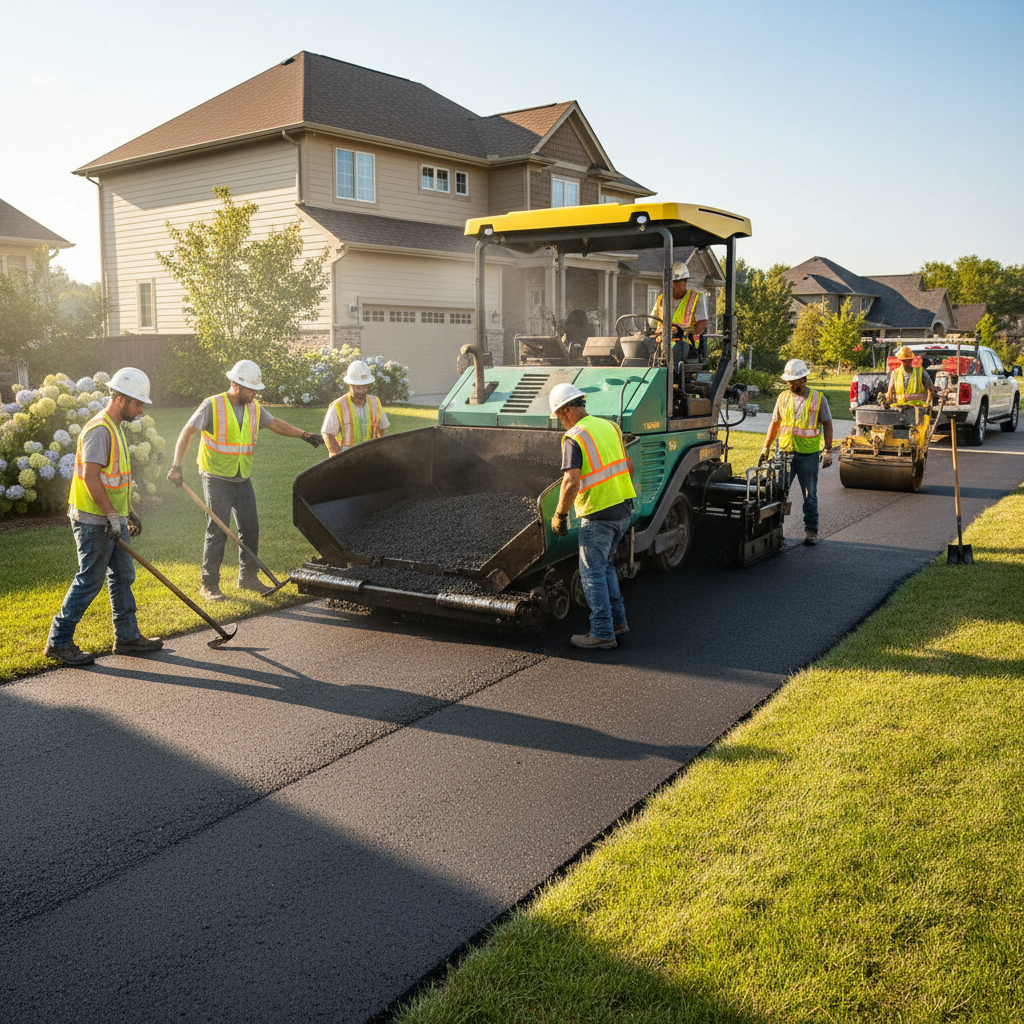
Driveway paving options and costs in University Heights
In University Heights, Alberta, homeowners typically choose between asphalt, interlocking concrete pavers, and poured concrete based on budget, appearance, and how they want the driveway to perform through Calgary-area freeze–thaw cycles. With a population of 2,965 (Statistics Canada, 2021 Census), it’s a small community where paving demand can spike quickly as the weather turns—especially around the busier residential pockets closer to the growth corridors in and around Rocky View County and nearby service areas. Most private driveways are attached to single-family homes, so driveway replacements and upgrades tend to be steady, repeatable work for local crews.
Calgary’s cold continental climate matters: frost can penetrate to about 1.2 m (4 ft), and that repeated freezing and thawing shifts water and soil under the pavement. The result is that contractors price deeper, well-compacted granular bases and stronger drainage details to prevent heaving, cracking, and raveling. Also, our paving season is short—most asphalt and concrete work has to happen from late spring through early fall when compaction and curing conditions are right—so spring scheduling pressure can increase labour and mobilization costs on smaller jobs.
If you’re comparing options, it helps to start with typical per-square-foot ranges and then adjust for your base, drainage, and tear-out. Use the table below as a planning baseline before you request an itemized quote.
| Material |
Lifespan |
Maintenance |
Best For |
Price per sq ft |
| Asphalt (new installation, proper base) |
15–25 years |
Sealcoat every 3–5 years; patching as needed |
Good value, smooth ride, common choice for Calgary-area driveways |
$12–$20 |
| Asphalt (overlay on existing gravel base) |
10–18 years |
Sealcoat every 3–5 years; more frequent patching than full rebuild |
Smaller budgets when base is still serviceable |
$10–$17 |
| Interlocking concrete pavers |
25–40 years |
Joint sand refresh; occasional panel reset |
Curb appeal and easier repairs without replacing the whole surface |
$18–$30 |
| Poured concrete (broom finish) |
20–30 years |
Minor crack repair; reseal if desired |
Low maintenance appearance with a solid, monolithic surface |
$15–$25 |
| Exposed aggregate concrete |
20–35 years |
Sealer typically every few years; crack repair as needed |
Improved traction and premium look |
$18–$28 |
| Gravel / crushed stone (budget option) |
3–10 years |
Top-ups, grading, weed control |
Short-term solution or where you need minimal upfront cost |
$6–$12 |
Prices are estimates only and vary by project scope, site access and material selection.
What affects the price of paving in University Heights
Even when two neighbours describe the “same” driveway, quotes in Calgary and the surrounding Alberta market can differ by 30–50%. The difference usually isn’t the asphalt or concrete itself—it’s the hidden work beneath it: base depth, compaction quality, drainage correction, and how much tear-out is required. Contractors also price for mobilization and crew efficiency during peak demand, since the paving season is compressed and frost-related risks are real.
In University Heights, frost line depth and freeze–thaw cycles are decisive cost factors. With frost penetration commonly reaching around 1.2 m (4 ft), the granular base must be deep enough to reduce subgrade movement; that means more imported aggregate, more lifts, and more compaction passes. If the job needs stronger, well-graded layers and positive drainage, you may see costs track toward the higher end of typical ranges—roughly $12–$20 per sq ft for new asphalt depending on base and site conditions.
Concrete can vary too. For poured concrete, air-entrained mixes and proper jointing are what help it survive Alberta winters; otherwise, freeze–thaw stresses show up as random cracking and surface breakdown. In practice, a driveway that needs regrading to shed water away from the house might push a concrete job closer to $15–$25 per sq ft, while a straightforward replacement on stable soil with good existing drainage can land nearer the lower end.
Two common University Heights examples: (1) if you have a low spot that ponded in spring, you’ll pay more for grading and drainage before any surfacing; (2) if your existing asphalt fails at the edges, you may need better edge restraint and base stabilization, not just “more asphalt on top.” Next, it’s worth mapping the main cost drivers in a clear, line-by-line way.
| Price Factor |
Why It Matters |
Cost Impact |
| Driveway area in sq ft |
Larger surfaces require more asphalt/concrete, base, and compaction time |
Major (typically the biggest portion of the quote) |
| Base depth required |
Frost line determines how much granular thickness you need to resist heaving |
High—can add significant material and labour |
| Grading and drainage work |
Slope corrections and drainage fixes prevent water from trapping under pavement |
Medium to high (often under-estimated) |
| Tear-out of existing surface |
Breaking and hauling concrete or old asphalt adds disposal and equipment time |
Medium to high depending on thickness and access |
| Edge restraints and curbing |
Prevents paver spread, asphalt edge raveling, and base washouts |
Medium (material + labour) |
| Sealing requirement |
Asphalt needs sealcoat after installation to extend service life in our winters |
Small upfront but important over lifecycle |
| Site access |
Narrow lots, long distances, and tight turns slow equipment movement |
Medium—crew time increases |
| Asphalt mix specifications |
Freeze–thaw-rated mixes cost more and may require specific scheduling |
Small to medium (but worth it for longevity) |
Permits & regulations in Alberta
For most University Heights homeowners, paving a private driveway on your own property typically does not require a building permit. The common exception is when the work affects municipal infrastructure or drainage in the municipal right-of-way—such as changes to a boulevard, new or altered curb cuts, or modifications to storm drainage connections. In those cases, you should expect municipal approval requirements before construction.
Here’s a practical way to think about it when you’re planning your project: work that stays entirely within your lot—like replacing the driveway surface, rebuilding the granular base on your property, or installing paver edges within your footprint—usually falls under homeowner/contractor scope without a permit. Work that touches the public realm—like altering the curb line, changing the drainage flow in the boulevard area, or making a new driveway access point—more often triggers approval steps.
Before excavation, make sure utilities are located. In Alberta, use Alberta One-Call (utility locates) to mark buried services. Then verify your contractor properly.
To verify an Alberta contractor, ask for three items and check them on paper and online: (1) Alberta licence status via the relevant registry/verification available for contractors in your category; (2) certificate of insurance showing general liability and the right limits for your job; and (3) WCB/WSIB coverage proof (Workers’ compensation coverage for the contractor and workers). If anything is unclear, request a clearance letter or current proof of coverage—good paving firms provide it without pushback.
Asphalt vs pavers vs concrete for University Heights driveways
In University Heights, the “best” driveway material depends on how you handle winter maintenance and how you want to repair problems later. Alberta’s freeze–thaw cycles (and the fact that frost can penetrate deep) punish weak bases and poor drainage—so the foundation matters as much as the surface. With that in mind, asphalt often wins for lowest upfront cost, but it’s a planned-maintenance material: seal it every 3–5 years to protect against moisture intrusion and raveling. For homeowners who use sand and plowing regularly, a properly sealed asphalt driveway can stay smooth and serviceable for many years.
Interlocking concrete pavers have the highest upfront cost in typical local pricing, but they’re also the most flexible for repairs: if a section fails due to localized base movement, it can often be lifted, re-levelled, and reset rather than replacing the entire driveway. That makes pavers a strong choice for neighbourhoods where soil conditions vary by lot. Their curb appeal is also excellent for street-facing homes.
Poured concrete sits in the middle cost-wise and can look great for a long time, but it is more sensitive to freeze–thaw damage if the mix isn’t properly air-entrained and if control joints and drainage aren’t done right. De-icing salt plus surface water can contribute to surface deterioration, so good curing and sealing decisions matter.
A simple dollar example: if your driveway estimate lands near $12–$20 per sq ft for asphalt, pavers might come closer to $18–$30 per sq ft. The extra cost is justified when you care about long-term appearance, want the option for localized repairs, or have a history of edge washout that paver restraints can better manage. Next, here’s a clear comparison for University Heights conditions.
| Material |
Frost Resistance |
Curb Appeal |
Repair Method |
Lifespan |
Price Band |
| Asphalt (sealed regularly) |
Good when base is deep/compacted and drainage is positive |
Medium (clean, dark finish) |
Patch/reseal; localized milling and resurfacing |
15–25 years |
$12–$20 |
| Interlocking concrete pavers |
Excellent when base is properly engineered and edges are restrained |
High (variety of patterns and colours) |
Lift-reset individual units or bands |
25–40 years |
$18–$30 |
| Poured concrete (air-entrained) |
Good with air-entrained mix, proper curing, and joints |
Medium to high (broom finish or decorative options) |
Crack repair and patch; sometimes slab replacement for major failure |
20–30 years |
$15–$25 |
| Exposed aggregate concrete |
Good when finished correctly and sealed on schedule |
Very high (textured, premium look) |
Patch and reseal; larger repairs are more involved than pavers |
20–35 years |
$18–$28 |
| Permeable pavers (drainage grid) |
Very good where designed for infiltration and underdrain use |
Medium to high (system look varies) |
Reset units; maintain drainage layer and geotextile |
25–40 years (if drainage is maintained) |
$22–$35 |
| Chip seal / tar-and-chip |
Moderate; performance depends heavily on base and surface prep |
Low to medium |
Spot chip repairs; eventual resurfacing |
8–15 years |
$10–$16 |
How to choose a paving contractor in University Heights
Choosing the right contractor makes the biggest difference in how your driveway performs through Calgary winters. Start by verifying three key items. First, Alberta licensing: ask for the contractor’s licensing/registration details relevant to their work and confirm they’re eligible to take on the scope you need. Second, liability insurance: request a certificate of insurance and ensure the coverage amount is appropriate for driveway work, including jobsite hazards. Third, confirm WCB/WSIB coverage: good paving firms provide proof for their employees and subcontractors (often as a clearance letter or updated coverage certificate). Don’t proceed if they can’t provide current documents.
Next, get 2–3 itemised written quotes—not a single lump-sum number. A real quote breaks down labour and materials: excavation, hauling/disposal, granular base thickness and lift compaction, geotextile (if needed), asphalt/concrete quantity, edge restraints/curb ties, and any finishing items like brooming, paver setting, or sealcoat. Make sure you understand what’s excluded: for example, permit pulling (if required for curb cuts), utility marking costs, and disposal fees.
For warranty, ask for both product/manufacturer warranty (if applicable) and workmanship warranty length. Ask whether it’s transferable if you sell your home. On payment, use a schedule where you never pay more than about 10–15% upfront; hold back the remainder until completion and cleanup.
Finally, timeline matters. Get a written start date and completion estimate tied to weather conditions—especially in spring and early fall, when contractor availability can change fast in the University Heights / Calgary market.
- Confirm Alberta licence/registration for the scope you’re hiring.
- Request a current certificate of liability insurance.
- Verify WCB/WSIB coverage with clearance letter or proof of coverage.
- Get 2–3 itemised quotes with labour + material breakdown (no “all-in” only).
- Ask for base specs: thickness, aggregate type, lift compaction method, and testing if offered.
- Check drainage plan: slope direction, catch details, and how water is kept away from the foundation.
- Confirm edge restraint method (paver edge supports or asphalt tie-in details).
- Clarify tear-out scope: include breaking, hauling, and disposal.
- Ask whether geotextile is included where soils are soft or variable.
- Confirm sealcoat timing for asphalt (typically after installation and once it’s ready) and who schedules it.
- Review warranty terms in writing, including workmanship and exclusions.
- Set payment schedule: maximum 10–15% upfront; holdback until final walkthrough.
Red flags I see in University Heights jobs: contractors who won’t show you base-depth details, quotes that ignore drainage/slope correction, “too-good-to-be-true” pricing with no breakdown of tear-out and disposal, refusal to provide proof of insurance/WCB coverage, and no clear start/finish dates tied to curing/compaction requirements.
Frequently asked questions — paving in University Heights
How often should I seal my asphalt driveway?
In University Heights and across the Calgary region, plan to sealcoat asphalt every 3–5 years, assuming the driveway was installed with a proper base and you maintain drainage. Sealing is what reduces moisture intrusion—especially important in our freeze–thaw climate where trapped water expands and stresses the pavement. If your driveway is brand new, many contractors recommend waiting until it’s fully ready for sealing (weather and curing dependent) rather than sealing too early. If you’re comparing budgets, sealing is usually a small part of the overall job cost versus replacing an asphalt surface. As a reference point, typical asphalt installations land around $12–$20 per sq ft, but lifecycle savings come from keeping the surface protected rather than waiting for widespread patching.
Why does my driveway crack and heave in winter?
Cracking and heaving are usually symptoms of water and frost working together. In this Calgary-area climate, frost can penetrate deeply, and repeated freeze–thaw cycles can lift or shift subgrade if the granular base isn’t thick enough, not well-graded, or not properly compacted. Poor drainage—like a driveway that sheds water toward the garage slab or into low spots—adds water that freezes under the asphalt or concrete. Edge failures are also common when restraints aren’t tight: as water collects and base material moves, the surface loses support and cracks open. If you’ve used heavy de-icing and the surface holds moisture, deterioration can speed up. The fix typically isn’t just patching; it usually requires correcting base support and drainage so the pavement stays stable next winter.
Do I need a permit to pave my driveway in Alberta?
In most cases in Alberta, paving your private driveway on your own property doesn’t require a building permit. However, if the work affects the municipal right-of-way—such as new or altered curb cuts, changes to boulevard landscaping, or adjustments to storm drainage—municipal approval may be required. University Heights homeowners often get tripped up when a driveway project also involves access changes at the curb or drainage tie-ins. Before the first scoop of gravel, confirm what portions of your scope stay within your lot versus what touches the boulevard or storm connection. Regardless of permits, utility locates are a must: use Alberta One-Call prior to excavation. When you request quotes, ask explicitly whether permit-related work is included (if applicable) and who is responsible for it.
How long before I can drive on new asphalt?
For asphalt in Alberta, the waiting period depends on how the mix was installed and weather conditions at the time of paving. Many crews target opening to light traffic after the asphalt has cooled and set, but you should follow the contractor’s written instruction—especially in colder or damp conditions near the end of the paving season. Immediately after placement, the surface is vulnerable to tracking and displacement until it cools. If you’re planning a driveway replacement in University Heights, coordinate timing so you’re not forced to park on the fresh mat before it’s ready. Your quote should specify curing/temperature expectations, and reputable installers will also explain how long to keep heavy vehicles off the surface. This is one reason scheduling within the late spring-to-early fall window matters—compressed season means they plan for workable conditions.
What causes potholes and how are they repaired?
Potholes form when water penetrates small failures in asphalt, then freezes and enlarges the damage under the surface. In freeze–thaw conditions around University Heights, a minor crack or edge breakdown can turn into a loss of base support. Vehicles then concentrate load on the weakened area, and the asphalt loses cohesion and “pops” out as a pothole. Repairs typically involve cutting out the failed asphalt to sound edges, removing any compromised material, adding and compacting new granular base (if needed), then replacing asphalt with proper tack and compaction. Some repairs are patch-and-level; others require a localized rebuild if the base has been washed out. If you’re seeing frequent potholes, ask for a drainage and base assessment—routine patching is often a band-aid.
How do I prepare for a paving project?
Before paving in University Heights, prepare both access and responsibilities. Clear vehicles, trailers, and fences near the driveway, and keep pets away during excavation and paving. Coordinate with your contractor on scheduling for utility locates via Alberta One-Call, so crews can safely excavate the full depth needed for the base. Decide whether you’ll need tear-out of existing asphalt or concrete—many bids include it, but confirm hauling/disposal and any backfilling. Ask for an itemised plan: base thickness, drainage changes, edge restraints, and finishing steps like brooming or sealcoat timing (for asphalt). Review the warranty and the payment schedule—good contracts usually limit upfront payment to about 10–15% and hold back until completion. Finally, plan for restricted driveway use during curing/setting, since Calgary-area conditions can shift quickly during the paving season.