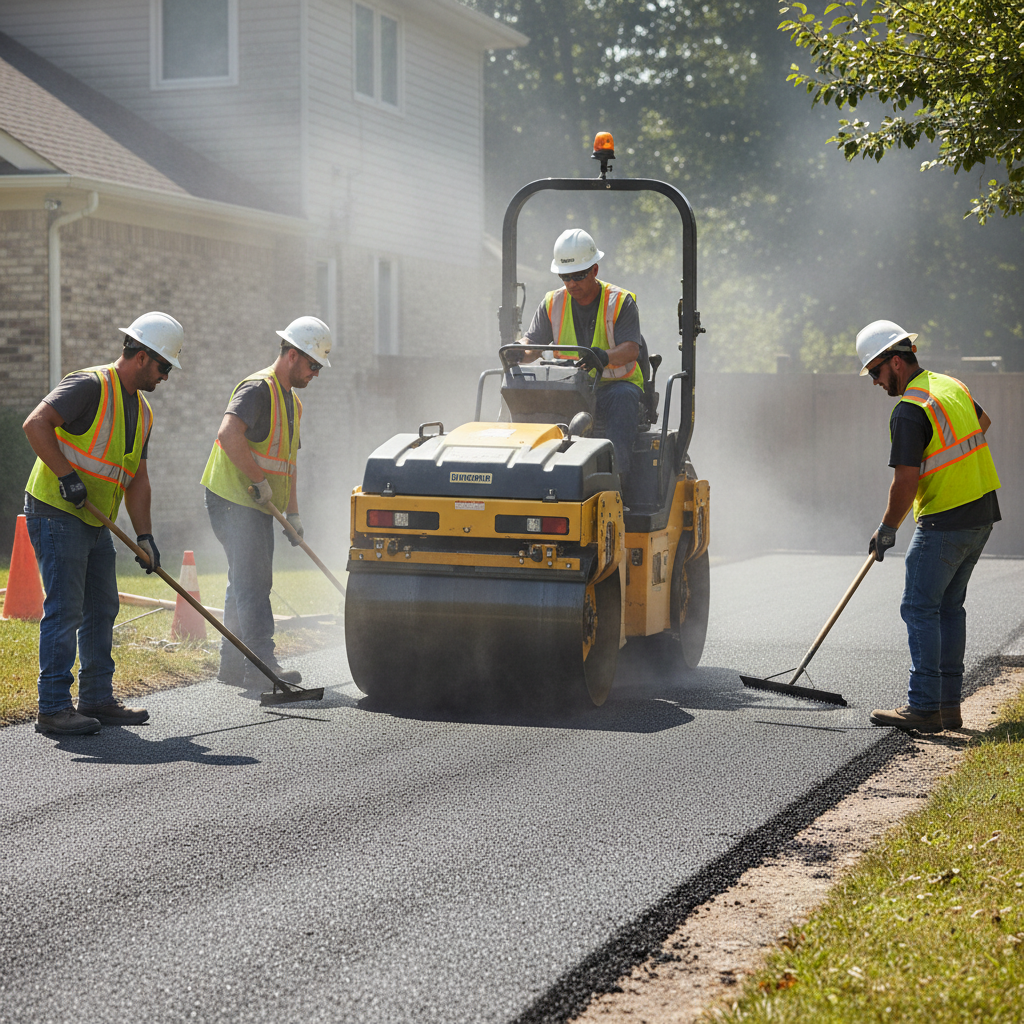
Driveway paving options and costs in Stony Plain
Stony Plain driveway paving comes down to picking the right surface for Alberta freeze-thaw, the look you want, and how much upfront work you’re willing to do on drainage and frost protection. With 17,993 people in the community (Statistics Canada, 2021 Census), most driveways are serving owner-occupied homes—about 73.0% of households own (Statistics Canada, 2021 Census). That matters because homeowners typically plan for a “set it and forget it” solution, especially where Stony Plain’s single-detached housing is common (58.1% of dwellings). Driveway upgrades are also in demand in established areas like the Downtown/Gateway corridor and along popular access routes where traffic, snowbanks, and ploughing push surfaces hard.
In the Edmonton economic region, costs are shaped less by asphalt alone and more by what’s underneath it. Central Alberta frost depth is commonly deeper (often around 1.5 metres or more), so contractors price in extra excavation, granular base thickness, and careful grading and drainage design to reduce heaving, cracking, and settlement. The paving season is shorter because hot-mix asphalt generally needs air temperatures above about 10°C, so scheduling and mobilization premiums can show up in spring and early summer.
Below is a practical comparison of common driveway materials—using the regional price bands you’ll see for Stony Plain—then we’ll break down what drives individual quotes.
| Material |
Lifespan |
Maintenance |
Best For |
Price per sq ft |
Price Range |
| Asphalt (new installation, proper base) |
15–25 years |
Seal every 3–5 years; patch minor raveling promptly |
Cost-effective, smooth ride, good value with the right base |
$3.50–$7.00 |
$7,000–$15,000 |
| Asphalt (overlay on existing gravel base) |
12–20 years |
Seal schedule similar to full installs; watch for weak subgrade |
When excavation is limited and the base is stable |
$3.00–$6.50 |
$6,000–$13,500 |
| Interlocking concrete pavers |
25–40 years |
Re-level sand joints as needed; isolated repairs are straightforward |
Premium appearance and flexibility to repair without full replacement |
$8.00–$14.00 |
$12,000–$28,000 |
| Poured concrete (broom finish) |
20–30 years |
Occasional crack monitoring and patching; seal selectively if desired |
Durability and a clean, straightforward look |
$7.00–$12.50 |
$9,000–$22,000 |
| Exposed aggregate concrete |
20–30 years |
Seal/enhance finish periodically if you want maximum stain resistance |
Better traction and upscale curb appeal |
$8.50–$14.50 |
$11,000–$26,000 |
| Gravel / crushed stone (budget option) |
5–12 years |
Top up seasonally; regrade after freeze-thaw and plowing |
Lower first cost, short-term solution, flexible layout |
$2.00–$4.50 |
$2,500–$7,500 |
Prices are estimates only and vary by project scope, site access and material selection.
What affects the price of paving in Stony Plain
In Stony Plain and the wider Edmonton area, two quotes for “the same driveway” can differ by 30–50% because the biggest costs are often the things you can’t see: frost protection, drainage, and how much demolition is needed. Asphalt or pavers themselves are a portion of the total; the rest is excavation, hauling, compacted granular base, and time-sensitive compaction. In colder Alberta conditions, contractors also account for freeze-thaw cycling: water trapped in weak base or poor drainage expands when frozen, then loosens the structure during thaw. That risk pushes bids upward when the existing grade is off or when contractors anticipate rebuilding the base rather than simply overlaying.
Another driver is timing and mix design. Asphalt paving generally requires warm conditions (air temperatures often above 10°C), so the workable window is narrower in central Alberta than in milder regions. That concentrates demand and can raise labour and mobilization premiums. Edmonton-area bids frequently also reflect freeze-thaw-rated mix requirements—costs rise when the job demands a higher-performance asphalt or additional binder/filler specs.
Local concrete pricing can swing too. For example, a driveway poured over a compromised subgrade may require deeper base restoration before any concrete goes down—pushing concrete closer to the upper end of the $9,000–$22,000 band. Conversely, an asphalt replacement with excellent drainage and a well-compacted granular base can land nearer the lower part of the $7,000–$15,000 range because less corrective work is needed. For homes built before 1981 (22.1% of dwellings), it’s also common to find older drainage patterns and settled approaches that require more grading, which shows up in the excavation line items.
| Price Factor |
Why It Matters |
Cost Impact |
| Driveway area in sq ft |
Most labour and material scale directly with surface area |
Can swing the total by 40–70% |
| Base depth required |
Frost depth drives granular thickness and compaction effort |
Often adds 15–35% vs. “thin base” assumptions |
| Grading and drainage work |
Proper slope and ditch/culvert connections reduce water pooling |
Typical +10–25% if drainage corrections are needed |
| Tear-out of existing surface |
Breaking, removal, and disposal are labour-heavy in winter-adjacent conditions |
Can add +10–30% depending on thickness |
| Edge restraints and curbing |
Controls paver movement and helps asphalt transitions stay tight |
+3–15% based on layout complexity |
| Sealing requirement |
Asphalt needs a seal after early cure (often within months) and then periodically |
+1–8% for the immediate scope; more over time |
| Site access |
Narrow lots slow equipment and can require smaller lifts/extra labour |
+5–20% if machine access is limited |
| Asphalt mix specifications |
Freeze-thaw-rated mixes can cost more and require correct placement conditions |
+5–15% for upgraded mix/binder specs |
Permits & regulations in Alberta
In Alberta, paving a private driveway within your own property usually doesn’t require a building permit. Where permits/approvals often come into play is when you work in the municipal right-of-way—typically the area between your property line and the roadway—or when you change how storm drainage functions. In practice for Stony Plain, the work that commonly does require municipal approval includes: new or altered curb cuts/approaches, modifications to boulevard drainage, changes to storm lines or catch basins near the approach, and any grading or works that affect municipal drainage patterns. Some municipalities also have lot-grading requirements that restrict how close a hard surface can be to property lines or how runoff must be managed, so it’s worth confirming those rules before excavation.
Step one for a homeowner is always utility locates. In Alberta, you (or your contractor) should arrange Alberta One-Call locates before digging to protect gas, power, and telecom services. Step two is confirming the contractor’s Alberta standing and insurance: ask for their Certificate of Insurance (liability) and their workers’ compensation clearance letter (commonly issued through WCB) if they employ workers. For licensing, check the contractor’s registration status through the appropriate Alberta business/contractor listings (and verify that the company who appears on the quote is the same entity providing the work). Finally, keep a paper trail: written scope, start date, warranty terms, and disposal plan.
Asphalt vs pavers vs concrete for Stony Plain driveways
For Stony Plain’s freeze-thaw winters, the best driveway choice depends on how you maintain it and how much you value easy repairs versus a smooth, low-maintenance surface. Asphalt is usually the lowest upfront option (often within the $7,000–$15,000 band when the base is built correctly) and gives a neat, uniform finish. The trade-off is maintenance: sealing typically every 3–5 years helps protect the binder from water and oxidation, which matters because Alberta winters drive moisture into the pavement edges and joints. Interlocking concrete pavers cost more (commonly $12,000–$28,000), but they’re highly repairable—if a spot settles or you need utility access, contractors can lift and re-set individual sections instead of removing and repaving the entire driveway. Poured concrete sits in the middle on price (often $9,000–$22,000), but it can crack under freeze-thaw if the base, subgrade, or air-entrainment isn’t handled correctly.
Edmonton-area frost protection requirements (commonly deeper than southern Alberta) mean all three options depend on a stable, well-graded granular base and a drainage plan that prevents water pooling. In winter maintenance, ploughing and sand/salt can punish exposed edges and weak joints. Where pavers shine is traction and the ability to restore sections without full replacement. A concrete driveway can perform very well too—if it’s air-entrained and properly detailed for Alberta conditions.
Example: If you’re choosing between asphalt and concrete on a 700 sq ft driveway, the price gap might be roughly a few thousand dollars—say asphalt near the mid-range and concrete toward the higher end—yet the extra cost is only justified if you want a longer “hands-off” lifespan and are confident you’ll get excellent drainage and air-entrainment. If your priority is budget with predictable maintenance, asphalt with proper base prep is often the smartest fit.
| Material |
Frost Resistance |
Curb Appeal |
Repair Method |
Lifespan |
Price Band |
| Asphalt (sealed regularly) |
Good with correct base + drainage; seal reduces moisture damage |
Medium (clean, uniform look) |
Patch and re-seal localized failures |
15–25 years |
$7,000–$15,000 |
| Interlocking concrete pavers |
Very good; tolerates minor movement better if base is engineered |
High (design, colours, borders) |
Lift, replace and re-level individual pavers |
25–40 years |
$12,000–$28,000 |
| Poured concrete (air-entrained) |
Good when air-entrained and built over a stable base |
Medium to high (finish options) |
Crack patching; limited sectional repairs |
20–30 years |
$9,000–$22,000 |
| Exposed aggregate concrete |
Good if properly finished and cured; traction is a plus in Alberta ice |
Very high (textured, upscale) |
Targeted patching; colour-match can be limited |
20–30 years |
$11,000–$26,000 |
| Permeable pavers (drainage grid) |
Excellent moisture management when installed with correct layers |
High (unique look) |
Replace grid/pavers if sediment clogs or units fail |
20–35 years |
$14,000–$32,000 |
| Chip seal / tar-and-chip |
Variable; depends heavily on base and binder selection |
Low to medium (rugged surface) |
Spot repair possible; full refresh sometimes required |
7–15 years |
$6,000–$14,000 |
How to choose a paving contractor in Stony Plain
Choosing the right paving contractor in Stony Plain is mostly about proof: licensing/registration where applicable, insurance, and how clearly they build frost-protection details into your quote. Start by requesting their liability insurance Certificate of Insurance, then confirm they have workers’ compensation coverage via a WCB clearance letter (if they employ workers). Next, verify the contractor’s Alberta registration and business identity—match the quote, contract, and insurance certificate to the same legal company name. If anything is vague (or they won’t provide documents), that’s a strong warning sign.
Get 2–3 itemised written quotes that separate labour and materials, not just a lump sum. Ask what’s included in the scope: excavation depth, base build (including granular material and compaction method), drainage corrections, demolition/disposal, and whether edge restraints are included. Confirm if permits/municipal approvals are included when required (such as curb cut or right-of-way changes). Review the warranty: workmanship coverage length, product/manufacturer warranty (and whether it’s assigned to you or transferable if you sell the home). Finally, payment should protect you—never pay more than 10–15% upfront, and hold back a portion until the job is completed and inspected.
Also lock in timing: request a written start date and completion estimate. In central Alberta, delays can happen when early-season weather doesn’t cooperate, but reputable crews communicate changes quickly and document them.
- Request insurance documents before signing: liability certificate and WCB clearance letter.
- Confirm the company name on the quote matches the insured legal entity.
- Ask for at least one project reference in the Edmonton/Stony Plain area (photos are fine, site visits are better).
- Get an itemised quote: labour, base material, asphalt/concrete, pavers, edging, and drainage.
- Confirm demolition scope (how much is removed) and disposal included or not.
- Verify base build specs: excavation depth, granular type, and compaction requirements.
- Require a drainage plan: slope direction, ditch/culvert ties, and how water won’t pond.
- For asphalt: confirm tack coat and seal timing, including the plan for first-year sealing.
- For concrete: confirm air-entrainment and joint/crack-control approach.
- For pavers: confirm edging restraints, bedding sand type, and joint sand specification.
- Ask about weather triggers for asphalt/concrete and what happens if it can’t be paved.
- Write warranty terms into the contract (duration, exclusions, and what’s covered).
Red flags in Stony Plain include: refusing to provide insurance/WCB clearance documentation, quoting without measuring driveway area or discussing base/drainage depth, offering a “cheap overlay” when the subgrade is unstable, using vague warranties (“materials only” or “no responsibility”), and asking for large upfront payments with no detailed contract or start date.
Frequently asked questions — paving in Stony Plain
Asphalt vs interlocking pavers vs concrete — which is best in Stony Plain?
In Stony Plain and the broader Edmonton area, asphalt is often best when you want the lowest upfront cost and can commit to regular maintenance. When the base is built properly for frost protection, asphalt typically lands in the $7,000–$15,000 band and can last 15–25 years with sealing every 3–5 years. Interlocking concrete pavers usually cost more (often $12,000–$28,000) but they’re easier to repair if a small section settles—important in freeze-thaw cycles. Poured concrete (often $9,000–$22,000) performs very well when it’s air-entrained and installed over a stable, well-graded base with correct slope and drainage. For many homeowners, the “best” choice is the one matched to your site drainage and base condition, not just the surface material.
How long does a paved driveway last in Stony Plain?
Typical service life in Stony Plain depends on frost-protection depth and how well water is managed away from the driveway. Asphalt on an engineered base commonly lasts 15–25 years, provided you seal it after the first cure period and then re-seal every 3–5 years. Interlocking pavers often last 25–40 years because repairs are local and small movements can be re-levelled by topping joint sand or re-setting sections. Poured concrete generally lasts about 20–30 years when air-entrained and detailed with joints or crack-control appropriate for Alberta freeze-thaw. Homes built earlier (22.1% of dwellings were built before 1981, Statistics Canada, 2021 Census) sometimes need more base correction because drainage patterns and grades can have settled—extending that early work is what prevents premature failures.
When is the best time of year to pave in Stony Plain?
For Stony Plain, the best paving window is late spring through summer when the ground is stable and temperatures allow proper placement. Asphalt generally needs warm enough air temperatures for the mix to be placed and compacted correctly (often above about 10°C). If you pave too early and the base is still holding moisture or the air is too cold, you can get weak compaction and faster deterioration. Concrete can be poured in colder conditions with proper protection, but crews still prefer weather that won’t disrupt curing. In Edmonton-area scheduling, spring weather can also compress timelines—so reserving your spot early often helps. A good contractor will coordinate prep (excavation and base compaction) first, then pave when conditions are right, not just “whenever equipment is available.”
How deep should the base be for Stony Plain's frost?
Base depth isn’t one fixed number for every lot in Stony Plain—it’s determined by subgrade condition, drainage, and frost depth guidance for central Alberta. Edmonton-area construction practices often plan for deeper frost protection (commonly around 1.5 metres or more), meaning contractors typically build a thicker, well-compacted granular base and ensure the subgrade is properly graded and drained. A reputable contractor will inspect your existing subbase, evaluate whether you need full tear-out or partial correction, and then propose a granular structure depth appropriate to the job. If your driveway is on weaker or poorly drained soil, you should expect deeper excavation and additional drainage stone rather than a thin “patch-and-go” approach.
How often should I seal my asphalt driveway?
Asphalt sealing in Alberta is usually a maintenance rhythm, not a one-time step. After a new asphalt install, many contractors recommend sealing once the surface has cured—commonly after the initial season—then re-sealing every 3–5 years depending on traffic, ploughing/sand exposure, and how much water gets to the edges. Sealing helps slow moisture penetration that accelerates raveling and binder aging during Edmonton-area freeze-thaw cycles. If your driveway sees heavy salt or constant snow management, plan on the shorter end of the interval. If you’re evaluating quotes, ask whether the contractor includes the initial seal in the contract. Sealing and repair services are often priced in a separate band, commonly $600–$3,500 depending on driveway size and condition.
Why does my driveway crack and heave in winter?
Cracking and heaving usually point to water and frost working together. In Stony Plain, freeze-thaw cycling expands water trapped in the pavement layers or weakens the structure after thaw. Common causes include an insufficient granular base, poor grading that allows water to pond, missing or inadequate drainage, and edges that don’t have proper restraint. Older driveways—especially on lots where grades have shifted over time—may also have accumulated settlement that lets water find low spots. Another contributor is incorrect or inconsistent compaction during installation; even small voids can become water pathways. If you see heaving at the same spots each winter, it’s usually a sign the base structure or drainage needs correction, not just cosmetic patching.