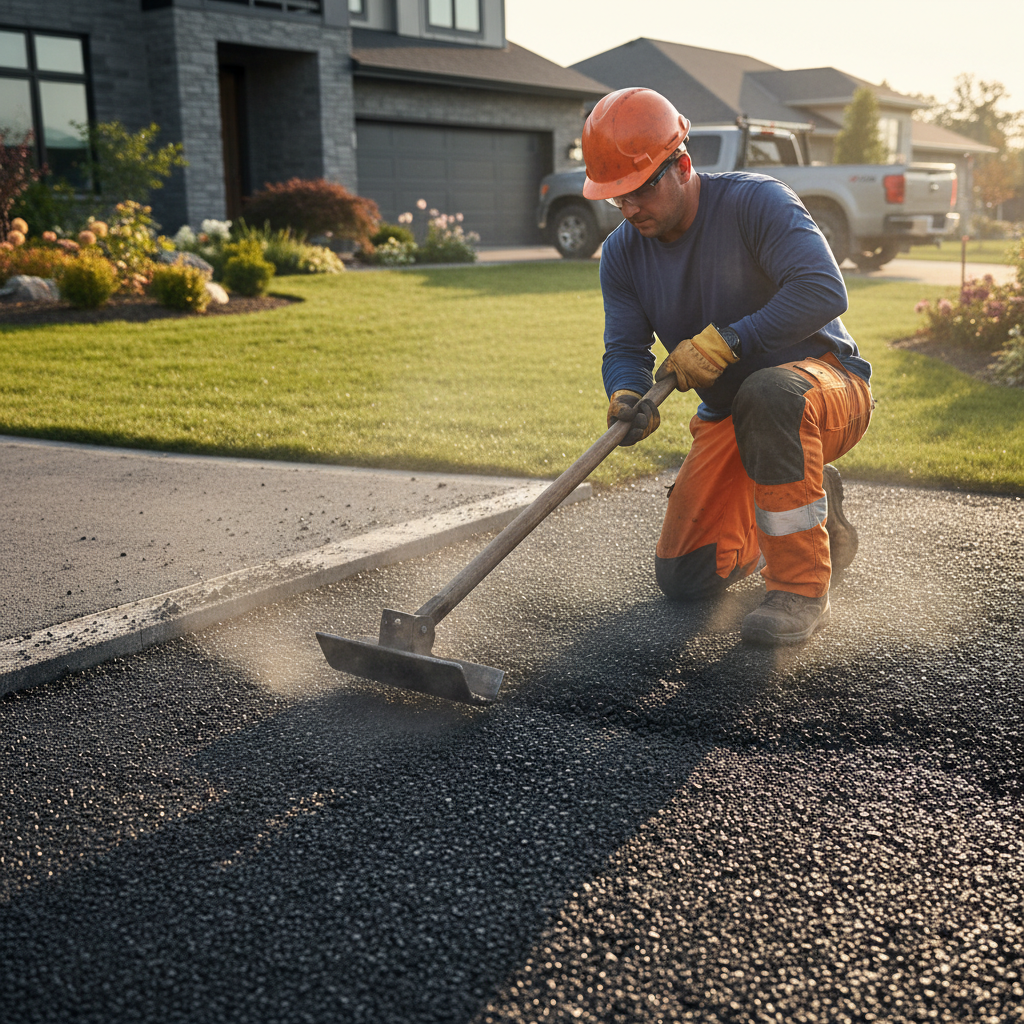
Driveway paving options and costs in Crossfield
Crossfield homeowners typically start by comparing driveway paving options that match how their place is set up and how winter behaves on the prairies. With roughly 1,105 homeowner households in Crossfield (83.1% of households own) and single-detached homes making up 78.2% of dwellings (Statistics Canada, 2021 Census), most driveways are tied to private detached properties—so access, drainage, and edge support matter a lot in the final result. In the Calgary region, frost routinely penetrates deep (about 1.2 m), and freeze–thaw cycles can move moisture in and out of the subgrade. That’s why asphalt and concrete quotes aren’t “one price fits all”: contractors often need thicker, well-graded granular bases and more attention to slopes and runoff, which increases both materials and labour.
Demand also peaks during the short paving season, when air temps are suitable for compaction and curing. In practical terms, late spring through early fall is when most installs and overlays can be scheduled, and that scheduling pressure can raise per-project costs—especially for smaller jobs. For Crossfield, we see steady demand in areas like the newer residential pockets along the southern edge, where homeowners are refreshing driveways as landscaping and grade work gets finalized.
Below is a clear comparison of typical lifespan, maintenance, and price ranges you’ll see for driveways in Crossfield and the broader Calgary area, assuming proper base preparation and normal residential vehicle loads—then we’ll break down what drives the biggest quote differences.
| Material |
Lifespan |
Maintenance |
Best For |
Price per sq ft |
Price Range |
| Asphalt (new installation, proper base) |
15–25 years |
Seal coat every 3–5 years |
Best value for a smooth, quiet surface |
$3.00–$6.50 |
$12,000–$20,500 |
| Asphalt (overlay on existing gravel base) |
10–18 years |
More frequent sealing; monitor settlement |
Budget-focused improvement with improved base |
$2.60–$5.50 |
$9,500–$16,000 |
| Interlocking concrete pavers |
25–40 years |
Weed control; re-leveling of individual stones if needed |
Curb appeal and easier spot repairs |
$5.00–$10.50 |
$18,000–$33,500 |
| Poured concrete (broom finish) |
20–30 years |
Joint sealant as required; periodic wash |
Low-maintenance look with strong durability |
$4.50–$9.00 |
$16,000–$28,500 |
| Exposed aggregate concrete |
20–35 years |
Reseal occasionally for best appearance |
Slip-resistant finish and upgraded appearance |
$6.00–$12.00 |
$22,000–$40,000 |
| Gravel / crushed stone (budget option) |
5–10 years |
Re-grade and top up annually; weed control |
Temporary solution or drainage-friendly base |
$1.50–$3.50 |
$5,500–$10,500 |
Prices are estimates only and vary by project scope, site access and material selection.
What affects the price of paving in Crossfield
In Crossfield (and the wider Calgary market), you can see the same driveway paving scope come back with bids that differ by 30–50%. The biggest reason is that “driveway paving” isn’t just laying asphalt or concrete—it’s the engineered base, drainage correction, and how much existing material has to be removed or rebuilt to handle freeze–thaw. In a cold continental climate with frost penetration around 1.2 m, the depth and quality of the compacted granular base become decisive cost drivers. Deeper frost and longer freeze–thaw cycles mean contractors often need thicker base sections and well-graded aggregates to prevent heaving and cracking. If drainage is off—even slightly—water can move under the surface during spring melt, which can shorten asphalt life and force earlier maintenance.
Scheduling pressure also plays a role. Hot-mix asphalt placement typically needs air temperatures above 10°C, so the effective work window is tight. When the season is busy, mobilization time and crew availability can raise labour costs, especially for smaller projects that still require the same truck rolls and equipment setup. For asphalt, mix design matters too: freeze–thaw-rated asphalt is not “just any mix,” and that can shift the price toward the higher end of common Calgary ranges such as $12,000–$20,500 for a new installation depending on area and base requirements.
Concrete can shift upward or downward based on site conditions. For example, a yard with stable, easy-to-excavate soil may keep poured concrete closer to the $16,000–$28,500 band, while a driveway over saturated subgrade often needs more base rebuild and sub-drain work. Likewise, older homes built before 1981 (25.9% of homes in the Crossfield profile) often have older drainage patterns and settled approaches that can add tear-out and regrading cost.
| Price Factor |
Why It Matters |
Cost Impact |
| Driveway area in sq ft |
Most material and production time scales directly with square footage |
Highest impact; can swing the quote by thousands |
| Base depth required |
Frost requires thicker, well-compacted granular layers to reduce heave |
Major impact when deeper rebuild is needed |
| Grading and drainage work |
Proper slope and positive drainage reduce water pumping in winter |
Can add days of excavation and re-compaction |
| Tear-out of existing surface |
Breaking concrete or old asphalt and hauling debris takes labour and equipment |
Medium to high impact |
| Edge restraints and curbing |
Prevents paver spread and keeps asphalt edges from failing early |
Medium impact; essential for longevity |
| Sealing requirement |
Asphalt needs seal coating to protect against oils, water, and oxidation |
Low upfront, ongoing lifecycle cost |
| Site access |
Narrow approaches slow trucks, reduce equipment productivity |
Medium impact in tight lots |
| Asphalt mix specifications |
Freeze–thaw-rated mix design can cost more but performs better locally |
Medium impact; tied to climate performance |
Permits & regulations in Alberta
For paving a private driveway on your own property in Crossfield, Alberta work typically does not require a building permit when you’re staying within your lot and not altering municipal infrastructure. Where permits and approvals do come into play is when the work affects the municipal right-of-way—think new curb cuts, changes to boulevard grading, or adjustments that impact storm drainage flow toward the road. If your driveway ties into drainage infrastructure or you need any work in the boulevard area, the municipality may require approval before construction begins.
Regardless of permit requirements, call for utility locates before excavation. Alberta One-Call helps coordinate the location of buried services so excavators don’t hit lines. Then, confirm whether any lot-grading rules apply (many communities restrict how close hard surfaces and drainage tie-ins can be to property lines, and they may have requirements for maintaining natural runoff patterns).
To verify your contractor before signing, follow these steps:
- Check the contractor’s Alberta business registration/licensing status (ask for the registration details and verify online).
- Request a current certificate of insurance showing general liability and ensure the coverage matches the project scope.
- Confirm the contractor’s worker coverage—WSIB/WCB status should be provided and current.
- Ask for the clearance letter or proof document they use for compliance, and keep a copy for your records.
- Make sure the contract clearly states what’s included (base depth, drainage corrections, disposal) and who is responsible if unmarked services are encountered.
Asphalt vs pavers vs concrete for Crossfield driveways
When you’re choosing between asphalt, interlocking pavers, and concrete in Crossfield, you’re really choosing how you want to manage freeze–thaw stress, winter maintenance, and repairs over time. Asphalt usually offers the lowest upfront cost and a smooth ride, but it is a maintenance material: it needs seal coating every 3–5 years to protect against water intrusion and oxidation. In Calgary’s cold climate, the best-performing asphalt jobs still depend on a thicker, properly compacted granular base and positive drainage. Without that, water expansion during freeze–thaw can lead to surface raveling and cracking.
Interlocking pavers have the highest curb appeal and offer the most flexible repair method. If a section settles, pavers can be lifted and re-laid without tearing up the entire driveway, which matters if your subgrade has variable soils or if you’ve had previous work near the edges. The trade-off is higher upfront cost; you’re paying for blocks, restraints, bedding sand, and labour. Poured concrete is mid-range cost and durable, but in freeze–thaw conditions it must be air-entrained and well jointed to control cracking. Salt and repeated plowing can accelerate wear at the edges and joints if the design isn’t right.
To see where price differences are justified: if an asphalt driveway is returned at roughly $12,000–$20,500 for a properly based installation, moving to pavers at about $18,000–$33,500 can be worth it when you want long-term curb appeal and the ability to repair localized areas after winter damage. If your priority is “install once and maintain minimally,” air-entrained concrete can be a strong option—provided drainage and base thickness are engineered for Calgary’s frost behaviour.
| Material |
Frost Resistance |
Curb Appeal |
Repair Method |
Lifespan |
Price Band |
| Asphalt (sealed regularly) |
Good with thick base and drainage; medium without seal maintenance |
Low to moderate |
Mill and overlay or patch localized failures |
15–25 years |
$12–$20 / sq ft |
| Interlocking concrete pavers |
Excellent where base and bedding are properly built |
High |
Lift and re-lay individual units or small sections |
25–40 years |
$18–$30 / sq ft |
| Poured concrete (air-entrained) |
Good with air-entrainment and correct jointing |
Moderate |
Patch at cracks; section repair in severe cases |
20–30 years |
$15–$25 / sq ft |
| Exposed aggregate concrete |
Good with proper mix and base; slip-resistant surface helps in winter |
High |
Limited; typically patch/replace affected areas |
20–35 years |
$20–$35 / sq ft |
| Permeable pavers (drainage grid) |
Very good for managing water where soils cooperate |
High (modern look) |
Repair by lifting sections; clean-out of drainage channels if needed |
20–35 years |
$25–$40 / sq ft |
| Chip seal / tar-and-chip |
Fair to good; more sensitive to proper base and seasonal wear |
Low to moderate |
Spot patching and re-chip cycles |
8–15 years |
$10–$16 / sq ft |
How to choose a paving contractor in Crossfield
Start by verifying the basics. In Alberta, you should ask every contractor for (1) proof of their business registration/licensing status, (2) a current certificate of insurance for general liability, and (3) coverage for workers—WSIB/WCB—if they employ or subcontract labour. Don’t rely on a verbal “we’re covered.” Look for the certificate details, confirm dates are current, and ensure the insured party and project location match. If they’re hesitant to provide documents, that’s a warning sign.
Next, get 2–3 itemised written quotes that break down labour and materials—especially base preparation (excavation depth, aggregate type, compaction method), drainage corrections, and haul/disposal. A lump-sum quote without line items makes it hard to compare apples to apples. Also check the scope for exclusions: is permit work included if it’s needed for right-of-way changes? Is tear-out disposal included? Who handles reinstating sod/landscaping at edges?
Warranty and payment terms matter. Ask for a workmanship warranty length in writing, and whether any manufacturer product warranty applies to the installed system (and if it’s transferable to future owners). For payment scheduling, never pay more than about 10–15% upfront; keep a holdback until the final grading and cleanup are confirmed. Finally, insist on a written timeline: target start date and estimated completion, because the paving season is limited and weather can shift schedules.
- Request Alberta insurance proof (certificate of insurance) before work begins.
- Confirm WSIB/WCB coverage and ask for the clearance letter or equivalent documentation.
- Verify the contract includes base depth and drainage scope—not just “pave the driveway.”
- Ask what happens if additional excavation is required after utility locates.
- Ensure disposal and hauling are explicitly included (and not “as available”).
- Confirm edge restraints/curbing details for pavers and asphalt edges.
- For asphalt, ask when seal coating is scheduled and whether it’s recommended after 6–12 months.
- Check that concrete is specified air-entrained and jointing is included.
- Request material specifications for the mix/aggregate, not just brand names.
- Get the warranty in writing with clear coverage boundaries and exclusions.
- Set payment milestones tied to inspection points, not only “percentage done.”
- Get a start date and completion estimate in writing, with weather contingencies.
In Crossfield, four–five common red flags include contractors who (1) won’t show insurance/WSIB/WCB documentation, (2) quote without describing base depth and drainage, (3) offer unusually low pricing without explaining how frost and freeze–thaw are addressed, (4) pressure you to pay most of the job upfront, and (5) provide a vague timeline with no weather/curing plan—especially important in Calgary’s short asphalt season.
Frequently asked questions — paving in Crossfield
When is the best time of year to pave in Crossfield?
For Crossfield, the best time is late spring through early fall, when soil temperatures are warm enough for proper excavation, subgrade prep, and reliable compaction. Asphalt placement generally needs air temperatures above about 10°C, so contractors often schedule weather-dependent start dates once consistent daytime warmth returns. In a cold continental climate with deep frost (around 1.2 m), doing paving too late can trap moisture or prevent adequate curing, which increases the risk of early cracking and raveling. If you’re planning seal coating, most crews recommend waiting after the initial install for the asphalt to cure—then sealing in the following season window (often within a 6–12 month timeframe) helps performance through Calgary winters.
How deep should the base be for Crossfield's frost?
Base depth in Crossfield is driven by frost penetration and local soil conditions—not just a single “standard number.” Because frost in the Calgary region can penetrate to roughly 1.2 m, installers need an engineered approach using thicker, well-graded granular layers and careful compaction to reduce subgrade movement. In practice, many driveway reconstructions end up needing deeper granular bases and better drainage than what you’d assume in milder regions. If a contractor only talks about surface thickness (asphalt inches or concrete thickness) but doesn’t discuss excavation depth, aggregate grading, and drainage, that’s a gap in the quote. A well-built base is one reason a properly based asphalt driveway commonly lands in the $12,000–$20,500 range.
How often should I seal my asphalt driveway?
For a typical asphalt driveway in Crossfield, sealing is commonly recommended every 3–5 years, depending on sun exposure, traffic, and how often water sits on the surface. If drainage slopes are correct and you maintain edges, sealing helps keep moisture out of the pavement and slows oxidation. A crucial local detail: don’t seal too early—many contractors wait until the asphalt has cured, often after 6–12 months—before applying a quality seal coat. Salt and sand from winter maintenance can wear the surface faster at the entrance and edges, so if your plow route hits the same lines each storm, you may see earlier need for touch-ups. If you’re budgeting for lifecycle costs, plan the seal coat as part of keeping performance and appearance.
Why does my driveway crack and heave in winter?
Cracks and heaving are usually symptoms of water and frost working together on the wrong conditions. In Crossfield’s freeze–thaw climate, moisture that migrates into the subgrade can expand during freezing, pushing up pavement and creating cracks. Common causes include insufficient granular base depth, poor compaction, weak or improperly graded aggregates, and drainage that allows water to pool at the surface or edges. Edge restraint issues can also let the surface move more than intended, especially on paver or asphalt borders. If your driveway was installed over an older base or over areas that settled after lawn irrigation, that can make winter movement worse. The fix is almost always tied to base and drainage design; patching cracks without addressing water control can be a short-term solution only.
Do I need a permit to pave my driveway in Alberta?
In most cases, paving your private driveway within your own property in Alberta typically does not require a building permit. However, permits or approvals may be required if the work affects the municipal right-of-way—such as new curb cuts, changes to boulevard grading, or alterations that impact storm drainage. Because Crossfield’s drainage patterns and how a driveway ties into the road matter, it’s smart to ask your contractor to confirm whether any right-of-way work is involved before they schedule excavation. Also remember the practical compliance step: you should call for utility locates (Alberta One-Call) prior to digging. If your scope is purely on-lot resurfacing or full replacement with no right-of-way changes, you’ll usually be in the “no permit needed” category—still confirm based on your exact site.
How long before I can drive on new asphalt?
After asphalt paving in Crossfield, the driveway is usually ready for light vehicle traffic relatively quickly, but the exact “drive-on” time depends on mix, weather, and whether tack coat and compaction were done properly. Many crews control traffic immediately after placement to prevent tire marks and displacement. Asphalt needs time to cool and set; if it’s too hot or if the surface isn’t fully compacted, tire loads can create permanent deformation. A colder day or damp conditions can extend the wait. To avoid damage, ask your contractor for the specific cure/traffic guidance for your job and follow their instructions on turning/weight limits. For lifecycle planning, also remember that sealing is typically scheduled later—often after 6–12 months—once the asphalt has cured and stabilized.