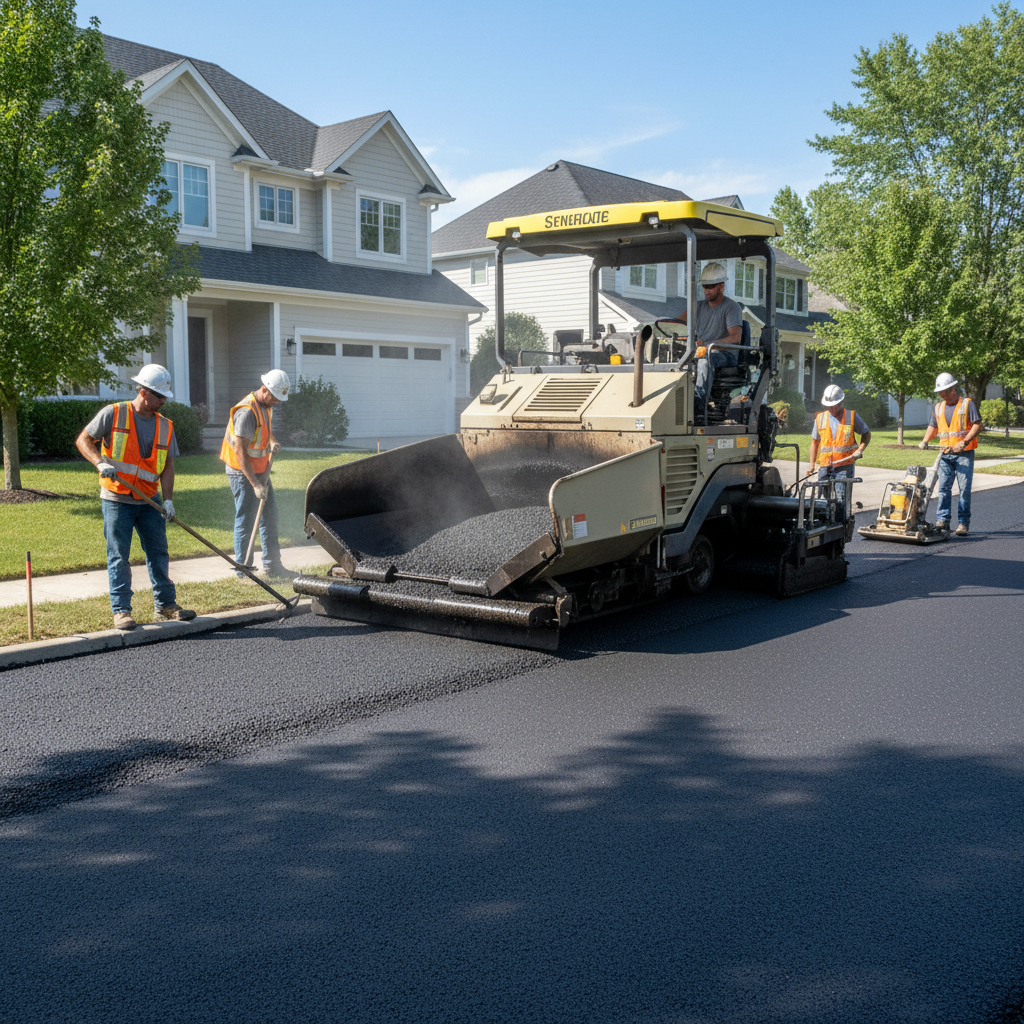
Driveway paving options and costs in Falconridge
In Falconridge, Alberta, homeowners typically compare driveway paving options based on upfront cost, winter durability, and how much disruption they can tolerate during the short paving season. With a 2021 population of 10,325 residents (Statistics Canada, 2021 Census), this community sits in the Calgary region where demand for driveways and upgrades spikes in late spring to early fall. Most private driveways here are tied to single-detached housing, and that means contractors often see a lot of similar-sized jobs—yet pricing still varies because sites differ in soil, drainage, and access.
Calgary-area frost routinely penetrates the ground to about 1.2 m (4 ft), and freeze–thaw cycles can push water and fine soils under weak edges. That’s why a “cheap” driveway with a thin base may look fine in year one, but can develop settlement, cracking, or surface raveling sooner. At the same time, the compressed paving window (hot-mix asphalt needs warm air and suitable compaction conditions) concentrates crew availability, making spring and peak summer weeks more expensive—especially for smaller projects that still require full mobilization.
In Falconridge, paving tends to be particularly busy around established residential corridors like 48 Street NE, where homeowners commonly add or replace driveway surfaces after years of ploughing and salt exposure. If you’re comparing asphalt, interlocking pavers, and concrete, start with the realistic cost bands below—then align the choice with the base, drainage, and maintenance plan your site will need before freezing weather sets in.
| Material |
Lifespan |
Maintenance |
Best For |
Price per sq ft |
| Asphalt (new installation, proper base) |
15–25 years |
Sealcoat every 3–5 years; patch minor cracks as needed |
Lowest upfront cost with a clean, smooth finish |
$12 – $20 |
| Asphalt (overlay on existing gravel base) |
12–20 years |
Sealcoat every 3–5 years; monitor edge settlement |
Upgrading a gravel approach when the subgrade is stable |
$14 – $22 |
| Interlocking concrete pavers |
25–35 years |
Re-sand and re-level jointing every 5–8 years; replace individual stones if needed |
High curb appeal and repairs without tearing out the whole driveway |
$18 – $30 |
| Poured concrete (broom finish) |
25–30 years |
Limited sealing; repair spalls/cracks if they develop |
Durable, simple maintenance and a solid “set it and forget it” look |
$15 – $25 |
| Exposed aggregate concrete |
25–30 years |
Occasional sealing; patch and re-finish localized surface if required |
Slip resistance and a textured, premium surface appearance |
$18 – $28 |
| Gravel / crushed stone (budget option) |
3–8 years (varies by drainage) |
Re-grade and top up annually; manage weeds and ruts |
Temporary solution or low-budget approach before hard surfacing |
$8 – $14 |
Prices are estimates only and vary by project scope, site access and material selection.
What affects the price of paving in Falconridge
In Falconridge (and across Calgary and surrounding Alberta municipalities), it’s common to see quotes for the “same” driveway come in 30–50% apart. The difference usually isn’t the surface material—it’s the build-up: how deep the base needs to be, how well drainage is handled, how much tear-out is required, and whether edge restraints are engineered to resist winter movement. Because frost line depth and freeze–thaw cycles are decisive cost factors here, contractors often have to overbuild the granular layers to prevent heaving, cracking, and surface raveling. That means more excavation, more compacted base, and higher material hauling costs.
Frost in Calgary can reach roughly 1.2 m (4 ft). In practice, that translates into thicker compacted granular base and careful subgrade preparation compared with milder regions. The paving season is also shorter in colder climates—hot-mix asphalt generally requires air temperatures above 10°C—so scheduling pressure can push asphalt and concrete crews into peak-demand pricing, particularly for small projects that still need the same mobilization.
Two examples from typical Falconridge conditions: (1) if your driveway sits on weaker, moisture-retentive soil and the slope drains toward the garage, you’ll often see added grading and drainage correction before asphalt—this can shift a project from the lower end toward mid-range pricing (for example, closer to asphalt’s $12 – $20 band rather than the low end). (2) if there’s already old asphalt with loose edges or failed subgrade, tear-out and rebuilding the base can narrow the gap between options—sometimes making concrete ($15 – $25) feel more “worth it” because the base is being rebuilt anyway.
Finally, asphalt mix specifications matter: freeze–thaw-rated mix and proper compaction are part of meeting local performance expectations. Skipping those details can reduce upfront cost but commonly increases patching and sealcoat frequency—raising lifecycle costs.
| Price Factor |
Why It Matters |
Cost Impact |
| Driveway area in sq ft |
Most materials and labour scale directly with surface area. |
Typically the largest portion of the total cost. |
| Base depth required |
Freeze–thaw demands a thicker, well-compacted granular base to prevent movement. |
Extra excavation and base material can add a major premium. |
| Grading and drainage work |
Correct slope and positive runoff control reduce water pooling and edge failures. |
Can add cost when regrading around garage slabs or low spots is needed. |
| Tear-out of existing surface |
Removing old asphalt/concrete reveals the real subgrade condition. |
Breaking, haul-away, and disposal increase labour and equipment time. |
| Edge restraints and curbing |
Edges control paver spread and asphalt raveling during freeze expansion. |
Often adds cost but improves long-term performance. |
| Sealing requirement |
Asphalt needs sealcoat after placement and periodically to reduce oxidation and water ingress. |
Usually increases lifecycle budget; if skipped, cracking can accelerate. |
| Site access |
Narrow lots and tight turns slow equipment and can require smaller crews. |
Can add a mobilization premium for time and handling. |
| Asphalt mix specifications |
Freeze-thaw rated mixes and correct binder help withstand Alberta winters. |
Higher material cost can raise the price on the same driveway area. |
Permits & regulations in Alberta
For most homeowners in Falconridge, paving within your own property boundary typically does not require a building permit—especially when you’re replacing an existing driveway footprint with a similar hard surface and you’re not changing major drainage patterns. However, permitting can be required when the work affects the municipal right-of-way or changes how stormwater is handled. That includes new curb cuts, modifications to boulevard areas, and any alteration of storm drainage that impacts how water leaves the site. Some municipalities also have lot-grading bylaws that restrict how close to property lines a hard surface can be and how stormwater must be directed.
No matter what material you choose, start with utility locates before you excavate. Call Alberta One-Call (the equivalent of having lines marked in the ground) and confirm services are located to avoid costly strikes. Next, verify the contractor’s compliance: ask for their Alberta licence details where applicable (and confirm they are allowed to perform the work), and request a current certificate of insurance showing liability coverage.
Then confirm coverage for workers: in Alberta, ensure the contractor has the appropriate WCB coverage for their employees. A complete contractor binder usually includes a clearance letter or WCB confirmation documentation. Finally, clarify whether waste disposal and haul-away are included in the quote, and whether the contractor is responsible for any required approvals tied to right-of-way work. This protects you from “surprise” scope gaps later.
Asphalt vs pavers vs concrete for Falconridge driveways
In Falconridge’s cold continental climate, all three surfaces can perform well when the base and drainage are built for freeze–thaw movement. The difference is how each material handles water, salt exposure, and winter maintenance (ploughing, sand, and de-icing chemicals). Asphalt generally wins on lowest upfront cost and smooth drive comfort, but it needs sealcoating to protect the binder and slow water penetration. When sealed properly every 3–5 years, asphalt is a practical choice for many households aiming to stay near the lower end of the $12 – $20 asphalt band.
Interlocking concrete pavers cost more upfront, but they’re often the best option if you want long-term flexibility. Individual stones can be lifted, re-set, and re-sanded without replacing the entire driveway—useful if you ever need future utility access or if localized settlement happens. That’s why pavers often justify their higher curb appeal and repairability despite landing in the $18 – $30 band.
Poured concrete is typically mid-range on price and can last decades if it’s air-entrained and properly cured. In Calgary’s frost environment, concrete must be reinforced and built with correct drainage and edge support to reduce cracking from expansion and freeze–thaw cycling. Exposed aggregate can improve slip resistance for winter approach surfaces, but it still follows the same durability rules.
A simple dollar example: if your driveway is roughly 400 sq ft, moving from asphalt at about $12–$20 per sq ft to pavers at $18–$30 per sq ft can mean a difference of several thousand dollars. That jump can be justified if you value curb appeal, want easy localized repairs, and anticipate long-term ownership—otherwise asphalt can be the more cost-effective choice when maintained.
| Material |
Frost Resistance |
Curb Appeal |
Repair Method |
Lifespan |
Price Band |
| Asphalt (sealed regularly) |
Good with correct base, drainage, and freeze-thaw rated mix |
Medium (clean, uniform look) |
Patch potholes/cracks; re-compact and seal |
15–25 years |
$12 – $20 |
| Interlocking concrete pavers |
Excellent with proper bedding and jointing sand |
High (varied colours and patterns) |
Lift and replace individual pavers; re-sand joints |
25–35 years |
$18 – $30 |
| Poured concrete (air-entrained) |
Good when air-entrained and properly drained |
Medium to high (broom finish) |
Crack repair/patching; localized repairs where possible |
25–30 years |
$15 – $25 |
| Exposed aggregate concrete |
Good with correct mix and edge support |
High (textured premium look) |
Patch and blend localized areas (limited, but possible) |
25–30 years |
$18 – $28 |
| Permeable pavers (drainage grid) |
Excellent for managing water at the surface (when engineered) |
High (modern drainage design) |
Replace individual pavers; maintain reservoir layer if needed |
25–35 years |
$22 – $35 |
| Chip seal / tar-and-chip |
Fair to good; performance depends heavily on install quality |
Lower (textured, smaller stones) |
Spot repairs; periodic re-surface |
6–12 years |
$10 – $16 |
How to choose a paving contractor in Falconridge
Choosing a paving contractor in Falconridge is less about marketing and more about verification. Start by confirming Alberta compliance and coverage. Ask for their proof of insurance (liability certificate) and verify the policy is active for the time frame of your project. Next, confirm workers’ compensation coverage (WCB) and request a clearance letter or WCB documentation—this protects you if an injury happens on your property. If the contractor subcontracted any portion, confirm they still maintain coverage for their crews or provide proof for subcontractors.
For pricing, request 2–3 itemised written quotes with clear breakdowns: labour, materials, excavation volume/base thickness assumptions, disposal/hauling, edge restraints/curbs, and drainage corrections if required. Avoid lump-sum quotes that don’t specify how thick the granular base will be or what compaction standard is expected. Also confirm whether permit work (if right-of-way changes apply), traffic control, and utility locate coordination are included or your responsibility.
Warranty matters too: ask for workmanship warranty length and what it covers (settlement, cracking, base failures). Separate product/manufacturer warranty from labour coverage. Finally, payment schedule should be conservative—never pay more than 10–15% upfront, and set a holdback until the job is complete and cleaned up. Get your start date and completion estimate in writing, because Calgary’s short paving window makes scheduling delays expensive.
- Verify contractor coverage: liability certificate with your address listed as the job site (or clearly referenced).
- Confirm WCB/clearance documentation is current for the contractor and any stated sub-trades.
- Ask for Alberta business details and how long the company has been operating in the Calgary area.
- Request an itemised scope showing base thickness and what’s included in excavation and compaction.
- Confirm drainage plan: slope targets, ditch tie-ins, and where runoff will go.
- For asphalt, confirm the sealcoat expectation (and whether it’s included or planned for 6–12 months later).
- For pavers, confirm bedding layer thickness, edge restraints, and joint sand specification.
- For concrete, confirm air-entrainment for freeze–thaw durability and curing practices.
- Check whether disposal/hauling of old asphalt or concrete is included.
- Confirm how equipment access is handled (where skid-steer, saw-cutting, or haul route is expected).
- Ask about scheduling realism for Falconridge: target pour/lay date and contingency if weather drops.
- Get a clear warranty statement in writing and whether it’s transferable to future owners.
In Falconridge, red flags include quotes with no base-depth explanation, refusal to provide insurance/WCB documentation, unclear disposal and drainage responsibilities, timelines that don’t consider the short paving window, and “guarantees” that are only verbal rather than written with scope details.
Frequently asked questions — paving in Falconridge
What base thickness do I need for pavers in Falconridge?
For pavers in Falconridge, base thickness is driven by frost exposure and drainage. Because freeze–thaw cycles can extend deep in the Calgary region, most driveway paver builds rely on a properly excavated and compacted granular base rather than “minimum thickness” estimates. While the exact depth depends on your soil and driveway load (and how much excavation is needed), your contractor should specify a granular base design and show how they’ll achieve consistent compaction. The right approach also includes edging restraints and correct slope so meltwater doesn’t sit under the paving. In an Alberta winter routine with ploughing and salt, skipping base depth or drainage detailing is where paver movement starts. Use the quote to confirm the stated layers (subgrade, base, bedding sand) and the compaction method. (Statistics Canada, 2021 Census)
How do I get the most accurate paving quote in Falconridge?
To get an accurate quote in Falconridge, make sure you’re comparing apples to apples. Provide the driveway dimensions (length and width) and let the contractor inspect the site—especially the existing subgrade, slope, and where water drains after a rain. Ask for an itemised proposal showing excavation depth assumptions, base thickness, drainage corrections, and what’s included in tear-out and disposal. For asphalt, confirm the mix is freeze–thaw appropriate and whether sealcoat will be applied after placement (commonly planned after 6–12 months). For pavers, require the bedding and edge restraint details. For concrete, ask about air-entrainment and finishing steps. Finally, schedule the site visit early enough to fit the late spring to early fall construction window in Alberta—weather and scheduling constraints can change pricing when crews are booked. If you get a quote near the $12 – $20 asphalt range but it doesn’t address base and drainage, treat it as incomplete.
How much does it cost to pave a driveway in Falconridge?
Driveway paving costs in Falconridge generally follow the regional per-square-foot bands based on material and site work. For asphalt, many properly built residential jobs land around $12 – $20 per sq ft when the base is rebuilt correctly. Pavers typically run higher, often in the $18 – $30 per sq ft range due to material and labour, while poured concrete is commonly in the $15 – $25 per sq ft band depending on finish and site conditions. Your final number changes if tear-out is required, if grading and drainage corrections are needed, or if access is tight for equipment. In addition, Calgary-area frost and freeze–thaw conditions push contractors to build thicker granular bases and manage water runoff carefully, which can add cost but prevents early failure. As a planning estimate, measure your total paved area and expect the quote to reflect both surface and base preparation, not just the top layer.
Asphalt vs interlocking pavers vs concrete — which is best in Falconridge?
“Best” in Falconridge depends on your priorities—upfront cost, long-term repair options, or a durable one-piece finish. Asphalt usually offers the lowest upfront cost (often $12 – $20 per sq ft) and a smooth driveway, but it requires sealcoating every 3–5 years to protect against Alberta winters. Interlocking concrete pavers cost more (often $18 – $30 per sq ft) but are highly repairable: if a small area settles, stones can be lifted and reset without tearing out the whole driveway. Poured concrete typically falls around $15 – $25 per sq ft and can last decades when air-entrained and properly cured. In Calgary’s freeze–thaw environment, drainage and edge support are what truly determine performance across all three. If you expect future utility work or you want maximum curb appeal with easy localized repairs, pavers often win. If you want the simplest maintenance plan and the best value, asphalt is usually a strong fit—provided the base and sealcoat schedule are built into the plan.
How long does a paved driveway last in Falconridge?
In Falconridge, driveway lifespan is strongly tied to base construction, drainage, and maintenance—not just the surface material. With a proper granular base and correct slope, asphalt commonly lasts about 15–25 years, but it performs best when sealed every 3–5 years and when minor cracks are patched before water gets in. Interlocking pavers are often the longest-lasting option, commonly around 25–35 years, because localized repair is possible without replacing the whole surface. Poured concrete can last about 25–30 years when air-entrained and built with appropriate edge support and curing; cracking can still occur with freeze–thaw if workmanship or drainage is off. Alberta winters add stress through ploughing, salt exposure, and water expansion under freezing conditions. That’s why contractors in the Calgary region tend to prioritize deeper, well-graded bases and positive drainage. If you maintain sealing on asphalt and keep runoff from pooling, you’ll typically get closer to the upper end of those ranges.
When is the best time of year to pave in Falconridge?
The best time to pave in Falconridge is during late spring through early fall, when air temperatures and ground conditions support compaction and proper curing. In Alberta, asphalt requires sufficiently warm air temperatures (often above 10°C) and the base must not be too wet or frozen. That’s why the paving season is compressed compared with milder climates: contractors schedule around weather windows to keep material quality consistent. If you’re planning asphalt, you’ll also want to understand that sealcoat is often applied after placement—frequently planned for 6–12 months later—so you’re protecting the driveway through subsequent winters. For concrete, timing still matters because curing can be impacted by cold snaps, and finishing should match the conditions on site. Bottom line: schedule site inspection early in the season so you can lock in a realistic start date within the workable window, and don’t wait until the first cool, unpredictable weeks when crews may be booked or forced to postpone.