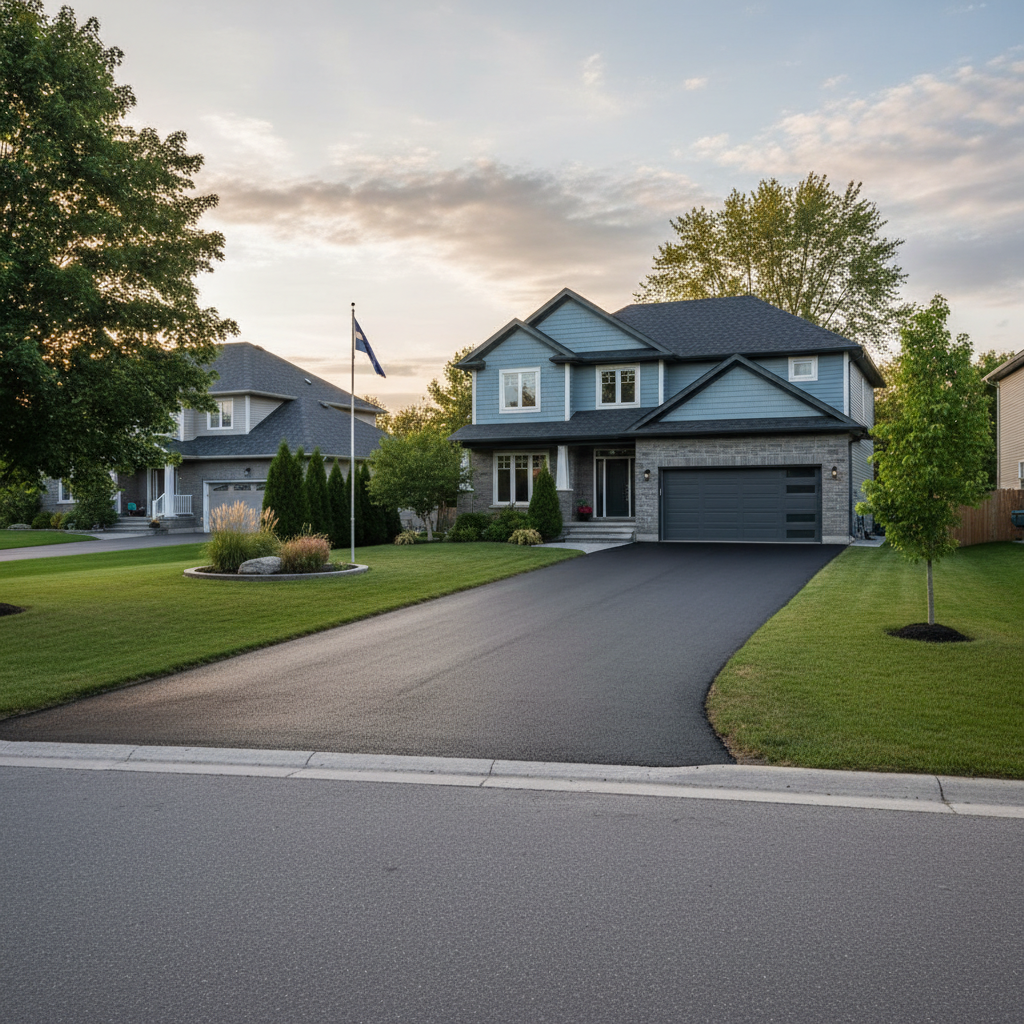
Driveway paving options and costs in Devon
In Devon, Alberta, homeowners typically choose driveway paving based on three things: the ability to handle Edmonton-area freeze-thaw, the look of the approach to the home, and how much disruption they can tolerate. With 78.4% of dwellings being single-detached houses, most local driveways are built as freestanding surfaces tied to detached homes, so proper base construction and drainage matter every bit as much as the finished surface. Devon also has a meaningful older housing stock—46.6% of homes were built before 1981—which often means existing driveways need more than a quick resurfacing; they may require base correction and subgrade stabilization before any asphalt or concrete layer goes down. (Statistics Canada, 2021 Census)
Pricing across the Edmonton economic region is shaped less by “material only” and more by frost protection. Central Alberta freeze-thaw cycling can be hard on bases where water isn’t managed. Edmonton-area bids commonly reflect extra excavation, hauling, and drainage stone to build a properly graded granular base (often around 1.5 m of frost protection in guidance used locally), plus time for compaction and QA. The working season is also shorter here because hot-mix asphalt generally requires air temperatures above 10°C, so spring and summer scheduling pressure can affect availability and crew mobilization—especially on projects near busy access points like the developer entry areas around Devon’s central corridor near Highway 60.
Use the table below to compare typical options and what they usually cost per square foot for Devon projects, then match the best material to your base condition and winter maintenance routine.
| Material |
Lifespan |
Maintenance |
Best For |
Price per sq ft |
Price Range |
| Asphalt (new installation, proper base) |
15–25 years |
Seal every 3–5 years |
Cost-effective, smooth drive; good when base is rebuilt or corrected |
$6.50–$10.50 |
$7,000–$15,000 |
| Asphalt (overlay on existing gravel base) |
8–15 years |
Seal every 3–5 years; watch for pumping or weak subgrade |
When the base is firm and drainage is already working |
$5.75–$9.25 |
$7,000–$13,500 |
| Interlocking concrete pavers |
25–40 years |
Re-sand joints as needed; localized repairs |
Repairability and curb appeal |
$10.50–$17.50 |
$12,000–$28,000 |
| Poured concrete (broom finish) |
25–35 years |
Seal occasionally; keep drainage directed away from slab edges |
Low maintenance and a clean, modern look |
$10.00–$15.00 |
$9,000–$22,000 |
| Exposed aggregate concrete |
25–35 years |
Seal more regularly depending on finish and de-icing use |
Slip resistance and upgraded curb appeal |
$12.00–$18.50 |
$11,500–$26,000 |
| Gravel / crushed stone (budget option) |
3–8 years (varies widely) |
Top up, re-grade, and weed control seasonally |
Lowest upfront cost; works if you can accept ongoing upkeep |
$3.50–$6.00 |
$4,000–$9,500 |
Prices are estimates only and vary by project scope, site access and material selection.
What affects the price of paving in Devon
Two Devon driveways can look the same at the curb—same width and length—but still come in 30–50% apart once you factor in base condition and frost protection. In the Edmonton region, contractors often price excavation and granular rebuild first, because freeze-thaw performance is won or lost below the surface. Frost depth and freeze-thaw cycles are decisive cost factors here: deeper frost generally requires a thicker, well-compacted granular base to reduce heaving, cracking, and settlement. In central Alberta, local practice commonly aligns with deeper frost protection expectations than you’d see in milder climates. That often translates to more excavation, more drainage stone, and more compaction passes than a “basic” job.
The paving season also tightens scheduling. Hot-mix asphalt placement typically needs air temperatures above 10°C, so crews can be booked quickly in spring and early summer. That demand pressure can raise mobilization and labour premiums on short-notice projects.
Concrete costs can swing based on whether the slab needs to be rebuilt at full depth versus patched, and whether you’re dealing with existing drainage problems. For example: if your current approach has standing water near the driveway apron, the contractor may need additional grading and subsurface drainage—adding both labour and materials. If your existing driveway is already failing with pumping or base separation, resurfacing asphalt may be less economical than rebuilding the base because a thin overlay won’t “fix” water movement. Conversely, if your driveway base is stable and drainage is good, you can sometimes stay near the asphalt range of $7,000–$15,000 for a full asphalt replacement, rather than climbing into higher rebuild scenarios.
Finally, your project’s finish can change the total: homeowners choosing interlocking pavers may see the larger band around $12,000–$28,000, but they’re often paying for curb appeal plus a system that can handle localized repairs without replacing the whole driveway.
| Price Factor |
Why It Matters |
Cost Impact |
| Driveway area in sq ft |
Most line items scale directly with surface area |
Typically 40–60% of total project cost |
| Base depth required |
Frost protection drives granular thickness and excavation volume |
Can add 10–30% depending on subgrade condition |
| Grading and drainage work |
Correct slope and directing water reduces freeze-thaw damage |
Commonly +5–25% for drainage corrections |
| Tear-out of existing surface |
Breaking, hauling, and disposing of old asphalt/concrete costs time and equipment |
Can vary by 15–35% if full-depth removal is needed |
| Edge restraints and curbing |
Prevents paver spread and asphalt edge failures |
Often +3–12% depending on perimeter length |
| Sealing requirement |
Asphalt performance improves when sealed after curing (6–12 months) |
Usually an additional seasonal budget item |
| Site access |
Narrow approaches slow equipment movement and increase labour hours |
Can add +5–20% where access is tight |
| Asphalt mix specifications |
Freeze-thaw-rated mix design and approved materials cost more |
Often +3–10% vs basic mix specs |
Permits & regulations in Alberta
For paving in Devon, Alberta, the key rule of thumb is whether you’re working strictly within your private property or changing anything in municipal space. In most cases, paving a private driveway within your own property does not require a building permit. However, permit or approval is commonly required when the work affects the municipal right-of-way—this includes new or altered curb cuts, changes to the boulevard area, or adjustments that impact storm drainage infrastructure.
Lot grading is another area to confirm. Some municipalities have grading bylaws or requirements that restrict how close hard surfaces and drainage features can be to property lines, and that may require a plan for how runoff is handled. Also, if your project involves excavation near existing services, you must complete utility locates before digging.
Step-by-step verification for Alberta contractors should be part of your homeowner checklist:
- Confirm licensing status using the appropriate Alberta registry (and that the contractor is eligible to perform the type of work quoted).
- Request a current certificate of liability insurance showing coverage limits that match the job size.
- Verify WSIB/WCB coverage for the trades involved (ask for proof of clearance or coverage documentation).
- Ask for an itemized contract/spec sheet showing base prep, drainage work, and disposal/haul-away inclusions.
- Before excavation, ensure the contractor schedules Alberta One-Call utility locates and respects the locate marks on site.
When in doubt, ask the contractor to identify what parts of the scope fall within your property versus the boulevard/right-of-way so you can confirm approvals early and avoid delays during the short paving season.
Asphalt vs pavers vs concrete for Devon driveways
In Devon’s Edmonton-area freeze-thaw conditions, all three common driveway materials can work—but they do so with different strengths and maintenance demands. Asphalt is usually the lowest upfront choice, and it delivers a smooth, quiet ride. The trade-off is that asphalt needs sealing to protect against water infiltration, especially after Edmonton-area freeze-thaw cycles; many homeowners plan to seal every 3–5 years for best longevity.
Interlocking concrete pavers cost more at the start, but they shine where you value repairability and curb appeal. When the base was built with proper frost protection and drainage, individual pavers can be lifted and reset if there’s ever a localized settlement or utility repair, without tearing out the whole driveway. Poured concrete sits in the middle price range and is durable, but it’s more sensitive to cracking if the base is weak or drainage is off. For Alberta winters, air-entrainment is crucial to manage freeze-thaw stress, and the jointing plan matters.
Practically, base preparation depth and drainage design are what keep the surface intact. If your existing driveway shows water pooling or you’re replacing failing base, the “best” material becomes the one that pairs with a properly graded granular base and correct drainage. That’s why a driveway that starts at the asphalt band of $7,000–$15,000 might become a concrete or paver project when the goal is maximum curb appeal or future flexibility for repairs.
As a specific example: if an asphalt driveway quote lands near the middle of $7,000–$15,000 but your base requires significant tear-out and you anticipate future work near utilities, pavers can be justified because their repair method is localized—often keeping the overall driveway service life higher over time. If your base is already stable and you simply want the best value, asphalt can still be the most cost-effective option.
| Material |
Frost Resistance |
Curb Appeal |
Repair Method |
Lifespan |
Price Band |
| Asphalt (sealed regularly) |
Good with proper base and drainage |
Moderate (depends on finish) |
Patching and localized resurfacing |
15–25 years |
$7,000–$15,000 |
| Interlocking concrete pavers |
Very good when base is engineered and joints are maintained |
High (variety of colours/patterns) |
Lift-and-reset individual units |
25–40 years |
$12,000–$28,000 |
| Poured concrete (air-entrained) |
Good with air-entrainment and correct base |
Moderate to high (finish dependent) |
Crack repair and selective patching |
25–35 years |
$9,000–$22,000 |
| Exposed aggregate concrete |
Good with proper mix and curing |
High (texture and slip resistance) |
Targeted patching; panel-scale repairs if extensive |
25–35 years |
$11,500–$26,000 |
| Permeable pavers (drainage grid) |
Very good when soils drain and design is correct |
High (modern look) |
Module replacement; cleaning to prevent clogging |
20–35 years |
$13,000–$30,000 |
| Chip seal / tar-and-chip |
Fair to good; depends heavily on base |
Low to moderate |
Spot repairs and re-chipping |
5–10 years |
$6,000–$12,000 |
How to choose a paving contractor in Devon
Choosing the right contractor in Devon, Alberta matters because Edmonton-area freeze-thaw punishes shortcuts—especially on base preparation and drainage. Start by verifying Alberta coverage and standing. Ask for their current business details and confirm they hold the appropriate Alberta licence/eligibility for the work they’re bidding. Request a certificate of liability insurance (make sure it’s current and matches the scope). For worker coverage, ask for proof of WSIB/WCB coverage and, if applicable, clearance documentation—don’t accept “we’re covered” without seeing paperwork.
Next, get 2–3 written, itemized quotes. You want labour + materials breakdowns, not just a lump-sum number. Ask what’s included for base excavation depth, granular types, compaction testing/QA, drainage stone, disposal/haul-away, and whether topsoil/stripping is part of the scope. Confirm whether permits or municipal approvals are included when work approaches the right-of-way.
Warranty should be clear: a workmanship warranty (how many years, what it covers, and how exclusions are handled) plus any product/manufacturer warranty details. Ask whether the warranty is transferable to future owners.
Payment schedule matters: never pay the full amount upfront. A common homeowner-safe approach is 10–15% deposit or less, with the balance due after milestones and final completion. Hold back enough to ensure finish and cleanup are done properly. Also get the schedule in writing—start date, expected curing/seasonal limitations (especially for asphalt sealing timing), and completion estimate.
- Confirm Alberta licensing/eligibility for the exact type of paving/basicscope.
- Require current liability insurance certificate before any work starts.
- Verify WSIB/WCB clearance/proof for each trade category on the job.
- Request itemized quotes: excavation, base rock, drainage, asphalt/concrete, pavers, edging.
- Check for explicit inclusions: disposal/haul-away, compaction, and grading tolerances.
- Clarify exclusions: utility locates, overnight protection, snow removal, restoration of landscaping.
- Ask if a geotextile or separation fabric is recommended (and why) for your soil condition.
- Confirm drainage design: slope direction, catch basin tie-ins (if applicable), and outlets.
- For asphalt: ask when sealing will be done (often after 6–12 months) and who supplies it.
- For pavers: confirm edging restraints and joint sand specification.
- Get warranty terms in writing—workmanship length and what voids coverage.
- Put the timeline in the contract: start date, curing/traffic limits, and weather contingencies.
In Devon, red flags I see include contractors who quote without assessing base/drainage, crews that can’t explain frost-protection thickness decisions, vague warranty language, pressure for large upfront payments, or bids that exclude disposal/haul-away so the final invoice “surprises” you.
Frequently asked questions — paving in Devon
Why does my driveway crack and heave in winter?
Cracking and heaving in Devon are usually signs that water and frost are interacting with an under-built or poorly drained base. In central Alberta, freeze-thaw cycling can be tough because any moisture left under the surface expands when it freezes, stressing the pavement layer and weakening it when thawed. The most common causes are insufficient granular base depth for frost protection, inadequate grading so water doesn’t shed, and missing or ineffective drainage stone/outlets. Homes built before 1981 (46.6% of Devon’s stock) often have older drainage and base conditions that don’t meet modern frost-protection expectations. (Statistics Canada, 2021 Census) If your driveway is heaving near the apron, the contractor should assess base stability and slope—not just “patch the surface.”
Do I need a permit to pave my driveway in Alberta?
In most cases in Devon and across Alberta, paving your private driveway on your own property doesn’t require a building permit. The situation changes if the work touches the municipal right-of-way—commonly if you’re creating or altering a curb cut, changing boulevard surfaces, or adjusting storm drainage that affects municipal infrastructure. Alberta municipalities may also have lot-grading requirements that restrict runoff patterns or how close hard surfaces are to property lines. Before any excavation, confirm utility locates through Alberta One-Call so buried services are marked. The best approach is to ask your contractor to clearly separate what’s inside your lot from what’s in the boulevard, then verify the approval needs with the municipality if any right-of-way work is involved.
How long before I can drive on new asphalt?
For new asphalt in Devon, you generally can drive after the surface has cooled and compacted, but the exact timeline depends on weather and the thickness of the lift. Many crews will allow light traffic relatively soon after rolling—often within hours on a warm day—while heavier loads may need more time. The bigger timing item for asphalt performance is sealing: asphalt is typically sealed after curing, commonly around 6–12 months after placement, depending on the product and your weather. Sealing is also where annual costs can add up, so homeowners often plan maintenance alongside the initial project. If your budget is in the asphalt band of $7,000–$15,000, it’s smart to also ask for sealing timing and expected cost so you’re not surprised later.
What causes potholes and how are they repaired?
Potholes usually start when water finds a weakness in the asphalt structure—often around edges, joints, or spots where the base has lost support due to pumping or washout. In Edmonton-area freeze-thaw conditions, trapped moisture expands in winter and accelerates breakdown when it thaws in spring. Common Devon scenarios include poor drainage at the driveway apron, freeze-thaw damage over a weak granular base, or localized settlement after a utility patch. Repair is typically not just “fill and forget.” A proper fix cuts back to sound material, addresses the underlying base (and drainage if needed), then places new asphalt in lifts and compacts it. Ask your contractor whether they’ll do full-depth repairs to the weak zone rather than superficial patching.
How do I prepare for a paving project?
Start with site prep: clear the driveway and parking areas, move vehicles and trailers, and protect nearby landscaping. If your driveway is failing, take photos of where water pools or where cracks are worst—those points help the contractor design drainage and base fixes. Arrange for pets and kids to stay away during excavation. Before work begins, confirm the contractor will complete Alberta One-Call utility locates and that they have a plan for any marked services. If you have existing fencing, steps, or retaining edges near the work zone, note where equipment access could be limited. Finally, prepare for scheduling around weather: asphalt placement and compaction are sensitive to temperature, and concrete finishing depends on conditions. A good contractor will also give clear traffic-cure instructions and timing expectations.
How do I compare paving quotes fairly?
To compare paving quotes fairly in Devon, you need apples-to-apples scope. Ask for itemized quotes showing labour and materials: base excavation depth, granular types, drainage stone, geotextile (if used), disposal/haul-away, and edging/restraints. Confirm whether the contractor includes tear-out to full depth or only surface milling—this can dramatically affect total cost and future performance. Also check whether permits or right-of-way approvals are included if any boulevard work is required, and whether sealing is included for asphalt (often after 6–12 months). If one quote is far below the others, look for missing line items rather than assuming it’s a deal. As a reference point, Devon asphalt driveway bids often fall around $7,000–$15,000, while pavers commonly sit in the $12,000–$28,000 band.