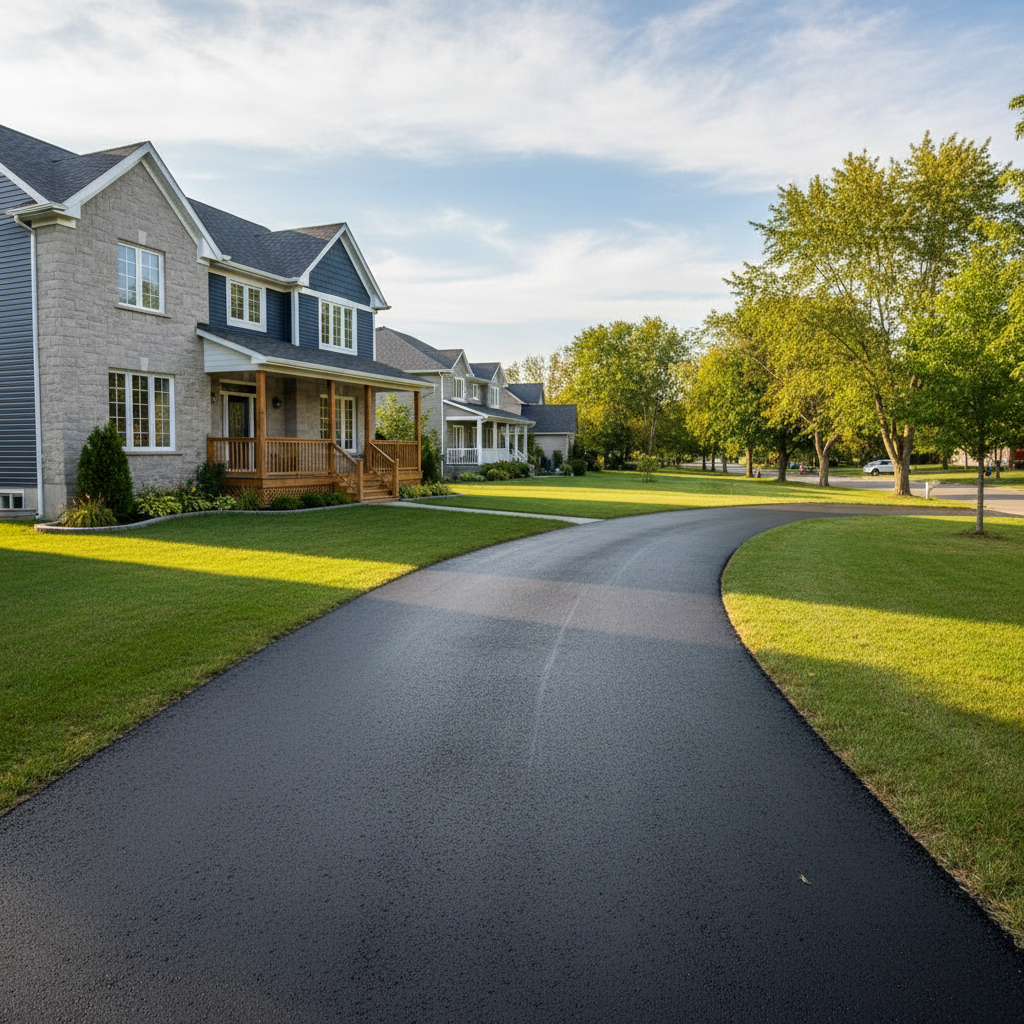
Driveway paving options and costs in Cold Lake
Cold Lake homeowners typically have three practical driveway paths: asphalt, interlocking pavers, or concrete. Because Cold Lake is a largely residential community (about 65.7% of dwellings are single-detached homes, Statistics Canada, 2021 Census), most private driveways you’ll see in neighbourhoods like Prairie Vista and East Bay can be upgraded without shared-property complications—so contractors can focus on subgrade and drainage, where the real cost driver sits. In a town of roughly 15,661 people (Statistics Canada, 2021 Census), there’s enough repeat work to keep crews busy, but the northern season still compresses paving to roughly May–September, which affects scheduling and price.
In the Wood Buffalo–Cold Lake region, pricing is shaped by deep frost penetration (often around the 1.2–1.5 m guidance range) and frequent freeze–thaw cycles. That means driveways and parking pads need a deeper, properly compacted granular base and robust drainage so water doesn’t infiltrate and expand under the pavement. If the base is underbuilt, you can get rutting, heaving, or cracking sooner—especially under plough traffic and winter meltwater. Base overbuild is also common to protect against differential settlement, and aggregate haul distances plus compressed production windows can add unit cost versus larger southern markets.
Below is a straightforward comparison of options homeowners in Cold Lake use most often, with typical cost ranges you can use to sanity-check quotes.
| Material |
Lifespan |
Maintenance |
Best For |
Price per sq ft |
| Asphalt (new installation, proper base) |
15–25 years |
Seal every 3–5 years; patch as needed |
Lowest upfront cost with good winter performance when built to spec |
$6.50–$12.00 |
| Asphalt (overlay on existing gravel base) |
10–18 years |
Earlier patching; seal every 3–5 years |
Budget upgrade when base can be corrected and compacted |
$4.50–$8.50 |
| Interlocking concrete pavers |
25–35 years |
Replace individual units; re-sand joints as required |
Curb appeal and “repair without full replacement” |
$10.50–$18.50 |
| Poured concrete (broom finish) |
20–30 years |
Seal selectively; patch hairline cracks |
Clean, durable surface with straightforward maintenance |
$9.00–$15.50 |
| Exposed aggregate concrete |
25–35 years |
Occasional sealing; crack monitoring |
High traction look and strong curb appeal |
$12.00–$20.00 |
| Gravel / crushed stone (budget option) |
5–12 years |
Top up 1–3 times per year; grading needed |
Short-term solution or areas with limited budget |
$2.25–$5.00 |
Prices are estimates only and vary by project scope, site access and material selection.
What affects the price of paving in Cold Lake
In Cold Lake and the wider Wood Buffalo–Cold Lake economic region, two quotes for what looks like the same driveway can easily swing by 30–50%. The main reason is that “paving” usually includes a lot of hidden work: subgrade correction, drainage detailing, base depth and compaction quality. Contractors also price in risk—frost depth and freeze–thaw cycles are decisive cost factors here, and deeper frost means you need a thicker, well-compacted granular base to prevent heaving and cracking. In practice, that typically translates to a deeper base than many southern builds and a more robust drainage plan. The paving window is also shorter; hot-mix asphalt generally needs air temperatures above 10°C, so scheduling pressure in spring/summer can push unit pricing higher and limit crew availability.
Concrete costs can move too, depending on whether the contractor builds thicker sections, uses proper air entrainment for freeze–thaw durability, and whether joints and reinforcement are planned for local conditions. For example, a driveway upgraded in a mature neighbourhood with older homes (about 30.8% of homes were built before 1981, Statistics Canada, 2021 Census) often needs more subgrade repair because the existing profile is inconsistent—meaning higher tear-out and base rework costs. Conversely, a newer parcel with clean, stable soils and straightforward access may come closer to the low end of the asphalt bands (for reference, asphalt driveway paving is often quoted around $6,000–$12,000).
Concrete and pavers can also vary with drainage needs and how much base is rebuilt. Interlocking projects often land around the $9,000–$18,000 band because curbs/restraints and jointing materials are labour-heavy.
| Price Factor |
Why It Matters |
Cost Impact |
| Driveway area in sq ft |
Most materials and labour scale by square footage |
High (primary driver; can swing the whole quote) |
| Base depth required |
Frost line determines granular thickness to resist heave |
Medium–High (more tonnes of base and more compaction) |
| Grading and drainage work |
Slope and drainage corrections control meltwater infiltration |
Medium (excavation, forms, culverts or swales) |
| Tear-out of existing surface |
Breaking and hauling asphalt/concrete plus disposal costs |
Medium–High (especially if multiple layers exist) |
| Edge restraints and curbing |
Needed to prevent paver spread and asphalt edge failure |
Medium (materials + extra labour) |
| Sealing requirement |
Asphalt must be sealed after 6–12 months to protect binder |
Low–Medium (planned maintenance cost) |
| Site access |
Narrow lots slow equipment movement and increase labour time |
Medium (more time per square foot, more staging) |
| Asphalt mix specifications |
Freeze–thaw-rated mix costs more and can require tighter quality control |
Low–Medium (but critical for longevity) |
Permits & regulations in Alberta
In Alberta, paving a private driveway within your own property typically does not require a building permit. The common “no permit” scenario is replacing or paving your driveway surface where you’re staying on your property line and not changing how stormwater drains to/through municipal infrastructure. However, work in the municipal right-of-way often does require municipal approval. That includes adding or modifying a curb cut, changing boulevard grading, altering roadside drainage patterns, or any tie-in that affects storm drainage function. If your project involves reshaping the ditch line or redirecting meltwater in a way that touches municipal drainage, expect permitting/approval steps.
Before any excavation in Cold Lake, confirm utilities with a locate request through Alberta One-Call (and be ready for marking that may affect how contractors stage equipment). Then, to verify your contractor is properly set up, take these steps:
- Confirm they carry appropriate liability insurance and request a Certificate of Insurance showing the policy active dates.
- Ask about their worker coverage (WSB/WCB coverage, depending on how they are registered) and request proof.
- Verify licensing/registration through the appropriate Alberta channels for the scope being performed (at minimum, confirm they’re a bona fide paving contractor and not subbing without coverage).
- Request a written warranty plan and keep it as part of your documentation.
For driveway projects, also ask whether local lot-grading rules restrict the hard surface placement or drainage grading near property lines—especially in older areas where the existing swales may not match today’s expectations.
Asphalt vs pavers vs concrete for Cold Lake driveways
For Cold Lake winters, the decision comes down to upfront cost, maintenance routine, and how each system handles freeze–thaw movement with plough/salt exposure. Asphalt is usually the lowest upfront option when built on a proper granular base; when maintained with sealing, it performs well through northern seasons. The trade-off is that asphalt needs sealing every 3–5 years, and if joints or edges are weak, water can work its way into the system.
Interlocking concrete pavers typically cost more to install, but they’re repair-friendly. If a section fails from frost movement or a localized drainage issue, individual units can be removed, base corrected, and reinstalled—without tearing up the whole driveway. That “modular repair” matters in a region where the effective paving window is short and where driveways are used heavily during the thaw.
Poured concrete sits in the middle on price. It can be durable, but it’s susceptible to cracking from freeze–thaw if not air-entrained and detailed correctly. Good base preparation and drainage are non-negotiable; slopes must shed meltwater instead of letting it infiltrate under slabs.
In Wood Buffalo–Cold Lake builds, deeper frost protection generally means more granular base and careful compaction, regardless of material. If your driveway is underbuilt, all three can fail—but pavers often fail more “locally,” while asphalt failures can show up as edge breakdown or alligator-like distress, and concrete can show cracking that follows the movement pattern.
As a practical example, a typical asphalt driveway paving range in Cold Lake is $6,000–$12,000, while interlocking commonly falls in the $9,000–$18,000 band. That extra cost is most justified when you want curb appeal, plan for possible future spot repairs, or you know the area has drainage quirks that may need localized fixes.
| Material |
Frost Resistance |
Curb Appeal |
Repair Method |
Lifespan |
Price Band |
| Asphalt (sealed regularly) |
Good when base/drainage are correct |
Medium |
Cut-out and patch; edge re-seal |
15–25 years |
$6,000–$12,000 |
| Interlocking concrete pavers |
Very good; movement absorbed by joints |
High |
Remove and relay individual units |
25–35 years |
$9,000–$18,000 |
| Poured concrete (air-entrained) |
Good with proper air-entrainment and base |
Medium–High |
Crack repair/patch; limited slab-level options |
20–30 years |
$8,000–$15,000 |
| Exposed aggregate concrete |
Good with air-entrainment and sealing |
High |
Localized patching; harder to match perfectly |
25–35 years |
$10,000–$18,000 |
| Permeable pavers (drainage grid) |
Very good when designed as a system |
High |
Remove/recover affected grid sections |
20–30 years |
$12,000–$22,000 |
| Chip seal / tar-and-chip |
Moderate; best for low-speed/limited load |
Low–Medium |
Spot patch and re-surface |
8–15 years |
$4,000–$9,000 |
How to choose a paving contractor in Cold Lake
Start by verifying Alberta coverage and credentials the right way. Ask for a copy of their liability insurance certificate and confirm it’s active for the project dates. For worker coverage, ask whether they are properly covered under WCB/WSB requirements and request proof. Then, verify their Alberta licensing/registration for the type of work they’re advertising (don’t rely on “we’re insured” alone—look for documentation).
Next, get 2–3 itemised written quotes that separate labour and materials. You want to see excavation, haul/disposal, base preparation, compaction requirements, asphalt/concrete/paver supply, edges/curbs, and any sealing or jointing materials. If the quote is a single lump sum, you can’t compare apples to apples—especially in Cold Lake where base depth and drainage corrections swing the total.
Read the scope carefully for what’s excluded: is permit/municipal approval support included if needed? Is old material disposal included? Are utilities included if trenching is required for drainage? Ask about the workmanship warranty length and what it covers (settlement vs. surface cracking vs. seal performance). Confirm whether the manufacturer product warranty is transferable if you sell the home.
For payment, avoid paying more than 10–15% upfront. Use a holdback until completion and final cleanup are done. Finally, request a start date and completion estimate in writing. In a short northern season, weather windows and crew scheduling can affect timelines, so you want clarity on what happens if frost conditions don’t cooperate.
- Provide a project-specific written scope (not a generic driveway description).
- Show proof of liability insurance and jobsite-active certificate dates.
- Confirm WCB/WSB coverage for workers and request proof.
- Include utility locate confirmation and excavation safety steps.
- Specify target base depth and compaction method (and whether they overbuild for frost).
- Describe drainage/slope plan and how meltwater will be directed.
- List asphalt mix/grade or concrete air-entrainment and curing method.
- Clarify edge restraints/curbing or restraint details for pavers.
- State whether sealing is included and when (typically after 6–12 months for asphalt).
- Detail disposal: where removed material is hauled and tipping fees included?
- Include warranty terms: duration, exclusions, and what constitutes “repair.”
- Set payment milestones tied to measurable completion steps.
Red flags to watch for in Cold Lake: a quote that doesn’t address base depth or compaction, no drainage plan, vague “we’ll handle permits” language, asking for a large upfront payment, and refusing to put warranty and scope in writing.
Frequently asked questions — paving in Cold Lake
How deep should the base be for Cold Lake's frost?
In Cold Lake, base depth is driven by frost penetration and how much frost-susceptible soil you have under the driveway. With northern Alberta’s typical frost guidance in the 1.2–1.5 m range, you should expect a more robust granular section than many southern layouts—especially if there’s peat-like material, thaw-sensitive silts, or poor drainage. Most successful projects end up with a thicker compacted granular base to resist heaving and cracking under freeze–thaw cycles, plus clear slopes so meltwater can’t sit near the pavement edge. The exact depth should come from a contractor’s site assessment and compaction plan, not a one-size-fits-all rule.
How often should I seal my asphalt driveway?
Asphalt in Cold Lake generally benefits from sealing every 3–5 years, with an important first step: many contractors wait until the asphalt has had time to cure before sealing (commonly after 6–12 months). Sealing helps protect the binder from winter wear—especially from plough traffic and freeze–thaw expansion—and reduces water intrusion into the surface. If you notice raveling, faded streaks, or small areas where water seems to soak in faster, sealing may be needed sooner. Your contractor should recommend a specific schedule based on thickness, binder selection, and how much the driveway is used during thaw. If you’re working with a budget, plan sealing into the overall cost rather than treating it as optional.
Why does my driveway crack and heave in winter?
Cracking and heaving in Cold Lake usually come back to water and frost movement. When meltwater gets into weak joints/edges or the drainage slope isn’t right, water can freeze beneath the pavement. Frost expansion then lifts sections unevenly, creating heaves; repeated cycles can widen cracks or break up the surface. Another common driver is an underbuilt or poorly compacted granular base—especially if the existing driveway profile settled after landscaping or if older fill was used. In communities where older housing stock exists (about 30.8% built before 1981, Statistics Canada, 2021 Census), you’ll also see more variability in subgrade conditions, which increases the likelihood of differential movement. A proper rebuild with corrected grading and drainage is the real fix; patching alone often delays the problem.
Do I need a permit to pave my driveway in Alberta?
Often, you don’t need a building permit for paving within your own property line in Alberta. Typical “no permit” work includes resurfacing or installing a driveway surface where you’re not changing municipal drainage or altering the roadside right-of-way. Permits or municipal approval may be required when the work affects the municipal right-of-way—for example, creating or modifying a curb cut, changing boulevard grading, or altering storm drainage patterns. In Cold Lake, the key is whether your excavation and grading touch municipal infrastructure. Before digging, you should always arrange utility locates through Alberta One-Call. When you request quotes, ask whether the contractor is handling any required municipal approval and clarify what steps are included. A good contractor will list responsibilities in the scope so there are no surprises.
How long before I can drive on new asphalt?
With asphalt, the timeline depends on how fresh it is and whether it was compacted and cooled properly. In general, light vehicle traffic is often permitted within 24–48 hours when temperatures are suitable and the surface has cooled to a safe level; heavier traffic typically requires more cure time. In Cold Lake’s shoulder-season swings, contractors may also pace opening dates based on weather and compaction performance. Your contractor should provide a written traffic/opening schedule and should communicate any restrictions for the first few weeks. If you also need sealing, remember that sealing is usually planned after 6–12 months rather than immediately after paving. If you’re comparing quotes, ask whether the price includes temporary protection, traffic control, and the planned sealing window—those details can change your real schedule and total cost.
What causes potholes and how are they repaired?
Potholes in Cold Lake most often develop from water infiltration into weakened asphalt. Freeze–thaw expands trapped moisture, breaking down the base and loosening the asphalt layer. Heavy turning movements—plough travel, vehicles at the same spot repeatedly, or oilfield/industrial traffic patterns—can accelerate failure at edges and low spots where water collects. Repairs typically involve cutting back to sound material, removing failed asphalt and any compromised base, then placing new base (with proper compaction) and re-paving with an appropriate mix. Temporary “fill and pack” without removing the saturated base usually fails sooner because the underlying water problem remains. If you’re budgeting, repair work is generally less than a full replacement, but multiple patch seasons can add up—so the best approach is often combining spot repairs with drainage and edge correction to stop recurrence.