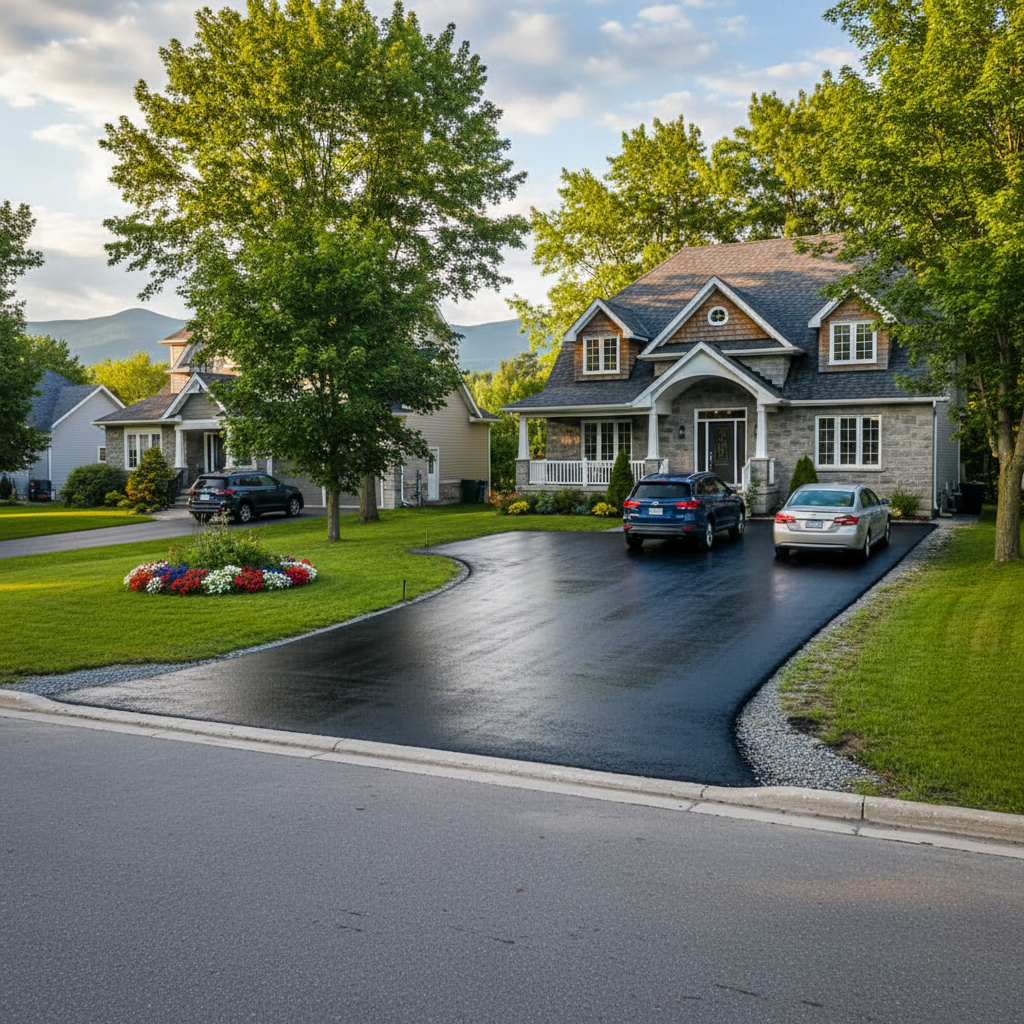
Driveway paving options and costs in Raymond
In Raymond, Alberta, choosing the right driveway surface comes down to balancing upfront cost with how well the material survives freeze–thaw cycles. Most private driveways here are tied to single-detached homes—about 89.5% of dwellings—so paving contractors regularly see steady demand as homeowners refresh older driveways and hardscapes. With 53.8% of homes built before 1981, a lot of existing base and drainage setups are simply worn out or no longer properly compacted, which can affect how much excavation is needed. (Statistics Canada, 2021 Census)
In the Lethbridge–Medicine Hat region, pricing is shaped by frost depth and seasonal scheduling. Frost penetration is commonly around the 6 ft range, so contractors plan excavation and a thicker, well-compacted granular base to reduce frost heave and early cracking. Asphalt also needs workable weather—hot-mix asphalt placement generally requires air temperatures above about 10°C—so the paving season is effectively late spring through early fall. That weather window pressure can tighten availability for smaller jobs, and it’s one reason you may see realistic ranges like asphalt at roughly $6,000–$12,000 installed in this tier.
If you’re in an area with lots of older properties and heavier foot-traffic access points, such as around the downtown core and established residential lanes, it’s especially common to see asphalt overlays or full reconstruction once drainage issues are corrected. Next, compare the typical materials side-by-side in the table.
| Material |
Lifespan |
Maintenance |
Best For |
Price per sq ft |
Price Range |
| Asphalt (new installation, proper base) |
15–25 years |
Seal every 3–5 years; patch as needed |
Best value with a durable base and good drainage |
$3.75–$6.75 |
$6,000–$12,000 |
| Asphalt (overlay on existing gravel base) |
8–15 years |
Seal and monitor edge settlement; spot patch |
When the underlying base is still solid and grades are acceptable |
$3.25–$6.25 |
$5,000–$10,500 |
| Interlocking concrete pavers |
25–40 years |
Occasional re-sanding; replace individual units if damaged |
Curb appeal and easy targeted repairs |
$8.50–$13.50 |
$9,000–$18,000 |
| Poured concrete (broom finish) |
20–30 years |
Limited routine care; seal if desired |
Clean look, straightforward snow-clearing compatibility |
$7.00–$12.00 |
$8,000–$16,000 |
| Exposed aggregate concrete |
20–30 years |
Re-seal periodically; crack control matters |
Slip resistance and decorative finish |
$9.50–$14.50 |
$10,000–$18,500 |
| Gravel / crushed stone (budget option) |
3–8 years (depends on grading) |
Re-grade and top up; weed control |
Short-term solution or temporary access |
$2.00–$4.25 |
$2,500–$6,000 |
Prices are estimates only and vary by project scope, site access and material selection.
What affects the price of paving in Raymond
If you get multiple quotes for the same Raymond driveway, it’s common to see swings of 30–50% because contractors can price different assumptions: how much excavation is required, whether drainage is corrected, and whether the contractor needs to haul away unsuitable subgrade. In the Lethbridge–Medicine Hat region, frost depth and freeze–thaw cycles are decisive cost factors. With repeated winter expansion and spring thaw, deeper frost means a thicker compacted granular base and careful drainage detailing are non-negotiable to prevent heaving and cracking. Where contractors normally might build a base on the order of 6–12 inches in many Alberta applications (soil conditions permitting), a poor base or weak drainage can force extra rework after the first winter.
The paving season also compresses when work can be scheduled. Hot-mix asphalt typically needs air temperatures above 10°C, so crews often protect their calendar for weather windows. That short season effect can push unit rates up compared with warmer regions, and it’s a key reason asphalt in this tier often lands around $6,000–$12,000 installed depending on scope. Concrete can still be priced competitively, but it also depends on preparation—especially air-entrainment and crack control—so older sites with questionable drainage can climb quickly toward $8,000–$16,000.
Concrete examples from Raymond: if your driveway ties into a slope where surface water can’t drain away from the slab or edges, the contractor may need subgrade correction before pouring (raising cost). If your existing asphalt is peeling and rutting but the base is otherwise stable, an overlay can reduce excavation and keep the project closer to the asphalt band; however, if the base is pumping or saturated, you’re often paying for reconstruction rather than an overlay. In many older homes built before 1981, these hidden drainage and base issues are why “same square footage” quotes don’t match.
| Price Factor |
Why It Matters |
Cost Impact |
| Driveway area in sq ft |
Most material and production time scales directly with square footage |
Typically the largest variable; can change total by 25–60% |
| Base depth required |
Frost line determines granular thickness; deeper frost increases excavation and compaction |
Higher base can add major aggregate, labour and haul-off costs |
| Grading and drainage work |
Slope corrections and subdrainage reduce ponding and frost-related failure |
Can add significant cost, especially if clay or low spots are found |
| Tear-out of existing surface |
Breaking and hauling concrete or old asphalt takes time and disposal fees |
Often adds several thousand dollars depending on depth and access |
| Edge restraints and curbing |
Prevents paver spread and provides structural containment for asphalt/concrete edges |
Adds labour and materials; usually worth it for durability |
| Sealing requirement |
Asphalt needs sealing after curing (often 6–12 months) to protect binder from aging |
Ongoing maintenance cost; important for life-cycle value |
| Site access |
Narrow drive lanes slow equipment movement and increase handling time |
Can raise labour costs and extend the schedule |
| Asphalt mix specifications |
Freeze–thaw-rated mix design and appropriate binder help resist cracking |
Premium mix can add cost but improves performance in Alberta winters |
Permits & regulations in Alberta
In Alberta, paving a private driveway within your own property typically does not require a building permit. However, as soon as you’re altering municipal infrastructure, you may need municipal approval—most commonly when work touches the municipal right-of-way. In practical terms for Raymond homeowners, this can include changing a curb cut, relocating or modifying boulevard drainage, altering storm drainage pathways, or adjusting grading that affects water flow toward municipal catch basins.
A separate but related point is local lot-grading expectations. Some municipalities have rules about how close hard surfaces can be to property lines and how runoff must be managed, particularly where water could be directed onto neighbouring properties. Even when no permit is required, it’s still wise to confirm those lot-grading bylaws before construction starts.
Before any excavation, always call for utility locates (Alberta One-Call) and ensure staking is complete. It’s a critical safety and liability step, especially where older neighbourhood services may be near the driveway footprint.
For contractor verification in Raymond, do it step-by-step: (1) ask for proof of Alberta licensing/registration where applicable and verify details through the appropriate online registry used for contracting credentials; (2) request a current certificate of insurance showing general liability; (3) confirm workers’ compensation coverage (WSIB/WCB coverage) with documentation; and (4) keep copies of the insurance certificate on file for your records. A reputable paving contractor should provide these without hesitation before the first shovel hits the ground.
Asphalt vs pavers vs concrete for Raymond driveways
For Raymond’s freeze–thaw climate, the “best” driveway material depends on what you value most: lowest upfront cost, curb appeal, or repair flexibility after winter damage. Asphalt typically costs the least installed and can be a great choice when the contractor builds the correct granular base and drainage profile. The trade-off is maintenance: sealing is essential after the initial cure (often after 6–12 months) and then every 3–5 years to slow binder aging and surface raveling. In our local freeze–thaw environment, asphalt without proper base and drainage is more likely to develop shallow cracking and edge failures.
Interlocking concrete pavers cost more upfront but offer the most homeowner-friendly repair approach: individual stones can be lifted, re-leveled, and reset. That matters in Raymond because winter settlement is usually localized—around wheel tracks, utility cuts, or areas where drainage is slightly off. Pavers also bring excellent curb appeal for many single-detached properties.
Poured concrete lands in the mid-range for cost, and when it’s correctly air-entrained and finished, it can hold up well with proper subgrade and control joints. Still, freeze–thaw can drive cracking if concrete isn’t designed for Alberta conditions or if salt and frequent plowing concentrate stress at edges. For many homeowners, the biggest differentiator is base preparation and drainage design—not just the surface.
To make the price difference tangible: if asphalt is quoted at around $6,000–$12,000 installed and pavers come in at roughly $9,000–$18,000, the extra cost is justified when you want easy repairs and a long-term, “keep it looking sharp” finish. But if your priorities are straightforward durability and budgeting, a properly built asphalt driveway with sealing can be the smarter spend.
| Material |
Frost Resistance |
Curb Appeal |
Repair Method |
Lifespan |
Price Band |
| Asphalt (sealed regularly) |
Good with deep granular base and drainage; depends on mix and sealing |
Medium (clean, uniform finish) |
Patch and re-level; seal-over maintenance |
15–25 years |
$6,000–$12,000 |
| Interlocking concrete pavers |
Very good; tolerates localized movement when built properly |
High (premium look) |
Remove and replace individual pavers |
25–40 years |
$9,000–$18,000 |
| Poured concrete (air-entrained) |
Good with air-entrainment, joints and correct thickness |
Medium to high (depends on finish) |
Slab repairs are limited; may require partial replacement |
20–30 years |
$8,000–$16,000 |
| Exposed aggregate concrete |
Good with proper curing; slip-resistant surface helps snow management |
High (decorative texture) |
Patch matching texture; larger repairs can blend less perfectly |
20–30 years |
$10,000–$18,500 |
| Permeable pavers (drainage grid) |
Very good where designed for runoff control and infiltration limits |
Medium to high (modern look) |
Replace units; typically easier than reconstructing asphalt/concrete |
20–30+ years (performance depends on subbase) |
$11,000–$20,000 |
| Chip seal / tar-and-chip |
Variable; depends heavily on base quality and maintenance |
Lower (more utilitarian finish) |
Spot seal and re-seal cycles |
6–12 years |
$4,500–$9,500 |
How to choose a paving contractor in Raymond
When you’re hiring a paving contractor in Raymond, Alberta, start by verifying the basics—then move to the details in the proposal. First, confirm Alberta licensing/registration where the contractor’s work is subject to provincial requirements, and ask for their current liability insurance certificate. Next, confirm workers’ compensation coverage (WSIB/WCB). You’re looking for documentation that is current, not expired, and that matches the contractor’s legal entity on the quote.
Then get 2–3 written, itemised quotes. “Itemised” matters: labour + materials breakdown, base preparation, compaction, drainage/grading, saw-cutting/edge work, and tear-out/disposal should be spelled out separately instead of hidden in a lump sum. Also ask whether a permit (if needed) is included in the price and who pulls it. If your site requires municipal approval for right-of-way or curb cut changes, the scope should state who handles that and what timelines are expected.
Warranty should be clear in plain language: workmanship warranty length, what’s covered (settlement, cracking, edge failure), and whether the warranty is transferable if you sell your home. For payment scheduling, never pay more than 10–15% upfront. A common safeguard is holding back the remainder until the job is complete and cleanup is confirmed.
Finally, demand a written start date and completion estimate. In southern Alberta, weather delays happen, so the schedule should explain how rain/freeze conditions can affect completion.
- Ask for Alberta insurance certificate and confirm it matches the contractor name on the quote.
- Verify workers’ compensation coverage (WSIB/WCB) with documentation.
- Request Alberta contracting credentials/registration proof where applicable.
- Get 2–3 itemised quotes (base prep, drainage, haul-off, surfacing, finishing, sealing).
- Confirm disposal is included for asphalt/concrete tear-out.
- Ensure grading and drainage corrections are included if ponding or low spots exist.
- Check whether edge restraints/curbing are included (especially for pavers).
- For asphalt, confirm sealing timing (often after 6–12 months) and whether it’s included or recommended.
- Ask what asphalt mix specs are being used for freeze–thaw resistance.
- Verify compaction requirements and whether a compaction report is provided (where applicable).
- Confirm warranty terms: workmanship vs material/manufacturer and duration.
- Plan payment: 10–15% upfront max; hold back until final inspection and cleanup.
Red flags I’ve seen in Raymond include: quotes that don’t specify base thickness or drainage work, “cheap” pricing that assumes the existing base is fine without inspection, pressure to pay a large deposit early, missing written scope (especially disposal and edge work), and no proof of insurance/WSIB/WCB when requested.
Frequently asked questions — paving in Raymond
How often should I seal my asphalt driveway?
In Raymond, sealing is one of the simplest ways to protect asphalt through Alberta winters. Typically, asphalt should be sealed after it has fully cured—often after 6–12 months—then re-sealed every 3–5 years depending on wear. If you use de-icing regularly and drive heavy vehicles across the same wheel paths, you’ll usually be closer to the shorter end of that range. The freeze–thaw cycle in southern Alberta accelerates binder aging, and once oxidation starts, small cracks spread faster. If your contractor quoted asphalt in the around-$6,000–$12,000 installed range, sealing is part of keeping that investment performing instead of shortening the lifespan.
Why does my driveway crack and heave in winter?
Cracking and heaving usually point to base and drainage problems, not just “bad luck.” In Lethbridge–Medicine Hat conditions, repeated freeze–thaw cycles can lift weak or waterlogged subgrade. If the granular base is too thin, poorly compacted, or if surface water can’t drain away from the edges, frost heave can form first along wheel tracks and low spots. Older driveways (and many homes built before 1981) often have settlement or missing drainage provisions, so moisture accumulates under the pavement. Once the base moves, asphalt can crack and concrete can show joint-related cracking. A proper rebuild addresses drainage and base depth rather than only patching the surface.
Do I need a permit to pave my driveway in Alberta?
In Alberta, paving within your own property generally doesn’t require a building permit for a typical private driveway. The permit/approval conversation usually starts when you affect the municipal right-of-way, such as a new or changed curb cut, modifying boulevard drainage, or altering how stormwater is managed near the road. In Raymond, that means if your driveway ties into municipal infrastructure, you should confirm whether municipal approval is required before construction. Regardless of permits, you must call Alberta One-Call and ensure utility locates are completed before any excavation. A good contractor will tell you early if any municipal approvals are expected based on your frontage and grading.
How long before I can drive on new asphalt?
After installation, new hot-mix asphalt needs time to cool and stabilize. The crew will typically allow light foot traffic quickly, but you should wait longer for vehicles depending on temperature and the mix used. Many homeowners can drive on the driveway the same day under controlled conditions, but in cooler or windy weather it may require a longer cure period to avoid rutting or surface pickup. The most important factor is whether the surface has cooled enough and whether the compaction and finish are correct. If you were in the asphalt band around $6,000–$12,000 installed, ask your contractor for their specific “drive-on time” based on the day’s weather and the thickness placed, because Alberta spring evenings can drop temperatures quickly.
What causes potholes and how are they repaired?
Potholes in Raymond are usually the result of water getting under the pavement. Freeze–thaw cycles enlarge small cracks; then snowmelt and meltwater work deeper into the base until the asphalt surface can’t support loads. The resulting void leads to sudden breakdown under tires, especially where plowing or turning concentrates stress. Repairs typically involve cutting out the failed area, removing unstable material, and then rebuilding with properly compacted granular base before repaving. If the issue is localized, a patch can work well. If you’re seeing repeated failures across the same section, the underlying base or drainage may need broader correction—not just surface patching.
How do I prepare for a paving project?
Preparation prevents delays and keeps the job within scope. Start by clearing the driveway of vehicles, stored items, and planters/edges that might be affected. Mark any sprinkler heads or landscaping that needs protection, and remove loose decorations. Arrange access so equipment can enter safely—tight lots can slow work. Before excavation, confirm Alberta One-Call locates are completed, and ensure you have communication for when the contractor may need to coordinate with utility providers. For homeowners in Raymond, it also helps to know your home’s age: with many properties built before 1981, there’s a higher chance of buried services and older drainage patterns, so ask for a site check. Review the contract scope for tear-out, disposal, grading, and whether sealing is included or scheduled later.