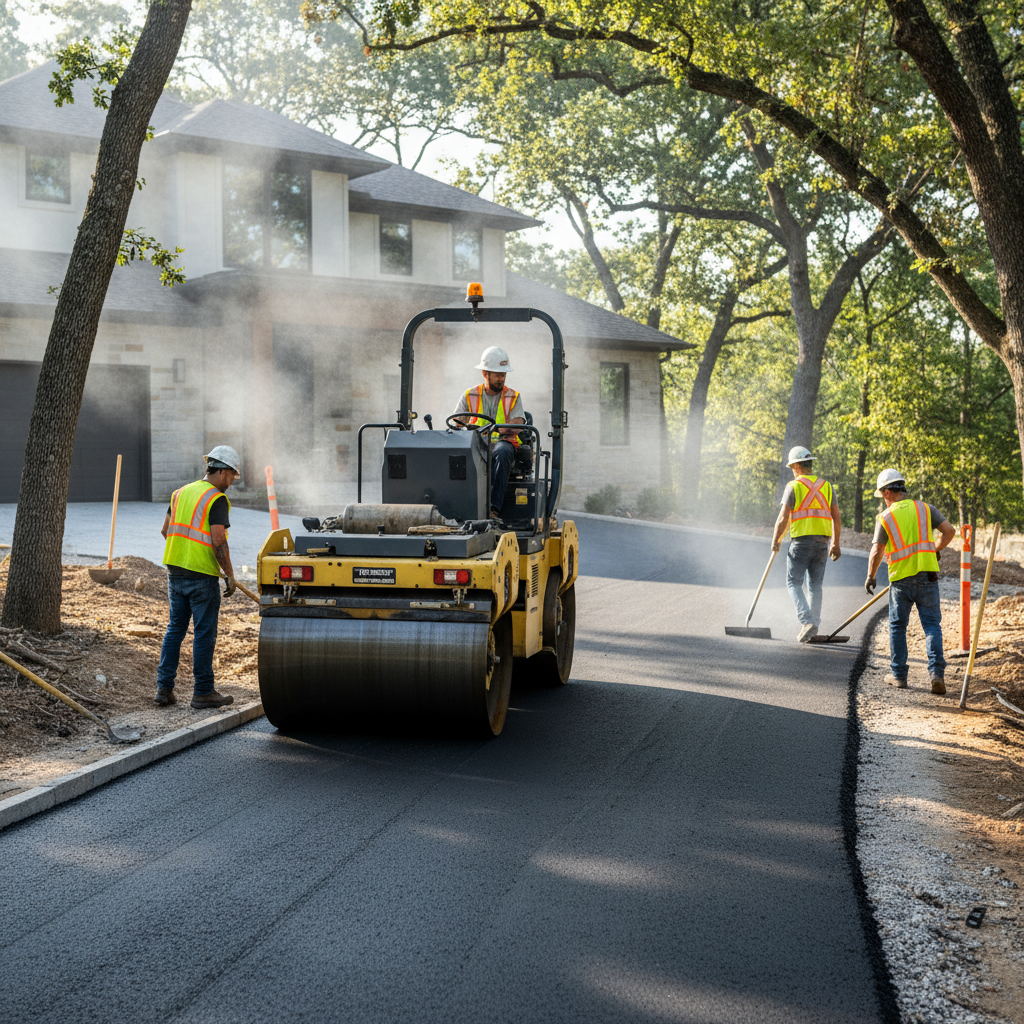
Driveway paving options and costs in Peace River
Peace River homeowners usually have a straightforward starting point: your driveway is tied to your house, and most local homes are single-detached (61.8% of dwellings). With 1,530 homeowner households (59.1% of households own), there’s strong demand for new driveways and re-surfacing that can handle a long freeze–thaw season. In the Athabasca–Grande Prairie–Peace River economic region, frost penetration routinely exceeds 1 m, so the roadbase needs to be built deeper and compacted tighter than many “milder” parts of Alberta. That means contractors price for thicker, well-graded granular base and for drainage that keeps meltwater from migrating under the asphalt or slab.
Timing also affects cost here. The effective paving window is compressed into roughly mid-May to September because hot-mix asphalt placement needs consistently warm air temperatures (above about 10°C). Add spring soft subgrades and early fall frosts, and you’ll see scheduling premiums and careful logistics (equipment staging, regrading, and compaction QA) show up in quotes. In Peace River, work is especially active around established neighbourhoods such as East Hill and the Riverside area, where older housing stock is common and driveways are often due for replacement.
Below is a practical cost comparison you can use when reviewing contractor estimates. After the table, you’ll see why “same size driveway” jobs can still vary meaningfully in Peace River based on base condition, drainage, and access.
| Material |
Lifespan |
Maintenance |
Best For |
Price per sq ft |
Price Range |
| Asphalt (new installation, proper base) |
12–20 years |
Seal coat at year 6–12, then every 3–5 years |
Smooth finish, good value, faster install |
$6.00–$10.50 |
$6,500–$12,000 |
| Asphalt (overlay on existing gravel base) |
8–15 years |
Seal coat sooner; monitor edges and base settlement |
Budget upgrade when base is stable |
$5.50–$9.50 |
$5,800–$10,500 |
| Interlocking concrete pavers |
25–35 years |
Spot repairs; occasional re-leveling |
Repairable surface and strong curb appeal |
$12.00–$18.00 |
$9,000–$18,000 |
| Poured concrete (broom finish) |
20–30 years (when properly air-entrained) |
Light sealing if desired; watch for surface spalling |
Clean, rigid surface and straightforward maintenance |
$10.50–$15.50 |
$8,000–$16,000 |
| Exposed aggregate concrete |
20–30 years |
Sealer refresh every few years (especially near salt) |
Slip resistance and premium look |
$12.50–$18.00 |
$9,500–$17,500 |
| Gravel / crushed stone (budget option) |
3–8 years (typical in heavy use) |
Re-grade and re-fill every 1–3 seasons |
Temporary or low-budget base while planning upgrades |
$3.00–$6.00 |
$3,000–$6,500 |
Prices are estimates only and vary by project scope, site access and material selection.
What affects the price of paving in Peace River
In Athabasca–Grande Prairie–Peace River, two contractors can quote the “same” driveway and still be 30–50% apart once you look beyond the surface material. The biggest reasons are (1) how they build the granular base for frost action, (2) how much drainage correction or undercutting is needed, and (3) how tight the installation schedule is during the limited paving window. Peace River has many older properties—especially with 52.9% of homes built before 1981—so you often find poorer subgrade drainage, buried topsoil, and inconsistent base layers that must be addressed before asphalt or concrete goes in.
Frost line depth and freeze–thaw cycles are decisive cost factors here. In a frost-susceptible zone where penetration can routinely exceed 1 m, the granular base often needs a deeper, well-compacted section (commonly in the 6–12 inch range for many Ontario/Alberta-style designs, adjusted to site conditions). In coastal BC, thinner base designs are sometimes used because frost penetration is less severe. In Peace River, if contractors build too shallow, you can end up with heaving, “alligator” cracking, or edge lift—costly outcomes that look like failed workmanship even when the top material is fine.
Concrete examples: If your driveway subgrade is clayey and holds water, you may need undercutting plus additional base thickness and sometimes stabilization before broom-finish concrete. If you’re replacing an old asphalt drive, tear-out and hauling can add significant labour—sometimes pushing a project toward the top end of the asphalt band of $6,500–$12,000. Conversely, if your existing gravel is well-drained and compact, a straight overlay can stay closer to the lower end of the same range. On the paver side, extra edge restraints and removal of roots in older yards can move an interlocking job toward $9,000–$18,000 even if the square footage is unchanged.
| Price Factor |
Why It Matters |
Cost Impact |
| Driveway area in sq ft |
Main driver of materials, base volume, and labour time |
Often sets the overall total; expect the biggest swing |
| Base depth required |
Frost action needs a thicker, properly compacted granular layer |
Can add hundreds to thousands depending on undercut depth |
| Grading and drainage work |
Slope corrections and positive drainage reduce freeze–thaw cycling |
May require regrading, extra base, and more machine time |
| Tear-out of existing surface |
Breaking, hauling, and disposing of old asphalt or concrete |
Common reason bids differ by 10–25% or more |
| Edge restraints and curbing |
Prevents pavers spreading and controls asphalt/stone migration |
Adds material and labour but improves long-term performance |
| Sealing requirement |
Asphalt needs sealing after initial curing and then on a schedule |
Costs extra now or later; skipping it shortens lifespan |
| Site access |
Narrow lots slow delivery, staging, and compaction runs |
Can increase crew hours and equipment mobilization |
| Asphalt mix specifications |
Freeze–thaw-rated mixes cost more but resist cracking better |
Can raise asphalt material cost and affect scheduling |
Permits & regulations in Alberta
For Peace River homeowners, the rule of thumb in Alberta is that paving within your own property typically does not require a building permit. However, approvals can apply when you change municipal infrastructure or drainage. Work that usually DOES require municipal approval includes new curb cuts/driveway access changes in the right-of-way, modifications to the boulevard area, and any changes to storm drainage patterns (for example, redirecting water flow toward or away from a municipal system). Also, some municipalities enforce lot-grading bylaws that limit how close a hard surface can be to property lines or how you manage catch basins and runoff, so it’s worth confirming before excavation.
Step-by-step, verify the contractor and your project properly:
- Before any digging, request utility locates through Alberta One-Call (wait for marked lines).
- Ask for the company’s Alberta licence number (if applicable to their scope) and confirm it matches the legal business name on their quote.
- Get a certificate of insurance showing general liability and confirm the coverage limits are current.
- For workforce coverage, confirm WSIB/WCB coverage (or the correct equivalent for the workers involved) through the contractor’s documentation.
- Request a written scope that identifies who handles any required municipal approvals and whether permit paperwork/disruption fees are included.
- Confirm waste disposal and hauling are included—don’t assume “removal” means “haul and disposal.”
If a contractor can’t clearly explain what approvals are needed for your exact Peace River site, that’s a sign to pause and tighten the plan in writing.
Asphalt vs pavers vs concrete for Peace River driveways
For Peace River, the choice between asphalt, interlocking concrete pavers, and concrete is mostly a trade-off between upfront cost, how repairable the surface is, and how well the system can resist frost-related movement. Asphalt is usually the lowest upfront option, and it’s fast to install during the short paving window. The catch in northern Alberta is maintenance: asphalt performs best when you plan sealing every 3–5 years after initial curing, especially where plowing creates edge wear and where winter traction materials are used.
Interlocking concrete pavers cost more initially, but they’re the most homeowner-friendly if you ever need repairs. If a frost-affected section settles, pavers can be lifted, the base can be corrected, and the surface relaid—without replacing the whole driveway. That repairability matters in a region where freeze–thaw penetration can be deep, and where drainage corrections are sometimes needed after the first spring.
Poured concrete sits in the middle on price and can last 20–30 years when it’s air-entrained and built on a proper base. Still, concrete can crack from frost movement if joints and reinforcement don’t match site conditions, and de-icing practices can accelerate surface deterioration if the mix and finishing aren’t appropriate.
A concrete example: If a 500 sq ft driveway estimate for asphalt is closer to $6,500–$12,000, while pavers land in the $9,000–$18,000 band, the difference can be justified when you want long-term curb appeal and repairability after plowing damage. If your main priority is lowest cost and you’re comfortable maintaining asphalt, asphalt is often the better value. If you want the cleanest look and the ability to fix localized base issues, pavers usually win in Peace River’s winter routine.
| Material |
Frost Resistance |
Curb Appeal |
Repair Method |
Lifespan |
Price Band |
| Asphalt (sealed regularly) |
Good with thick, compacted base and proper drainage |
Medium |
Patching & seal maintenance |
12–20 years |
$6,500–$12,000 |
| Interlocking concrete pavers |
Excellent when base is stable and edges are restrained |
High |
Lift, re-level, re-install section |
25–35 years |
$9,000–$18,000 |
| Poured concrete (air-entrained) |
Good with correct base, joints, and air entrainment |
Medium–High |
Crack repair/patching sections |
20–30 years |
$8,000–$16,000 |
| Exposed aggregate concrete |
Good with correct base and finishing |
Very High |
Patch and re-finish localized areas |
20–30 years |
$9,500–$17,500 |
| Permeable pavers (drainage grid) |
Good when drainage system is correctly designed and maintained |
High (modern design) |
Lift grids/pavers if clogged or settled |
20–30 years (system-dependent) |
$10,000–$19,000 |
| Chip seal / tar-and-chip |
Variable; depends on base quality and annual performance |
Low–Medium |
Spot repairs and re-seal cycles |
6–12 years |
$5,500–$9,500 |
How to choose a paving contractor in Peace River
When you’re hiring in Alberta and building for Peace River’s long freeze–thaw season, you want a contractor who can prove they’re set up for the work—not just sell the surface material. Start by verifying the company’s Alberta licensing for their scope (if they’re required to hold a specific licence), and confirm liability insurance and WSIB/WCB coverage for the people who will be on your site. You should be able to request a certificate of insurance that shows active coverage and limits, and a clearance/coverage proof for workers. If they can’t provide documentation promptly, move on.
Next, get 2–3 written, itemised quotes. Look for a breakdown that separates labour and equipment, granular base quantities and compaction requirements, asphalt or concrete thickness, drainage/grading work, any tear-out and disposal, and (for asphalt) sealing plan and timing. Avoid “lump sum only” quotes where you can’t tell what you’re paying for or what’s excluded (like removal/hauling, surface restoration, or reinstating sod/landscaping).
Warranty matters in a frost zone. Ask for the workmanship warranty length and whether it covers base issues or just surface materials. Confirm the product/manufacturer warranty details (and whether it transfers to you). Finally, tighten payment terms: never pay more than 10–15% upfront; hold back a portion until completion and final cleanup are confirmed. In Peace River, scheduling is tight—ask for the start date and a completion estimate in writing, tied to weather and availability.
- Provide Alberta insurance certificate and confirm it’s current for your project dates.
- Confirm WSIB/WCB (or correct worker coverage proof) before work starts.
- Ask which documents they reference for mix/design specs suitable for freeze–thaw.
- Request itemised scope: base depth, aggregate type, compaction method, and testing.
- Get tear-out and disposal listed separately (no “assumed” removal).
- Confirm drainage corrections: slope, ditch/catch area tie-ins, and positive flow.
- Verify edge restraints/curbing are included where required.
- For asphalt, confirm sealing is planned (year 6–12 depending on product and cure).
- For concrete, confirm air-entrainment and joint/spacer approach.
- For pavers, confirm geotextile use (if recommended) and base graduation.
- Ask for a detailed timeline and what triggers schedule changes.
- Put payment schedule and warranty terms in the contract before signing.
Red flags in Peace River include contractors who won’t discuss base thickness or drainage in detail, quotes that exclude tear-out/haul-away, vague warranties with “no responsibility for base,” crews that arrive without utility locate confirmation, and contracts that demand large upfront payments or refuse to provide a written itemised scope.
Frequently asked questions — paving in Peace River
What base thickness do I need for pavers in Peace River?
Pavers rely on the whole system, not just the block. In Peace River, where frost penetration can run deep and freeze–thaw cycles are tough, contractors typically design a deeper, well-compacted granular base and control drainage so water doesn’t sit under the driveway. Your exact thickness depends on subgrade condition (especially if you have clay/silt that holds moisture), how much undercut is required, and whether you’re tying into existing grades.
When comparing quotes, ask for the proposed base section in inches, the granular layers (often a base aggregate plus finer leveling course), and the compaction method. A stable, drained base is what prevents paver movement during spring thaw. If a quote skips undercutting or doesn’t explain thickness and drainage, it often leads to early settlement and higher repair costs.
How do I get the most accurate paving quote in Peace River?
To get a quote that reflects Peace River reality, make sure the contractor measures square footage and walks the site for drainage and subgrade condition before quoting. The most accurate estimates come from itemised scope: base depth, granular material type, expected tear-out/haul-away, edge restraints, and whether they’re correcting slope so meltwater flows away from the structure.
Ask how they’ll handle frost-susceptible subgrades common in the region—often fine-grained soils that need more preparation. Request a written plan for sealing (for asphalt) and a curing/joint plan (for concrete). Finally, confirm the schedule: paving in northern Alberta is constrained, so contractors should explain start and completion timing. If you’re targeting asphalt, expect typical totals to fall within the driveway pricing band of $6,500–$12,000, but site conditions can move that up or down quickly.
How much does it cost to pave a driveway in Peace River?
Driveway cost in Peace River depends mainly on square footage plus how much base and drainage work is required. As a planning benchmark, asphalt driveway paving commonly comes in around $6,500–$12,000, assuming proper base construction for frost conditions. If your site needs significant undercutting, tear-out of an existing surface, or drainage corrections, you can land toward the higher end even for the same size driveway.
Interlocking pavers typically budget higher—often within $9,000–$18,000—because of base refinement, edge restraints, and higher material costs. Concrete (broom finish or exposed aggregate) is commonly in $8,000–$16,000. A precise number requires a site visit because older properties (and Peace River’s climate) frequently affect subgrade moisture and required base depth.
Asphalt vs interlocking pavers vs concrete — which is best in Peace River?
“Best” depends on what you value most: lowest upfront cost, easiest repairs, or a rigid surface look. In Peace River, asphalt is usually the lowest upfront option and works well when installed on a properly compacted, frost-resistant base with good drainage. But asphalt needs regular sealing to survive winter wear—skipping sealing shortens its life.
Interlocking concrete pavers usually come out best for homeowners who want long-term curb appeal and repairability. If frost-related movement happens in one area, pavers can be lifted and reset after correcting the base. That flexibility matters in a long freeze–thaw climate.
Concrete can last a long time when air-entrained and built with correct joints and base, but it’s more sensitive to improper base preparation and can crack if freeze movement isn’t handled. If your budget is tight, asphalt within $6,500–$12,000 is often justified; if you can invest toward $9,000–$18,000, pavers can pay off where you want easier fixes after spring settlement.
How long does a paved driveway last in Peace River?
In Peace River, lifespan is strongly tied to base thickness, drainage, and how well the contractor matches the paving system to frost action. With proper construction and routine maintenance, asphalt often lasts about 12–20 years. Its lifespan is shorter if sealing is delayed or if meltwater is allowed to cycle through freeze–thaw at the base.
Interlocking concrete pavers typically last 25–35 years because they can be repaired section-by-section if minor base settlement occurs. Poured concrete can often reach 20–30 years when it’s air-entrained, built on a stable base, and finished and jointed correctly for movement.
Your winter routine also plays a role. Heavy plowing impacts edges and can damage the surface if restraints and drainage are not designed properly. For best results, ask contractors how they’ll protect edges and manage water flow so the driveway doesn’t trap moisture under the surface during thaw.
When is the best time of year to pave in Peace River?
The best time to pave in Peace River is during the period when conditions support compaction and asphalt placement—typically mid-May through September. Asphalt placement generally requires consistently warm conditions (about 10°C or higher), and contractors also need dry, stable subgrades so the granular base can be compacted properly. In northern Alberta, spring can be soft, and early fall frosts can arrive quickly, which shortens the practical paving window.
Concrete work depends more on cure and weather protection, but freeze conditions still limit when crews can safely finish and cure. If you’re planning a driveway replacement, book during late spring so you can start as soon as the site is firm and utilities/base work are complete. A contractor should provide a written timeline that includes weather contingencies, especially in a frost-susceptible zone.