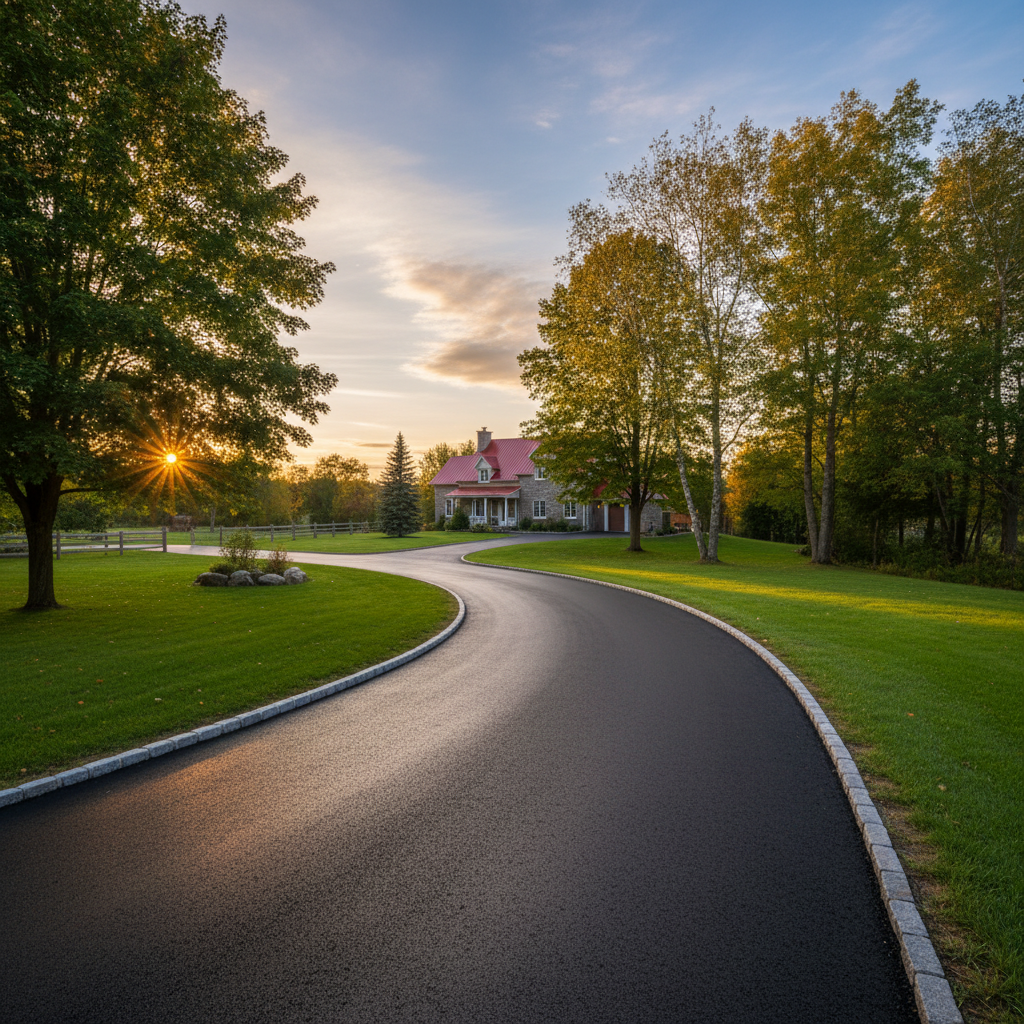
Driveway paving options and costs in Beaverlodge
Beaverlodge driveways get hit with a tough mix of spring thaw, long freeze–thaw cycles, and deep frost potential across the Athabasca–Grande Prairie–Peace River region. That matters because most homes here are single-detached (84.2% of dwellings), and with 77.2% of households owning, many homeowners are planning upgrades to the same day-in/day-out surfaces—especially in neighbourhoods like the older-residential areas near main streets and the typical subdivision blocks where lots are often established and grading is already “set.”
In this frost-susceptible zone, paving costs trend higher than in milder Alberta areas because contractors build thicker, well-compacted granular base and pay extra attention to drainage. Frost penetration routinely exceeds 1 m and can run higher in harsh spots, so the job design focuses on keeping meltwater from cycling under the surface. Also, the paving window is tighter: hot-mix asphalt needs adequate air temperatures (generally above 10°C), so scheduling in mid-May to September can add mobilization pressure and premiums.
As a result, you’ll see wider quote ranges for the same asphalt or concrete size when crews include undercutting, stabilization, and proper edge restraint. To help you compare apples-to-apples, the table below shows typical lifespan, maintenance needs, and realistic cost ranges for Beaverlodge.
| Material |
Lifespan |
Maintenance |
Best For |
Price per sq ft |
Price Range |
| Asphalt (new installation, proper base) |
15–25 years |
Sealcoat every 3–5 years |
Balanced cost + durability when base is done right |
$6.50–$10.50 |
$6,500–$12,000 |
| Asphalt (overlay on existing gravel base) |
8–15 years |
More frequent patching; consider sealcoat |
Budget option when the subgrade is still stable |
$5.75–$9.00 |
$5,800–$10,500 |
| Interlocking concrete pavers |
25–40 years |
Replace individual stones as needed |
High curb appeal and easy repairs |
$10.00–$16.50 |
$9,000–$18,000 |
| Poured concrete (broom finish) |
20–35 years |
Crack sealing as needed |
Low maintenance look with straight, clean edges |
$9.00–$15.00 |
$8,000–$16,000 |
| Exposed aggregate concrete |
20–35 years |
Periodic crack sealing; surface cleaning |
Grip + premium look for winter driving conditions |
$12.00–$19.00 |
$10,500–$20,500 |
| Gravel / crushed stone (budget option) |
5–10 years |
Top up and re-grade as rutting develops |
Lowest upfront cost before you’re ready to pave |
$3.00–$6.00 |
$3,000–$7,500 |
Prices are estimates only and vary by project scope, site access and material selection.
What affects the price of paving in Beaverlodge
Two quotes for the same Beaverlodge driveway can easily differ by 30–50% because the “material price” is only one slice of the total. The bigger swing usually comes from what’s happening under the pavement: how much undercutting is needed, how the granular base is built, whether drainage is corrected, and how much effort it takes to keep the surface stable through Alberta’s freeze–thaw cycle.
In the Athabasca–Grande Prairie–Peace River region, frost penetration routinely exceeds 1 m and can approach 1.5–2 m in harsher pockets. That means deeper granular construction is not optional if you want to reduce heaving and cracking. Where coastal BC projects may need less frost protection, Northern Alberta typically relies on thicker, well-graded aggregate layers—often in the 6–12 inch granular base range for typical driveway builds, plus careful compaction and positive drainage. The paving season is also short: hot-mix asphalt generally requires air temperatures above 10°C, so spring grading and fall constraints can compress schedules and affect crew availability.
For concrete, locally common fine-grained subgrades (clays and silts) can force stabilization or removal before base placement, which raises cost but protects the slab. A common real-world example: if an older driveway built on weaker soils is torn out to sound subgrade, you may move from an asphalt cost closer to the low band near $6,500–$12,000 toward the high end because added excavation and hauled-in base material aren’t “optional.” Another example is drainage: fixing a low spot or adding proper slopes can add labour, but it often prevents premature asphalt failures that would otherwise trigger repeat repairs and sealing earlier than expected. With 48.9% of homes built before 1981 in Beaverlodge (Statistics Canada, 2021 Census), many properties have older grading patterns that contractors must correct before paving.
| Price Factor |
Why It Matters |
Cost Impact |
| Driveway area in sq ft |
Most material and labour scales directly with square footage |
High (+/- 40% total variance on size) |
| Base depth required |
Frost line and local soil type determine granular thickness to prevent heave |
High; deeper base can add hauling and compaction time |
| Grading and drainage work |
Proper slope and daylighting/surface drainage keep meltwater out |
Medium to high if swales/ditches or low spots are corrected |
| Tear-out of existing surface |
Breaking and hauling concrete or old asphalt adds equipment and disposal |
Medium; increases cost especially with reinforced concrete |
| Edge restraints and curbing |
Prevents paver movement and asphalt edge raveling in thaw cycles |
Medium; often required for clean long-term edges |
| Sealing requirement |
Asphalt needs sealcoat after 6–12 months to protect from moisture damage |
Low to medium upfront; affects lifecycle costs |
| Site access |
Narrow lots slow down delivery and can require smaller equipment |
Medium; can add time and mobilization |
| Asphalt mix specifications |
Freeze–thaw-rated mixes and proper binder selection improve long-term performance |
Low to medium; usually worth it for northern service |
Permits & regulations in Alberta
For Alberta homeowners in Beaverlodge, paving a private driveway on your own property typically does not require a building permit. The usual case is surface work within your lot—removing an old driveway and replacing it with asphalt, concrete, pavers, or gravel—so long as you are not altering municipal infrastructure.
Permits and approvals are commonly required when your paving affects the municipal right-of-way. Examples include creating or changing a driveway apron/cut at the sidewalk or boulevard, altering a curb cut, changing how stormwater drains from the right-of-way, or modifying municipal ditches/culverts. Some municipalities also have lot-grading and drainage rules that restrict where water can flow and how close hard surfaces can sit to property boundaries—so you should confirm the lot-grading expectations before work starts.
Step-by-step, verify your contractor the Alberta way: first, ask for their Alberta licence reference (or licence number if applicable for their trade category) and confirm they are in good standing using the relevant online registry. Next, request a certificate of insurance showing liability coverage that includes your address and jobsite. For workers, confirm WCB coverage (or WSIB/WCB status as applicable) using a clearance letter or direct proof from the insurer/registry they provide. Finally, call Alberta One-Call before excavation so underground utilities are located and marked—especially if you’ll be undercutting, adding base, or cutting near service lines.
Asphalt vs pavers vs concrete for Beaverlodge driveways
In Beaverlodge, the best driveway option is the one that survives freeze–thaw without letting meltwater get trapped underneath. Asphalt is typically the lowest upfront cost, while interlocking concrete pavers are usually the highest upfront but offer the most flexible repairs. Poured concrete usually sits in the middle, but it can crack under northern movement if the base and air-entrainment aren’t handled properly.
All three choices depend on base preparation depth in the Athabasca–Grande Prairie–Peace River frost-susceptible zone. Contractors should build a thicker, well-graded granular base and compact it thoroughly, then maintain positive drainage so the driveway drains away instead of cycling water through freeze–thaw right under the asphalt or slab. With plowing and winter sanding/salting routines, edge integrity matters: pavers resist localized damage well, while asphalt needs protection through sealcoating.
Maintenance expectations differ. Asphalt driveways generally require a sealcoat after installation—often within 6–12 months—then every 3–5 years to reduce moisture penetration. Pavers can be repaired by replacing individual units if frost heave or a localized settlement happens. Poured concrete is durable when properly air-entrained and constructed, but it can still develop cracks from seasonal movement and de-icing if it’s not designed for the climate and local soils.
Where price differences are justified: say two contractors quote similar sizes and drainage work. If asphalt lands near the lower end of $6,500–$12,000 and pavers are around $9,000–$18,000, the added paver cost can be worth it if you want the option to fix one area without replacing the entire driveway after a thaw-season problem. In older Beaverlodge lots (many established long before modern grading standards), pavers’ repairability can pay off.
| Material |
Frost Resistance |
Curb Appeal |
Repair Method |
Lifespan |
Price Band |
| Asphalt (sealed regularly) |
Good with proper base and drainage; sensitive if water is trapped |
Medium |
Patch/overlay; sealcoat to restore protection |
15–25 years |
$6,500–$12,000 |
| Interlocking concrete pavers |
Excellent when edges are restrained and base is compacted |
High |
Replace individual pavers; re-level sand setting layer |
25–40 years |
$9,000–$18,000 |
| Poured concrete (air-entrained) |
Good; cracking prevention depends on base and mix design |
Medium to high |
Crack sealing; localized patching |
20–35 years |
$8,000–$16,000 |
| Exposed aggregate concrete |
Good with correct base; texture helps winter traction |
Very high |
Crack seal and patch; less “invisible” than smooth concrete |
20–35 years |
$10,500–$20,500 |
| Permeable pavers (drainage grid) |
Very good when subgrade supports infiltration and base is built correctly |
High (modern look) |
Replace affected pavers; flush/maintain openings |
25–35 years |
$11,000–$22,000 |
| Chip seal / tar-and-chip |
Moderate; performance varies with base and thickness |
Low to medium |
Spot re-chip; re-seal cycles as needed |
7–12 years |
$5,000–$9,000 |
How to choose a paving contractor in Beaverlodge
Choosing a paving contractor in Beaverlodge comes down to proof, not promises. Start with Alberta compliance checks. Ask for their Alberta licence details (where applicable for their trade category) and confirm they are eligible to do the work. Request a certificate of liability insurance naming your address and showing the coverage limits. Then verify workers’ compensation: ask for current WCB clearance or proof of coverage (and that it applies to the workers on your site). If they can’t provide documentation quickly, that’s a practical red flag.
Next, get 2–3 itemised written quotes. You want labour + materials separated (base excavation/hauling, granular base material, asphalt mix, concrete materials, forms/edge restraints, disposal, and traffic control). Avoid lump sums that don’t state what thicknesses and compaction steps are included. Carefully read exclusions: is permit/municipal approval handling included if you’re changing a boulevard/cut? Is debris/disposal included, and where will the waste be hauled? What exactly is the warranty—workmanship length, product/manufacturer warranty (if any), and whether warranties are transferable to future owners?
For payment schedule, keep it tight: never pay more than 10–15% upfront. Hold back a portion until the job is substantially complete and you’ve received final grading confirmation and documentation (especially for base build and thickness). Demand a written timeline with a target start date and completion estimate, since Beaverlodge’s freeze–thaw schedule can limit weather windows.
- Confirm Alberta licence/eligibility for the scope they’re bidding.
- Request liability insurance certificate and verify dates/limits.
- Ask for WCB clearance/proof before work starts.
- Get itemised quotes with thickness and base build details.
- Clarify disposal: dump fees/hauling included or not.
- Confirm drainage plan: slope, daylighting, and low-spot fixes.
- Verify edge restraints (paver edging/curbing) are included where needed.
- Check if saw-cut control joints (concrete) or reinforcement plan is included.
- Ask about asphalt mix specs for freeze–thaw conditions.
- Review warranty terms and whether workmanship is separate from materials.
- Agree on a payment schedule with 10–15% maximum upfront.
- Get start date and completion timing in writing.
Concrete red flags in Beaverlodge include: contractors who won’t show proof of insurance or WCB coverage; quotes that skip base depth/compaction details; “guaranteed no cracking” wording (unrealistic in frost zones); vague scope language like “we’ll fix whatever’s needed” without a change-order process; and crews pushing work outside the proper weather window with no plan for cold mornings or short asphalt paving temperatures.
Frequently asked questions — paving in Beaverlodge
What causes potholes and how are they repaired?
In Beaverlodge and across northern Alberta, potholes usually start when water gets into small surface voids or cracks and expands during freeze–thaw cycles. In spring, meltwater can sit on low areas or edge failures; then plowing and tire loading open up the damage. The fix isn’t just patching the surface—good repairs remove the weak asphalt around the hole, check whether the granular base is damaged, and rebuild a compacted base before placing new asphalt. For small failures, a contractor may do a localized cold-mill and hot-mix patch. For repeated failures in the same area, an overlay or drainage correction is often the real solution. A proper repair plan also considers that your driveway is likely in a frost-susceptible zone where frost penetration can exceed 1 m, so water control is key.
How do I prepare for a paving project?
Before asphalt, pavers, or concrete work begins in Beaverlodge, clear vehicles from the area and make sure access paths are safe for deliveries and equipment. Mark where you need to keep clearances for garage doors, walkways, and any service panels. If you have sprinklers, flag irrigation lines so the crew can protect them during excavation. If your driveway drains toward a low spot or toward the garage, tell the contractor what you’ve noticed after thaws—this helps them design grading correctly. Confirm any municipal right-of-way considerations if the project includes a driveway apron/cut at a boulevard. Finally, ask for an itemised scope and timeline in writing so you know whether tear-out and disposal are included and when the driveway will reopen. Preparation can prevent delays in the tight mid-May to September paving window.
How do I compare paving quotes fairly?
Compare quotes by scope, thickness, and drainage—not just the total price. Ask each contractor what base depth is included and how they’ll handle frost-susceptible subgrades common in northern Alberta (fine-grained soils can need stabilization or undercutting). For asphalt, confirm whether they include proper granular base prep and whether sealcoat is recommended after curing—most good results include sealcoat after about 6–12 months, with regular maintenance every 3–5 years. For the overall budget, make sure the numbers align with local driveway price bands—new asphalt often trends around $6,500–$12,000, while interlocking pavers commonly land around $9,000–$18,000. Also check what disposal, edge restraints, and any drainage corrections are included. The best quote is the one that matches the same design details.
Can asphalt be laid in cold weather in Beaverlodge?
Asphalt should not be placed “whenever it’s available” in Beaverlodge. Hot-mix asphalt generally needs adequate air temperature (commonly above 10°C) and good drying conditions so it can compact and bond correctly. In colder mornings or after early fall frosts, asphalt can cool too quickly, reducing compaction quality and increasing the risk of premature surface failures. That said, crews may sometimes work near the shoulder of the season if temperatures and site conditions allow, but they should explain how they’ll protect the placement and ensure compaction meets spec. In a frost-susceptible region where freeze–thaw cycles are harsh, doing asphalt outside the paving window often costs more later through patching and possible overlay needs.
What is a driveway apron and do I need one in Beaverlodge?
A driveway apron is the paved section that connects your driveway to the sidewalk, boulevard, or curb area, often within the municipal right-of-way. Whether you “need” one depends on how water flows, how the existing curb cut or boulevard is built, and whether your project involves changing that connection. If your contractor is creating a new curb cut or altering boulevard grading/storm drainage, that’s typically where you’ll need municipal approval and it may require additional permitting steps compared to work entirely within your lot. For many Beaverlodge homeowners, the driveway apron becomes important when paving replaces a gravel approach that no longer drains well or when you want a clean, durable transition for snowplows and winter maintenance.
How do I maintain my driveway through Beaverlodge winters?
Winter maintenance is about protecting the surface from water intrusion and reducing mechanical damage. Start with snow management: plow early so the surface isn’t scraped repeatedly when ice forms. For asphalt, avoid repeated metal blade contact at the edges; edge damage is often where freeze–thaw begins. Try to keep traffic off newly sealed areas until the sealcoat is fully cured. De-icing salts help with traction, but excessive salt can accelerate surface deterioration—use sand/salt judiciously and keep applications controlled. For any asphalt, plan sealcoat maintenance (often every 3–5 years) because the Athabasca–Grande Prairie–Peace River frost environment can drive moisture damage once water finds its way in. For pavers, make sure sand joints aren’t washed out and re-level if settling occurs. If your driveway drains toward the garage, fix low spots before winter so meltwater doesn’t freeze under the surface.