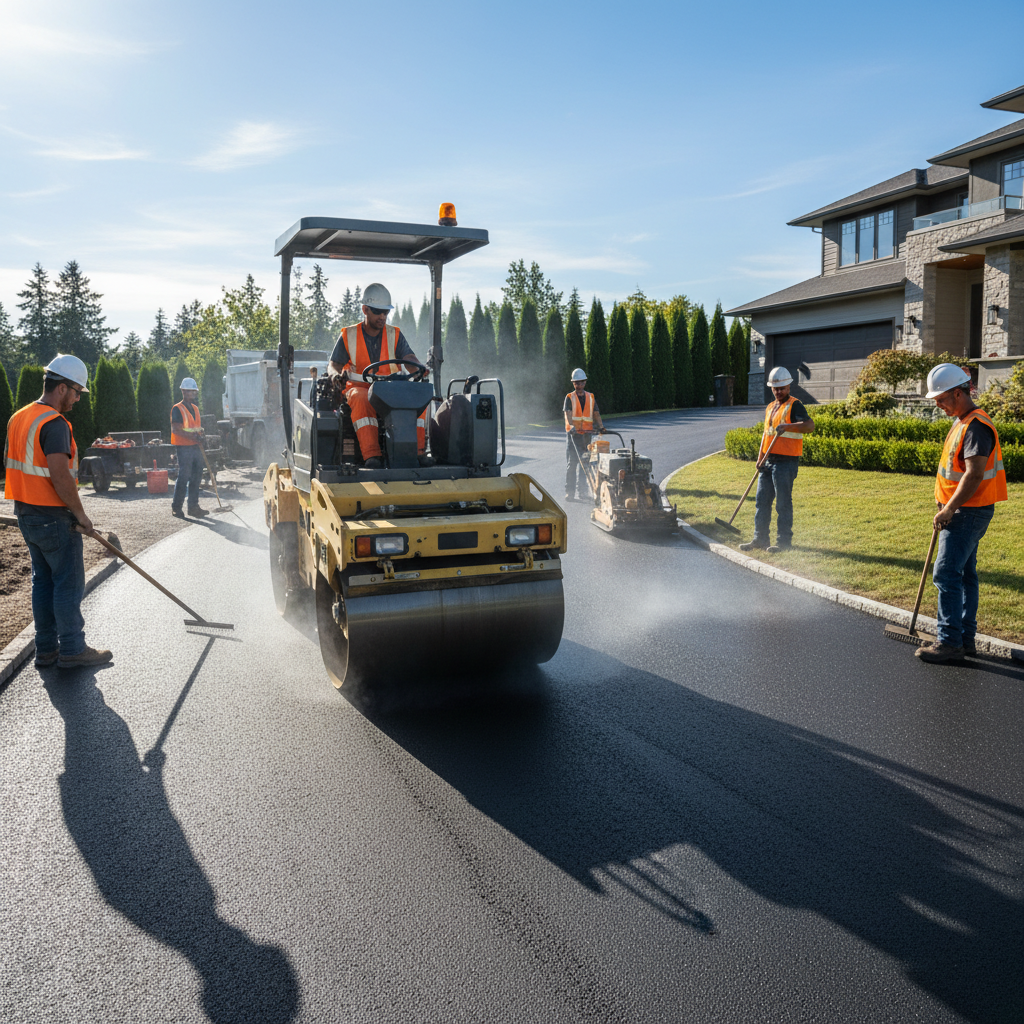
Driveway paving options and costs in Smoky Lake
Smoky Lake homeowners typically start with asphalt or concrete because they’re familiar, and because most local addresses are attached to single-detached homes—79.8% of dwellings are that type (Statistics Canada, 2021 Census). With 325 homeowner households and 70.5% of homes built before 1981, many driveways have older base conditions that need correction before any new surface goes down. That’s where pricing starts to diverge: a “new asphalt driveway” quote might include only lift-and-pave, or it might include deeper granular rebuild, proper subgrade moisture conditioning, and drainage improvements.
In the Wood Buffalo–Cold Lake region, costs are shaped by deep frost penetration and intense freeze–thaw cycles. With a frost line guidance commonly in the 1.2–1.5 m range for northern Alberta, contractors in our area often design for heavier heave protection than southern communities. The shorter effective paving window (often May–September) also compresses schedules, so mobilization, weather risk, and overtime are factored into the unit rates—especially for smaller residential jobs where setup costs are spread over fewer square metres.
This work is particularly in demand around the core residential areas near downtown Smoky Lake and along the busier access routes where plowing and turnaround traffic beat up the edges of pavements. Next, use the table below to compare material options, typical lifespan, maintenance, and realistic price ranges for Smoky Lake projects.
| Material |
Lifespan |
Maintenance |
Best For |
Price per sq ft |
| Asphalt (new installation, proper base) |
15–25 years |
Seal coat every 3–5 years; patching as needed |
Value-focused driveways that see plowing |
$6 – $12 |
| Asphalt (overlay on existing gravel base) |
10–18 years |
Seal coat every 3–4 years; more frequent patching if base is weak |
Budget rebuild where base is sound enough |
$5 – $9 |
| Interlocking concrete pavers |
25–40 years |
Re-sand joints; replace individual stones if needed |
Curb appeal and easy repairs without full replacement |
$10 – $18 |
| Poured concrete (broom finish) |
20–30 years (with proper air-entrainment and base) |
Occasional crack filling; sealant if desired |
Low-maintenance flatwork with fewer moving parts |
$10 – $17 |
| Exposed aggregate concrete |
20–30 years |
Seal for staining protection; patching for isolated failures |
Slip-resistant finish and premium appearance |
$12 – $20 |
| Gravel / crushed stone (budget option) |
3–8 years |
Annual grading, topping up, weed control |
Short-term solution or very limited budgets |
$3 – $6 |
Prices are estimates only and vary by project scope, site access and material selection.
What affects the price of paving in Smoky Lake
In Smoky Lake, two quotes for what looks like the same driveway can vary by 30–50% once you account for base preparation, drainage correction, and how much frost-protection your contractor plans for. In the Wood Buffalo–Cold Lake economic region, that difference is often tied to deeper, better-compacted granular work: freeze–thaw cycles stress weak subgrades, and water that migrates into the base during shoulder-season thaw can lead to pumping, edge raveling, and early cracking. A properly built asphalt structure on a frost-susceptible subgrade typically requires robust base thickness and compaction control—often more than people expect if they’re comparing to southern Alberta pricing.
Another big driver is the paving window. Hot-mix asphalt generally requires air temperatures above about 10°C for paving, so schedules compress into May–September and contractors must factor weather delays. Asphalt mix design also matters: freeze–thaw-rated binder and aggregate choices can cost more, but they help the surface resist rutting and thermal cracking under repeated freeze cycles.
Concrete costs can rise when existing slabs or thickened bases must be removed and hauled, or when air-entrainment and reinforcement details are upgraded to manage cracking in northern conditions. Gravel jobs can look cheaper, but they often “cost twice” if the driveway is graded only lightly—then you’re paying for top-ups every season. As a rough guide, asphalt installations commonly land in the $6,000–$12,000 band, while interlocking pavers often fall in the $9,000–$18,000 range because of restraints, bedding sand, and more labour-intensive laying.
Finally, your local housing stock plays in: with 70.5% of homes built before 1981, many driveways have older approaches, poor drainage swales, or buried service conflicts that increase excavation and disposal. Even small grading adjustments can add measurable labour and equipment time—especially in a compact rural town where access and turning space are limited.
| Price Factor |
Why It Matters |
Cost Impact |
| Driveway area in sq ft |
The largest driver; materials and equipment scale with square footage. |
Often 40–70% of the total |
| Base depth required |
Frost line protection depends on granular thickness and compaction. |
Can add 15–35%+ |
| Grading and drainage work |
Slopes and ditch tie-ins keep meltwater from infiltrating joints and edges. |
Commonly 5–20% |
| Tear-out of existing surface |
Breaking up and hauling concrete or old asphalt takes time and disposal capacity. |
Often 10–25% |
| Edge restraints and curbing |
Prevents paver spread and asphalt edge break-down under plowing. |
Typically 3–12% |
| Sealing requirement |
Asphalt sealing every 6–12 months early life (and then 3–5 years) protects binder. |
Usually 1–6% of annualised cost |
| Site access |
Narrow gates, soft ground, or limited turning slows placement and requires extra steps. |
Can add 5–15% |
| Asphalt mix specifications |
Freeze–thaw-rated mixes and binder choices improve performance in northern cycles. |
Often 5–20% depending on requirements |
Permits & regulations in Alberta
In Alberta, paving a private driveway within your own property typically does not require a building permit—because you’re improving an existing, private hard-surface area rather than constructing a new building. However, work that affects the municipal right-of-way usually does require municipal approval. That includes things like new or modified curb cuts/driveway approaches, any changes to boulevard grading, and alterations to storm drainage flow patterns. If your contractor plans to tie into municipal ditches or adjust drainage so water doesn’t cross sidewalks or property lines, ask whether a permit/approval is required before excavation.
Before anything is dug up, you should expect all reputable contractors to arrange utility locates through the proper Alberta system (Alberta One-Call) and to protect services throughout excavation. Even on private lots, locates are essential because driveways in older Smoky Lake neighbourhoods often run near buried power, telecom, and servicing lines.
To verify a contractor’s credentials in a straightforward homeowner checklist: (1) confirm they’re properly licensed for the work scope in Alberta (use the appropriate provincial registry/search tools available online for the business name), (2) request a certificate of liability insurance showing active coverage and enough limits for excavation and paving, and (3) verify WCB coverage/clearance for the company and any subcontractors—ask for current proof and a clearance letter or equivalent documentation. Step-by-step, do it before you sign: call/email for documents, then match the names on the certificates to the exact legal entity on the quote.
Asphalt vs pavers vs concrete for Smoky Lake driveways
For Smoky Lake driveways, your best choice usually depends on how much you want to spend upfront versus how you want to repair later. Asphalt is the lowest upfront option, especially when the job includes proper base prep; in northern Alberta it needs sealing regularly because freeze–thaw cycling accelerates binder ageing and surface oxidation. Interlocking concrete pavers cost more at the start, but they’re repairable: if a section heaves, pumps, or settles, you can lift and reset only the affected units rather than replacing the whole surface. That’s a meaningful advantage in a place where deep frost and repeated cycles can create localized movement.
Poured concrete sits mid-range in many quotes, but it’s not “set and forget” for freeze–thaw. Proper air-entrainment and reinforcement/termination details matter a lot, and de-icing practices can still stress surfaces over time. Exposed aggregate can improve traction in winter conditions, though it also demands correct mix design and finishing to avoid early scaling. Across Wood Buffalo–Cold Lake, the base and drainage design are what make any of these materials last: contractors often overbuild the granular base to manage frost susceptibility and keep meltwater from infiltrating.
For a local dollar example, many homeowners find asphalt within the $6,000–$12,000 band for a straightforward installation, while interlocking pavers commonly land in the $9,000–$18,000 range once restraints, bedding sand, and labour are included. That difference is usually justified if you value curb appeal and want the ability to do spot repairs after plowing-related edge wear or minor subgrade movement.
| Material |
Frost Resistance |
Curb Appeal |
Repair Method |
Lifespan |
Price Band |
| Asphalt (sealed regularly) |
Good when built on a well-drained, properly compacted granular base |
Medium |
Mill/patch or overlay section |
15–25 years |
$6,000 – $12,000 |
| Interlocking concrete pavers |
Very good; can tolerate some movement because units are replaceable |
High |
Lift units, correct base, re-lay and re-sand |
25–40 years |
$9,000 – $18,000 |
| Poured concrete (air-entrained) |
Good if correctly air-entrained and jointed for freeze–thaw |
Medium to High |
Crack filling and patching; localized repairs only |
20–30 years |
$8,000 – $15,000 |
| Exposed aggregate concrete |
Good; depends heavily on finishing and correct mix design |
High |
Patch areas with matched mix (spot fixes) |
20–30 years |
$10,000 – $17,000 |
| Permeable pavers (drainage grid) |
Very good for drainage control when designed correctly |
High |
Replace limited sections; maintain vacuum/cleaning of joints |
25–35 years |
$10,000 – $20,000 |
| Chip seal / tar-and-chip |
Moderate; performance depends on binder and proper thickness |
Low to Medium |
Spot re-seal or re-chip over time |
5–12 years |
$4,500 – $9,000 |
How to choose a paving contractor in Smoky Lake
Picking the right contractor matters a lot in Smoky Lake because northern freeze–thaw performance is largely about base prep, drainage, and workmanship details. Start by verifying Alberta licensing for the contractor’s business scope, then ask for proof of liability insurance (certificate of insurance) that matches the company name and includes work/excavation coverage. For worker protection, confirm WCB/WCB coverage—ask for a current clearance letter or proof of coverage and verify that any subcontractors are included, not just the main firm.
Next, get 2–3 itemised written quotes. You want a breakdown that shows labour and materials separately (base materials, asphalt/concrete quantities, geotextile where used, compaction/rolling, saw cutting/jointing, disposal, and any drainage corrections). A “lump sum” quote with no quantities makes it hard to compare apples to apples—especially when some bids include a deeper granular base to protect against heaving while others do not.
Read the scope carefully: what’s included in tear-out, disposal, and restoration? Is permit/approval work included if any right-of-way changes are needed? Is grading tied to a specific slope and ditch tie-in? Clarify warranty terms: workmanship warranty length (often the key one), product/manufacturer warranty on materials, and whether the warranty is transferable if you sell your home. On payment, plan to never exceed about 10–15% upfront; use holdback (a portion) until completion and final walkthrough. Finally, ask for a written timeline: targeted start date, weather contingencies, and an estimated completion window.
- Ask for Alberta licensing details for the exact legal business name.
- Request certificate of liability insurance before work begins.
- Verify WCB/WCB coverage and get a current clearance letter/proof.
- Get 2–3 itemised quotes with quantities and unit prices, not just totals.
- Confirm base thickness and compaction requirements in writing.
- Require drainage/slope notes (where water goes when it melts).
- Clarify whether geotextile, filter fabric, or separation fabric is included (if needed).
- Check what tear-out and hauling/disposal costs are included.
- Confirm edge restraints, curb options, and jointing method (for concrete/pavers).
- Ask about sealing timing for asphalt (and whether early-life seal coats apply).
- Review warranty length, exclusions, and whether it covers settlement/heave symptoms.
- Use a payment schedule with a holdback until final grading/cleanup is complete.
In Smoky Lake, common red flags include: quotes that don’t mention base depth or compaction; starting excavation without utility locates; “no-drainage” approaches that rely on the existing slope; asking for most payment upfront; and vague warranty language that only covers materials but not workmanship.
Frequently asked questions — paving in Smoky Lake
How long before I can drive on new asphalt?
In Smoky Lake and across northern Alberta, typical asphalt driveways are ready for light vehicle traffic after the surface has cooled and set—often within 24 to 48 hours, depending on temperature and thickness. Contractors usually avoid heavy turning, sharp braking, or equipment loads until the mix is fully cured enough to resist tracking. If your project includes a new base rebuild and a binder course, curing and surface stability are a bit more sensitive to the weather during the short May–September window. Also, ask whether tack coat was used at the lift joints and whether you’ll need to stay off during any foggy/wet conditions. A good contractor will give you a written access window and will coordinate with paving and sealing schedules so you don’t trap moisture or damage the surface before it reaches strength. If you’re budgeting, factor sealing timing into future maintenance—many northern driveways need sealing work within the first year to protect the binder.
What causes potholes and how are they repaired?
Potholes usually form when water infiltrates the pavement and undermines the granular base during freeze–thaw cycles. In Smoky Lake, repeated thawing in spring and shoulder seasons can loosen the bond at edges and joints, especially if a driveway has drainage issues, low compaction, or thin base where frost movement is concentrated. Potholes are often a symptom of a bigger problem—like voids under the asphalt—so a proper repair removes the failed asphalt to sound material, corrects base condition (and sometimes replaces granular layers), then repaves and compacts in lifts. Surface patching alone can fail again if the base isn’t addressed. Expect a repair to be more effective when the contractor identifies the location pattern (near culverts, low spots, or plow-wear edges) and improves slope or drainage. Cost-wise, repairs are usually far cheaper than full replacement, and they’re one reason homeowners that budget for asphalt maintenance (and sealing) often protect their $6,000–$12,000 driveway investment longer.
How do I prepare for a paving project?
Start by clearing the driveway area and providing access for delivery equipment. In Smoky Lake, that can mean moving vehicles, trailers, and sheds/obstructions out of the work zone the day before excavation. Mark landscaping features, sprinkler heads, and any buried lines you know about. Arrange a plan for pets/children so the site stays safe while work crews remove and haul materials. If you’re having tear-out, note that break-up and disposal can take time—so confirm with your contractor whether you’ll have full driveway access before the paving day. For fairness, request that the quote lists what includes disposal and whether grading corrections are part of the scope. Also, confirm utility locate scheduling (Alberta One-Call) if excavation is involved. Finally, keep de-icing and winter maintenance in mind: if you’re planning concrete, ask how joint spacing and air-entrainment are addressed given local freeze–thaw demands, and if you’re planning asphalt, confirm the sealing plan so your new surface gets the protection it needs in northern conditions.
How do I compare paving quotes fairly?
To compare quotes fairly in Smoky Lake, insist on comparable scope details—not just a single bottom-line price. Ask for the total area in square feet and the thickness of the granular base, not vague statements like “proper base.” Make sure each quote addresses drainage and slope corrections, because deeper granular rebuild and regrading often explain big differences between bids. Confirm what’s included in tear-out and disposal (breaking and hauling old asphalt or concrete can vary widely). For asphalt, clarify mix specifications for freeze–thaw performance and whether sealing is included in the first-season plan. For pavers, verify edge restraints, bedding sand thickness, and how cut stones and borders are handled. For concrete, ask about air-entrainment and jointing, plus whether broom finish or exposed aggregate is in the scope. If one quote is dramatically lower, it may be missing steps that prevent frost heave and edge failures. As a reference point, asphalt installations commonly fall in the $6,000–$12,000 band, while interlocking pavers often land in the $9,000–$18,000 range.
Can asphalt be laid in cold weather in Smoky Lake?
Asphalt paving in Smoky Lake is limited by weather because hot-mix asphalt needs adequate air temperature to place and compact properly. In practice, most contractors target conditions when air temperatures are typically above about 10°C (and stable enough for compaction), which is why the short northern season affects scheduling. If it’s too cold or too wet, you risk poor compaction, premature surface defects, and reduced performance under freeze–thaw cycles. That’s especially important with Smoky Lake’s frost and intense winter cycles, where weak compaction can accelerate rutting and cracking. Some contractors may offer limited solutions (like scheduling within a warm window, using controlled heating, or adjusting operations), but they should spell out what they’ll do to meet mix and compaction requirements. Ask for their weather policy and how they protect the surface after paving. If your project is delayed into colder conditions, it’s often safer to reschedule than to force placement—because a driveway built for northern Alberta needs that early quality.
What is a driveway apron and do I need one in Smoky Lake?
A driveway apron is the section at the property frontage/approach that transitions from the street or walkway area to your driveway surface. In Smoky Lake, whether you “need” one depends on existing conditions and whether your work affects drainage and any right-of-way features. If your driveway ties into a municipal curb cut, changes to boulevard grading, or alterations to storm drainage are involved, you may require municipal approval, and the apron becomes part of a compliant, smooth transition. Even on private properties, an apron is often recommended when the first few feet of the driveway experience heavy plowing turns, settlement, or washboarding—common on older lots built before 1981. It can be built in asphalt, concrete, or sometimes with pavers, and it’s typically reinforced with better edge support and drainage detailing. Ask your contractor to include the apron in the scope if it’s needed for proper slope and tie-in; doing so can reduce edge failures that lead to early patching, helping protect the overall life of your driveway investment in the $6,000–$12,000 (asphalt) or $8,000–$15,000 (concrete) bands.