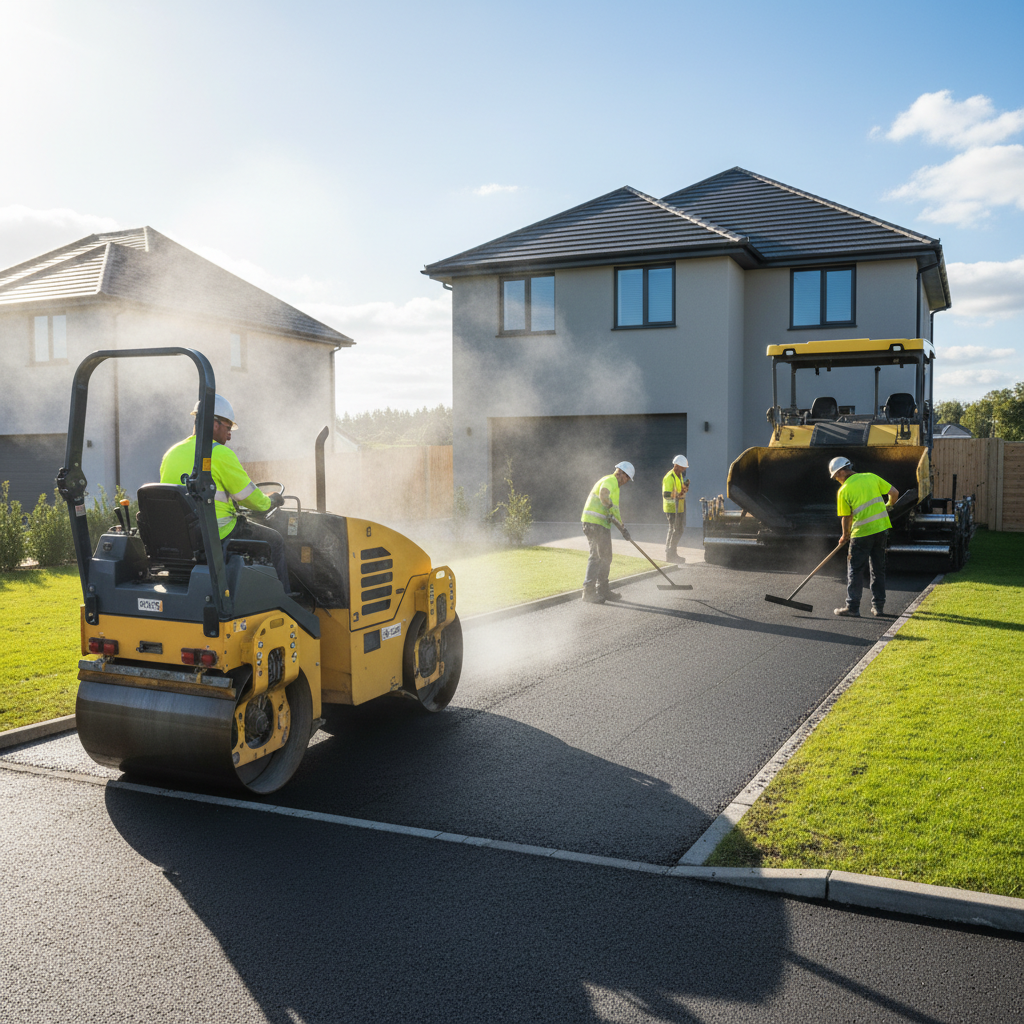
Driveway paving options and costs in Leduc
Leduc is a growing part of the Edmonton economic region, and driveways here see the same challenge that shows up every winter: water freezes and thaws, and that freeze-thaw cycling punishes a weak base. With 34,094 residents (Statistics Canada, 2021 Census) and about 9,490 homeowner households (Statistics Canada, 2021 Census), most private driveway work is tied to detached homes—single-detached houses account for 63.2% of dwellings—so demand for durable, well-drained surfaces is steady year-round.
In central Alberta, paving costs are shaped less by the surface material alone and more by frost protection and drainage design. Frost depth commonly reaches about 1.5 metres or more in Edmonton/central Alberta guidance, which means contractors typically plan a deeper, well-graded granular base and meticulous subgrade preparation. Freeze-thaw cycles also make moisture control critical: if water is trapped in the base, it expands when frozen and weakens the pavement when thawed, leading to cracking and settlement. That drives excavation, drainage stone, and compaction time—and bids rise when existing base conditions must be rebuilt rather than simply resurfaced.
Neighbourhoods where we often see strong demand in Leduc include Southfork and the surrounding mature residential blocks, where many lots are approaching the point where drainage upgrades and base renewal become cost-effective. From there, the main options come down to cost, appearance, and how repairable you want the system to be—so here’s a clear comparison to help you budget before you request your Leduc quote.
| Material |
Lifespan |
Maintenance |
Best For |
Price per sq ft |
| Asphalt (new installation, proper base) |
15–25 years |
Sealcoat every 3–5 years |
Best balance of upfront cost and smooth driving surface |
$7 – $12 |
| Asphalt (overlay on existing gravel base) |
10–18 years |
Sealcoat sooner (often 3–4 years if base is still settling) |
When the existing subgrade is sound and drainage is adequate |
$6 – $10 |
| Interlocking concrete pavers |
25–30+ years |
Occasional re-leveling of individual units |
Curb appeal and easy spot repairs without full replacement |
$12 – $20 |
| Poured concrete (broom finish) |
20–30 years |
Minimal; seal optional every 5–10 years |
Low maintenance, clean lines, strong winter durability |
$10 – $17 |
| Exposed aggregate concrete |
20–30 years |
Seal/refresh optional; watch for patching aesthetics |
Non-slip texture and premium look |
$13 – $22 |
| Gravel / crushed stone (budget option) |
3–8 years |
Top up annually; re-grade and weed control |
Short-term budget, low traffic, or temporary access |
$3 – $6 |
$7,000 – $15,000 Asphalt driveway paving and $12,000 – $28,000 interlocking paver projects are common ranges in the Edmonton area, and your final number usually depends on base depth, drainage corrections, and how much tear-out is required. Prices are estimates only and vary by project scope, site access and material selection.
What affects the price of paving in Leduc
In Leduc, it’s not unusual to see quotes for the “same driveway” vary by 30–50% across the Edmonton region because the real cost drivers usually live under the surface. Contractors can price very differently depending on whether they must rebuild the base, correct drainage, haul away unsuitable material, or install new edge restraints. Even with similar asphalt or concrete materials, labour time changes dramatically when access is tight, the slope is challenging, or the existing base is wet or unstable.
Frost protection and freeze-thaw cycling are decisive factors in central Alberta. Deeper frost requires a thicker compacted granular base to reduce frost heave, cracking, and settlement. In practice, Edmonton-area projects often call for a substantial granular section (typically in the 6–12 inch range for many driveway designs, depending on site conditions and subgrade), and the amount can increase if the subgrade must be stabilized. On top of that, asphalt mix design has to be freeze-thaw-rated, and hot-mix asphalt placement generally depends on suitable air temperatures (often above 10°C), which concentrates work into a shorter paving season and can raise scheduling and mobilization pressure.
Concrete costs can move for similar reasons. For example, poured concrete in Leduc can cost more if it requires thicker slabs, steel reinforcement, or extra-form work to handle uneven grades. Conversely, a straightforward, well-graded subbase can make asphalt overlays closer to the lower end of $7,000 – $15,000, while a full tear-out to rebuild the base can push you toward the higher end—especially when you’re replacing old asphalt that’s broken up and contaminated with fines.
| Price Factor |
Why It Matters |
Cost Impact |
| Driveway area in sq ft |
Labour, base, and surface materials scale directly with square footage |
Typically the largest line item; can swing the total most |
| Base depth required |
Frost protection thickness and compacted granular volume prevent heave and cracking |
More excavation/haul and more stone; increases cost notably |
| Grading and drainage work |
Proper slope and subsurface drainage keep water out of the pavement system |
Can add time for excavation, pipe/drainage stone, and re-compaction |
| Tear-out of existing surface |
Breaking up old concrete or asphalt and hauling material off-site is labour-heavy |
Often increases costs more than homeowners expect |
| Edge restraints and curbing |
Restraints stop paver or asphalt edges from spreading under winter expansion |
Adds material and formwork/installation time |
| Sealing requirement |
Asphalt needs sealcoat after initial cure; sealing reduces moisture and oxidation |
Shortens early-life wear; adds a future maintenance budget |
| Site access |
Narrow approaches slow equipment movement and can require additional staging |
Higher labour hours and sometimes additional equipment rentals |
| Asphalt mix specifications |
Freeze-thaw-rated mixes and correct aggregate selection improve durability in Alberta |
Usually costs more than basic mixes, but reduces premature failures |
Permits & regulations in Alberta
For many homeowners in Leduc, paving your private driveway within your own property generally does not require a building permit. However, if the work touches the municipal right-of-way or affects how stormwater is managed, approvals are commonly required. That includes installing a new curb cut, changing an existing driveway crossing in the boulevard, altering municipal storm drainage connections, or modifying the boulevard/ditch line in a way that changes how water flows. In those cases, you should confirm the requirement with the municipality before excavation begins.
Another practical issue is lot grading. Some Alberta municipalities enforce lot-grading expectations that restrict how close to property lines you can place hard surfaces and how water must be directed. Even where a permit isn’t required, you can still be held to grading and drainage standards—so the safe approach is to verify lot-grading rules locally, then design drainage accordingly.
Before any digging, always arrange utility locates through Alberta One-Call. Step-by-step, you can also protect yourself by verifying your contractor’s credentials: (1) confirm the contractor is licensed/registered as required for their trade and scope using the appropriate online registry; (2) ask for a current certificate of liability insurance naming you as an additional insured if applicable; and (3) request proof of workers’ compensation coverage (WSIB/WCB coverage, depending on the reporting structure) so you know workers are properly covered. If the contractor provides a clearance letter or current coverage documentation, keep copies with your contract paperwork.
Asphalt vs pavers vs concrete for Leduc driveways
For Leduc winters, all three materials can work well if—big if—they’re built on a stable, well-drained granular base designed for freeze protection and appropriate slopes. Asphalt is typically the lowest upfront option and gives a smooth ride, but it performs best when sealed regularly every 3–5 years to limit moisture intrusion and oxidation. Interlocking concrete pavers cost more to install, yet they’re highly repairable: if a section settles or a utility needs access, individual units can be lifted and re-set without demolishing the whole driveway. Poured concrete sits in the mid-range and can look sharp with a broom finish, but freeze-thaw durability depends heavily on proper air entrainment, proper curing, and joints—otherwise cracking can show up earlier.
In Edmonton-area freeze-thaw conditions, the base preparation matters more than the surface layer. Contractors commonly design the granular base and subgrade compaction to handle deeper frost and reduce water retention. Drainage design—daylighting and subsurface drainage where needed—often has a direct impact on whether asphalt stays crack-free or whether concrete joints behave as intended. For winter maintenance, salt and sanding can be harsher on the surface than people expect; smooth surfaces without good sealing or without air-entrained concrete can degrade faster.
Here’s a practical example: a typical asphalt driveway paving project may land in the $7,000 – $15,000 range, while interlocking pavers are commonly $12,000 – $28,000. The extra cost is usually justified when you want long-term curb appeal and the ability to repair localized failures—something that can be valuable in Leduc as older lots (especially those built before 1981) get drainage updates and base re-compaction over time.
| Material |
Frost Resistance |
Curb Appeal |
Repair Method |
Lifespan |
Price Band |
| Asphalt (sealed regularly) |
Good with proper base + correct mix; sealing protects against moisture |
Moderate (clean, dark finish) |
Patch and seal the affected area |
15–25 years |
$7,000–$15,000 |
| Interlocking concrete pavers |
Excellent; individual units tolerate movement when installed on the right base |
High (colour blends and patterns) |
Lift, re-level, replace selected pavers |
25–30+ years |
$12,000–$28,000 |
| Poured concrete (air-entrained) |
Very good when air-entrained and jointed properly |
Moderate to high (broom finish) |
Break out and replace panel sections |
20–30 years |
$9,000–$22,000 |
| Exposed aggregate concrete |
Good; depends on mix quality, finishing, and curing |
High (textured premium look) |
Patch matching can be difficult—usually panel replacement |
20–30 years |
$12,000–$25,000 |
| Permeable pavers (drainage grid) |
Good for water handling; works best with properly designed subsurface drainage |
High (modern look) |
Spot repair/replacement of units and drainage inspection |
20–30 years with maintenance |
$14,000–$30,000 |
| Chip seal / tar-and-chip |
Moderate; relies on good base and maintenance |
Low to moderate (textured surface) |
Re-chip and spot patch |
7–15 years |
$6,000–$12,000 |
How to choose a paving contractor in Leduc
Choosing the right paving contractor in Leduc is about more than price—it’s about whether they build for Edmonton-area freeze protection and whether they can prove they’re properly covered. Start by verifying Alberta licensing/registration for the scope they’re doing. Then request proof of liability insurance; a current certificate should show your project address or at least the contractor’s legal name and coverage limits. Finally, confirm workers’ compensation coverage (WSIB/WCB). Ask for a clearance letter or current documentation so you can see coverage is active.
Next, get 2–3 itemised written quotes, ideally with a breakdown of labour and materials rather than a single lump-sum number. Ask what’s included and what’s excluded: permit pull (if any), utility locates, excavation depth, base material type, compaction testing, drainage stone/pipe, dust control, and disposal. Also ask about edge restraints, because the cost of preventing migration of pavers or asphalt edges is small compared to the repair cost later.
Warranty matters. Confirm workmanship warranty length and what it covers (for example, settlement below a certain tolerance, joint failure, or base-related issues). If the manufacturer provides a product warranty (asphalt mix components or paver materials), ask whether it’s transferable. Keep a payment schedule conservative—never pay more than 10–15% upfront. Use a holdback until substantial completion, especially for base readiness and surface quality checks.
Finally, require a start date and completion estimate in writing, including weather contingencies. In central Alberta, crews often schedule around hot-mix asphalt placement temperature targets, so timeline clarity protects both sides.
- Ask for Alberta licensing/registration details matching the exact work to be performed.
- Request a current certificate of liability insurance; verify coverage limits.
- Confirm active workers’ compensation coverage (WSIB/WCB) with documentation.
- Get 2–3 quotes that are itemised (labour, base materials, surface, drainage, disposal).
- Require a scope-of-work list: excavation depth, base thickness, compaction expectations.
- Clarify drainage: slope targets, weeping/pipe options, and where water will go.
- Confirm edge restraints/curbing are included where needed to stabilize edges.
- Ask whether sealcoat is included after initial cure for asphalt, and the timing.
- Check whether tear-out and hauling are included, or if it’s a separate charge.
- Verify warranty terms: workmanship duration, exclusions, and escalation/rectification process.
- Use a conservative payment schedule: 10–15% upfront maximum; holdback until complete.
- Get the timeline in writing, including weather-based pauses and rescheduling terms.
Red flags in Leduc include: (1) a quote with no mention of base depth or drainage, (2) “we’ll overlay no matter what” without inspecting existing base conditions, (3) no proof of insurance or workers’ compensation coverage, (4) unclear warranty terms (or only vague promises), and (5) pressure to pay large deposits before base work is verified.
Frequently asked questions — paving in Leduc
How long before I can drive on new asphalt?
In Leduc and the Edmonton region, most new asphalt driveways can be opened to vehicles after the pavement has cooled and reached sufficient stability—often the same day or within about 24–48 hours, depending on temperature, thickness, and whether the mix is compacted to spec. If your project includes a sealcoat plan, note that seal typically isn’t done immediately; many contractors schedule seal after the asphalt has cured, commonly around the 6–12 month window, weather and product dependent. If the contractor quotes asphalt within the $7,000 – $15,000 band, it should still include a clear cure/opening schedule and a maintenance plan. Good base compaction and drainage also reduce the chance of tracking or early surface movement.
What causes potholes and how are they repaired?
Potholes usually start from water getting into weak spots—often around edges, low areas, or places where the base wasn’t properly graded and compacted for central Alberta frost conditions. Freeze-thaw cycles then expand moisture and break down the surrounding asphalt, leading to voids that become potholes. Repairs typically include saw-cutting the damaged area into a solid perimeter, removing failed material down to stable base, re-building with properly compacted granular layers, and then patching with asphalt matched to the project mix. A professional repair also addresses the drainage issue that caused the failure; otherwise the same pattern reappears. If your driveway is reaching the stage where seal maintenance was missed, addressing it early can be cheaper than rebuilding.
How do I prepare for a paving project?
Preparation is mostly about making the site accessible and confirming details ahead of excavation. In Leduc, review property access for equipment—gate widths, turns, and whether there’s room for a skid steer or dump truck. Clear vehicles, trailers, and decorative items from the driveway footprint and ensure hoses and outdoor electrical are protected or moved. If you have existing underground services (irrigation, wiring for lights, drainage), ask for utility locates well in advance via Alberta One-Call. Work with your contractor to set expectations for grading so water doesn’t run toward foundations or neighbouring lots. Also, if you’re in an older neighbourhood with lots built before 1981 (26.6% of homes in the area, Statistics Canada, 2021 Census), expect the base may contain fines; ask your contractor whether base stabilization or deeper excavation is likely.
How do I compare paving quotes fairly?
To compare quotes fairly in Leduc, insist on apples-to-apples scopes. Look for included items: excavation depth, base material type and thickness, compaction steps, drainage correction (if any), edge restraints, and disposal/haul. For asphalt, confirm the mix design is suited to freeze-thaw performance and whether sealcoat is included after cure; for concrete, confirm air entrainment and jointing approach. Compare total price alongside unit quantities (square footage) and how each contractor handles the existing base—overlay-only quotes may look cheaper but can fail faster if drainage is inadequate. A transparent quote that explains why it’s in the $7,000 – $15,000 asphalt range or in the $12,000 – $28,000 paver range is usually the easiest to trust.
Can asphalt be laid in cold weather in Leduc?
Asphalt can be placed only when conditions allow proper compaction and curing. In Leduc, colder nights and variable spring temperatures often limit paving until weather is consistently suitable. Hot-mix asphalt placement generally requires air temperatures above about 10°C to get good workability and compaction. If it’s too cold, the mix can cool too quickly, which reduces density and increases the risk of early cracking or raveling during freeze-thaw cycling. Your contractor should schedule around forecast conditions and describe what they’ll do if weather shifts—sometimes paving pauses until the temperature threshold is met. If a contractor promises asphalt installation during consistently cold periods without temperature controls, that’s a concern.
What is a driveway apron and do I need one in Leduc?
A driveway apron is the paved transition area between the driveway and the street or boulevard crossing, where the grade changes and vehicles enter/leave the property. Whether you “need” an apron depends on your existing crossing conditions—especially if you have a curb cut, a boulevard dip, or uneven drainage near the crossing. In Leduc, any work impacting the municipal right-of-way (like changes to curb cuts or storm drainage connections) typically involves municipal approval, so ask your contractor whether your scope includes an apron and whether permits/approvals are required. An apron also matters for durability: it reduces stress concentration where pavement meets changing grades. If your contractor is budgeting repairs, confirm they’re addressing the apron area rather than only overlaying the main driveway slab.