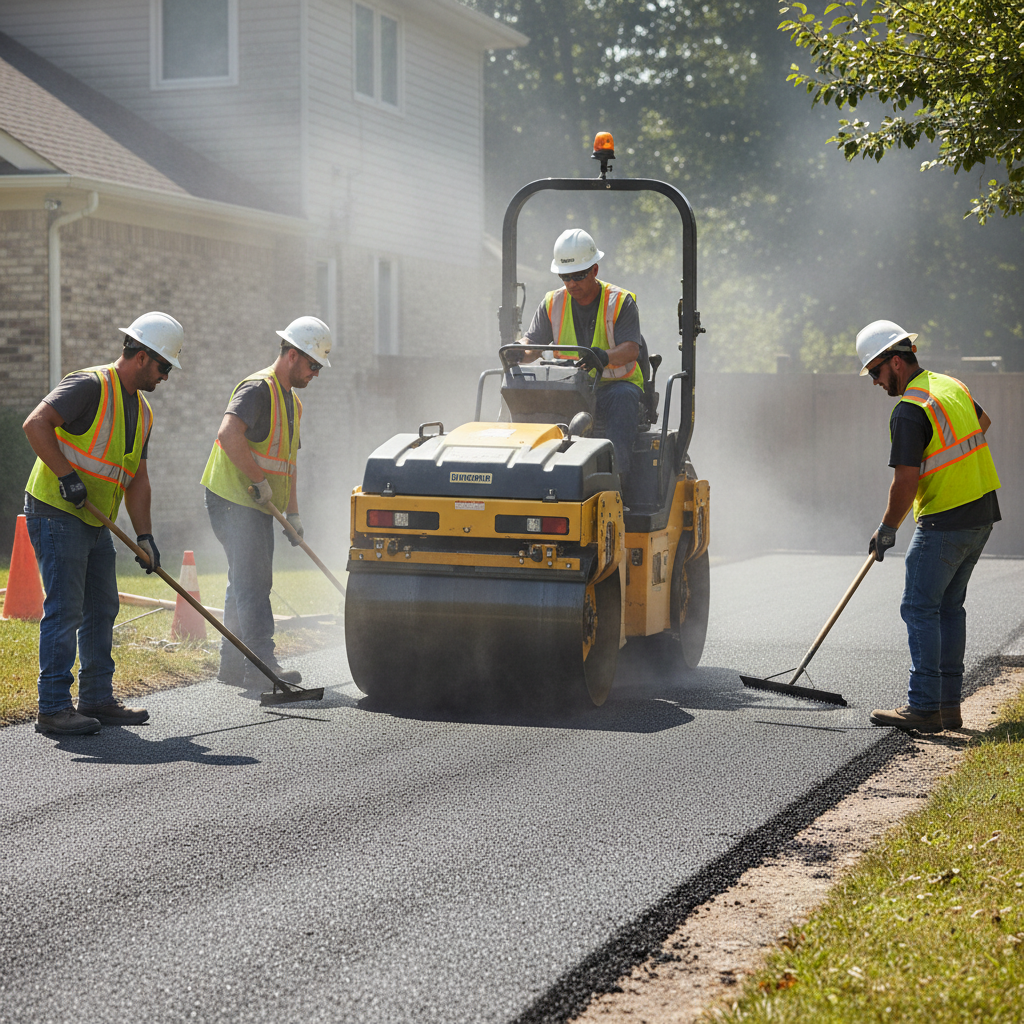
Driveway paving options and costs in Tweed
Tweed, Ontario is a great place to live, but driveways here have to earn their keep. With 88.6% of dwellings in the local area being single-detached homes (Statistics Canada, 2021 Census), most private driveways are tied to detached-house lots, which creates consistent demand for asphalt, interlock and concrete. It also matters that 61.2% of homes were built before 1981 (Statistics Canada, 2021 Census); older properties often have settled base, soft spots, or drainage patterns that need correcting before any new surface goes down.
In the Kingston–Pembroke economic region, paving pricing is shaped first by climate and soil. Frost penetration commonly reaches around 4 feet (about 1.2 m), and freeze–thaw cycles are intense. That means contractors in and around Tweed typically excavate deeper and rebuild a compacted granular base with good drainage (ditching, swales, and sometimes French drains). Spring shoulder seasons are also wetter, and hot-mix asphalt needs air temperatures above about 10 °C—so the paving window is tighter, which can affect schedule availability and push costs higher when demand peaks.
In Tweed’s more active residential stretches—commonly around the town’s core and along Highway 7 approaches—driveway work is especially in demand because homeowners want a cleaner look and better vehicle access before winter. Use the table below to compare realistic material options and typical cost ranges for a properly built base.
| Material |
Lifespan |
Maintenance |
Best For |
Price per sq ft |
Price Range |
| Asphalt (new installation, proper base) |
15–25 years |
Seal every 3–5 years; crack fill as needed |
Best all-around value for rural driveways |
$6.50–$10.50 |
$4,500–$9,000 |
| Asphalt (overlay on existing gravel base) |
10–18 years |
Seal every 3–5 years; monitor joints/edges |
When you keep some existing base and need a budget lift |
$5.50–$9.00 |
$3,800–$8,200 |
| Interlocking concrete pavers |
25–35 years |
Weed control; occasional replacement of individual stones |
High curb appeal and easy repairs |
$11.00–$17.50 |
$6,500–$14,000 |
| Poured concrete (broom finish) |
25–30 years |
Minor patching; reseal only if desired/appropriate |
Durable, straightforward surface with solid base |
$10.00–$18.00 |
$7,000–$15,000 |
| Exposed aggregate concrete |
20–30 years |
Seal occasionally; clean and re-seal if chalking appears |
Slip resistance and decorative finish |
$12.00–$21.00 |
$8,200–$16,800 |
| Gravel / crushed stone (budget option) |
3–10 years (depends on base and drainage) |
Top up annually or as needed; re-grade and compact |
Temporary access or lowest upfront spend |
$2.00–$5.50 |
$2,200–$6,200 |
Prices are estimates only and vary by project scope, site access and material selection.
What affects the price of paving in Tweed
Even when two homeowners describe the “same driveway,” quotes across the Kingston–Pembroke region can swing by roughly 30–50%. The biggest reason is that asphalt and concrete pricing here is driven by how much work it takes to reach stable material below the surface—especially with frost penetration around 4 feet and strong freeze–thaw cycles. If the subgrade is clay, has past drainage problems, or has already settled, contractors often need extra excavation and imported aggregate to prevent heaving and surface cracking.
Another cost driver is the paving season. Hot-mix asphalt generally needs air temperatures above about 10 °C, so in colder months the window narrows and crews concentrate work into peak spring and summer weeks. That schedule pressure can affect pricing, particularly when you’re trying to book a specific start date. Mix design also matters: asphalt needs to be rated for freeze–thaw performance, and that can add small material costs that show up in the final number.
In Tweed specifically, older properties (61.2% built before 1981) frequently require more base rebuild than newer lots. For example, a driveway that’s been patched for years may require tear-out plus rebuilding a deeper granular base to match frost influence—while a simpler overlay on a well-draining gravel base can sometimes keep you closer to the lower end of the asphalt bands (around the $4,500–$9,000 range). Conversely, if you need grading, ditching adjustments, or a drainage correction before paving, the job often moves toward the higher end because the prep work is what protects the surface.
Concrete and interlock can also vary widely: interlock pricing jumps when edge restraints, proper bedding sand depth, or tight curves require more labour. Concrete can rise when air-entrainment and crack control measures are specified for freeze–thaw durability.
| Price Factor |
Why It Matters |
Cost Impact |
| Driveway area in sq ft |
Most materials and labour scale directly with surface area |
Largest driver (often 50–70% of total cost) |
| Base depth required |
Frost line depth influences granular thickness to prevent heaving |
Can add 10–25% if deeper base is needed |
| Grading and drainage work |
Fixing slope and directing water reduces future cracking and settlement |
Often adds 5–20% depending on site conditions |
| Tear-out of existing surface |
Old asphalt/concrete must be broken and hauled; disposal adds cost |
Can add 10–30% versus new work |
| Edge restraints and curbing |
Prevents paver spread and helps maintain clean asphalt/concrete edges |
Typically adds 3–12% |
| Sealing requirement |
Asphalt needs sealcoat after curing (commonly 6–12 months) |
About $400–$1,800 at time of sealing |
| Site access |
Narrow drives, slopes, and long hauls slow equipment and increase handling time |
Can add 5–15% |
| Asphalt mix specifications |
Freeze–thaw-rated mix costs more than basic mix designs |
Usually a small add, but totals can rise 2–8% |
Permits & regulations in Ontario
In Ontario, paving a private driveway within your own property usually does not require a building permit. Where approvals often come into play is when you alter the municipal right-of-way—examples include creating or changing a curb cut/apron at the boulevard, modifying storm drainage in the road allowance, or making changes that affect municipal infrastructure. Some municipalities also have lot-grading rules that can limit how close you can place hard surfaces to property lines or ditches, especially where drainage is a concern.
Before any excavation, always arrange utility locates. In Ontario this is typically done through Ontario One Call (call before you dig), and you should confirm your contractor is using the locate marks when setting excavation limits.
To verify a contractor in Tweed, take a few step-by-step checks. First, confirm their Ontario licence/registration details are current using the appropriate provincial business/contractor information they provide. Next, ask for a certificate of liability insurance showing driveway-scale work coverage; if they can’t provide it or it’s out of date, treat that as a red flag. Also request proof of WSIB/WCB coverage (or a clearance/coverage letter, depending on how they’re set up) because paving involves risks like cutting, hauling, and equipment operation. Finally, get these items confirmed before scheduling.
If your scope involves any boulevard work, ask who pulls the municipal approvals—your contractor should explain whether permit pulling is included or if you’ll need to coordinate approval steps.
Asphalt vs pavers vs concrete for Tweed driveways
For Tweed driveways, asphalt, interlocking pavers, and concrete each have a “best fit” based on winter conditions and the way you maintain the driveway. Asphalt is the lowest upfront cost and generally runs well when the base is built for frost protection, but it does require sealing every 3–5 years. Interlocking concrete pavers cost more up front, yet they’re easier to repair: if a section settles or a utility needs future access, crews can lift and reset individual stones without replacing the whole driveway. Poured concrete sits mid-range for many budgets, but it can be vulnerable to cracking if it isn’t properly air-entrained and controlled for freeze–thaw movement—especially when de-icing practices are rough on the surface.
Because frost penetration in the Kingston–Pembroke region is commonly around 4 feet, base preparation is non-negotiable across all three. Your contractor should rebuild compacted granular layers and ensure drainage is corrected so water doesn’t sit beneath the pavement. With plowing, sand and salt are also common winter realities in Tweed; materials that tolerate repeated freeze–thaw while handling winter abrasives tend to perform better. In practice, interlock often holds up well to plow impacts because localized damage is replaceable, while asphalt’s lifespan is strongly tied to whether sealcoat is scheduled after the pavement cures and before water gets into surface pores.
A concrete example of value: if asphalt is quoted at the typical $4,500–$9,000 driveway band and interlock comes in near the $6,500–$14,000 band, the extra spend can be justified on high-visibility driveways where curb appeal matters and you want patchability. If you’re mainly focused on lowest upfront cost and straightforward maintenance, asphalt is usually the better first choice—provided the granular base and drainage are done properly.
| Material |
Frost Resistance |
Curb Appeal |
Repair Method |
Lifespan |
Price Band |
| Asphalt (sealed regularly) |
Good with proper base and freeze–thaw-rated mix |
Moderate (clean, uniform look) |
Crack fill/patch; milling and overlay if needed |
15–25 years |
$4,500–$9,000 |
| Interlocking concrete pavers |
Excellent with engineered bedding and restrained edges |
High (variety of patterns and colours) |
Replace individual units or small sections |
25–35 years |
$6,500–$14,000 |
| Poured concrete (air-entrained) |
Good when air-entrained and crack control is used |
Moderate (can be broomed or textured) |
Patching; repairs to control cracks may be needed |
25–30 years |
$7,000–$15,000 |
| Exposed aggregate concrete |
Good; surface texture can handle winter well |
High (decorative finish) |
Patching/section repairs (spot fixes may differ in appearance) |
20–30 years |
$8,200–$16,800 |
| Permeable pavers (drainage grid) |
High with correct sub-base and filter fabric |
High to very high (modern drainage look) |
Replace sections; maintain sediment-free surface |
20–30 years |
$7,500–$16,000 |
| Chip seal / tar-and-chip |
Fair to good; depends heavily on base prep |
Low to moderate (more utilitarian) |
Top-up chip coat; re-surface cycles |
7–12 years |
$4,000–$8,500 |
How to choose a paving contractor in Tweed
Start by verifying coverage and credentials the right way. For Ontario projects in Tweed, ask for the contractor’s proof of Ontario licensing/registration (as applicable), current liability insurance, and WSIB/WCB status. You can check their Ontario registration online (or through the business information they provide), but the most practical step for homeowners is asking for up-to-date certificates and letters directly, then matching the company name and address to what’s on the certificate. If they won’t provide paperwork or only share an outdated COI, don’t proceed.
Next, get 2–3 itemised written quotes. Good quotes show labour and materials breakdown—not just a lump sum—and specify what’s included: excavation depth, granular base type and compaction, whether geotextile is used, drainage corrections, and disposal fees. Clarify exclusions (for example, what happens if a weak spot is discovered during excavation). Ask whether a permit pull is included if municipal right-of-way work is required, and confirm what’s included for saw cutting, edge restraints, and any traffic control.
Warranty matters. Look for a workmanship warranty length and what it covers (settlement? surface cracking? joint/edge issues?) and note whether the product/manufacturer warranty applies to you directly. Also confirm if warranties are transferable if you sell your home.
For payment, plan to pay no more than 10–15% upfront, with a holdback until the job is complete and cleaned up. Get your start date and completion estimate in writing so weather-related delays are documented.
- Confirm Ontario licence/registration details match the quoting company name
- Request current liability insurance and verify policy dates
- Confirm WSIB/WCB coverage or clearance letter (and that it’s current)
- Require a written, itemised quote with material quantities and unit rates
- Ask for base specifications: granular type, depth, and compaction expectations
- Confirm drainage plan (ditching/slope/French drain if needed)
- Clarify tear-out scope and disposal—no “we’ll handle it” language
- Check edge restraint details (especially for pavers and exposed edges)
- Ask when asphalt will be sealed and whether sealing is scheduled/guaranteed
- Get warranty terms in writing (workmanship and product, with exclusions)
- Agree on payment schedule with a holdback until final walkthrough
- Ensure photos are included for pre-base grading and post-install checks
Red flags in Tweed include contractors who (1) won’t show insurance/WSIB documents, (2) quote asphalt or concrete without discussing drainage and base depth, (3) refuse to provide an itemised breakdown, (4) demand large upfront payments beyond 10–15%, or (5) give vague timelines with no completion estimate in writing.
Frequently asked questions — paving in Tweed
Can asphalt be laid in cold weather in Tweed?
In Tweed and across Eastern Ontario, asphalt placement is mainly about temperature and curing conditions. Hot-mix asphalt typically needs air temperatures above about 10 °C for proper laydown and compaction, and contractors also consider surface temperature and wind/chill. If it’s cold, you can get poor compaction, trapped moisture, and weaker long-term performance—especially with Tweed’s freeze–thaw cycles and the region’s deep frost influence. That’s why many crews concentrate asphalt work in late spring through summer when the paving window is reliable. A well-built granular base still matters, but cold-weather paving increases the risk that you’ll be dealing with raveling or premature cracking sooner. If weather is questionable, ask whether they’ll postpone or use cold-weather practices that are designed for asphalt curing, and require the plan in writing.
What is a driveway apron and do I need one in Tweed?
A driveway apron is the part of the driveway that transitions from the municipal road/ditch area to your property—often at the boulevard area where drainage and vehicle entry meet. Whether you “need one” depends on where your driveway ties in, how your current curb cut/ditch is shaped, and whether you’re making changes to the right-of-way. If you’re only repaving within your property limits, an apron may not be required, but if you’re altering curb cuts or adjusting storm drainage patterns near the road allowance, municipal approval is commonly involved. In Tweed, where many properties rely on roadside ditch drainage, getting the apron and grading correct helps prevent water from pooling at the edge of the pavement—one of the causes of heaving and cracking over time. Ask your contractor whether your scope includes boulevard/ditch work and whether permits or approvals are required.
How do I maintain my driveway through Tweed winters?
Winter maintenance in Ontario is mostly about limiting water intrusion and minimizing surface damage. For asphalt, avoid letting salt brine sit and focus on reasonable de-icing habits—salt is common, but aggressive scraping right after snowfall can tear surface edges. Keep an eye on weak spots where water runs: if you see ponding after rain or melt, address drainage early rather than waiting for the freeze–thaw cycles to magnify the issue. For pavers, don’t let sand accumulate in the joints if it’s dislodging the bedding; regular brushing helps. For concrete, protect against scaling by using appropriate de-icers and avoiding heavy impact right on corners and joints. Regardless of material, plowing is easier when the surface is smooth and edges are restrained—this is why a properly built base and good drainage are as important as the surface layer.
Is it worth sealing a new driveway right away in Tweed?
Generally, you shouldn’t seal immediately the same week. Most asphalt needs time to cure so oils can come back and the surface can accept the sealcoat properly—commonly around 6–12 months depending on product and weather. In Tweed’s freeze–thaw conditions, sealing is worth it because it reduces how quickly water penetrates and helps slow surface raveling and cracking. Think of sealing as a protection step, not a fix for a poorly built base. If your driveway was quoted near the typical asphalt band (for example, $4,500–$9,000), ask the contractor whether sealing is planned and whether they’ll specify the expected seal timing and product type in your warranty paperwork. If you’re evaluating costs, remember that sealing is often an additional line item later (commonly around $400–$1,800), but it can extend service life and reduce expensive repairs.
What is a chip seal driveway and is it suited to Tweed?
A chip seal driveway is a surface treatment where liquid asphalt (or binder) is spread and covered with crushed stone chips. It’s usually more utilitarian than pavers or exposed aggregate, and it tends to be more sensitive to base preparation and traffic patterns. In Tweed’s climate, a chip seal can work when the granular base is properly built and the stone is graded for stability under freeze–thaw movement. However, it may require more frequent maintenance than a full asphalt paving job; expect periodic top-up or re-surfacing if the chips wear or migrate. If you want longer-term durability with fewer touch-ups, a new asphalt installation or interlocking pavers typically hold up better. That said, if you’re looking at a lower-cost driveway option and can maintain it, chip seal can be a reasonable fit—just don’t confuse “lower upfront cost” with “no base work required.”
How much does driveway crack repair cost in Tweed?
Crack repair pricing varies based on crack length, width, surface condition, and whether the base is moving (which is common when drainage is off and freeze–thaw cycles repeat). For short, stable cracks, contractors often use crack sealing materials and labour to clean and prepare the crack, then apply a sealant. If you have wider movement, raveling, or edge failure, you may need localized patching or a small section repair rather than simple sealing. As a ballpark for Ontario work, homeowners often see repair/sealing-type line items in the general range of $400–$1,800 depending on scope. If your surface is older or has drainage issues, addressing the root cause (grading, ditch/swale improvements, or base drainage corrections) is what prevents the cracks from returning. If you share photos and approximate driveway area, you can get a more accurate number from an itemised quote.