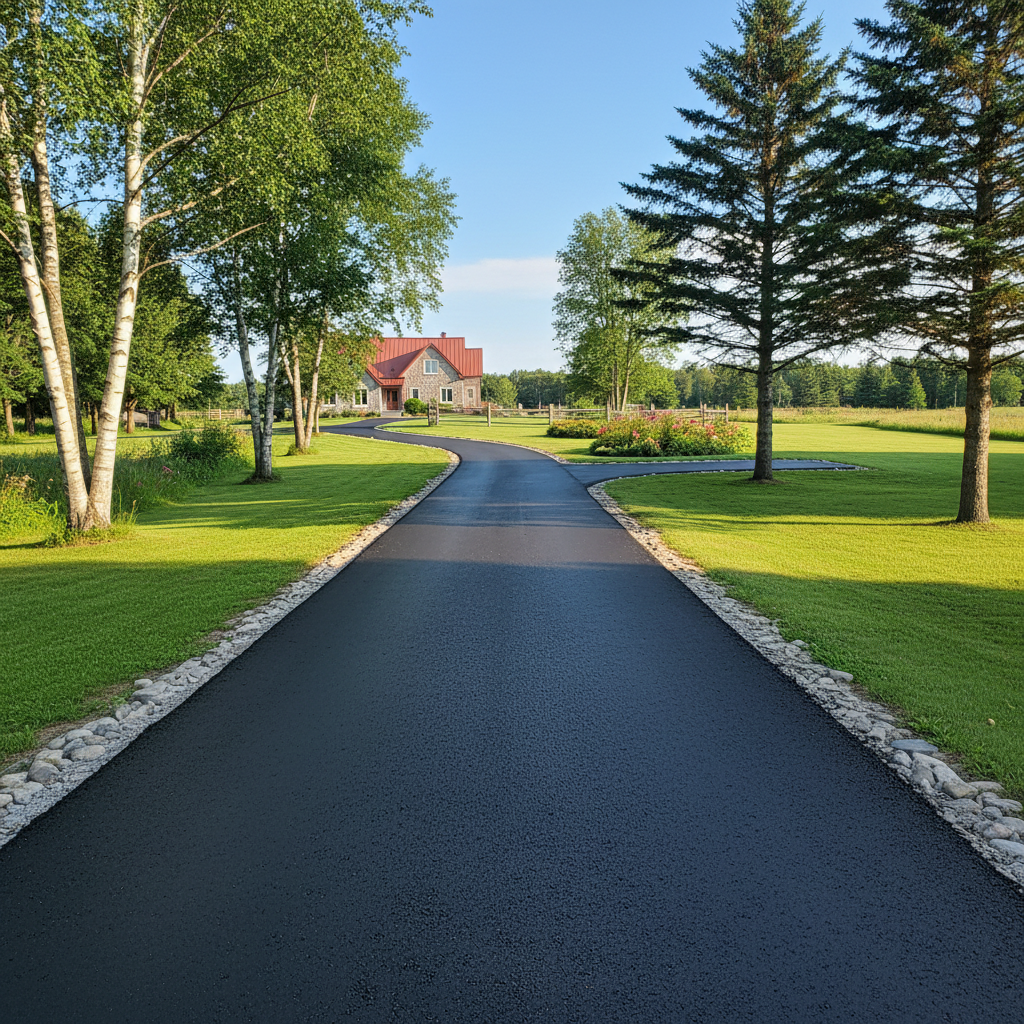
Driveway paving options and costs in St. Thomas
St. Thomas homeowners have a few solid driveway paving choices, and the “best” one usually comes down to frost performance, drainage, and how often you’re willing to do maintenance. With single-detached homes making up 64.8% of dwellings and homeowner households representing 67.8% of households (Statistics Canada, 2021 Census), there’s a steady need for durable surfaces that can handle long winters and busy plow/salt seasons.
In the London economic region, pricing is shaped by frost depth and aggressive freeze–thaw cycles. A typical frost line in southern Ontario is about 1.0–1.2 m, which means the driveway can’t rely on “thin pavement and hope.” We often design for a deeper, well-compacted granular base and careful drainage so water doesn’t sit under the asphalt during shoulder-season rain. That structural work is one of the reasons asphalt and concrete quotes can land higher here than in milder climates—even when the driveway size is the same.
Scheduling also plays a role: the paving window is compressed into late spring through early fall, and cool nights limit paving/compaction hours. During peak months, labour availability and haul distances can tighten, nudging unit pricing upward. You’ll also see stronger demand in older residential pockets—particularly around the west end and newer infill areas near downtown—where driveways are more often rebuilt due to cracking, washboarding, or settlement.
Below is a practical comparison of options for St. Thomas projects, using typical local ranges for materials and installed work before adding site-specific excavation or drainage upgrades.
| Material |
Lifespan |
Maintenance |
Best For |
Price per sq ft |
Price Range |
| Asphalt (new installation, proper base) |
15–25 years |
Seal every 3–5 years |
Best value with good base + drainage |
$4.50–$8.50 |
$4,500–$9,000 |
| Asphalt (overlay on existing gravel base) |
10–18 years |
Seal every 3–5 years; watch for base settlement |
When the existing base is stable and thickness can be increased |
$3.75–$7.25 |
$4,000–$8,000 |
| Interlocking concrete pavers |
25–40 years |
Occasional re-leveling of stones; re-sand top up |
Curb appeal and modular repairs |
$10.00–$17.50 |
$8,000–$16,000 |
| Poured concrete (broom finish) |
25–35 years |
Minor repairs; seal optional every 4–8 years |
Low visual maintenance with strong base |
$9.50–$15.50 |
$9,000–$18,000 |
| Exposed aggregate concrete |
25–35 years |
Seal optional; cleanings for salt/sand build-up |
Slip resistance and upscale look |
$11.00–$17.50 |
$10,500–$19,000 |
| Gravel / crushed stone (budget option) |
5–12 years (depends on grading/drainage) |
Re-grade and top up 1–3 times per year |
Temporary or lowest upfront cost |
$1.75–$4.00 |
$2,500–$5,500 |
Prices are estimates only and vary by project scope, site access and material selection.
What affects the price of paving in St. Thomas
In St. Thomas, it’s normal to see two reputable contractors quote the “same” driveway project with a 30–50% difference. The reason usually isn’t the asphalt or pavers—it’s the hidden groundwork: how deep they excavate, how they rebuild the base for frost, whether they correct drainage, and what exactly is included for haul-off, labour sequencing, and edges/restraints.
In the London region, frost line depth and freeze–thaw cycles are decisive cost factors. Southern Ontario’s frost is roughly 1.0–1.2 m, which typically pushes the design toward a thicker compacted granular base and careful subgrade preparation. When excavation and replacement add 6 inches (or more) of aggregate in problem areas—especially where clay soils hold moisture—your tonnage and labour both increase. Asphalt mix design also matters: it needs to meet freeze–thaw performance expectations, and that can affect the delivered cost of the mix.
Scheduling pressures also show up in pricing. Hot-mix asphalt generally requires air temperatures above 10°C, so the effective paving season is later and shorter. When demand spikes in late spring and early summer, fewer crews can spread the fixed costs over fewer days, which can raise unit pricing. For concrete work, the same frost reality remains: without proper base and air-entrainment, cracking risk climbs.
Concrete examples in St. Thomas are usually drainage-related. A driveway tied to a flat yard often needs grading correction to stop water from flowing under the slab, and that can add extra excavation and compacted base. Conversely, if you already have a stable, well-drained base and only need resurfacing, asphalt overlay can keep the project closer to the lower band of the typical driveway paving range—sometimes around the lower end of the $4,500–$9,000 asphalt band. If you’re starting fresh with deeper excavation plus paver restraints and full drainage, you may move toward the higher $8,000–$16,000 paver band.
| Price Factor |
Why It Matters |
Cost Impact |
| Driveway area in sq ft |
The more square footage, the more base, asphalt/concrete, and labour are required. |
Major (often the biggest single driver) |
| Base depth required |
Frost line conditions require thicker compacted granular thickness to reduce heaving and cracking. |
High where clay soils or low spots exist |
| Grading and drainage work |
Slope correction, swales, and proper runoff paths prevent water pooling beneath pavement. |
Moderate to high (can add substantial excavation) |
| Tear-out of existing surface |
Breaking, removal, and disposal of concrete/old asphalt adds equipment time and hauling costs. |
Moderate (higher for full-depth reconstruction) |
| Edge restraints and curbing |
Proper restraints stop pavers/spalls from spreading and keep lines straight. |
Moderate |
| Sealing requirement |
Asphalt should be sealed after 6–12 months, then maintained to resist oxidation and water damage. |
Low to moderate as an add-on/long-term cost |
| Site access |
Narrow lots, gates, and soft shoulders slow equipment movement and extend setup time. |
Moderate (sometimes high for tight urban sites) |
| Asphalt mix specifications |
Freeze–thaw-rated mix designs can increase material costs but improve long-term durability. |
Low to moderate per job; higher when full replacement is needed |
Permits & regulations in Ontario
In Ontario, paving a private driveway within your own property typically does not require a building permit. Where you do need municipal approval is work that touches the municipal right-of-way—most commonly new or modified curb cuts, changes to boulevard grading, or any adjustment to storm drainage connections that affect how runoff leaves the property. Some municipalities also have lot-grading or drainage rules that restrict how close hard surfaces can be to property lines and how water must be directed away from neighbouring lots and foundations. If your driveway ties into a municipal ditch, catch basin, or changes surface water patterns, treat it as “permit/approval territory” until confirmed.
Step one for a St. Thomas homeowner is always utility locates. Call Ontario One Call before excavation so buried services are marked. Step two is to confirm any lot-grading bylaw requirements with the local municipality, especially if the project involves re-grading or adding slope/drainage features.
Step three is verifying the contractor: ask for their Ontario business licence (or the applicable municipal registration if they need one), proof of general liability insurance, and WSIB/WCB coverage status. You can check for WSIB/WCB clearance information directly with the coverage provider or the contractor’s documentation. For insurance, request a current certificate of insurance showing your address or “certificate holder” (if offered) and confirm the coverage is active before work begins. Finally, ask the contractor for written confirmation of what is included in their quote—haul-away, disposal, and any restoration (topsoil/seed/sod) after excavation.
Asphalt vs pavers vs concrete for St. Thomas driveways
For St. Thomas, the real comparison between asphalt, interlocking pavers, and concrete is how each handles freeze–thaw, drainage, and daily winter abuse from salt, sand, and plowing. Asphalt is typically the lowest upfront option and is a good fit when you want predictable cost and smooth driving. It does require sealing every 3–5 years to protect against oxidation and water intrusion. Without sealing, surface binder can age faster in Ontario winters.
Interlocking concrete pavers have the highest upfront cost but strong curb appeal and the biggest flexibility for repairs. If one area settles or cracks, you can often lift and re-set stones without tearing out the entire driveway. For homeowners who plan to stay in the house long-term, that repairability is a key advantage in a freeze–thaw climate where small base issues can eventually show up at the surface.
Poured concrete sits in the mid-range, but it’s more sensitive to workmanship and design details. Proper subgrade prep, the right thickness, and air-entrainment are critical to reduce cracking risk under Ontario freeze–thaw cycles and salt exposure. Exposed aggregate can add slip resistance, but it’s not a substitute for base and drainage.
In London-region frost conditions, all options depend on a deeper, compacted granular base and positive drainage away from foundations. A driveway that sheds water well tends to perform better regardless of material. If your site is clay-heavy or slopes toward the house, expect more base excavation and potentially drainage correction, which can move projects toward the higher end of the pricing bands.
Where the price difference is justified: say you have a 500 sq ft driveway. Asphalt often targets the $4,500–$9,000 band when the base is sound and access is reasonable. Pavers may land near the $8,000–$16,000 band when full-depth prep, restrained edges, and stone settings are included. The jump is worth it if you value curb appeal and “localized repair” over time, or if you expect future grading changes.
| Material |
Frost Resistance |
Curb Appeal |
Repair Method |
Lifespan |
Price Band |
| Asphalt (sealed regularly) |
Good with proper base and drainage; seal reduces water damage |
Moderate |
Resurface/patch broken areas; full overlay if needed |
15–25 years |
$4,500–$9,000 |
| Interlocking concrete pavers |
Excellent where base is properly compacted and edged |
High (variety of patterns and colours) |
Lift-and-replace individual stones/sections |
25–40 years |
$8,000–$16,000 |
| Poured concrete (air-entrained) |
Good with air-entrainment, correct thickness, and joints |
Moderate to high |
Patch and seal; larger failures may require section repair |
25–35 years |
$9,000–$18,000 |
| Exposed aggregate concrete |
Good with proper base; surface finish holds up to sanding/salt better |
High |
Targeted patching; resurfacing is less common |
25–35 years |
$10,500–$19,000 |
| Permeable pavers (drainage grid) |
Very good where designed correctly for local water movement |
High (modern look) |
Lift/replace or clean-and-reline depending on system |
20–35 years |
$9,500–$17,500 |
| Chip seal / tar-and-chip |
Moderate; best for appropriate base and traffic levels |
Low to moderate |
Spot aggregate repairs; re-chip over time |
7–12 years |
$3,500–$7,000 |
How to choose a paving contractor in St. Thomas
Choosing a contractor in St. Thomas comes down to proof, not promises. Start by verifying Ontario coverage and credentials. Ask for the contractor’s WSIB/WCB status and request written confirmation (or a clearance/coverage letter where applicable). Then verify general liability insurance with a current certificate of insurance showing active coverage and enough limits for driveway work. If they advertise that they’re “insured,” request the certificate—you shouldn’t accept verbal confirmation.
Next, get 2–3 itemised written quotes that break down labour and materials rather than just a single lump sum. You want line items for excavation, granular base, compaction, asphalt/pavers/concrete supply, restraints/edges, tack coat (where asphalt is involved), and any drainage/grading corrections. Make sure disposal/haul-away is included and not treated as an “extra” after excavation.
Read the scope carefully: what is excluded (tree removal, extra excavation for soft spots, utility adjustments, or off-site drainage repairs)? Is a permit/municipal approval included if your driveway affects curb cuts or storm drainage? Ask for a timeline and make sure the start date and estimated completion are in writing.
For warranty, confirm the workmanship warranty length and whether the material/manufacturer warranty applies to products used on your site. Ask if warranties are transferable if you sell the home. Payment scheduling should be conservative—never more than 10–15% upfront. Hold back a portion until completion and final grading/clean-up are confirmed.
- Confirm WSIB/WCB coverage and request documentation before work starts.
- Verify general liability insurance with a current certificate.
- Ask for Ontario business licence/registration details (and any required municipal registration).
- Use itemised quotes (base, compaction, materials, haul-away, restraints) vs one-line estimates.
- Confirm excavation depth assumptions for your driveway (especially if clay soils exist).
- Require drainage plan details (slope, swales, edge grading, and water direction).
- Get clarification on disposal/haul-away of old asphalt/concrete.
- Check whether utility locates are included or if you must arrange them.
- Ask how edges will be restrained (pavers) or finished (asphalt/concrete transitions).
- Ensure the quote states asphalt sealing timing (typically after 6–12 months).
- Ask for a written warranty: workmanship duration and what’s excluded.
- Agree on payment milestones: small deposit, then payments tied to completed stages, with holdback.
In St. Thomas, common red flags include: contractors who won’t put excavation/base details in writing, quotes that ignore drainage/slope corrections, promises of “full-depth” work without stating granular thickness, vague warranty wording (especially no workmanship term), and requiring large upfront payments beyond about 10–15% without a clear schedule and signed agreement.
Frequently asked questions — paving in St. Thomas
Do I need a permit to pave my driveway in Ontario?
In most cases, paving a private driveway entirely within your own property in Ontario does not require a building permit. However, if the work affects the municipal right-of-way—like creating or changing a curb cut, altering boulevard grading, or modifying storm drainage patterns—you typically need municipal approval before excavation and paving. Some municipalities also have lot-grading or drainage rules that restrict how runoff is directed and how close grading changes can get to property lines. For St. Thomas homeowners, the safest approach is to ask the contractor what portion of the driveway touches the boulevard/ditch and then confirm requirements with the municipality. Also, don’t skip utility locates; Ontario One Call markings should be completed before any digging.
How long before I can drive on new asphalt?
For new asphalt in St. Thomas, you can usually drive on the driveway soon after compaction and cooling, but “how soon” depends on temperature, lift thickness, and weather. Typically, light traffic is best after the surface has cooled sufficiently and shows no tire pickup. If you’re doing resurfacing, installers often focus on compaction and allow time for the mat to cool before full use. To protect the new surface, avoid turning or parking on it until the contractor confirms it’s ready. Scheduling matters too: because St. Thomas has a shorter paving season with cool shoulder-season conditions, contractors often time work to ensure proper asphalt temperature and compaction for good freeze–thaw durability.
What causes potholes and how are they repaired?
Potholes usually start when water gets under the pavement and undermines the base, then freeze–thaw expands the damage. In Ontario, the freeze–thaw cycles can magnify small base failures, especially on driveways with poor drainage or an insufficient granular base. Potholes are repaired by removing failed asphalt to stable material, addressing the base (regrading/adding and compacting stone), and then placing and compacting hot-mix asphalt in lifts. The key is that a good repair fixes the cause, not just the surface patch. If the base is repeatedly failing, a localized patch may not hold and an overlay might be more cost-effective in the long run. This is also why detailed base preparation often pushes projects into the broader asphalt band of $4,500–$9,000.
How do I prepare for a paving project?
Preparation is where projects succeed or stumble. Start by clearing the driveway area completely—vehicles, trailers, and landscaping items—so equipment can work safely. If there’s existing asphalt or concrete, ask where the contractor will stage equipment and how they’ll handle haul-away. Arrange for utility locates (Ontario One Call) before excavation. Confirm whether your contractor will do grading/drainage corrections and whether you’ll need to move topsoil, sod, or plantings. If the driveway is near a foundation, ensure the drainage direction is clearly understood (water must be directed away, not toward the house). For older homes in St. Thomas—many built before 1981 (Statistics Canada, 2021 Census)—subgrade conditions can be less predictable, so preparation may include additional base excavation once the contractor inspects.
How do I compare paving quotes fairly?
Compare quotes line-by-line, not by “lowest price.” Ask each contractor to provide itemised scope: excavation depth, granular base depth/type, compaction method, drainage/grading changes, edge restraints/curbs, and disposal/haul-away. Confirm the paving material spec—especially for asphalt and its freeze–thaw performance—and whether sealing is included or recommended. Watch for missing assumptions: some quotes may treat drainage as “not required,” which can lead to faster failure during Ontario winters. Also confirm payment schedule, warranty terms, and the start/completion timeline in writing. For context, St. Thomas asphalt driveway paving typically lands within the local estimate band of $4,500–$9,000, while interlocking pavers are commonly quoted higher, often within $8,000–$16,000, depending on base prep and site access.
Can asphalt be laid in cold weather in St. Thomas?
In St. Thomas, asphalt placement in cold weather is limited by temperature and compaction requirements. Asphalt generally needs air temperatures above about 10°C for proper placement, and installers also need the mat to cool in a controlled way so it compacts correctly. Trying to pave too early in spring or too late in fall can lead to poor bonding, weaker compaction, and earlier surface distress under freeze–thaw cycles. Because southern Ontario has roughly 1.0–1.2 m of frost depth and frequent freeze–thaw transitions, timing is not just a schedule issue—it’s part of building a durable base-to-surface system. If a contractor proposes paving outside the workable window, ask what controls they use to ensure compaction quality and mix temperature.