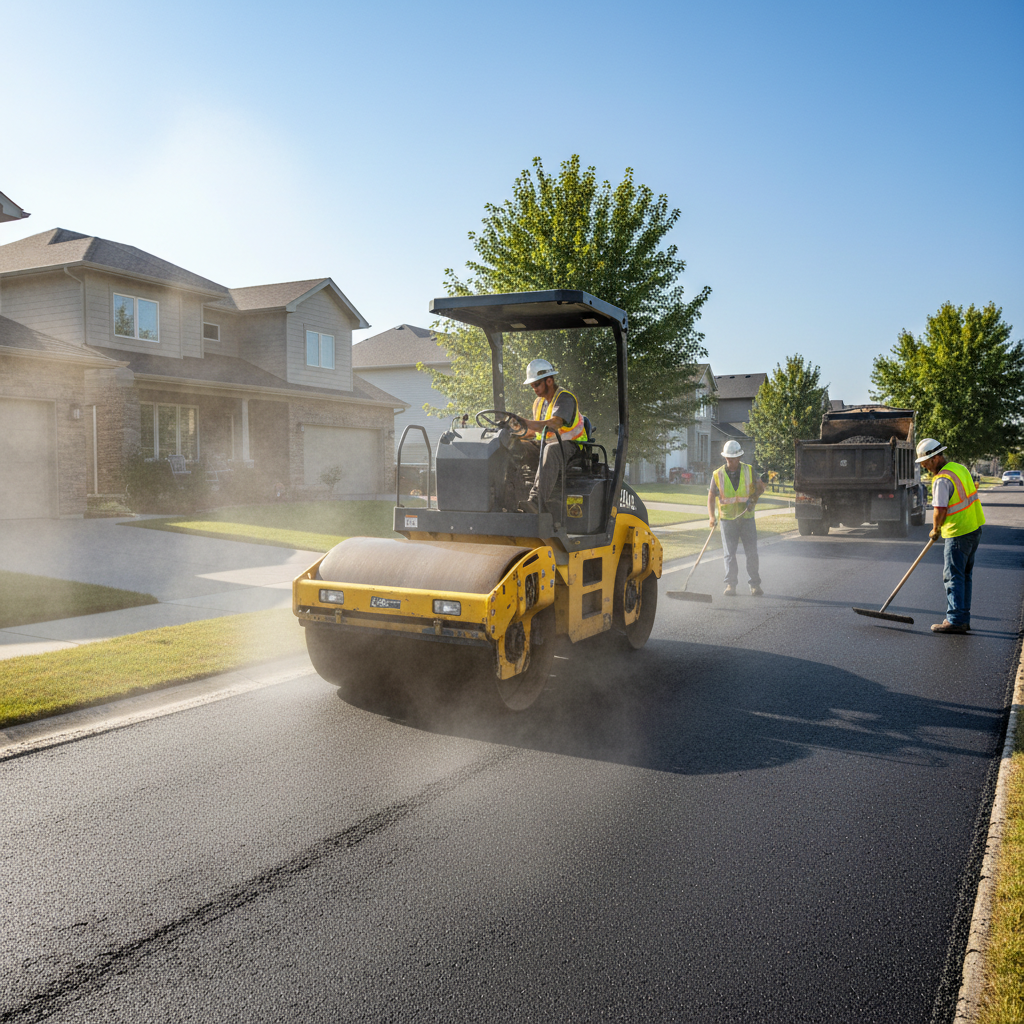
Driveway paving options and costs in Richmond Hill
Richmond Hill homeowners typically have three main driveway paving routes—hot-mix asphalt, interlocking concrete pavers, or concrete—plus smaller “upgrade” work like sealing and patching. With about 56.7% of dwellings in Richmond Hill being single-detached homes (Statistics Canada, 2021 Census), most driveways are attached to detached properties, which makes this a high-volume market for private paving. Locally, there are also many older homes; about 15.1% of dwellings were built before 1981 (Statistics Canada, 2021 Census), and those driveways often need more base correction at tear-out because the subgrade was compacted differently back then.
In the Toronto economic region, your quote is heavily influenced by frost depth and freeze–thaw cycles. Ground freezing to roughly 3–4 feet around Toronto means driveways need a deeper, well-compacted granular base and reliable drainage so water doesn’t sit under the surface and heave when it freezes. You’ll also feel pricing pressure from the shorter paving window: asphalt placement and base work are best above practical temperature thresholds, so peak scheduling from late spring through early fall can raise labour costs and “prime date” pricing—especially around busy corridors and neighbourhoods like Oak Ridges.
Below is a homeowner-friendly cost comparison for common Richmond Hill driveway scenarios. Use it to benchmark quotes before you commit to dates or materials.
| Material |
Lifespan |
Maintenance |
Best For |
Price per sq ft |
| Asphalt (new installation, proper base) |
15–25 years |
Seal every 3–5 years |
Good value, smooth ride, faster install |
$4.50–$10.50 |
| Asphalt (overlay on existing gravel base) |
10–20 years |
Seal every 3–5 years; watch for base settlement |
Lower upfront cost where base is sound |
$3.50–$8.50 |
| Interlocking concrete pavers |
25–40 years |
Re-sand joints as needed; replace individual stones |
Highest curb appeal and “repair local” capability |
$10–$21 |
| Poured concrete (broom finish) |
25–35 years |
Seal selectively; maintain drainage; protect joints |
Clean look with fewer joints than pavers |
$8–$16 |
| Exposed aggregate concrete |
25–35 years |
Seal for stain resistance; keep edges tight |
Non-slip surface and premium appearance |
$10–$20 |
| Gravel / crushed stone (budget option) |
3–10 years |
Top up and re-grade; weeds control |
Short-term solution or very budget-focused areas |
$2–$5.50 |
Prices are estimates only and vary by project scope, site access and material selection.
What affects the price of paving in Richmond Hill
In Richmond Hill and across the Toronto economic region, two bids for what looks like the same driveway can differ by 30–50% because “the finish” is only part of the cost. The rest is what you can’t see: excavation depth, the quality of subgrade compaction, base thickness, drainage correction, and how much tear-out is needed. Asphalt pricing also depends on the mix design requirements to handle local freeze–thaw—ground freezing to roughly 3–4 feet means the base and surface system have to resist water movement and heaving, not just traffic loads.
Toronto-area winters compress the work window. Hot-mix asphalt needs air temperatures above practical thresholds (commonly around 10°C), and base prep is most productive when soils aren’t saturated or frozen. That concentrates demand into late spring through early fall and can push contractors to charge more for prime dates, especially if your preferred timeline lands during the busiest weeks in the Markham–Vaughan–Aurora traffic corridor.
For concrete, costs can rise if your existing subgrade is soft or if you need additional thickness and proper jointing to control cracking. For example, an older Richmond Hill driveway may require deeper base replacement; that can move a job from the asphalt range of about $3,500–$8,000 toward the higher end once you add excavation and drainage. Conversely, if your site access is straightforward and the base is already well-drained, you might stay closer to the lower end because less material is removed and replaced.
The age mix matters too: with many homes being older (including about 15.1% built before 1981 in the Statistics Canada profile), more properties have inconsistent grading and weeping areas that demand rework before any asphalt overlay or paver base goes down.
| Price Factor |
Why It Matters |
Cost Impact |
| Driveway area in sq ft |
Most costs scale directly with square footage of surface and base |
High |
| Base depth required |
Frost line affects granular thickness needed to prevent heaving/cracking |
High |
| Grading and drainage work |
Slope correction and drainage channels prevent water pooling under pavement |
Medium to High |
| Tear-out of existing surface |
Breaking/hauling concrete or old asphalt plus disposal and clean-up |
Medium to High |
| Edge restraints and curbing |
Maintains line and thickness—especially for pavers to prevent spread |
Medium |
| Sealing requirement |
Asphalt typically needs sealing after proper cure (often 6–12 months) |
Low to Medium (ongoing) |
| Site access |
Narrow driveways and tight corners slow equipment movement and increase labour |
Medium |
| Asphalt mix specifications |
Freeze–thaw-rated mixes and thicker pavement structure can cost more |
Medium |
Permits & regulations in Ontario
For many Richmond Hill homeowners, paving a private driveway within your own property typically does not require a building permit. In most cases, you’re replacing the driveway surface and base in place—so long as you’re not making changes that affect municipal infrastructure. Where things shift is when the work touches the public realm or alters drainage conditions that the municipality regulates.
Work that usually DOES require municipal approval includes installing or changing a curb cut/driveway access in the boulevard, altering the municipal sidewalk/curb elements, and making changes to storm drainage (for example, connecting or redirecting flow that impacts the municipal storm system). If your job involves modifications in the right-of-way or changes to how water leaves your property toward municipal drainage, you should expect an approval process.
Work that typically does NOT require a permit is driveway surface replacement on private property: removing existing asphalt or concrete within your lot line, rebuilding a granular base, setting edging, and paving the driveway area—assuming no right-of-way changes and no major grade/drainage redirection to public systems.
Step-by-step verification: first, call for utility locates before excavation (Ontario One Call). Then confirm your paving contractor’s Ontario licence status (where applicable for the work they’re doing), and check the certificate of insurance for liability coverage. Ask for proof of workers’ compensation coverage (WSIB/WCB) and request the clearance letter where your contractor is operating. Finally, confirm lot-grading rules with the City/municipality before you start if you plan to change elevations near property lines.
Asphalt vs pavers vs concrete for Richmond Hill driveways
Choosing a driveway material in Richmond Hill comes down to balancing upfront cost, long-term performance in freeze–thaw, and what you want to fix later. Asphalt is usually the lowest upfront option and it performs well when installed on a deep, compacted granular base with good drainage. It’s also smooth and easy to plow, but it needs regular sealing—typically every 3–5 years—to protect against water penetration and oxidation. If you’re aiming to keep initial spend near the asphalt band of $3,500–$8,000, asphalt is often the practical path—provided the base is engineered for Toronto’s climate.
Interlocking concrete pavers cost more upfront, but they’re very forgiving locally. In Richmond Hill’s winter conditions, the system benefits from a flexible base and proper edge restraints. If a small section settles or cracks, you can lift and rebuild only that area rather than replacing the full driveway. This repairability is a big reason pavers are popular in neighbourhoods with established curb lines and higher curb appeal expectations—especially where you want the driveway to look “finished” year-round.
Poured concrete sits in the middle: it can last decades if it’s air-entrained, properly thickened, and controlled with joints. Still, freeze–thaw plus salt and de-icing can accelerate surface wear and cracking if the mix and curing aren’t right. For many Richmond Hill driveways, the key differentiator between concrete options is how well drainage and jointing are planned before placement.
As a realistic example, if asphalt comes in near $3,500–$8,000 but pavers land in the $9,000–$20,000 range, the extra cost is justified when curb appeal matters and you value the ability to make targeted repairs without a full tear-out. If your main priority is lowest upfront cost and you’re comfortable maintaining asphalt sealing, asphalt often wins; if you want the most flexible long-term repair strategy, pavers are hard to beat.
| Material |
Frost Resistance |
Curb Appeal |
Repair Method |
Lifespan |
Price Band |
| Asphalt (sealed regularly) |
Good when base is deep and drained; seal protects from water |
Moderate (clean and smooth) |
Patch and re-surface localized areas |
15–25 years |
$3,500–$8,000 |
| Interlocking concrete pavers |
Very good with engineered base and edge restraints |
High (premium look) |
Remove and replace individual pavers or small sections |
25–40 years |
$9,000–$20,000 |
| Poured concrete (air-entrained) |
Good with air-entrainment, thickness, and jointing |
Moderate to high (depends on finish) |
Crack repair/patch; sometimes localized replacement |
25–35 years |
$6,000–$15,000 |
| Exposed aggregate concrete |
Good when drainage and curing are correct |
High (texture and appearance) |
Patch and blend; localized resurfacing may be required |
25–35 years |
$7,000–$16,500 |
| Permeable pavers (drainage grid) |
Excellent for water management when designed correctly |
High (modern look) |
Replace localized stones; inspect/maintain drainage system |
25–40 years (with maintenance) |
$11,000–$22,000 |
| Chip seal / tar-and-chip |
Moderate; sensitive to base quality and maintenance |
Lower (utilitarian appearance) |
Spot repair and re-chipping over time |
5–12 years |
$3,000–$6,500 |
How to choose a paving contractor in Richmond Hill
Picking the right paving contractor in Richmond Hill is less about flashy ads and more about verification and clarity. Start with licensing: ask your contractor for their Ontario registration details (and any trade-specific credentials relevant to the work they’re doing). Then confirm liability insurance—request the certificate and ensure the coverage limits are appropriate for paving and excavations. Finally, verify workers’ compensation coverage (WSIB/WCB) and ask for a clearance letter so you know you’re protected if there’s an on-site incident.
For pricing, ask for 2–3 itemised written quotes. Not just a lump sum—break out labour and materials separately (excavation, hauling/disposal, granular base, geotextile if used, asphalt/concrete/pavers, edging, and compaction). The quote should say what’s included for drainage corrections and whether you’re replacing only the surface or rebuilding the base to address frost-line performance. Ask if permits, locates, and disposal are included (and if not, who pays).
Warranty matters for workmanship, not just materials. Ask: what’s the workmanship warranty length, does it cover base settlement or just surface defects, and is it transferable to a new owner? For payment, a good rule is to avoid paying more than 10–15% upfront; hold back the remainder until completion and clean-up meet spec. Also insist on a written timeline with a start date, completion estimate, and what happens if weather interrupts the work during Ontario’s colder shoulder months.
- Confirm insurance certificate (liability) and request the full limits.
- Provide WSIB/WCB clearance letter for the company and ensure it’s current.
- Use itemised quotes (labour vs materials vs equipment/hauling/disposal).
- Ensure the scope states exact base thickness and compaction requirements.
- Ask who provides utility locates and whether locates are included in cost.
- Verify edging/restraints are included (especially for pavers).
- Confirm drainage details: slope direction, any catch basins/pipe, and how water is managed.
- Check for included tear-out and disposal of debris (not “by estimate”).
- Confirm asphalt cure/seal requirements and whether first-year sealing is recommended.
- Review warranty terms for workmanship and whether it covers settlement or cracking.
- Get payment schedule in writing with holdback until final acceptance.
- Insist on a start date and completion target in the contract.
In Richmond Hill, common red flags include “base included” with no thickness specified, quotes that skip drainage corrections, refusing to provide insurance/WSIB paperwork, vague warranty language (“good for a season”), and requiring large upfront payments beyond 10–15% without a clear work plan.
Frequently asked questions — paving in Richmond Hill
How much does driveway crack repair cost in Richmond Hill?
Crack repair in Richmond Hill can range widely because contractors price based on crack type, depth, and whether water can enter under the surface. For small asphalt cracks, contractors typically do a clean-and-seal operation or targeted patching; for many homeowners, that lands in the lower part of the repair/seal spectrum (often a few hundred dollars for minor areas). If the crack is widened by freeze–thaw and there’s evidence of base voids or poor drainage, repair may require deeper patching and more prep, which increases labour and material costs. As a reference point, sealing and minor repair work commonly falls around $300–$1,500 depending on the number of cracks and driveway size. If you tell your contractor how old the driveway is and whether there’s pooling after rain/snowmelt, you’ll usually get a more accurate scope.
What base thickness do I need for pavers in Richmond Hill?
For paver driveways in Richmond Hill, the base needs to be engineered for freeze–thaw performance, not just a “standard” number. Because Toronto-area soils freeze to roughly 3–4 feet, the key is achieving a properly compacted granular base with reliable drainage. In practice, many Ontario installations target granular base thickness in the ballpark of 6–12 inches (plus bedding and jointing sand), depending on site conditions like subgrade stability, drainage, and whether there’s existing base to build from. If your property has older grading or the driveway has settled, contractors often recommend full removal and rebuild rather than topping on top of weak material. Your best path is to ask your contractor to state the proposed base depth and compaction plan in the quote, and to explain how water is managed so the base doesn’t stay saturated through winter cycles. (Statistics Canada, 2021 Census profile shows many Richmond Hill homes are detached; this affects typical driveway sizes and access constraints, which can influence base rebuild decisions.)
How do I get the most accurate paving quote in Richmond Hill?
To get an accurate Richmond Hill quote, you need the same information your contractor uses: measured driveway area, current condition, and drainage reality. Start by inviting the contractor to inspect on-site and ask them to measure square footage rather than guessing. Make sure they note whether there’s water pooling, soft subgrade, or edge failure—those are common drivers in freeze–thaw areas. Request an itemised written estimate that breaks down excavation/ttear-out, granular base, compaction, drainage correction, and the final surface material. For asphalt overlays, ask whether they’re evaluating the existing gravel base and subgrade stability; a “pave over anything” approach often leads to repeat repairs. Compare like-for-like scopes across bidders: include whether disposal is part of the price, whether edging/curbing is included, and whether sealing is recommended after installation. With asphalt, total project cost often falls in the $3,500–$8,000 band, so you can quickly tell if quotes are missing base or drainage details.
How much does it cost to pave a driveway in Richmond Hill?
Driveway paving costs in Richmond Hill depend mainly on area, how much excavation/tear-out is required, and how much drainage and base reconstruction is needed for Toronto’s freeze–thaw climate. As a benchmark for homeowners, asphalt driveway paving commonly ranges about $3,500–$8,000 for typical installations with proper base work. Concrete driveways often land around $6,000–$15,000, while interlocking concrete pavers are typically the highest upfront, frequently in the $9,000–$20,000 range. If you need substantial tear-out, line and grade corrections, or extended equipment time due to tight access, the upper end becomes more likely. If your driveway is older (Richmond Hill includes a meaningful share of homes built before 1981, per Statistics Canada, 2021 Census), base conditions may require more rebuild, which pushes pricing upward.
Asphalt vs interlocking pavers vs concrete — which is best in Richmond Hill?
There isn’t one “best” material for every Richmond Hill driveway, but freeze–thaw performance and your maintenance comfort level decide the winner. Asphalt is usually best for homeowners who want the lowest upfront cost and can maintain it—seal regularly (often every 3–5 years) so water doesn’t enter during winter melt cycles. Interlocking concrete pavers are often best if you value curb appeal and the ability to repair localized areas without replacing the whole driveway; they’re also very serviceable after settlement issues. Poured concrete is a strong option when it’s air-entrained, properly thickened, and jointing/drainage are planned to control cracking. Salt and plowing are real factors here, so edges and drainage details matter for all three. If you’re choosing between budgets, moving from asphalt (often $3,500–$8,000) toward pavers (often $9,000–$20,000) is usually justified when you want long-term aesthetic consistency and easier spot repairs.
How long does a paved driveway last in Richmond Hill?
In Richmond Hill’s Toronto-area freeze–thaw conditions, lifespan depends heavily on base depth, drainage, and maintenance—not just the surface material. When installed correctly with a deep, compacted granular base and good water management, asphalt often lasts about 15–25 years, especially if you seal it every 3–5 years. Interlocking pavers commonly last 25–40 years because individual units can be reset or replaced if minor movement occurs. Poured concrete is often in the 25–35 year range when air-entrained and properly jointed, with drainage kept functioning so it doesn’t stay wet under the slab. Older Richmond Hill homes can have subgrade variability, so the “real” lifespan may be shorter if base work is skipped. Before you compare warranties, ask bidders how they addressed drainage and what base construction they’re using for the local frost-depth conditions. (Statistics Canada, 2021 Census shows a large detached-home share in Richmond Hill, which typically means driveways see frequent daily loading, reinforcing the importance of base performance.)