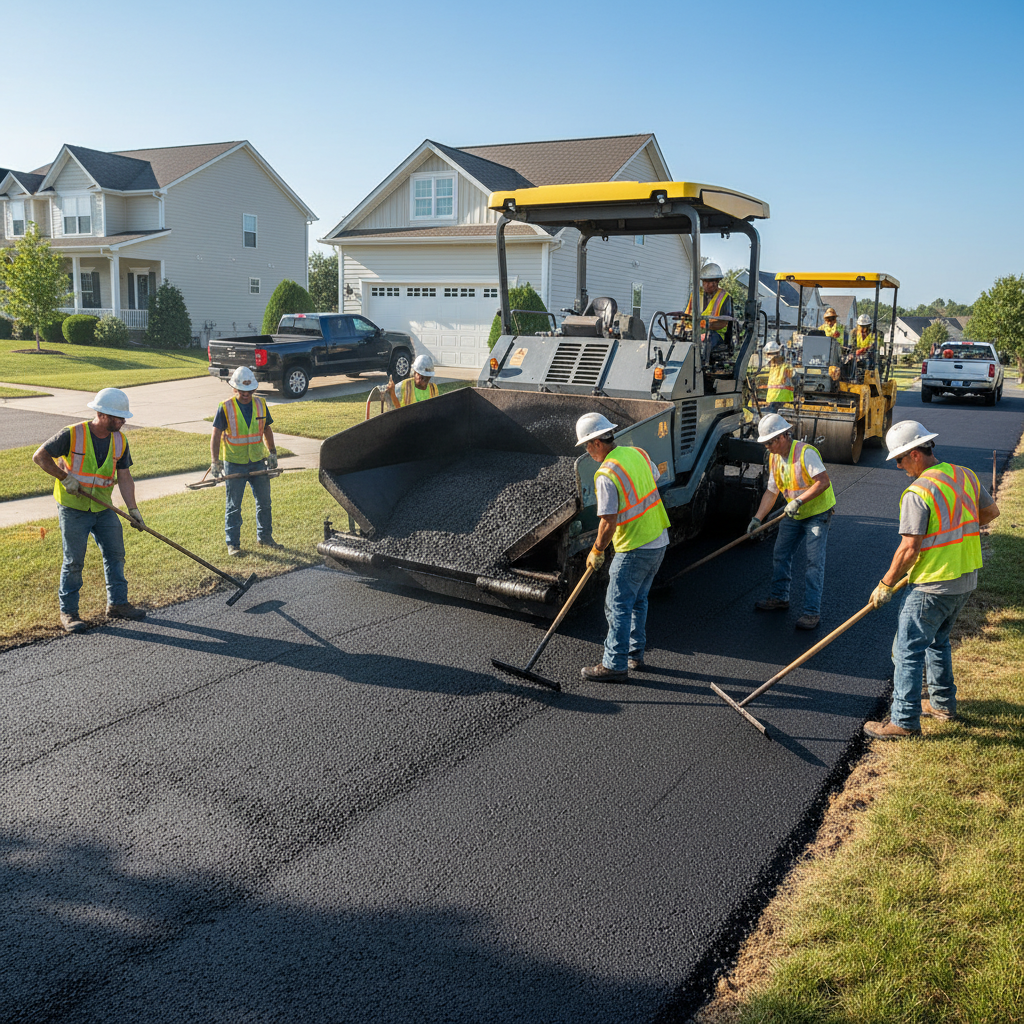
Driveway paving options and costs in Quinte West
Quinte West homeowners typically choose between asphalt, interlocking pavers, and concrete—and the “right” option usually comes down to how your site handles frost, drainage, and winter maintenance. In Quinte West, most private driveways serve single-detached homes (76.1% of dwellings), and that steady demand keeps paving contractors busy across the Kingston–Pembroke region (population 46,560; Statistics Canada, 2021 Census). Pricing, though, isn’t just about material choice. It’s shaped by local soil type and the region’s freeze–thaw rhythm: frost penetration is commonly around 4 feet (about 1.2 m) in much of Southern and Eastern Ontario, so good paving depends on getting below frost with a deeper, well-compacted granular base and robust drainage. In Quinte West, the shorter paving window also matters—hot-mix asphalt needs air temperatures above about 10°C, and spring can be wet, so contractors often schedule work tightly in late spring and summer.
Demand is especially strong in family-heavy neighbourhoods like Madoc Street/Keeler area and along residential stretches near Wellington Street, where older homes (61.5% built before 1981; Statistics Canada, 2021 Census) often need driveway reconstruction and drainage improvements. If you’re comparing quotes, use the table below as a starting point for typical project pricing ranges—then expect your final cost to shift based on excavation, base depth, hauling distance, and site access.
Next, compare the material options and what they usually cost per square foot in Quinte West.
| Material |
Lifespan |
Maintenance |
Best For |
Price per sq ft |
Price Range |
| Asphalt (new installation, proper base) |
15–25 years |
Sealcoat every 3–5 years |
Smoother ride, mid-budget, fast install |
$5.00–$8.50 |
$4,500–$9,000 |
| Asphalt (overlay on existing gravel base) |
10–18 years |
Sealcoat as needed; monitor base settlement |
When the old base is sound and grade is good |
$4.25–$7.75 |
$4,000–$8,000 |
| Interlocking concrete pavers |
25–35 years |
Joint sand top-ups; re-leveling blocks as needed |
Long life, curb appeal, easy spot repairs |
$10.00–$16.50 |
$6,500–$14,000 |
| Poured concrete (broom finish) |
20–30 years |
Crack monitoring; seal if desired |
Low maintenance appearance, straightforward layout |
$9.00–$14.25 |
$7,000–$15,000 |
| Exposed aggregate concrete |
20–30 years |
Seal if specified; occasional crack repairs |
Slip resistance, decorative look |
$11.00–$17.50 |
$8,500–$16,500 |
| Gravel / crushed stone (budget option) |
3–8 years |
Re-grade and top up annually; weed control |
Short-term solution, tight budgets |
$3.00–$5.25 |
$2,000–$5,500 |
Prices are estimates only and vary by project scope, site access and material selection.
What affects the price of paving in Quinte West
In Quinte West and the broader Kingston–Pembroke area, two quotes for what looks like the same driveway can swing by 30–50% because the cost drivers aren’t always visible at the surface. The biggest differences usually come from how far contractors must excavate, how much import aggregate and base construction is required, and how difficult it is to maintain proper drainage and slope. Even within Southern Ontario, frost and soil conditions change what “proper base” means—so the same asphalt thickness doesn’t always deliver the same performance.
Frost line depth and freeze–thaw cycles are decisive here. When frost has to be resisted at roughly 4 feet in much of the region, contractors typically build a thicker, well-compacted granular base. That deeper base requirement means more excavation, more hauling and spreading of aggregate, and more machine time on site. It’s one reason asphalt projects often land in the $4,500 – $9,000 band once full base and drainage corrections are included. The paving season is also tighter than in milder areas—hot-mix asphalt generally requires air temperatures above 10°C—so spring scheduling pressure can raise crew rates when many homeowners want work done at once.
Concrete examples also show how local conditions change the price. A poured slab may cost closer to the $7,000 – $15,000 band, but adding reinforcement, proper air entrainment, and saw-cut control joints increases material and finishing time. If your driveway ties into an older, poorly drained section near a clay pocket, drainage corrections (ditching, swales, or a French drain) can add noticeable cost but prevent the recurring settlement that otherwise shows up as uneven panels or asphalt raveling.
| Price Factor |
Why It Matters |
Cost Impact |
| Driveway area in sq ft — the primary cost driver |
Materials and labour scale directly with surface area |
+/- 40% depending on size |
| Base depth required — frost line determines granular thickness |
More excavation and aggregate to resist heaving |
Often +$1,000 to +$3,500 |
| Grading and drainage work — slope or drainage corrections add cost |
Stops water pooling that weakens subgrade |
+$800 to +$4,000 |
| Tear-out of existing surface — breaking and hauling concrete or old asphalt |
Disposal, backfill and compaction time |
+$600 to +$3,500 |
| Edge restraints and curbing — needed to prevent paver spread |
Maintains geometry and reduces shifting |
+$400 to +$2,000 |
| Sealing requirement — asphalt must be sealed after 6–12 months |
Protects binder from UV and oxidation |
+$400 to +$1,200 |
| Site access — narrow or tight lots slow equipment movement |
More time for staging, smaller loads, manual work |
+$300 to +$2,000 |
| Asphalt mix specifications — freeze-thaw-rated mix costs more |
Better durability in Southern/Eastern Ontario cycles |
Often +5% to +15% |
Permits & regulations in Ontario
In Ontario, paving a private driveway within your own property usually does not require a building permit. That said, Quinte West homeowners often cross into regulated territory when the work affects how water drains or where the driveway meets municipal infrastructure. Generally, work that typically does NOT require a permit includes: resurfacing your driveway on your private property, replacing asphalt with asphalt, installing interlocking pavers over a properly prepared base on your lot, and pouring a driveway slab entirely within your property line.
Work that DOES require municipal approval commonly includes: creating or changing a curb cut, altering the boulevard/road allowance area, changing existing storm drainage patterns, reconnecting or modifying drainage infrastructure, or performing any work that impacts how municipal drainage functions. Some municipalities also have lot-grading bylaws that limit how close hard surfaces and grading can be to property boundaries and how stormwater must be managed—important in areas with older drainage patterns.
Before excavation, step one is utilities: call Ontario One Call to have buried lines marked so the contractor can excavate safely. Step two is contractor verification: ask for their Ontario business registration details (where applicable), a current Certificate of Insurance showing liability coverage, and WSIB/WCB coverage (or the applicable clearance documentation). Then confirm the contractor’s paperwork before work starts—don’t rely on promises after mobilization.
Asphalt vs pavers vs concrete for Quinte West driveways
For Quinte West driveways, asphalt usually wins on upfront cost and speed. In the Kingston–Pembroke market it often fits homeowners who want a smooth surface without the highest material cost, but it needs a sealcoat program. Typically, asphalt is sealed after roughly 6–12 months and then again every 3–5 years to protect the binder from oxidation and winter wear. Interlocking concrete pavers cost more at the start, but they are the most flexible if you ever need a utility repair: individual stones can be lifted, fixed, and reset—so you don’t replace the whole driveway. Poured concrete lands mid-range and is durable if it’s properly air-entrained and constructed with control joints, but freeze–thaw can still lead to cracking if finishing and jointing aren’t done correctly, especially with de-icing salt.
All three options must be built on a frost-resistant base. Because frost penetration is commonly around 4 feet in much of Southern and Eastern Ontario, the “real” performance comes from drainage and granular base thickness—not just the top surface. If you have a downspout outlet dumping toward the driveway or a low spot that holds water, pavers and asphalt can both fail early without proper grading and subdrainage. Concrete can also suffer if water is trapped beneath the slab.
In Quinte West winter routines—plowing, sanding, and periodic salting—pavers usually hold up best to repeated scraping because they can be repaired section-by-section. As a pricing reality check, a typical interlocking driveway often falls into the $6,500 – $14,000 band, while a properly based asphalt driveway is often in the $4,500 – $9,000 band. That extra cost is justified when you want maximum curb appeal, long-term serviceability, or you anticipate future landscaping/drainage work.
| Material |
Frost Resistance |
Curb Appeal |
Repair Method |
Lifespan |
Price Band |
| Asphalt (sealed regularly) |
Good with deep granular base and drainage |
Medium (clean, dark finish) |
Patch and overlay sections as needed |
15–25 years |
$4,500 – $9,000 |
| Interlocking concrete pavers |
Excellent when edges are restrained and joints are maintained |
High (custom patterns and colours) |
Lift and replace affected pavers |
25–35 years |
$6,500 – $14,000 |
| Poured concrete (air-entrained) |
Good with air entrainment and control joints |
Medium–High (finish options) |
Crack repairs or patching isolated areas |
20–30 years |
$7,000 – $15,000 |
| Exposed aggregate concrete |
Good when base and sealing are properly specified |
High (textured decorative look) |
Patch with matching finish (more visible than asphalt) |
20–30 years |
$8,500 – $16,500 |
| Permeable pavers (drainage grid) |
Very good where stormwater design supports infiltration |
High (modern look) |
Replace sections; maintain drainage layer |
20–30 years (system-dependent) |
$7,500 – $16,500 |
| Chip seal / tar-and-chip |
Moderate; depends heavily on base and grading |
Low–Medium (functional) |
Spot repairs and resealing |
8–15 years |
$3,800 – $7,000 |
How to choose a paving contractor in Quinte West
Choosing the right contractor matters as much as the surface material in Quinte West—especially because freeze–thaw failures usually start with base prep and drainage, not the top layer. Start by confirming insurance and coverage. Ask for their Certificate of Insurance (liability coverage) and verify the limits are appropriate for property work. For WSIB/WCB coverage, request documentation showing they’re registered and in good standing; if they provide a clearance letter or similar proof, make sure the coverage applies to paving/construction staff on your job site.
Next, get 2–3 itemised written quotes rather than one lump-sum number. A solid estimate breaks out labour and materials: excavation, granular base and compaction, drainage work (if needed), geotextile (if specified), the asphalt or concrete or pavers themselves, edge restraints, and surface finishing/sealing. Review exclusions—will they haul and dispose of tear-out? Is topsoil restoration included? Are you paying for repairs if settlement occurs because the subgrade wasn’t corrected?
Warranty is another big differentiator. Ask for the workmanship warranty length and what it covers (typically lifting/replacing, not just cosmetic patching). Also clarify the manufacturer warranty for products (and whether it’s transferable to you if you sell). In payment terms, never pay more than about 10–15% upfront; keep a holdback until the job is complete and defects are addressed. Finally, insist on a written timeline with start date and an estimated completion window—Quinte West paving scheduling is seasonal, so vague “as soon as possible” leads to delays when crews are booked.
- Verify WSIB/WCB coverage documentation before work begins.
- Request a current liability insurance Certificate of Insurance (and confirm the insured party matches the company quoting).
- Confirm they include utility locates and follow Ontario One Call marking requirements.
- Ask for an itemised breakdown (base, drainage, materials, labour) vs a single total.
- Get written scope details: thicknesses, compacted base depth, and any geotextile/insulation.
- Ask who supplies and compacts every lift of aggregate (and how compaction is verified).
- Clarify disposal: tear-out hauling and dump fees included or extra?
- Confirm edge restraints/curbs for pavers, and jointing/control joints for concrete.
- For asphalt, confirm sealing plan (after 6–12 months) and who supplies it.
- Review warranty terms: workmanship duration, what’s excluded, and how claims are handled.
- Never agree to pay the full amount upfront; use progress payments with a holdback.
- Require a written schedule and communication plan for rain/wet-season delays.
Red flags to watch for in Quinte West: contractors who won’t show insurance/coverage documents, quotes that don’t mention base depth or compaction, no mention of drainage corrections in clay-prone lots, refusal to itemise disposal and tear-out, and warranties that cover “materials only” with no workmanship protection.
Frequently asked questions — paving in Quinte West
Is it worth sealing a new driveway right away in Quinte West?
In most Quinte West cases, sealing should not be done immediately after paving. Asphalt needs time to cure and to bleed off oils so the sealer can bond properly. A common local approach is to let new asphalt cure for about 6–12 months before your first sealcoat, then plan a repeat every 3–5 years depending on traffic and sun exposure. If you’re budgeting, sealing typically falls in the $400 – $1,800 range depending on driveway size and surface prep. With Quinte West’s freeze–thaw cycles, sealing is one of the simplest ways to slow surface oxidation and raveling, especially if you’re also sanding or salting through winter. If your contractor tells you to seal right away, ask what product they’re using and how they’re verifying cure.
What is a chip seal driveway and is it suited to Quinte West?
Chip seal (sometimes called tar-and-chip) is a surface treatment where a binder is sprayed on top of a prepared base, then aggregate chips are spread and compacted. It’s generally a functional, lower-cost option compared with full asphalt paving. In Quinte West, it can work well on lighter-use driveways or where the goal is improved traction without the cost of a full asphalt build-up, but it’s not as forgiving if drainage and grading aren’t right. Because freeze–thaw can move water under the surface, chip seal success depends on a solid granular base and proper slope. Pricing is often lower than full asphalt; you may see it around the low end of the $4,500 – $9,000 asphalt band—though many projects land below that when size is small. Expect more maintenance: spot repairs and occasional re-coating may be needed over time.
How much does driveway crack repair cost in Quinte West?
Crack repair cost in Quinte West varies mainly by crack type, area, and whether the base is still stable. If it’s cosmetic cracking in asphalt, contractors typically clean and seal the crack to prevent water infiltration; if the crack is wider or due to base movement, a patch or localized resurfacing may be required. As a rough planning guide, sealing or small patch repairs often fall within the $400 – $1,800 range, while broader repairs (more square footage or thicker cut-and-replace work) can move higher. The key point is that freeze–thaw cycles drive water in and out—so untreated water ingress can turn a simple crack into edge breakdown. If your driveway is older (many Quinte West homes were built before 1981; Statistics Canada, 2021 Census), it’s especially important to verify drainage and base condition before you pay for surface-only repairs.
What base thickness do I need for pavers in Quinte West?
For pavers in Quinte West, base thickness depends on your soil and the frost protection you need—not just the paver thickness. Because Southern and Eastern Ontario commonly experience frost penetration around 4 feet, contractors typically specify a deeper, well-compacted granular base than you’d use in mild climates. Practically, that means planning for excavation and multiple compacted layers (often with a thicker base than homeowners expect), plus a leveling sand layer designed for paver bedding. If drainage is poor or you have clay pockets, the required granular build-up usually increases because you need both frost resistance and water management. This is why two quotes can differ even when the final paver surface looks identical. If you want a clear answer, ask your contractor to state: (1) compacted base thickness in inches, (2) what aggregate type is used, (3) how compaction is verified, and (4) what drainage corrections are included.
How do I get the most accurate paving quote in Quinte West?
To get an accurate quote in Quinte West, provide contractors with site access details and ask for an itemised estimate. Start by sharing driveway measurements (length and width), photos from multiple angles, and any known drainage issues (downspouts, low spots, ponding). Request that the quote breaks out excavation, base construction, drainage work, disposal, and the surface materials—rather than a single lump sum. Because frost and freeze–thaw cycles make base depth and drainage decisive, ask whether they’re designing for the region’s conditions (deeper frost resistance and robust drainage). Also confirm whether permit or right-of-way approvals are needed if your work touches a curb cut or storm drainage. Finally, verify that the contractor includes utility locates and can show liability insurance and WSIB/WCB coverage before they mobilize. This approach reduces surprises and helps you compare bids apples-to-apples.
How much does it cost to pave a driveway in Quinte West?
Driveway paving cost in Quinte West typically falls within the established local price bands once you include proper base construction and drainage. For asphalt driveway paving, many projects land in the $4,500 – $9,000 range, especially when excavation, compacted granular base, and correct slope/drainage are included. Interlocking concrete pavers often come in around $6,500 – $14,000 because of edging, restraints, and labour-intensive installation. Poured concrete commonly fits $7,000 – $15,000, depending on finish and any reinforcement/jointing requirements. If you’re comparing quotes, watch for what’s included: tear-out, disposal, base depth, and sealing (for asphalt, typically after 6–12 months). With Quinte West’s winter freeze–thaw and seasonal scheduling limits, proper construction can cost more upfront, but it’s what keeps repairs from becoming an ongoing cycle.