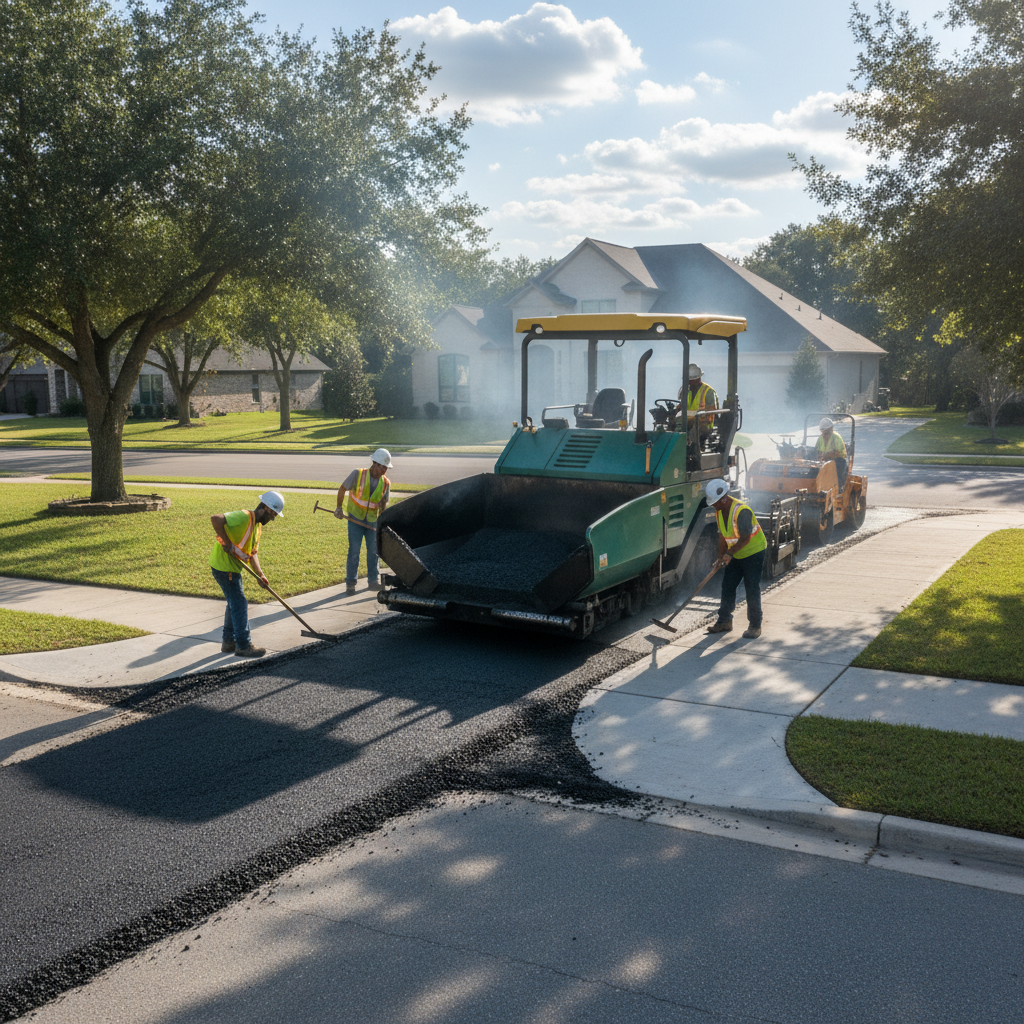
Driveway paving options and costs in Port Hope
Port Hope homeowners typically have lots of choice when it comes to driveway surfacing, but the climate in Muskoka–Kawarthas really sets the “rules of the road.” With 72.2% of local dwellings being single-detached homes (Statistics Canada, 2021 Census), most driveways are built for heavier winter traffic from cars, ploughing, and snow storage, so the base and drainage matter as much as the finish. Add to that the age profile—63.7% of homes were built before 1981 (Statistics Canada, 2021 Census)—and you’ll often see older driveways that need expanded excavation, reshaping, and thicker granular base to handle today’s freeze–thaw demands.
In this region, frost penetration is commonly planned around about 1.2 m (≈4 ft), and freeze–thaw cycles are aggressive. That means contractors around Port Hope (Cobourg area tie-ins are common for crews) tend to price more for excavation, compacted granular base (often 12+ inches for residential pavements), and proper edge containment. The other market pressure is timing: the paving season is narrower in colder areas because hot-mix asphalt is weather-dependent (typically needs sustained air temperatures above about 10°C), which tightens scheduling and can raise labour costs during peak weeks.
You’ll especially notice demand in established residential pockets like downtown-adjacent streets and older neighbourhoods near the waterfront and Highway 2 corridor, where lot grading and drainage can be challenging and homeowners want a cleaner, longer-lasting look before winter maintenance ramps up. Below is a practical comparison to help you budget before you call for site measurements and a formal scope review.
| Material |
Lifespan |
Maintenance |
Best For |
Price per sq ft |
| Asphalt (new installation, proper base) |
15–25 years |
Seal every 3–5 years; crack fill as needed |
Most cost-conscious homeowners wanting smooth, dark finish |
$7 – $12 |
| Asphalt (overlay on existing gravel base) |
10–18 years |
Seal every 3–5 years; may require patching sooner if base is weak |
When you need a faster, cheaper upgrade and base can be confirmed sound |
$6 – $10 |
| Interlocking concrete pavers |
25–40 years |
Replace individual stones/sections; periodic joint sand top-up |
Curved layouts, premium curb appeal, easier localized repairs |
$12 – $20 |
| Poured concrete (broom finish) |
20–30 years |
Keep joints sealed; patch spalls; reseal if desired |
Simple, low-profile, durable finish with clean maintenance |
$11 – $18 |
| Exposed aggregate concrete |
20–35 years |
Minimal; seal and manage joint lines |
Texture for traction and a more decorative surface |
$13 – $22 |
| Gravel / crushed stone (budget option) |
3–8 years (varies with compaction and drainage) |
Re-grade and top up yearly; weed control |
Temporary solution or low-budget access before full rebuild |
$3 – $6 |
Prices are estimates only and vary by project scope, site access and material selection.
What affects the price of paving in Port Hope
In Muskoka–Kawarthas, two quotes for what looks like the “same” driveway can land 30–50% apart because the expensive parts are usually hidden: excavation volume, granular base thickness, drainage corrections, and how much tear-out is needed. In Port Hope, the most common driver of higher pricing is that older driveways don’t always match the frost-protection approach today’s builds require. When a contractor discovers weak subgrade, soft spots, or poor water flow, they may need to remove and replace more material than expected—especially in areas with heavier clay pockets or where runoff historically sheet-flow onto the lawn and foundation line.
Frost line depth and freeze–thaw cycles are decisive cost factors here. Planning for frost influence (often around 1.2 m) means a thicker compacted granular base—commonly 12+ inches for residential pavements—plus thorough subgrade preparation to avoid heaving and cracking. Paving season also shortens in colder regions: hot-mix asphalt typically requires air temperatures above about 10°C, so demand is concentrated into late spring through early fall. That scheduling pressure can push asphalt and concrete crews to prioritize certain projects first, affecting labour rates and availability.
Concrete examples in Port Hope: (1) if your driveway has to be built with thicker frost-protected base under forms and joints, poured concrete can move toward the higher band (often $8,000 – $16,000 project-style pricing depending on size), but (2) if you’re simply replacing an old slab with good drainage and strong subgrade, concrete can land closer to the mid-range. For asphalt, homeowners who need a full-depth rebuild frequently see costs in the $4,500 – $9,000 range, while overlays on sound base stay lower—until repairs reveal base problems. With 63.7% of homes built before 1981 (Statistics Canada, 2021 Census), upgrading drainage and base is often the “make-or-break” cost item.
| Price Factor |
Why It Matters |
Cost Impact |
| Driveway area in sq ft |
Most material and labour are sized per square foot |
Typically the largest swing factor; doubling area roughly doubles cost |
| Base depth required |
Frost influence drives how much compacted granular you need to prevent heaving |
More excavation can add thousands, especially with poor subgrade |
| Grading and drainage work |
Proper slope/positive drainage keeps water out of the structure |
Can materially increase costs if you need regrading, swales, or drains |
| Tear-out of existing surface |
Old asphalt/concrete removal and hauling impacts time and disposal fees |
Often one of the biggest “surprise” line items on older driveways |
| Edge restraints and curbing |
Prevents paver movement/spread and keeps asphalt from raveling at edges |
Adds labour and materials, especially on irregular shapes |
| Sealing requirement |
Asphalt needs sealing to reduce oxidation and water penetration |
Costs for seal coats are ongoing; budgeting helps avoid premature replacement |
| Site access |
Narrow lots slow equipment and increase handling time |
Can raise labour hours due to more manual work and multiple trips |
| Asphalt mix specifications |
Freeze–thaw-rated mixes and proper binder content improve long-term performance |
Higher spec mix can cost more per tonne and affect scheduling |
Permits & regulations in Ontario
In Ontario, most homeowners won’t need a building permit for paving work that stays entirely within their own property limits—such as resurfacing your driveway on private property, installing interlocking pavers on your lot, or replacing asphalt/concrete where it doesn’t change municipal infrastructure. The permit question changes when work touches the municipal right-of-way or affects how water and access are handled by the public road.
Work that typically DOES require municipal approval includes new or modified curb cuts (including widening or relocating an access point), alterations to boulevard areas, changes to storm drainage connections, and any grading or drainage improvements that impact municipal infrastructure. Some municipalities also regulate lot grading so water doesn’t drain toward neighbouring properties or toward foundations—so it’s smart to confirm lot-grading rules with the municipality before excavation.
Before any digging in Port Hope, verify utility locates through Ontario One Call. Then, verify your paving contractor properly: confirm they hold an Ontario business number and that the company is in good standing, request a certificate of liability insurance showing adequate coverage for your project, and ask for proof of WSIB clearance/coverage (or applicable documentation if the contractor is exempt). When you get a bid, look for an itemised scope that lists excavation depth, base type/compaction approach, disposal, and restoration—so the “small print” doesn’t shift costs at the end.
Asphalt vs pavers vs concrete for Port Hope driveways
For Port Hope’s freeze–thaw winters, the best material is the one that keeps water out of the structure and tolerates movement without failing prematurely. Asphalt is usually the lowest upfront choice and looks clean and dark, but it relies on good construction and routine maintenance—typically sealing every 3–5 years—to slow oxidation and water infiltration. Interlocking concrete pavers cost more initially, yet they’re often the most forgiving in the long run because individual stones can be reset if settling or localized base issues occur; that matters when you’re dealing with older housing stock and varying subgrade. Poured concrete sits in the mid-range on cost, but it’s susceptible to cracking if the base isn’t engineered for frost protection and if you don’t get proper air-entrainment and jointing for freeze–thaw.
In Muskoka–Kawarthas, base preparation generally needs to be designed for frost influence, which commonly means deeper compacted granular under the driveway in exposed areas, and drainage detailing so runoff doesn’t pool. All three systems require solid edge containment; pavers especially need restraints to prevent shifting, while asphalt needs clean, stable edges to reduce raveling. With local winter maintenance—salt on plough roads, occasional sanding, and regular snow removal—pavers usually take the least performance penalty because surface-level repairs are straightforward.
A practical example: if asphalt is priced near the lower band around $4,500 – $9,000 for a typical residential driveway, pavers might land closer to $7,000 – $15,000. That extra upfront cost is often justified when you want long-term repairability and curb appeal, or when you expect future driveway changes (like drainage adjustments) where you’d rather lift and re-lay a section than replace a full asphalt mat or a slab.
| Material |
Frost Resistance |
Curb Appeal |
Repair Method |
Lifespan |
Price Band |
| Asphalt (sealed regularly) |
Good with proper frost-protected base and sealing |
Medium (clean, smooth look) |
Patch and seal localized areas |
15–25 years |
$4,500 – $9,000 |
| Interlocking concrete pavers |
Very good when base is compacted and edges are restrained |
High (premium pattern and colour options) |
Lift, re-grade, and replace individual stones |
25–40 years |
$7,000 – $15,000 |
| Poured concrete (air-entrained) |
Good with correct air-entrainment, base, and joints |
Medium (simple and modern when finished well) |
Concrete patching for spalls/cracks; sometimes section replacement |
20–30 years |
$8,000 – $16,000 |
| Exposed aggregate concrete |
Good with proper mix, base, and finishing schedule |
High (decorative, slip-resistant texture) |
Patch matching can be limited; repairs may be more visible |
20–35 years |
$9,500 – $17,500 |
| Permeable pavers (drainage grid) |
Very good for managing water at the surface |
High (modern look; functional drainage) |
Remove and replace sections; maintain infiltration layer |
25–40 years |
$10,000 – $20,000 |
| Chip seal / tar-and-chip |
Fair to good; performance varies with base quality |
Low to medium (utility surface) |
Spot repairs and periodic re-coating |
7–12 years |
$4,000 – $8,000 |
How to choose a paving contractor in Port Hope
Choosing a paving contractor in Port Hope is less about flashy photos and more about proof: licensing/business compliance, insurance coverage, and workmanship that survives freeze–thaw for years—not just weeks after install. Start by asking for their liability insurance certificate (naming you as additionally insured if possible for your project) and confirming they carry WSIB/WCB coverage where applicable. Then verify payment and scheduling practices: a responsible contractor will provide an itemised written quote and a clear timeline for base prep, installation, compaction/testing, and cleanup.
When you request quotes, don’t accept a “lump sum with no breakdown.” Ask for 2–3 itemised bids that separate labour and materials and include excavation depth, base specification, geotextile (if used), compaction approach, and disposal/recycling details. Make sure the quote states whether permits or municipal approvals are included if any right-of-way work is required, and whether the contractor includes tear-out and haul-away of old asphalt or concrete.
Warranty matters too: get the workmanship warranty length in writing (and what it covers—settlement, cracking, or joint issues) and understand the manufacturer product warranty terms for asphalt mixes or paver materials. Ask if any warranty is transferable to future owners. On payment, avoid large deposits—never more than about 10–15% upfront—and request a holdback until completion and final walkthrough. Finally, confirm the start date and estimated completion date in writing, because the paving season pressure in Muskoka–Kawarthas can affect scheduling after weather delays.
- Ask if the quote includes a site visit and measurements (not just online estimates).
- Confirm excavation depth and base thickness for frost protection.
- Require a drainage plan for slope and water run-off (not just “install and done”).
- Check whether disposal/hauling of old asphalt or concrete is included.
- Verify interlocking pavers include edge restraints and proper jointing sand.
- For asphalt, ensure the quote includes compaction and sealing recommendation.
- Request the asphalt mix spec that’s appropriate for freeze–thaw exposure.
- Ask about geotextile use and why it’s included or not included.
- Confirm equipment access plan for your driveway width and gate/turning radius.
- Get warranty terms in writing and clarify what “workmanship” covers.
- Review the payment schedule: limit upfront and set a holdback.
- Check references from similar driveways in nearby areas around Port Hope.
Red flags to watch for in Port Hope: a contractor who won’t provide proof of insurance or coverage documentation; quotes that omit base depth/compaction details; unclear disposal responsibilities for tear-out; pressure to pay a large deposit before work starts; and no written timeline or written scope explaining exclusions.
Frequently asked questions — paving in Port Hope
What base thickness do I need for pavers in Port Hope?
In Port Hope (Muskoka–Kawarthas), paver base design is typically driven by frost influence and your subgrade condition. Many residential installations plan on a compacted granular base that’s often 12+ inches total in frost-prone Central Ontario scenarios when the driveway is being rebuilt (not just top-layed). The exact depth should be confirmed based on your driveway’s current condition—especially if the existing base is weak, wet, or uneven. A contractor should also address grading and drainage so water doesn’t sit near the base. If your quote is far cheaper than comparable jobs like asphalt near $4,500 – $9,000 or pavers closer to $7,000 – $15,000, ask whether they’re reducing the granular thickness, because that’s where long-term performance is won or lost. (Statistics Canada, 2021 Census)
How do I get the most accurate paving quote in Port Hope?
To get an accurate quote in Port Hope, insist on an on-site measurement and a detailed scope. Provide clear driveway dimensions (length and width), photos of any drainage issues, and tell the contractor whether you’re replacing an existing driveway or overlaying on asphalt/gravel. The best bids itemise excavation, base depth, granular type, edge restraints, compaction/testing approach, disposal/haul-away, and final finishing. Also ask if utilities locates are required and confirm who manages them. Because the paving season is tighter in colder regions and winter maintenance is intense, you want a contractor to specify frost-protection approach—not just “we’ll level it.” If you’re comparing asphalt and pavers, use consistent assumptions; otherwise, a “low” asphalt price can hide more excavation needs that surface during tear-out.
How much does it cost to pave a driveway in Port Hope?
Driveway paving costs in Port Hope vary mainly by square footage, how much excavation and tear-out is needed, and whether drainage upgrades are required. As a starting point, asphalt driveway paving is commonly quoted in a range of $4,500 – $9,000, while interlocking concrete pavers often land in the $7,000 – $15,000 band. Poured concrete is frequently in the $8,000 – $16,000 range depending on thickness, finishing, and base prep. If your home is older—many in the area are (Statistics Canada, 2021 Census)—expect more potential for hidden base issues, which can move you toward higher end pricing. A thorough contractor will explain what changes if the subgrade isn’t strong and why frost-protection thickness changes the budget.
Asphalt vs interlocking pavers vs concrete — which is best in Port Hope?
“Best” depends on how you weigh upfront cost, long-term repairability, and how your driveway handles water. Asphalt is often best for homeowners who want the lowest upfront cost and are willing to seal regularly; sealing is especially important in Port Hope winters to reduce water penetration during freeze–thaw cycles. Interlocking concrete pavers usually perform best for curb appeal and for homeowners who want easier repairs—because you can lift and replace sections without replacing the entire surface. Poured concrete can be excellent when air-entrained concrete, joints, and a frost-protected base are done correctly, but cracking can show up sooner if the base/drainage isn’t right. If you’re deciding between price bands, compare asphalt near $4,500 – $9,000 versus pavers around $7,000 – $15,000; the difference is typically justified when you value longevity and localized fix capability after settlement or drainage tweaks.
How long does a paved driveway last in Port Hope?
With proper base preparation and maintenance, you can expect asphalt to last about 15–25 years, pavers about 25–40 years, and quality poured concrete about 20–30 years in Port Hope. Longevity is heavily tied to frost protection and drainage: if water is allowed to infiltrate or pool, freeze–thaw cycles accelerate cracking, pumping, or settlement. Asphalt performance is also closely linked to sealing; most homeowners benefit from sealing every 3–5 years to slow oxidation and water ingress. Pavers generally tolerate localized issues better because repairs are targeted. Concrete lifespan can be reduced if joints aren’t managed or if the contractor underbuilds the base. Because many Port Hope homes were built before 1981 (Statistics Canada, 2021 Census), older driveway bases may require more work up front to reach these expected lifespans.
When is the best time of year to pave in Port Hope?
For Port Hope, late spring through early fall is the practical window. Hot-mix asphalt typically requires sustained air temperatures above about 10°C, and work needs suitable base moisture conditions for compaction. In colder months or during wet shoulder seasons, you’ll often see delays or reduced production capacity, which can push scheduling. For concrete, contractors also plan around temperature swings to control curing and finishing quality, and they’ll avoid work when conditions are likely to drop quickly overnight. If you want the smoothest, most consistent outcome, aim for a period with stable daytime temperatures and good site access for equipment. Your contractor should also discuss sealing timelines for asphalt—since sealing usually happens after the asphalt cures, it’s planned into the project sequence rather than treated as an afterthought.