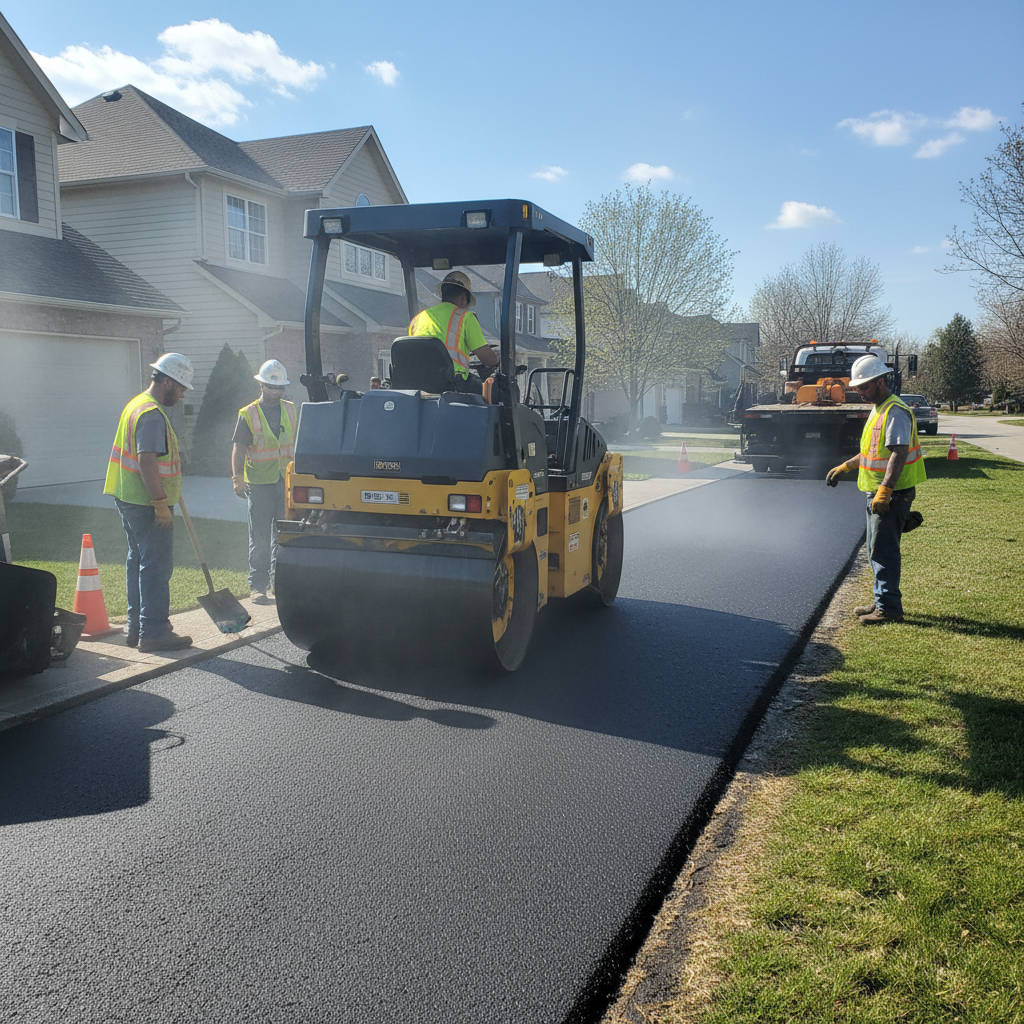
Driveway paving options and costs in Waterdown
Driveway paving in Waterdown, Ontario comes down to three practical choices: asphalt, interlocking pavers, or concrete—each with different upfront costs, maintenance needs, and winter performance. With Waterdown’s population at about 24,400 (Statistics Canada, 2021 Census), there’s steady local demand, especially in mature pockets where driveways were poured decades ago and now need resurfacing or full replacements. Most private driveways in Waterdown serve detached homes, and that matters because installation quality depends heavily on how the contractor handles excavation, base compaction, and drainage on typical residential lot grades.
In the Hamilton–Niagara Peninsula market, pricing is shaped by our moderate-to-cold Southern Ontario conditions. Freeze–thaw cycles and frost penetration (often planned around roughly 1.2–1.5 m in this region) push contractors to build a deeper, well-compacted granular base—commonly 6–10 in. compacted—plus reliable side drainage. That base and drainage work can represent roughly 35–45% of a residential driveway budget, which is why “same size” quotes can differ quickly. Demand also concentrates during the April–October paving season, so scheduling in spring can feel competitive and can move costs toward the upper end of the local bands.
In Waterdown, areas near the Waterdown core and older neighbourhoods with established curb lines (where drainage corrections and excavation are frequent) are especially in demand for full replacements and asphalt overlays. Below is a practical comparison table to help you budget and understand where your quote dollars typically go.
| Material |
Lifespan |
Maintenance |
Best For |
Price per sq ft |
Price Range |
| Asphalt (new installation, proper base) |
15–25 years |
Seal every 3–5 years; patch as needed |
Balanced cost and durability; smooth driving surface |
$4.50–$7.25/sq ft |
$3,500–$8,000 |
| Asphalt (overlay on existing gravel base) |
10–18 years |
Seal every 3–5 years; monitor for base movement |
When you have decent base and can minimize excavation |
$4.00–$6.75/sq ft |
$3,000–$6,500 |
| Interlocking concrete pavers |
25–35 years |
Resand/joint top-up; occasional panel replacement |
Curb appeal and modular repairs without full replacement |
$10.00–$16.50/sq ft |
$9,000–$20,000 |
| Poured concrete (broom finish) |
20–30 years |
Seal selectively; repair minor spalls/cracks as required |
Low visual maintenance; solid, straightforward surface |
$8.00–$13.50/sq ft |
$7,000–$18,000 |
| Exposed aggregate concrete |
20–30 years |
Seal and clean; minor crack monitoring |
Higher-end look with good texture under winter traction |
$10.00–$16.00/sq ft |
$8,500–$18,000 |
| Gravel / crushed stone (budget option) |
5–10 years |
Regrade annually; top up stone; weed control |
Short-term budget; low upfront cost |
$2.00–$3.75/sq ft |
$2,000–$5,000 |
Prices are estimates only and vary by project scope, site access and material selection.
What affects the price of paving in Waterdown
In Waterdown and the broader Hamilton–Niagara Peninsula, it’s common to see driveway paving quotes swing by 30–50% for what looks like the “same” job. The usual driver isn’t the asphalt or concrete—it’s what’s happening below the surface. Contractors can quote very differently depending on excavation depth, granular base design, drainage corrections, how much existing material must be torn out and hauled away, and how tight the access is for skid steers, excavators, and asphalt delivery trucks. In older neighbourhoods around Waterdown, it’s also common to uncover clay-rich fill, soft spots, or poor slope-to-drain patterns that require regrading and additional base.
Frost line depth and freeze–thaw cycles are decisive cost factors in this region. When frost pushes up and down repeatedly, a driveway needs a thicker compacted granular base (often 6–12 in. of properly layered Granular A/B) to reduce heaving and limit cracking. That thicker base directly adds trucking, excavation time, and compaction passes. The paving season is also effectively April–October here, because hot-mix asphalt needs warm conditions (air temperature generally above 10°C) and compaction work becomes difficult when it’s too cold. When the calendar compresses, labour and equipment scheduling tightens, which can push asphalt closer to the upper end of the local band (up to about $8,000 for many typical residential scopes).
Concrete costs can move as well. For example: (1) air-entrained concrete and correct subbase preparation usually cost more up front than “basic” concrete, but they reduce freeze-thaw damage over time; (2) if you need curb or edge restraints to control paver spread, interlocking can climb toward the $9,000–$20,000 band, especially with full tear-out. In practice, a job that only needs resurfacing may land closer to the lower end, while one requiring deeper granular rebuild and drainage fixes can shift toward the mid-to-upper range.
| Price Factor |
Why It Matters |
Cost Impact |
| Driveway area in sq ft |
More square footage means more asphalt/concrete, base material, and compaction time. |
Largest driver; can change the total by thousands |
| Base depth required |
Frost protection depends on granular thickness and density. |
Often adds the most hidden cost; can swing total by 10–25% |
| Grading and drainage work |
Improper slope or missing drainage leads to pooling and base saturation, increasing failure. |
Commonly 5–20% of the project depending on repairs |
| Tear-out of existing surface |
Breaking and hauling old asphalt/concrete increases labour and disposal fees. |
Can add several thousand dollars on full replacements |
| Edge restraints and curbing |
Restraints keep pavers and asphalt edges from migrating during freeze–thaw movement. |
Typically modest but impactful; often 3–10% |
| Sealing requirement |
Asphalt sealing after installation protects binder from oxidation. |
Adds recurring cost; usually a planned line item |
| Site access |
Narrow lots slow down equipment and can force smaller staging. |
Often increases labour time by 5–15% |
| Asphalt mix specifications |
Freeze-thaw-rated mixes and proper aggregate design can cost more but perform better. |
May add 5–12% versus basic mixes |
Permits & regulations in Ontario
In Ontario, paving a private driveway within your own property usually does not require a building permit. Where you do need municipal involvement is when your project touches the municipal right-of-way—think new or modified curb cuts, changes to the boulevard area, or alterations that affect storm drainage patterns or infrastructure. In Waterdown, if your driveway work changes how water moves off your lot (especially near the street line), that’s exactly the kind of scope municipalities may want reviewed before excavation and grading begin.
Here’s the practical way to verify what’s required: start by identifying the boundary between your property and the boulevard/right-of-way. If you’re only replacing an existing driveway surface and staying wholly within your lot lines, that’s typically permit-exempt. If you’re adjusting curb geometry, cutting asphalt/sidewalk in the public area, or redirecting drainage that crosses toward municipal systems, plan on getting municipal approval. Also confirm any lot-grading bylaws that restrict how close hard surfaces can be to property lines or how water must be directed.
Before any digging, do utility locates through Ontario One Call. Then, when hiring a contractor in Waterdown, verify three things: (1) Ontario licensing/registration as applicable to the contractor’s work category (ask for the number and verify it online if a registry is available); (2) liability insurance certificate of insurance naming you as additional insured for the project dates; and (3) WSIB coverage (clearance letter) if the contractor uses employees. Request these documents before work starts, not after excavation begins.
Asphalt vs pavers vs concrete for Waterdown driveways
For Waterdown driveways, asphalt, interlocking concrete pavers, and concrete all can work—but they’re different tools for a freeze–thaw-heavy climate. Asphalt is usually the lowest upfront option, and it tends to flex better under temperature swings, which helps it handle movement from frost. The trade-off is maintenance: asphalt sealing is typically needed every 3–5 years to keep the surface protected. Interlocking pavers cost more initially, but they’re modular—if a section shifts or a base area settles, a contractor can lift and re-install only the affected units rather than ripping out the entire driveway. Poured concrete often lands mid-range in price, yet concrete is more sensitive to cracking if the base isn’t engineered and air content isn’t right for freeze–thaw conditions; de-icing salts and winter traction habits can also influence how quickly hairline cracks expand.
On the Hamilton–Niagara Peninsula, the winning factor is usually base and drainage design: a deeper compacted granular base and correct slope/drainage are what ultimately determine how any surface performs through winter plowing and salt use. For many Waterdown sites, asphalt and concrete need the same foundational work (Granular A/B, proper compaction, and drainage attention), while pavers are even more dependent on tight edge restraint and correct bedding sand depth to prevent uneven settling. In terms of winter routine, pavers and sealed asphalt generally tolerate sanding and plowing well when the base is correct; concrete can perform very well too, but it has less “forgiving” flexibility when something underneath moves.
Example: if asphalt quotes come in around the mid to upper driveway band (say roughly $6,000–$7,500 for a typical replacement scope) while interlocking lands in the $9,000–$16,000 range, the price difference can be justified when you want curb appeal and long-term repairability—especially if your driveway has complex drainage, tight access, or a driveway apron area where movement is more likely.
| Material |
Frost Resistance |
Curb Appeal |
Repair Method |
Lifespan |
Price Band |
| Asphalt (sealed regularly) |
Good with engineered base and proper drainage |
Good (clean, modern look with finishing options) |
Patch localized areas; resurfacing later |
15–25 years |
$3,000–$8,000 |
| Interlocking concrete pavers |
Very good when base is well compacted and restrained |
Excellent (high-end appearance and colour variety) |
Lift/reinstall affected paver sections |
25–35 years |
$9,000–$20,000 |
| Poured concrete (air-entrained) |
Good with proper air entrainment and jointing |
Good to excellent (finish options available) |
Repair cracks/spalls; sometimes patching sections |
20–30 years |
$7,000–$18,000 |
| Exposed aggregate concrete |
Good with correct mix and base prep |
Excellent (texture and curb presence) |
Patch carefully; often limited to small areas |
20–30 years |
$8,500–$18,000 |
| Permeable pavers (drainage grid) |
Good when designed for local subgrade drainage |
Very good (modern look) |
Lift/reinstall pavers; clean/check drainage layer |
20–30 years |
$10,000–$22,000 |
| Chip seal / tar-and-chip |
Fair (more dependent on base quality and maintenance) |
Lower to moderate (more utilitarian) |
Spot repairs; re-seal/recoat later |
5–12 years |
$3,500–$7,000 |
How to choose a paving contractor in Waterdown
Choosing the right paving contractor in Waterdown is mostly about verifying coverage and clarifying scope. In Ontario, ask every contractor for (1) proof of Ontario licensing/registration as applicable to their work, (2) a certificate of liability insurance for the specific project dates and property address, and (3) WSIB clearance (or coverage documentation) if they use employees. If they can’t provide those items quickly, that’s a major warning sign—especially because driveway excavation and base work involve real hazards and liability exposure.
Next, get 2–3 itemised written quotes rather than a single lump sum. A useful quote shows labour and materials by line item (excavation, hauling/disposal, base/granular, geotextile if used, asphalt/concrete, compaction, finishing, and—where relevant—sealing and curing notes). Scope exclusions should be explicit: is the disposal included? Is tear-out included if you find unsuitable subbase? Are utility locates responsibility and timing included? If an asphalt quote expects you to regrade later, or if interlocking assumes perfect existing base, you want that in writing.
For warranty, confirm workmanship warranty length in plain language and whether it covers labour only or materials too. Also ask about product/manufacturer warranty and whether it’s transferable to the next homeowner. Payment schedules should be conservative: plan for no more than 10–15% upfront, then progress payments tied to measurable milestones. Hold back a portion until substantial completion and final grading/cleanup are verified. Finally, request a start date and completion estimate in writing—seasonal pressure is real in this region, and clarity prevents delays.
- Ask for insurance certificate and confirm the address and dates are correct.
- Request WSIB clearance if the contractor has employees.
- Verify Ontario licensing/registration details before signing.
- Insist on itemised quotes: excavation, base layers, paving, disposal, restraints, and sealing.
- Confirm how many inches of compacted granular base you’re getting (and whether it matches frost needs).
- Ask who performs grading and drainage corrections and whether they’re included.
- Require details on compaction method (number of lifts, testing approach, and equipment used).
- For interlocking: confirm edge restraints/curbing and bedding sand thickness.
- For asphalt: confirm tack coat and whether sealing is included after curing.
- Ask about jointing plan for concrete (saw cuts/timing) and whether air-entrainment is specified.
- Get timelines and the weather/cold-temperature contingency plan in writing.
- Ensure cleanup/disposal and haul-away are included or explicitly excluded.
Red flags I see around Waterdown include: contractors who won’t provide insurance or WSIB documentation, quotes that don’t specify base depth and drainage scope, “we’ll figure it out later” language about tear-out and disposal, unusually low pricing with no itemisation, and crews that can’t explain curing/sealing timelines for asphalt or joint-cut timing for concrete.
Frequently asked questions — paving in Waterdown
What is a chip seal driveway and is it suited to Waterdown?
Chip seal (tar-and-chip) is an asphalt binder sprayed on a prepared base, followed by a layer of aggregate stone. It can be a budget-friendly surface, but in Waterdown’s freeze–thaw environment it’s more sensitive to base quality and drainage. If the subbase holds moisture, movement can loosen aggregate and lead to raveling sooner than with full asphalt paving. I generally steer homeowners toward chip seal only for certain low-traffic, simpler sites or as a short-to-medium term solution while planning a full rebuild. For most residential Waterdown driveways where cars track in snow melt and salt, the longer-term value usually comes from properly based asphalt (often within the $3,000–$8,000 driveway band) or interlocking/concrete with deeper engineered base prep.
How much does driveway crack repair cost in Waterdown?
Crack repair cost in Waterdown depends on whether you’re dealing with surface cracking only or deeper base movement. For typical narrow, non-structural cracks, contractors may use crack routing and sealant or patch material—often a smaller-ticket repair. If cracks are accompanied by edge settlement, ponding, or repeating frost heave, the “repair” may be temporary unless the base and drainage are corrected. As a realistic planning range, many homeowners budget within the broader sealing & repair band of about $400–$2,000 for localized work, while more involved repairs can escalate when tear-out and re-compaction are required. The key is to inspect during thaw cycles, because cracks that appear minor in summer may reflect movement that only shows up clearly after freeze–thaw.
What base thickness do I need for pavers in Waterdown?
For paver driveways in Waterdown, base thickness should be designed for frost protection and drainage—not just “whatever was there.” In Southern Ontario’s freeze–thaw conditions, contractors commonly plan for roughly 6–10 inches (compacted) of granular base, layered and compacted properly, with bedding sand over top for paver setting. If your subgrade is clay-heavy or holds water, you may need additional excavation and granular rebuild to achieve uniform support and prevent differential movement. Tight drainage control matters as much as thickness: water trapped under pavers leads to pumping and uneven settling. A strong paver base is one reason interlocking projects often land in the $9,000–$20,000 band, especially when full tear-out and drainage corrections are part of the scope.
How do I get the most accurate paving quote in Waterdown?
To get an accurate paving quote in Waterdown, make sure the contractor prices based on what they can verify on-site, not assumptions. Ask for a site walk that includes measuring driveway dimensions, checking slope/drainage, and identifying existing pavement condition. Request core details: proposed base depth (compacted inches), whether geotextile is needed, how much tear-out is included, and how disposal/haul-away will be handled. The best quotes are itemised—labour and materials broken down—so you can compare apples-to-apples. If you’re replacing an old slab or deteriorated base, ask how they’ll address soft spots. Finally, confirm the schedule: paving season is effectively April–October, and weather affects curing and compaction, which can change outcomes and costs.
How much does it cost to pave a driveway in Waterdown?
Driveway paving cost in Waterdown typically depends on driveway size (square footage), required base rebuild depth, and whether there’s tear-out and drainage correction. For asphalt, many residential projects land roughly between $3,000 and $8,000 depending on scope. Concrete is often in the $7,000–$18,000 range, with exposed aggregate sometimes higher. Interlocking pavers usually come in higher, commonly $9,000–$20,000, because base build-up, restraints, and paver installation are more labour-intensive. If your driveway needs deeper granular rebuild and improved drainage to resist frost heave, that base work can represent a big portion of your total—often around 35–45%. Getting the quote right starts with the subgrade and drainage, not just choosing the surface.
Asphalt vs interlocking pavers vs concrete — which is best in Waterdown?
There isn’t a single “best” option for every Waterdown driveway, but there is usually a best fit for your priorities and budget. Asphalt is the most cost-friendly upfront (often $3,000–$8,000) and can perform well through freeze–thaw when the base and drainage are properly designed; it does require sealing every 3–5 years. Interlocking pavers provide the highest curb appeal and are the most repair-friendly—if a section shifts, it can be lifted and fixed without replacing the whole driveway—though the total cost often falls in the $9,000–$20,000 band. Concrete (often $7,000–$18,000) can be durable if it’s properly air-entrained and jointed to manage movement, but it’s less forgiving if base prep or drainage is off. If you plow frequently and want long-term flexibility, pavers are hard to beat; if you want lower initial cost and can commit to sealing, asphalt is usually the practical choice.