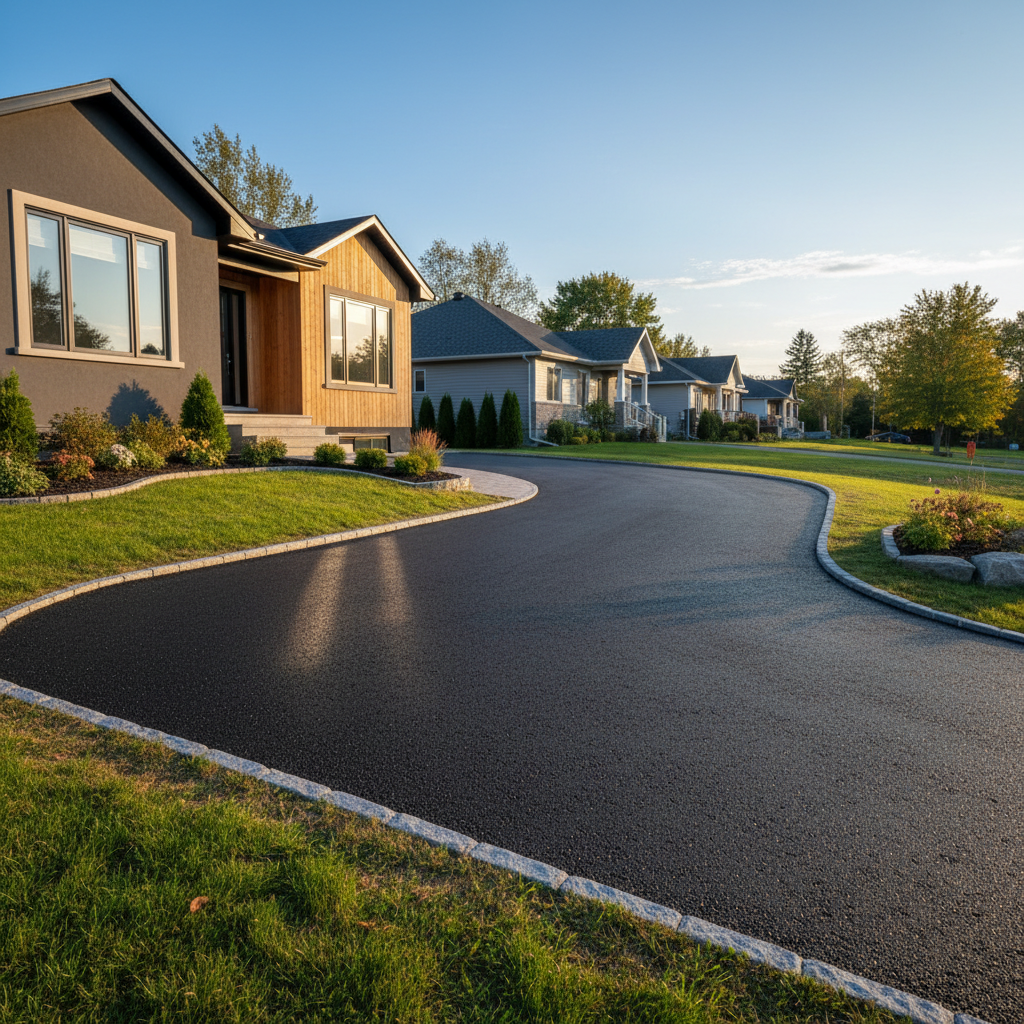
Driveway paving options and costs in Cochrane
Cochrane homeowners typically pave driveways tied to single-detached houses, and in the 2021 profile that housing type makes up 66.5% of dwellings—so this is a big, steady market for asphalt, pavers and concrete. With 1,650 homeowner households (71.3% of households owning), many residents are planning improvements to reach a winter-ready surface that holds up to ploughing, sanding, and occasional salt. Pricing depends heavily on site conditions, but for a “typical” residential driveway in Cochrane you’ll usually see asphalt come in first, pavers and concrete higher up the list.
Across the Northeast economic context, contractors plan for deeper frost penetration and aggressive freeze–thaw cycles. Practically, that means more excavation and a thicker compacted granular base so the pavement doesn’t heave, and positive drainage so water doesn’t sit under the slab. It also affects scheduling: the paving season is shorter, and hot-mix asphalt needs sustained warm conditions (air temperatures generally above 10°C) to place and compact properly. Because demand can spike in the limited warm window, mobilization and labour availability can push total costs toward the upper end of the price bands.
If you’re in an area with heavier winter traffic—like the newer north-end developments near the Cochrane hill-side—expect more requests for overlays, full tear-outs and improved drainage details. Use the comparison table below to match material choice to lifespan, upkeep and typical per-square-foot pricing.
| Material |
Lifespan |
Maintenance |
Best For |
Price per sq ft |
Price Range |
| Asphalt (new installation, proper base) |
12–20 years |
Seal every 3–5 years; patch ruts as needed |
Good value, smooth ride, moderate curb work |
$5.50–$9.50 |
$4,500–$8,500 |
| Asphalt (overlay on existing gravel base) |
8–15 years |
Seal every 3–5 years; more frequent patching early on |
Budget-friendly improvement when subgrade is sound |
$5.00–$8.75 |
$4,200–$7,800 |
| Interlocking concrete pavers |
25–30 years |
Re-seat and replace individual stones; periodic joint sand |
Highest curb appeal and easy localized repairs |
$10.50–$15.50 |
$8,000–$16,000 |
| Poured concrete (broom finish) |
20–30 years |
Seal selectively; manage cracks with patching/joints |
Low ongoing hassle, clean straight lines |
$11.00–$16.50 |
$9,000–$18,000 |
| Exposed aggregate concrete |
20–30 years |
Seal to reduce staining and salt “etching” |
Slip resistance and premium appearance |
$12.00–$18.50 |
$10,000–$20,500 |
| Gravel / crushed stone (budget option) |
3–8 years |
Top up 1–2 times per season; re-grade periodically |
Short-term solution or light use |
$3.00–$5.00 |
$2,200–$5,500 |
Prices are estimates only and vary by project scope, site access and material selection.
What affects the price of paving in Cochrane
Even when two homeowners describe the “same” driveway, quotes in Cochrane can differ by 30–50%. In practice, that gap usually comes from how much excavation is required, how the subgrade is treated, and what drainage and base thickness are included—not just the surface material. In older neighbourhoods, and on homes built before 1981 (63.1% in the profile), existing fill can be inconsistent, so contractors often have to over-excavate and rebuild the granular layers to get reliable compaction.
The biggest Northeast cost driver is frost and freeze–thaw performance. Deeper frost requires a thicker compacted granular base; Ontario and similar inland conditions often need something like 6–12 inches of properly graded granular material below asphalt, plus a separation fabric/geotextile in unstable soils. That prevents frost heave and reduces long-term cracking. The freeze–thaw cycle also stresses the asphalt mix: a freeze-thaw-rated mix design and correct asphalt thickness matter, which is one reason asphalt may land closer to the upper end of the typical driveway band (for instance, projects trending toward the $4,500–$8,500 range).
Concrete pricing shifts too. If the job needs thicker sections, proper air entrainment, and joints that can handle winter movement, concrete may approach the $9,000–$18,000 band. Examples from Cochrane that commonly raise costs include: removing an old interlock base that has settled unevenly, correcting a low spot that ponds water after snowmelt, or adding edge restraints/curbing where paver or asphalt edges can spread under plough pressure. Costs can be lower when the subgrade is already stable, site access allows efficient equipment movement, and drainage is naturally positive.
| Price Factor |
Why It Matters |
Cost Impact |
| Driveway area in sq ft |
Labour, asphalt/concrete, and base materials scale directly with square footage |
Often 40–70% of total variation between quotes |
| Base depth required |
Frost protection depends on thicker compacted granular layers in colder conditions |
+$1,000–$4,000 depending on excavation amount |
| Grading and drainage work |
Correct slope and positive drainage reduce water trapped under the pavement |
+$800–$3,000 for re-grading/ditch tie-ins |
| Tear-out of existing surface |
Breaking, loading, and hauling asphalt or concrete adds labour and disposal fees |
+$1,000–$5,000 for larger tear-outs |
| Edge restraints and curbing |
Edges keep pavers from spreading and asphalt from raveling |
+$500–$2,500 depending on layout complexity |
| Sealing requirement |
Asphalt needs sealing after curing (commonly 6–12 months, then periodic re-seal) |
+$200–$900 over the first few years (budget annually) |
| Site access |
Narrow lanes and tight turning radii slow equipment and can require handwork |
+$300–$1,800 for traffic control and extra labour |
| Asphalt mix specifications |
Freeze–thaw-rated mix and proper binder content improve performance under winter stress |
+$400–$1,600 versus basic mix assumptions |
Permits & regulations in Ontario
In Ontario, paving a private driveway within your own property typically does not require a building permit. The common exception is when the work touches areas controlled by the municipality—especially if you’re changing the entrance details at the road allowance. In Cochrane, anything that affects storm drainage or requires a new or modified curb cut generally needs municipal approval before excavation and paving, because the municipality has to protect drainage infrastructure and safety at the driveway apron.
In most homeowner-driveway projects, the work that usually does not require a permit includes: repaving a driveway in your yard, replacing the surface on an existing footprint, adding standard base layers entirely on private property, and re-aligning driveway material where you’re not altering municipal assets. Work that does typically require approval includes: new driveway access/culvert work, changes to boulevard grading that affect how water leaves the site, and any alterations to storm drainage patterns or curb infrastructure.
Step-by-step, verify a contractor before excavation: (1) confirm they have the right provincial business registration for the trade and check their standing using the appropriate online resources (and ask for their licence number if they provide one); (2) request a current certificate of insurance and check it includes general liability with adequate limits; (3) ask for WSIB coverage confirmation (or a clearance letter) and make sure the policy is valid for the project dates; and (4) request the utility-locate confirmation after you book through Ontario One Call. A reputable company will not start digging until locates are complete and will clearly outline disposal and site restoration in writing.
Asphalt vs pavers vs concrete for Cochrane driveways
For Cochrane driveways, asphalt is usually the lowest upfront option and gives a smooth surface, but it needs sealing to protect against moisture and abrasion from winter traffic. Interlocking concrete pavers cost more at the start, yet they’re repair-friendly: if one area fails due to localized settlement or a drainage issue, you can lift and reset individual units instead of replacing an entire section. Poured concrete sits in the middle on typical cost and can last decades, but freeze–thaw movement and de-icing practices can lead to cracking if the mix is not properly air-entrained and if joints and subbase aren’t detailed for winter movement.
In Northeast conditions, the “winner” usually depends on base and drainage quality first. Cochrane’s freeze–thaw cycles make the granular base thickness and compaction non-negotiable—regardless of surface choice. Pavers can tolerate certain movements better because they’re modular, and good edge restraints help resist plough pressure. Asphalt performs well when it’s placed on a well-prepared base and then sealed at the right time (commonly after the initial curing period, then every few years). Concrete can hold up well with proper air entrainment and jointing, but you’ll want a plan for managing water flow away from the slab.
Here’s where the dollars make sense: a basic asphalt driveway may land in the $4,500–$8,500 range. If you’re choosing pavers in the $8,000–$16,000 band, that extra cost is justified when you value curb appeal, want flexible repairs, and have occasional spot issues (like slight subgrade variation) where localized fixes are preferable to full replacement.
| Material |
Frost Resistance |
Curb Appeal |
Repair Method |
Lifespan |
Price Band |
| Asphalt (sealed regularly) |
Good with proper base and freeze–thaw mix; seal protects surface |
Medium (clean, uniform finish) |
Mill/patch or overlay section |
12–20 years |
$4,500–$8,500 |
| Interlocking concrete pavers |
Very good; modular design handles minor movement |
High (wide colour/stone patterns) |
Lift/replace individual pavers or small sections |
25–30 years |
$8,000–$16,000 |
| Poured concrete (air-entrained) |
Good to very good with air entrainment, joints, and drainage |
Medium to high (clean lines, finish options) |
Patch cracks/joints or localized sections |
20–30 years |
$9,000–$18,000 |
| Exposed aggregate concrete |
Good with proper mix and curing; surface textures can resist slip |
Very high (decorative, premium look) |
Patch with matching material; cosmetic repairs are more visible |
20–30 years |
$10,000–$20,500 |
| Permeable pavers (drainage grid) |
Excellent for water management when the subdrain is engineered |
High (modern layouts) |
Replace localized units; maintain joint infill |
20–30 years (system-dependent) |
$10,500–$22,000 |
| Chip seal / tar-and-chip |
Moderate; can require more frequent surface maintenance |
Low to medium (more functional) |
Top up with additional chips or spot seal |
7–12 years |
$3,800–$7,200 |
How to choose a paving contractor in Cochrane
Choosing the right paving contractor in Cochrane starts with verifying the essentials: Ontario business credentials (where applicable), liability insurance, and WSIB coverage. Ask for a certificate of insurance and confirm it’s current and covers the type of work (general liability is the baseline). For WSIB, request confirmation or a clearance letter that shows coverage is active for the employees who will be on your site; if a contractor can’t provide it, that’s a serious risk for homeowners. Then ask how they handle utility locates—your driveway excavation should follow Ontario One Call requirements, and your contractor should confirm locates are complete before digging.
Next, get 2–3 itemised written quotes. Don’t accept one lump-sum number; ask for a breakdown that clearly shows labour, base material quantities, excavation depth, geotextile/insulation allowances (if needed), disposal fees, and the finished paving thickness. Confirm whether the quote includes permit/municipal approvals if your driveway ties into the curb cut or drainage; even if you’re handling the application, good contractors will tell you what they need to submit.
Review the warranty terms carefully. Ask for the workmanship warranty length (and what triggers it), the manufacturer’s warranty details for materials, and whether warranties are transferable if you sell your home. In payment schedule terms, never pay more than 10–15% upfront. Use a holdback until the work is complete, cleaned up, and any required curing/sealing steps are done on schedule. Finally, require a start date and completion estimate in writing, so weather delays are addressed—especially important when Cochrane’s paving window is tight.
- Ask for proof of liability insurance (current certificate) before you sign.
- Confirm WSIB coverage or obtain a clearance letter.
- Request utility-locate evidence/process via Ontario One Call.
- Get at least 2–3 itemised quotes (base, excavation, disposal, surface).
- Insist on thickness details: asphalt/concrete thickness and base depth.
- Clarify whether geotextile, insulation, or additional drainage is included.
- Confirm edge restraint/curbing requirements for your driveway layout.
- Ask how they handle grading to prevent ponding after melt or rain.
- Verify how old asphalt/concrete is removed and hauled (disposal included?).
- Require a workmanship warranty and what maintenance affects coverage.
- Use a payment schedule with a holdback until completion and cleanup.
- Get the timeline and weather contingency notes in writing.
Red flags: they won’t provide written itemized scopes, they refuse to disclose base thickness or drainage plan, they ask for large upfront payments, they can’t show insurance/WSIB documentation, or they “guarantee” no cracking/heaving without discussing subgrade and frost protection.
Frequently asked questions — paving in Cochrane
How long does a paved driveway last in Cochrane?
In Cochrane, driveway lifespan is mostly about base preparation and drainage—not just the surface material. Asphalt installed on a properly compacted base commonly lasts around 12–20 years, but that window shortens if water ponds or if the asphalt isn’t sealed after curing. Pavers can be long-lasting (often 25–30 years) because individual units can be lifted and reset if localized settlement happens. Poured concrete, especially when air-entrained and properly jointed, typically falls in the 20–30 year range. Your home’s age can also matter: many properties built before 1981 may have inconsistent fill, which can require deeper reconstruction to reach those lifespans. (Statistics Canada, 2021 Census)
When is the best time of year to pave in Cochrane?
For asphalt, the best paving window is late spring through summer when temperatures stay consistently warm and the ground is dry enough to support compaction. Asphalt placement generally needs warm conditions (commonly air temperatures above 10°C) so the mix can be properly laid and compacted. In Cochrane, that short season means you’ll often want to book early to secure your preferred start date. Concrete can sometimes go later into the year than asphalt, but it still depends on temperature for curing and finishing. Regardless of material, a contractor should schedule around weather risk because freeze–thaw cycling starts challenging the pavement soon after placement.
How deep should the base be for Cochrane's frost?
There isn’t one magic number, but frost protection in colder Ontario conditions generally calls for a thicker compacted granular base than you’d see in mild coastal climates. For many residential driveways, contractors plan on about 6–12 inches of properly graded and compacted granular material beneath the asphalt or concrete surface, sometimes more if the subgrade is weak or there’s poor drainage. If the soil is unstable or water-sensitive, you may also see geotextile (separation) and improved drainage (to keep frost from forming under the slab). A good quote will state what base depth and layers are included and why—because that’s the difference between a driveway that lasts versus one that heaves early.
How often should I seal my asphalt driveway?
Typically, asphalt sealing starts after the pavement has cured—often after 6–12 months—so moisture and binder stabilise first. After that, many homeowners plan on sealing every 3–5 years depending on sun exposure, ploughing abrasion, and winter use (sand and salt). If you’re seeing surface oxidation, fine raveling, or accelerated fading, sealing earlier can help slow moisture intrusion that leads to cracking. When you budget, factor sealing as part of owning asphalt, not as an optional add-on. In Cochrane, where winter wear is heavy and the freeze–thaw cycle is hard on surfaces, sealing is one of the most cost-effective ways to protect the upfront paving investment, whether your driveway started closer to $4,500–$8,500 or toward the high end of asphalt scopes.
Why does my driveway crack and heave in winter?
The two usual culprits are water and frost. If water seeps under the driveway—because drainage is flat, the base is undersized, or the slope directs meltwater toward low spots—freeze–thaw cycles can expand and lift the pavement (heaving). Cracking then follows as the material repeatedly flexes and loses bond to the base. In many cases, homeowners notice it first after a wet fall or spring melt. If the base wasn’t properly excavated/rebuilt (especially common on older properties with inconsistent fill), the pavement may settle unevenly over time, making frost effects worse. The fix is usually not “just seal it,” but correcting drainage and base thickness so the system stays stable during winter.
Do I need a permit to pave my driveway in Ontario?
In most cases in Ontario, repaving a private driveway within your own property footprint does not require a permit. However, permits or municipal approvals may be required if your paving work changes municipal assets—such as a new or modified curb cut, alterations to boulevard grading, or any work that affects storm drainage. For a Cochrane driveway, it’s also smart to confirm lot-grading expectations with the municipality before you pour or pave anything that changes how water moves. Regardless of permits, utility locates are essential: book through Ontario One Call before excavation. If you’re unsure, ask your contractor to clearly state whether your project involves municipal right-of-way and what approvals (if any) they handle versus what you need to arrange.