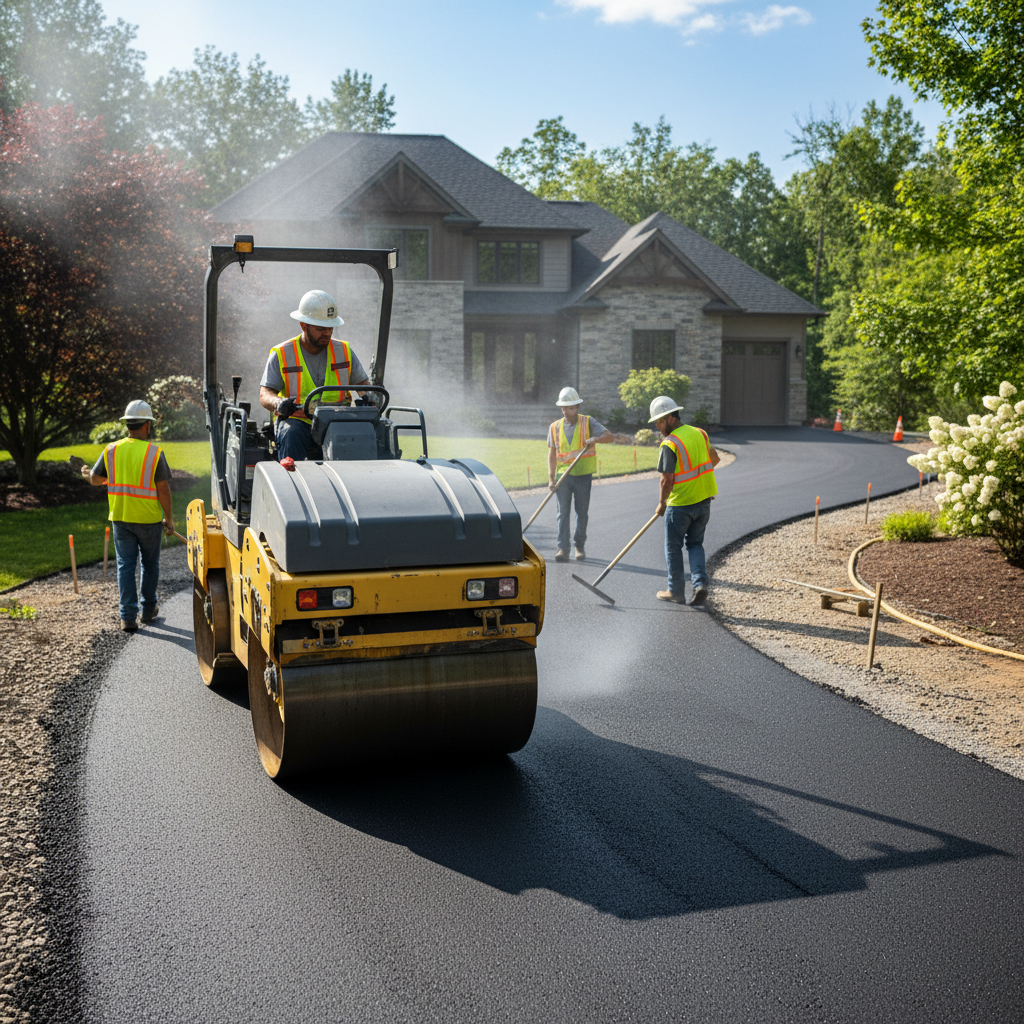
Driveway paving options and costs in Midland
Midland driveway paving choices usually start with three questions: What material looks best, how much it costs up front, and how it will survive Midland winters. With 65.0% of dwellings being single-detached homes (Statistics Canada, 2021 Census), most private driveways here are tied to detached properties—so homeowners commonly want something that stays straight through plowing and salt-season. The local housing stock also skews older: 61.6% of homes were built before 1981 (Statistics Canada, 2021 Census), which often means existing driveways have unknown base condition and may need added granular thickness before any new surface can perform.
In the Kitchener–Waterloo–Barrie economic corridor, pricing is heavily influenced by frost depth and freeze-thaw cycles. Asphalt and concrete both have to be built on a deeper, well-compacted granular base with reliable drainage to reduce heaving, settlement, and cracking. Contractors also deal with a shorter paving season; hot-mix asphalt generally needs above-10°C air temperatures to place properly, so spring-to-fall scheduling pressure can affect availability and turn-around times. For that reason, “same driveway, different quote” isn’t unusual—especially in high-demand pockets like the residential areas near Bay Street and Victoria Street East, where many trades crews concentrate between thaw and fall.
Below are typical price bands for Midland, Ontario, to help you compare options before you request an itemised quote.
| Material |
Lifespan |
Maintenance |
Best For |
Price per sq ft |
| Asphalt (new installation, proper base) |
15–25 years |
Seal every 3–5 years; patch as needed |
Lowest upfront cost with good performance on a correct granular base |
$4.25–$8.00 |
| Asphalt (overlay on existing gravel base) |
10–18 years |
Seal every 3–5 years; repair failing subgrade sooner |
When the existing base is sound and settlement is minimal |
$5.00–$9.50 |
| Interlocking concrete pavers |
25–40 years |
Re-sand joints; occasional replacement of individual stones |
Curb appeal and easy, local repairs without full replacement |
$12.50–$22.50 |
| Poured concrete (broom finish) |
20–30 years (with proper air-entrainment) |
Minimal; address spalls early; occasional sealing |
Durable, clean look; good for wider residential aprons |
$10.00–$17.50 |
| Exposed aggregate concrete |
20–30 years |
Low; sealing optional depending on appearance goals |
Texture and slip resistance for winter conditions |
$12.00–$19.50 |
| Gravel / crushed stone (budget option) |
3–10 years |
Re-grade seasonally; top up annually |
Temporary or low-budget base layer while you plan a full install |
$3.00–$6.25 |
Prices are estimates only and vary by project scope, site access and material selection.
What affects the price of paving in Midland
Even for the same driveway size in Midland, quotes can differ by 30–50% across the Kitchener–Waterloo–Barrie market and the broader Ontario range. The biggest drivers are how deep the contractor must go for a frost-resilient base, how much drainage or grading correction is needed, and what the crew has to break out and haul away. Labour costs and plant availability also swing through the short paving season—so if work windows are tight, crews may price higher to protect schedule certainty.
In this region, frost line depth and freeze-thaw cycles are decisive cost factors. Deeper frost requires a thicker compacted granular base to prevent heaving and cracking—typically achieved with additional excavation and a controlled granular build-up. If your driveway sits on a wet or poorly drained subgrade, the contractor has to address moisture before asphalt or concrete goes down, which increases excavation, aggregate tonnage and compaction time. Asphalt mix design also needs to meet local freeze-thaw performance expectations; the wrong mix or shortcut on base prep can lead to early raveling and potholing.
Concrete can also swing in cost based on local site conditions. For example, a broom-finished slab on well-drained, stable subgrade can land closer to the lower end of the concrete band (roughly the $9,000–$16,000 driveway range), while a job that requires more subgrade removal or thicker support layers can push toward the higher end. Likewise, interlocking pavers may cost more, but if your priority is “repair one area instead of replacing the whole driveway,” that approach can be justified—especially where localized settlement is likely given older home lots and established drainage patterns.
| Price Factor |
Why It Matters |
Cost Impact |
| Driveway area in sq ft |
The surface area determines material quantity and paving time |
Largest single driver; most estimates move directly with area |
| Base depth required |
Frost line conditions dictate granular thickness to reduce heaving and cracking |
More excavation + more aggregate increases the price significantly |
| Grading and drainage work |
Proper slope and drainage prevent water from freezing under the pavement |
Can add cost when swales, culverts, or re-grading are needed |
| Tear-out of existing surface |
Concrete breaking/old asphalt removal requires equipment and disposal |
Hauling and landfill fees can materially raise total cost |
| Edge restraints and curbing |
Prevents paver spread and holds asphalt/concrete profiles stable |
Often essential for longevity; cost varies by perimeter complexity |
| Sealing requirement |
Asphalt typically needs sealing to protect from oxidation and moisture ingress |
Starter sealing is low compared to resurfacing later |
| Site access |
Narrow lots slow equipment movement and extend labour time |
Tight access can add crew-hours and small equipment costs |
| Asphalt mix specifications |
Freeze-thaw-rated mixes help resist rutting, raveling, and early failure |
Higher-quality mixes cost more per ton, especially in peak demand |
Permits & regulations in Ontario
In Ontario, paving a private driveway within your own property usually doesn’t require a building permit. However, if your project affects municipal infrastructure, you should expect municipal approval. That’s typically the case when you need a new curb cut, make changes to the boulevard, alter storm drainage patterns, or adjust anything that ties into municipal right-of-way. Some municipalities also enforce lot-grading rules that restrict how you can place a hard surface near property lines and how you handle runoff; it’s worth confirming what applies in Midland before work starts.
Before excavation, always arrange utility locates through Ontario One Call. Tell the locate request what area will be dug out for base preparation, drainage, and any saw-cut tie-ins—because driveway replacements often require deeper work than homeowners expect.
To verify an Ontario contractor is properly set up, follow a practical checklist:
- Ask for their Ontario licence and the business info that matches the company name you’re contracting.
- Request a certificate of liability insurance showing current coverage limits and effective dates.
- Confirm workers are covered under the appropriate provincial workers’ compensation coverage (request proof and clearance where applicable).
- Get the WSIB/WCB clearance details in writing so it’s clear what was verified before the job begins.
- Match the insurance certificate and clearance to the exact legal entity on the contract.
For Midland homeowners, this step-by-step verification protects you when subgrade drainage or utility relocations come up mid-project.
Asphalt vs pavers vs concrete for Midland driveways
For Midland driveways, asphalt, interlocking pavers, and concrete can all work—but they shine in different ways under freeze-thaw and winter maintenance (plowing, salt, and slush). Asphalt is usually the lowest upfront option, commonly landing in the $3,500–$7,000 driveway range depending on area and base conditions. The trade-off is that asphalt needs sealing about every 3–5 years to slow oxidation and reduce water infiltration that leads to potholes and edge deterioration.
Interlocking concrete pavers cost the most up front (often the $12,000–$22,000 band), but they handle Midland’s expansion and movement better from a homeowner perspective: individual stones can be lifted, re-leveled, and reset if a localized issue develops. That’s helpful on older lots where subgrade conditions can vary. Pavers also score high for curb appeal, which is a common driver in neighbourhoods around the downtown core and older residential pockets.
Concrete usually sits mid-to-high, often around the $9,000–$16,000 driveway range. Poured concrete that’s properly air-entrained and built on a frost-resilient base can perform well, but it’s still susceptible to cracking when drainage is off or when de-icing salt is used heavily on corners and joints. Exposed aggregate offers improved texture and appearance, while maintaining proper base and finish remains the key.
As a budgeting example, if you’re comparing asphalt at about $5,500 versus pavers around $16,500 for a similar-size driveway, the paver premium is often justified when you expect future ground movement, want easy repairs, and place a high value on a neat, customizable look. If your priority is lowest cost and you’re comfortable with routine sealing, asphalt typically makes the most sense.
| Material |
Frost Resistance |
Curb Appeal |
Repair Method |
Lifespan |
Price Band |
| Asphalt (sealed regularly) |
Good when base and drainage are frost-resilient |
Medium (clean, dark finish) |
Patch potholes/areas; overlay when needed |
15–25 years |
$3,500–$7,000 |
| Interlocking concrete pavers |
Very good; flexible sections tolerate movement |
High (varied styles and clean lines) |
Remove and relay individual pavers or sections |
25–40 years |
$12,000–$22,000 |
| Poured concrete (air-entrained) |
Good to very good with air-entrainment and base prep |
Medium to high |
Crack repair (epoxy/patch) and spot resurfacing |
20–30 years |
$9,000–$16,000 |
| Exposed aggregate concrete |
Good with correct base and drainage |
High (textured, premium look) |
Patch/repair small spalls where feasible |
20–30 years |
$12,000–$18,500 |
| Permeable pavers (drainage grid) |
Very good when designed as a complete drainage system |
High (modern, design-forward) |
Replace pavers and maintain aggregate storage |
20–35 years |
$14,500–$24,000 |
| Chip seal / tar-and-chip |
Fair to good; depends heavily on placement and base |
Low to medium (more utilitarian finish) |
Blot and re-chip; sometimes reseal/retreat |
7–15 years |
$4,000–$8,500 |
How to choose a paving contractor in Midland
Choosing the right paving contractor in Midland is mostly about proof: proof of insurance, proof of workers’ coverage, proof of experience with frost-resilient base builds, and a quote that clearly separates labour from materials. Start by verifying Ontario licensing/business registration for the company you’re hiring, and request a certificate of liability insurance with coverage dates and limits that make sense for driveway work. For workers’ compensation, ask how their WSIB/WCB coverage applies to this job and request confirmation documents before any equipment arrives. If a contractor can’t provide these items quickly, it’s a strong sign to keep looking.
Next, get 2–3 written, itemised quotes—not just one lump sum. Ask for a labour + materials breakdown showing excavation depth (or base thickness), granular supply/compaction details, asphalt/concrete tonnage or slab square footage, and whether disposal fees are included. Confirm what’s excluded: permit or municipal approval work (if any), utility locating fees, saw-cutting, regrading, drainage corrections, and how they’ll handle unexpected base issues. A good contractor states these clearly and ties them to the scope.
Warranty is another differentiator. Ask for the workmanship warranty length, whether it covers labour only or labour + material, and whether product/manufacturer warranties apply. Also ask if the warranty is transferable if you sell your home. For payment, never pay more than 10–15% upfront; keep a holdback until you’re satisfied with grading, compaction, and final cleanup. Finally, require a start date and a completion estimate in writing—Midland’s paving window is seasonal, so schedule certainty matters.
- Verify Ontario business registration/licence details match the contract name.
- Request current liability insurance and confirm it covers the work area.
- Confirm WSIB/WCB coverage for the project and keep proof on file.
- Demand itemised quotes (labour vs materials, not one number).
- Ask for base build-up thickness and compaction expectations.
- Confirm drainage handling: slope, tie-ins, and water management.
- Ask about edge restraints/curbs and jointing for concrete.
- Clarify tear-out scope and disposal/hauling inclusions.
- Get a written timeline: start date and realistic completion window.
- Ask when you can drive on new asphalt or concrete (and what weather affects it).
- Confirm sealing plan for asphalt (after curing) rather than “later if needed.”
- Put warranty terms in writing, including transferability.
Red flags to watch for in Midland: (1) no proof of insurance or workers’ coverage, (2) vague quotes that don’t specify base thickness or drainage work, (3) promises of “no excavation” when the driveway is failing, (4) large upfront deposits beyond 10–15%, and (5) refusal to provide a written scope, schedule, or warranty in the contract.
Frequently asked questions — paving in Midland
How often should I seal my asphalt driveway?
In Midland, sealing is one of the lowest-cost steps to protect asphalt through winter cycles. A common recommendation is to seal about every 3–5 years, depending on sun exposure, traffic load, and how well the driveway sheds water. If you’ve ever seen darkened spots, small raveling, or early drying cracks, it’s often a sign the surface is aging and letting moisture in—moisture is what can freeze, expand, and worsen damage. Asphalt sealing is typically far cheaper than a full resurfacing job; many homeowners budget sealing & repair in the roughly $250–$1,500 range depending on how extensive it is. For best results, contractors should seal after the asphalt has cured and only when temperatures and weather conditions are suitable for proper bonding.
Why does my driveway crack and heave in winter?
Cracking and heaving in Ontario usually come back to a moisture and frost problem. Water getting into the base or at the edges freezes and expands; over repeated freeze-thaw cycles, that movement can lift pavement (heaving) and create cracks. In the Kitchener–Waterloo–Barrie corridor, frost-resilient construction relies on deeper, well-compacted granular base and reliable drainage—if either is missing or compromised, damage can accelerate. Older homes in Midland (with many built before 1981) often have unknown base conditions, so settlement can create “ponding” that then freezes. Also, de-icing salt and plowing can expose weak edges and worsen small failures until they open up. The fix is usually not just patching the surface—proper drainage correction and base rehab are often the real solution.
Do I need a permit to pave my driveway in Ontario?
Typically, paving a private driveway within your own property limits in Ontario doesn’t require a building permit. The situation changes if the work affects municipal right-of-way or drainage infrastructure—such as creating a new curb cut, altering the boulevard, or changing storm drainage flow. Midland homeowners should also be aware that some municipalities apply lot-grading bylaws that control where hard surfaces can be placed and how runoff must be directed. Even when no permit is required, utility locates are essential before excavation (Ontario One Call). If your paving contractor wants to excavate near services or replace sections that could tie into drainage, insist they confirm whether any municipal approval is needed before they start.
How long before I can drive on new asphalt?
After asphalt paving in Midland, you usually can drive on it within a short curing window, but the exact timing depends on temperature, humidity, and mix design. Many contractors complete rolling and finish work and then allow traffic after the surface has cooled enough to prevent tracking. For safety and to avoid rutting, homeowners should follow the contractor’s weather-based schedule and avoid turning heavy vehicles or tight steering right away. If the asphalt is newly sealed as part of the project, sealing generally must wait until the asphalt has cured—often several months for a new driveway—so the driveway isn’t damaged by trapped moisture. If you’re planning the project during the shoulder season, scheduling matters because asphalt placement needs suitable conditions (typically warmer than 10°C) to compact and bind correctly.
What causes potholes and how are they repaired?
Potholes are usually caused by water infiltration that weakens the base, followed by traffic loads that break the pavement surface. In Midland winters, freeze-thaw cycles speed up that deterioration: water expands when frozen, widening existing cracks until the asphalt can no longer hold together. Potholes can also start at edges where drainage is poor or where the driveway transitions from different materials. Repairs typically start with cutting out the failed area to reach stable material, then re-compacting base/aggregate before placing new asphalt. Surface-only patching can fail quickly if the underlying base is still saturated. Budget-wise, small localized repairs are often far less than a new driveway—while a full replacement may fall in the $3,500–$7,000 asphalt driveway range, a repair-focused approach can be much more modest depending on how extensive the damage is. A good contractor will identify the drainage/edge cause, not just fill the hole.
How do I prepare for a paving project?
Preparation reduces delays and helps the driveway perform better. First, clear the area so equipment can work safely—remove vehicles, plan for temporary access, and keep pets/kids away from the work zone. If you have existing drainage concerns (ponding after rain or water near the garage), tell the contractor before they quote so they can plan grading and water management. Make sure any landscaping that will be affected is marked, and consider whether you’ll need to protect fences, light posts, or steps. Ask for an itemised scope and timeline in writing, including tear-out and disposal. Also confirm utility locates are done before excavation and that your contractor has liability insurance and workers’ coverage. Finally, plan for weather: Midland projects can shift in late spring or early fall, so having flexible days for curing and finishing matters.