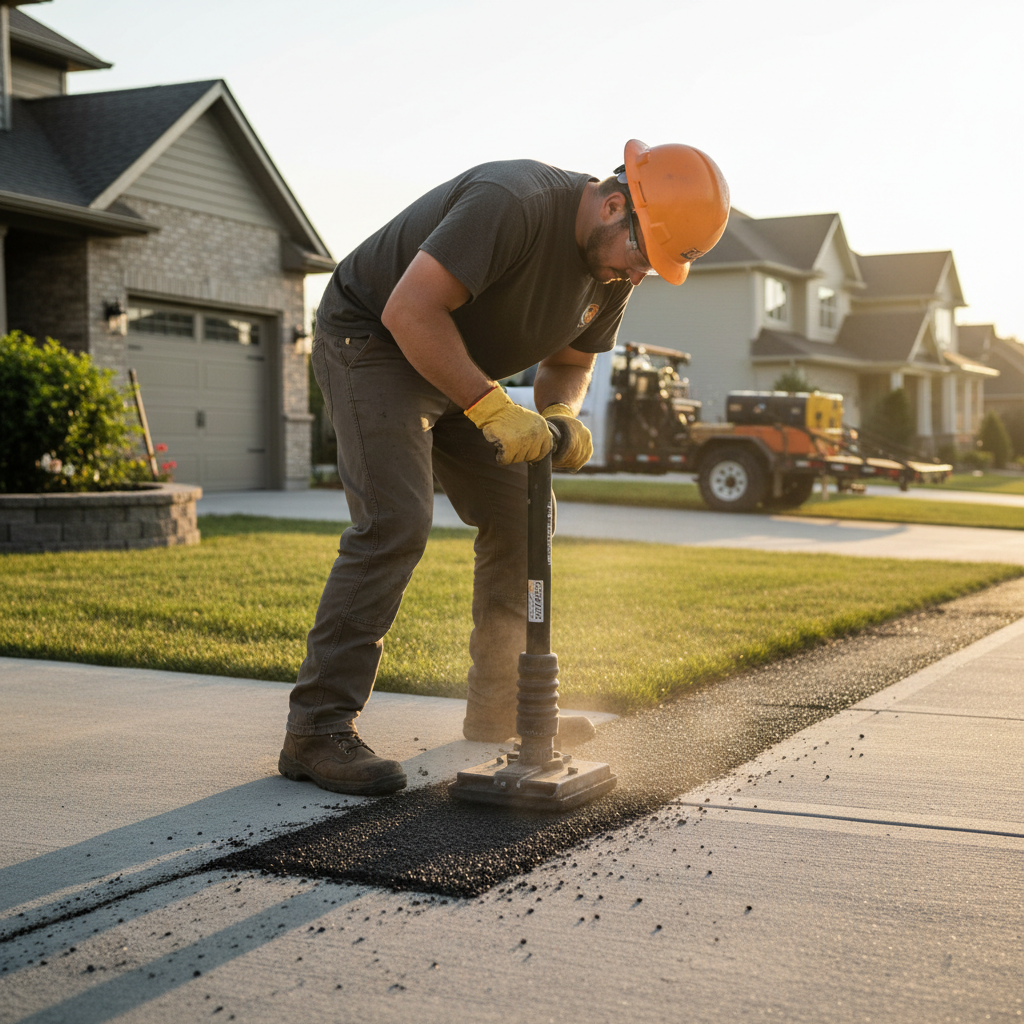
Driveway paving options and costs in London
London, Ontario homeowners have a clear set of driveway choices, but the total cost depends heavily on how the base is built for our freeze–thaw conditions. With about 48.8% of dwellings being single-detached homes, most private driveways in London are tied to detached properties, where owners want a smooth, long-lasting surface that handles heavier vehicles and winter maintenance. It also matters that 52.3% of homes were built before 1981—many of these properties have older grading, weaker subgrades, or drainage issues that need correction before asphalt or pavers will perform well.
In London’s climate, the frost line in southern Ontario is roughly 1.0–1.2 m, so asphalt and concrete must sit on a deeper, well-compacted granular base to stay below the active frost zone. That often means extra excavation and aggregate in problem areas, especially where clay-heavy soils hold water. It’s also a scheduling game: the paving season is typically strongest from late spring to early fall, and cool nights with shoulder-season rain can reduce workable days and tighten labour availability. In neighbourhoods with ongoing upgrades—such as northwest London near Masonville/Westminster—demand can be higher because owners want curb appeal and fewer winter failures.
Below are common price ranges and typical expectations so you can compare options side-by-side before requesting your itemised quote.
| Material |
Lifespan |
Maintenance |
Best For |
Price per sq ft |
Price Range |
| Asphalt (new installation, proper base) |
15–25 years |
Seal every 3–5 years; crack fill as needed |
Cost-effective, smooth ride with good longevity |
$3.75–$6.75 |
$4,500–$9,000 |
| Asphalt (overlay on existing gravel base) |
8–15 years |
Seal and patch more frequently; manage settlement early |
Budget rebuild when the base is still sound |
$3.00–$5.75 |
$4,000–$7,500 |
| Interlocking concrete pavers |
25–40 years |
Weed control; occasional joint sand top-up |
Maximum curb appeal and easy spot repairs |
$10.00–$16.50 |
$8,000–$16,000 |
| Poured concrete (broom finish) |
20–30 years |
Seal periodically; monitor for surface scaling |
Low maintenance with a clean, uniform look |
$9.00–$14.00 |
$9,000–$18,000 |
| Exposed aggregate concrete |
20–30 years |
Seal less often than plain concrete; monitor micro-scaling |
Better traction and decorative finish |
$10.50–$16.00 |
$10,000–$19,500 |
| Gravel / crushed stone (budget option) |
3–8 years |
Re-grade and top up annually; address washouts |
Temporary solution or overflow parking |
$1.50–$3.50 |
$2,000–$5,500 |
Prices are estimates only and vary by project scope, site access and material selection.
What affects the price of paving in London
In London, the same driveway can produce quotes that differ by 30–50% because the real work is rarely “just paving.” Two contractors may price the surface, but the difference often comes from excavation depth, base design, drainage corrections, disposal, and how much labour is needed to prep an older, settled subgrade. With London’s population at 422,324 (Statistics Canada, 2021 Census), there’s steady demand, and that can tighten scheduling in peak months—pushing unit pricing up when teams are booked.
Frost depth and freeze–thaw cycles are decisive cost factors. Even though the frost line in southern Ontario is roughly 1.0–1.2 m, what matters for your driveway is keeping the pavement system below the active frost zone. Deeper frost requires a thicker compacted granular base—often 6–12 inches more than you’d use in milder climates—so water doesn’t sit under the asphalt and expand during cold snaps. Asphalt mix design also matters: the mix needs to be rated to handle local freeze–thaw conditions, and a freeze–thaw-appropriate mix can cost more per ton.
Concrete examples in London are common. First, if your existing base has soft, clay-heavy pockets, contractors may need to over-excavate and replace aggregate in those areas—raising the project toward the higher end of the $4,500–$9,000 asphalt band. Second, a driveway that slopes toward the street without a proper swale or underdrain may need French drains and regrading; that can move the job from “mid-range” toward a full reconstruction budget—especially if you’re comparing to pavers in the $8,000–$16,000 range where edge restraint and deeper bedding are built in.
| Price Factor |
Why It Matters |
Cost Impact |
| Driveway area in sq ft |
Most materials and labour scale directly with square footage |
Typically biggest driver; small changes can shift total by thousands |
| Base depth required |
Frost line depth determines granular thickness to prevent heaving |
Extra depth can add significant excavation and aggregate cost |
| Grading and drainage work |
Slope corrections and drainage keep water from pooling under the surface |
Can add thousands if swales or drains are required |
| Tear-out of existing surface |
Breaking, hauling, and disposal of old concrete/asphalt adds labour and time |
Commonly increases total by 10–25% depending on debris and access |
| Edge restraints and curbing |
Prevents paver spread and maintains line/grade under freeze–thaw pressure |
Materials and extra formwork can raise costs, especially on long runs |
| Sealing requirement |
Asphalt performance in Ontario improves when sealed after curing |
Adds an ongoing line item; skipping sealing can shorten life |
| Site access |
Narrow lots or tight turns slow equipment movement and add labour |
May increase costs via more hand work and repositioning |
| Asphalt mix specifications |
Freeze-thaw-rated mix performs better under Ontario temperature swings |
Higher-spec mix costs more per ton but reduces premature failure |
Permits & regulations in Ontario
For most London homeowners, paving a private driveway within your own property usually does not require a building permit. In practice, many driveway replacements—such as removing old asphalt, excavating and rebuilding the base, and paving within the lot—are handled as a private property improvement. However, work that touches the municipal right-of-way often does require municipal approval. That includes new curb cuts, alterations to boulevard areas, changes that affect storm drainage, or any modifications near the road ditch or drainage infrastructure.
Another factor in Ontario is lot grading. Some municipalities have lot-grading rules that restrict how close you can place hard surfaces to property lines and may require keeping water properly directed away from neighbours and foundations. Because these rules can vary, it’s smart to confirm local lot-grading requirements before you schedule excavation.
Step-by-step, homeowners in London should:
- Call for utility locates before any digging (Ontario One Call).
- Ask the contractor what portion of the work is inside your property versus within the right-of-way.
- Verify the contractor’s Ontario licensing (where applicable to the scope) and request their certificate of insurance.
- Check proof of WSIB coverage (or WCB coverage) before work begins.
- Request a clearance letter if the contractor indicates utilities or inspections are tied to the schedule.
- Confirm disposal is included (clean fill and asphalt/concrete haul are often separate line items).
If the quote includes any curb-related changes or drainage alterations, ask whether permits/approvals are included in the scope and who will apply.
Asphalt vs pavers vs concrete for London driveways
For London driveways, asphalt, interlocking pavers, and concrete all can work well—but each has different trade-offs under our freeze–thaw cycles and winter maintenance routines (salt, sand, and frequent ploughing). Asphalt is typically the lowest upfront option, with a smoother finish when installed over a properly designed granular base. The catch is maintenance: sealing helps protect the binder, and most owners plan on resealing every 3–5 years to slow moisture and oxidation. Interlocking concrete pavers cost more at the start, but they’re repair-friendly—if a section settles or a drain line is accessed later, you can lift and reset only the affected area without replacing the entire driveway.
Poured concrete sits in the middle on price and can look clean and uniform. In London, durability depends on air-entrainment and proper jointing; otherwise, freeze–thaw can lead to surface scaling and cracking. Exposed aggregate can provide better traction on icy days, but it still needs the same frost-protected base.
Base preparation is the common denominator. With London’s frost depth in southern Ontario roughly 1.0–1.2 m, all three systems perform best when drainage is engineered—well-graded base stone, proper compaction, and slopes that don’t allow water to sit under the slab or mat. For an owner comparing budgets, an asphalt driveway may land around the lower end of the $4,500–$9,000 band, while pavers often land in the $8,000–$16,000 band. That extra cost is justified when you want easier future repairs, stronger curb appeal, or your driveway’s grade/drainage challenges are likely to require adjustments.
| Material |
Frost Resistance |
Curb Appeal |
Repair Method |
Lifespan |
Price Band |
| Asphalt (sealed regularly) |
Good when base and drainage are engineered |
Good (clean black finish) |
Patch and re-tack; crack fill; seal coats |
15–25 years |
$4,500–$9,000 |
| Interlocking concrete pavers |
Very good with correct bedding and edge restraint |
Excellent (options and patterns) |
Lift/reset individual stones or sections |
25–40 years |
$8,000–$16,000 |
| Poured concrete (air-entrained) |
Good when air-entrained and properly jointed |
Good (simple, solid look) |
Limited patching; larger repairs may require sections |
20–30 years |
$9,000–$18,000 |
| Exposed aggregate concrete |
Good with frost-protected base |
High (textured, upscale look) |
Resurfacing or patching; spot repairs are more visible |
20–30 years |
$10,000–$19,500 |
| Permeable pavers (drainage grid) |
Very good where water management is designed |
Good (modern systems, clean lines) |
Section replacement; system maintenance for infill |
20–30 years |
$10,000–$18,500 |
| Chip seal / tar-and-chip |
Moderate; best for specific base/traffic conditions |
Basic (utility look) |
Roll-out of topping; reseal/rechip as needed |
6–12 years |
$4,000–$7,000 |
How to choose a paving contractor in London
Choosing the right contractor is about verifying coverage, quality controls, and how clearly they scope your work—especially in London where freeze–thaw failures often trace back to base depth, drainage, and compaction, not just the top layer. Start by confirming Ontario requirements relevant to the work: request the company’s certificate of insurance and verify the policy covers your project location and the type of paving/land improvement being done. Ask for WSIB coverage (or the appropriate WCB coverage) and keep copies for your records.
Next, get 2–3 itemised written quotes. You want a breakdown that separates labour and materials—excavation depth, base material specs, asphalt mix or concrete air-entrainment details, compaction testing (if offered), reinforcement (for concrete), and any drainage work (swales, French drains, or underdrains). A fair quote should show what’s included versus excluded: permit pull (if municipal approval is needed), disposal/haul, topsoil replacement, and restoration of edges and landscaping.
Warranty matters too. Ask for a workmanship warranty length and whether it covers base issues that cause settlement or only surface defects. Confirm if the manufacturer warranty for paving products is transferable to future homeowners.
Finally, check payment terms: never pay more than 10–15% upfront, and use a holdback until substantial completion. Get a start date and completion estimate in writing.
- Ask for the contractor’s insurance certificate and WSIB/WCB clearance—then read the job address and coverage type.
- Request an itemised quote that lists base depth and drainage steps, not just “asphalt supply and install.”
- Confirm granular base type and compaction requirements (and whether compaction is documented).
- Check that tear-out and disposal are included (old asphalt/concrete haul can be a large line item).
- Verify whether curb cuts or right-of-way work trigger municipal approval and whether it’s included.
- Ask how they protect landscaping and where topsoil/seed/sod restoration is included or excluded.
- Confirm edge restraint details for pavers and the jointing plan for concrete.
- Ask when sealing is recommended for asphalt and whether crack fill is included in the first season.
- Review warranty terms in plain language: what defects are covered and for how long.
- Ensure the schedule includes weather contingencies for London’s shoulder-season rain.
- Get a written timeline with milestones (prep, paving, curing/sealing).
- Confirm equipment access plans for your lot layout so the contractor isn’t assuming unlimited driveway width.
Red flags in London include: quotes that avoid stating base depth, promises of “no excavation needed” on clay-heavy subgrades, missing insurance/WSIB paperwork, unusually low pricing without a disposal or tear-out line item, and contracts that don’t specify warranty coverage for workmanship.
Frequently asked questions — paving in London
How long before I can drive on new asphalt?
In London, Ontario, most new asphalt driveways can typically be driven on within about 24–48 hours, but the timing depends on temperature, humidity, and how thick the lift is. If the weather is cool and damp—common during spring shoulder conditions—curing can take longer. For safety and to prevent tracking, contractors usually require the surface to cool and set before vehicles cross it. If your job includes base work and multiple lifts, ask your paving contractor for a written “ready for traffic” timeframe. If you’re planning a busy move or winter preparations, also consider that asphalt benefits from staying protected during the initial curing period; sealing is generally done after a curing window and then every 3–5 years.
What causes potholes and how are they repaired?
Potholes are usually a symptom, not the original problem. In London’s freeze–thaw climate, water enters the asphalt through cracks or weak joints, expands as temperatures drop, and undermines the pavement structure—especially where the base wasn’t graded or drained correctly. Poor compaction, thin asphalt over a weak base, or drainage that directs runoff toward the driveway are common contributors. Repairs are not all the same: proper pothole repair typically involves saw-cutting back to solid material, removing softened asphalt and any saturated base, then re-building the base with compacted aggregate before placing hot-mix asphalt. A good contractor will also recommend crack sealing where the damage started, otherwise the pothole often returns in the same spot.
How do I prepare for a paving project?
Preparation is mostly about making the site safe, accessible, and ready for excavation. In London, confirm utility locates before any digging (Ontario One Call), and mark any items you want protected. Clear the driveway area of vehicles, trailers, and planters; trim back shrubs so equipment can work along the edges. If you have drainage concerns—standing water after rain or ice build-up—tell the contractor before the base is opened so they can plan grading and drainage fixes (like improved slopes or French drains). If your quote includes restoration, discuss the timeline for sod/topsoil replacement. Finally, arrange parking for the days your driveway is under construction, including any curing/sealing window for asphalt.
How do I compare paving quotes fairly?
Comparing paving quotes fairly means you can’t look only at the final number. Ask for an itemised scope that states the base depth and base material, compaction approach, and whether drainage corrections are included. For asphalt, confirm the mix is designed for Ontario freeze–thaw conditions and whether crack fill and sealing are included or excluded. Compare concrete options by checking air-entrainment and jointing/finishing details, not just “broom finish.” For pavers, ensure bedding course depth and edge restraints are specified. Use the local price bands as a sanity check: a typical asphalt driveway often lands around $4,500–$9,000, while pavers commonly fall in $8,000–$16,000. If one quote is far outside the band, the scope should reveal why (more excavation, drainage, or better materials) rather than disappearing items.
Can asphalt be laid in cold weather in London?
Asphalt can’t be laid whenever you want in London, because hot-mix asphalt requires suitable air and surface temperatures for proper placement and compaction. In general, contractors avoid paving when air temperatures are too low—often targeting above about 10°C to achieve consistent compaction. During colder periods, the mix may cool too quickly, leading to poor bond and a shorter lifespan. If you’re scheduling late-season work, ask how they plan to manage temperature and curing. Also confirm that the base is dry and properly compacted—freeze–thaw problems start when water is trapped under the asphalt. If your project falls near season end, plan for the contractor’s proposed schedule rather than pushing the date.
What is a driveway apron and do I need one in London?
A driveway apron is the transition section where your driveway meets the street or sidewalk, typically within or at the boundary of the municipal right-of-way. In London, whether you “need one” depends on your current condition: if the driveway ties into an apron area that’s crumbling, uneven, or causing drainage issues, replacing or upgrading the apron is often recommended for long-term performance. If the work involves new or modified curb cuts, or changes that affect storm drainage, it may require municipal approval before paving proceeds. Even on private property, a proper apron helps prevent the pavement edge from breaking down under ploughing and vehicle turning. Ask your contractor whether your project includes apron work and whether permits/approvals are part of the scope.