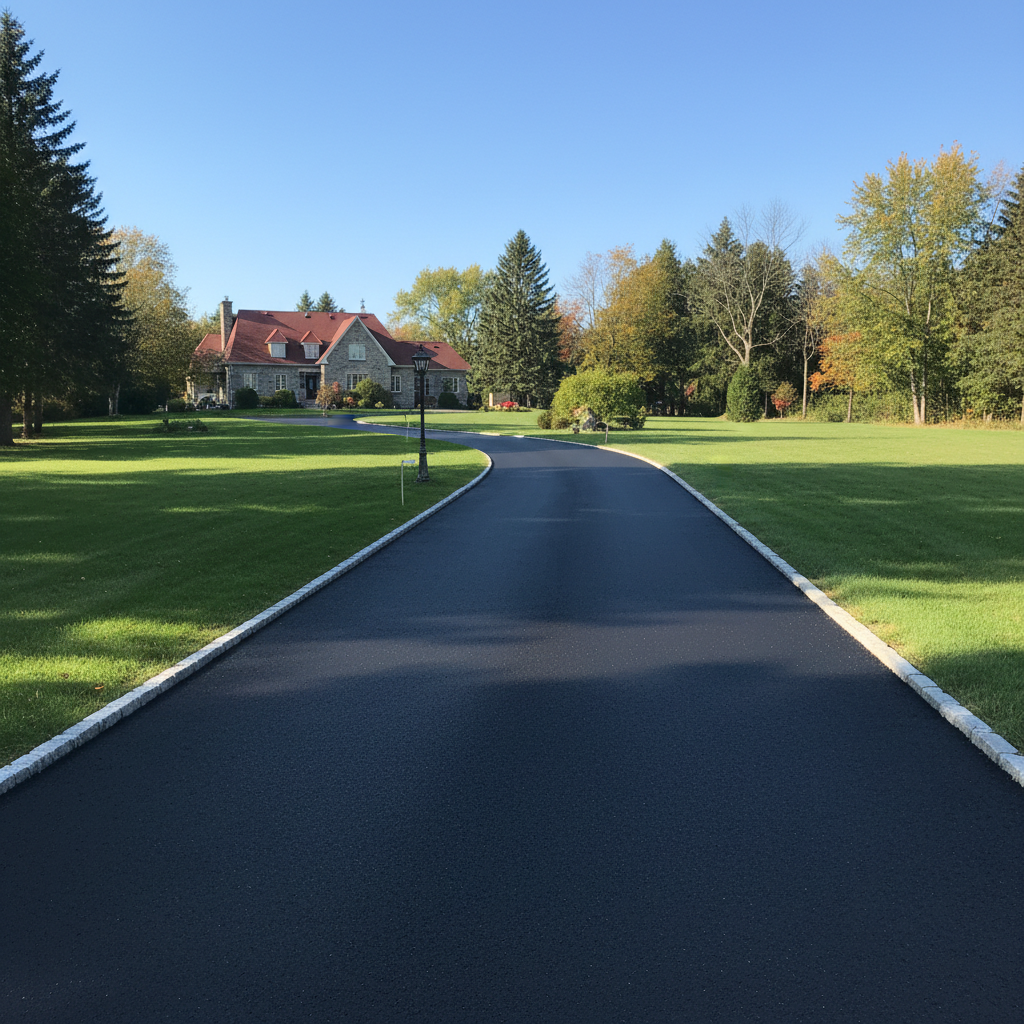
Driveway paving options and costs in Lincoln
In Lincoln, driveway paving is a big decision because most homes are single-detached (69.8% of dwellings), and that housing pattern puts a lot of driveways right up against frequent freeze–thaw conditions. With 8,055 homeowner households in the area (Statistics Canada, 2021 Census), there’s steady demand for clean, durable asphalt, pavers, and concrete installations. The Hamilton–Niagara Peninsula market also means pricing follows the region’s build season and labour availability: your paving is typically scheduled April–October, and asphalt work depends on hot-mix temperatures above about 10°C for proper compaction. That seasonal window can tighten in spring, especially in neighbourhoods with older homes and deeper subsoil challenges.
Climate plays a direct role in cost. Frost penetration and repeated winter cycles are major cost drivers here, which is why quality driveways start with a deeper, well-compacted granular base (often 6–10 inches) and reliable drainage. In older areas—particularly where homes built before 1981 make up 41.2% of the stock (Statistics Canada, 2021 Census)—you’re more likely to see clay/silty subsoils, uneven settlement, and buried drainage issues that require excavation and base corrections. In many Lincoln communities, that added prep work is common around Vineland-area rural edges and older residential pockets where the driveway ties into existing grading.
Below is a practical snapshot of what homeowners in Lincoln typically budget, and how the choices compare before you review site-specific quotes.
| Material |
Lifespan |
Maintenance |
Best For |
Price per sq ft |
| Asphalt (new installation, proper base) |
15–25 years |
Seal every 3–5 years |
Most driveways needing a strong, flexible surface |
$3.50–$6.50 |
| Asphalt (overlay on existing gravel base) |
10–20 years |
Seal every 3–5 years; watch settlement spots |
Smoother sites where the existing base is stable |
$4.25–$7.00 |
| Interlocking concrete pavers |
25–30 years+ |
Occasional joint sand top-up; re-level isolated areas |
High curb appeal and easy localized repairs |
$9.50–$18.00 |
| Poured concrete (broom finish) |
20–30 years |
Seal when recommended by contractor; maintain joints/cracks |
Clean, low-maintenance look with solid base design |
$8.00–$14.50 |
| Exposed aggregate concrete |
20–30 years |
Seal periodically for stain resistance |
Slip-resistant finish and premium appearance |
$10.00–$18.00 |
| Gravel / crushed stone (budget option) |
3–8 years |
Re-grade and add stone as it migrates |
Temporary solution or low-traffic areas |
$2.00–$4.50 |
Prices are estimates only and vary by project scope, site access and material selection.
What affects the price of paving in Lincoln
Even with the same driveway dimensions, Lincoln-area quotes can differ by roughly 30–50% because the work behind the surface changes: how deep the excavation goes, how much base and drainage correction is needed, and how complicated your edges are (curbs, slope transitions, or tying into an existing asphalt/concrete apron). In Ontario, asphalt work often carries a bit less upfront material cost than pavers or concrete, but high-quality asphalt here still requires the right granular thickness and a freeze–thaw rated mix design—otherwise you pay later in patching.
In the Hamilton–Niagara Peninsula climate, frost line depth and freeze–thaw cycles are decisive cost factors. Colder Southern Ontario typically needs a thicker compacted granular base (commonly 6–12 inches) than milder climates because the base must stay stable through repeated expansion and contraction. Driveways also need reliable drainage and proper slope away from the foundation/garage approach. If drainage is off, you get soft spots and premature failure, even if the surface looks fine at first. On top of that, the paving season is essentially April–October; asphalt requires warm conditions for production and compaction, which concentrates demand and can raise scheduling pressure in peak months.
Concrete can look “similar” on paper, but local conditions often push cost either up or down. For example, if your driveway already has a stable, well-graded base, poured concrete can be a mid-range budget (often closer to the $7,000–$18,000 driveway band). Conversely, if soil is soft or the grade needs re-engineering, concrete prep and dowels/joints design can push the total toward the upper end. Asphalt might start in the $3,000–$8,000 band, but when you need deeper granular base and drainage corrections, asphalt quotes often climb toward the mid-to-upper range for a quality installation.
| Price Factor |
Why It Matters |
Cost Impact |
| Driveway area in sq ft |
Material and compaction quantities scale directly with area |
Largest variable; typically the biggest line item (up to the full difference between low/high quotes) |
| Base depth required |
Frost stability depends on compacted granular thickness |
Deeper base can add a major portion of the budget, often within the 35–45% range of the driveway total for excavation/base |
| Grading and drainage work |
Slope, ditch tie-ins, and subsoil corrections prevent water-related failure |
Can materially increase costs when excavation and regrading are extensive |
| Tear-out of existing surface |
Hauling and disposal costs vary by depth and material type |
Concrete removal and proper breaker/loader time can add a noticeable surcharge |
| Edge restraints and curbing |
Pavers need restraint to resist lateral movement; asphalt needs clean edges |
Higher if your driveway borders lawns/steps and needs more engineered edges |
| Sealing requirement |
Asphalt sealing protects against moisture and oxidation |
Costs recur; usually a modest line item, but it affects long-term performance |
| Site access |
Long pushes, tight turns, and limited staging slow equipment movement |
Usually adds labour time and equipment handling charges |
| Asphalt mix specifications |
Freeze–thaw rated mixes and correct lift thickness reduce cracking risk |
Higher-quality mix and proper lift schedule can raise per-sq-ft pricing versus budget mixes |
Permits & regulations in Ontario
For most Lincoln homeowners, paving a private driveway within your own property typically does not require a building permit—especially when you’re replacing an existing driveway surface and staying inside the property line. However, permits and approvals can be required when the work touches municipal infrastructure. If your project includes changes in the municipal right-of-way—such as installing or altering a curb cut, changing boulevard grading, or modifying storm drainage pathways—check with the municipality for the approvals they require.
Some municipalities also have lot-grading bylaws that limit how close a hard surface can be to property lines or how water must be directed away from neighbouring lots and foundations. Even when a permit isn’t required, utility safety is still non-negotiable. Before any excavation, you should confirm utility locates through Ontario One Call to mark underground services.
To verify a contractor’s Ontario compliance step-by-step, ask for:
- Ontario business/contractor licence details (where applicable) and confirm the company name matches the estimate.
- Certificate of Insurance (general liability) naming you as an interested party if required by your situation.
- WSIB clearance letter for workers performing the paving scope (or the applicable proof they provide for your contractor).
- Workmanship warranty in writing, including what’s covered and for how long.
- Itemised scope that clearly shows excavation, base depth, drainage corrections, and disposal.
If you can’t get clear documentation during the quote stage, it’s a warning sign. A proper contractor should provide these items before scheduling equipment.
Asphalt vs pavers vs concrete for Lincoln driveways
In Lincoln, the “best” driveway material depends on how much you value upfront cost versus long-term flexibility through freeze–thaw. Asphalt is usually the lowest upfront option, and it handles temperature swings well because it’s flexible; that said, asphalt needs sealing every 3–5 years to slow moisture penetration and oxidation. Interlocking concrete pavers cost more up front, but they’re highly repairable—if a settling spot forms, you can lift and reset a limited section without tearing out the entire driveway. That’s a real advantage in Southern Ontario where subsoil variability is common. Poured concrete sits in the middle for price and can look sharp, but it’s more sensitive to base preparation quality and joint design; if air-entrainment and crack/joint strategy aren’t done correctly, freeze–thaw movement can lead to visible cracking over time.
For the Hamilton–Niagara Peninsula climate, good base preparation is the equalizer across materials: drainage and a thicker compacted granular base (often 6–10 inches for many residential driveways, depending on soil and design) are what keep the surface stable. In day-to-day winter maintenance, salt and plowing are realities. Asphalt generally tolerates light wear better, but it still needs sealing to protect the binder. Pavers handle plow contact well and can be maintained with joint sand, while concrete durability depends heavily on air entrainment and proper isolation/joints.
A practical dollar example: if an asphalt driveway quote lands around the $3,000–$8,000 band, an interlock bid might come in closer to the $9,000–$20,000 band. That premium can be justified if you want top curb appeal and the ability to repair only affected sections after a frost-related settling event—particularly in older Lincoln neighbourhoods where soil conditions vary and homes built before 1981 (41.2% of dwellings) are more common (Statistics Canada, 2021 Census).
| Material |
Frost Resistance |
Curb Appeal |
Repair Method |
Lifespan |
Price Band |
| Asphalt (sealed regularly) |
Good flexibility under freeze–thaw when base/drainage are correct |
Good (clean, dark finish) |
Patch and re-seal; localized milling possible |
15–25 years |
$3,000–$8,000 |
| Interlocking concrete pavers |
Excellent; performs well with proper restraint and base |
Highest (wide range of styles/colours) |
Remove and relay individual paver sections |
25–30 years+ |
$9,000–$20,000 |
| Poured concrete (air-entrained) |
Good with correct air entrainment and joints |
Good to very good (clean lines) |
Crack patching and joint repair; full replacement if extensive |
20–30 years |
$7,000–$18,000 |
| Exposed aggregate concrete |
Good when properly finished and cured; base still critical |
Very high (textured, premium look) |
Limited localized repair; often patching plus finishing |
20–30 years |
$10,000–$20,000 |
| Permeable pavers (drainage grid) |
Very good drainage performance; depends on subgrade permeability |
Good (modern look) |
Localized panel/paver repairs; requires correct underdrain design |
20–30 years+ |
$11,000–$22,000 |
| Chip seal / tar-and-chip |
Moderate; performance varies by design and maintenance |
Utility-grade (not typically premium curb appeal) |
Spot re-surfacing/chip additions |
7–12 years |
$2,500–$6,000 |
How to choose a paving contractor in Lincoln
When you’re comparing contractors in Lincoln, the fastest way to separate experienced crews from “good on paper” quotes is to verify compliance and demand clarity. Start with licensing and coverage. In Ontario, ask for the contractor’s WSIB status (clearance letter) for workers involved in the paving scope, and request a current certificate of insurance showing general liability coverage. Many paving issues become expensive when there’s damage to your property or a worker injury—so you want those documents before any equipment arrives. If they can’t provide clear proof, move on.
Next, get 2–3 itemised written quotes. You want a breakdown of labour and materials (excavation, base materials, asphalt/pavers/concrete, disposal, compaction, and any drainage corrections), not one lump sum. Scope details matter here because freeze–thaw performance depends on base depth and drainage: a driveway priced in the middle of the asphalt band can jump toward the upper range if deeper granular base and drainage adjustments are included. Ask whether disposal is included, whether permit/approval work is needed (for right-of-way or drainage changes), and what’s excluded (topsoil replacement, restoring landscaping, or repairs to underground drainage).
For warranty, confirm workmanship warranty length and what it covers (cracking/settlement, edge failure, or patching). Also ask whether manufacturer warranties are transferable if materials are involved. Finally, payment timing: never pay more than 10–15% upfront; hold back the remainder until the job is complete and clean-up is done.
- Ask for a detailed site visit plan and who will assess base/drainage.
- Confirm base depth and compaction requirements in writing (not just “we’ll do proper base”).
- Request proof of insurance (liability) and WSIB clearance letter.
- Get an itemised breakdown: excavation, base, surface material, edging, and disposal.
- Check whether they include utility locates responsibilities on demolition/excavation.
- Clarify drainage/slope corrections and where runoff will go.
- Ask for edge restraint details (especially for pavers) and geotextile use if needed.
- For asphalt, ask about lift thicknesses and seal timing (often after 6–12 months).
- For concrete, confirm air-entrainment, joint spacing, and curing plan.
- Get start date and completion estimate in writing.
- Review warranty terms: workmanship duration, exclusions, and response timeline.
- Ensure payment schedule is staged with a holdback (typically until completion).
Red flags to watch for: quotes that don’t specify base depth or drainage corrections, refusal to provide WSIB/insurance proof, vague “we’ll handle permits” wording without stating who pulls what approval, large upfront payments beyond 10–15%, and no written warranty or scope exclusions.
Frequently asked questions — paving in Lincoln
How do I get the most accurate paving quote in Lincoln?
To get an accurate paving quote in Lincoln, start with a site measurement and a real discussion about base and drainage—because in the Hamilton–Niagara Peninsula climate, freeze–thaw performance is driven by what’s underneath the surface. Have the contractor confirm proposed base depth and compaction, show how they’ll manage slope away from the garage/house, and note whether existing drainage needs correction. Ask for an itemised breakdown (excavation, base materials, disposal, surface material, edging/curbs, and any required patching). It also helps to ask whether they’re pricing a proper new installation or an overlay. Quotes are most comparable when they include the same scope. If you’re considering asphalt, ask about sealing timing; if you’re considering pavers or concrete, ask about joint/crack strategy. (Statistics Canada, 2021 Census)
How much does it cost to pave a driveway in Lincoln?
In Lincoln, the typical budget bands for driveway paving land around the mid-to-upper Southern Ontario ranges. For asphalt, many residential projects fall within the $3,000–$8,000 driveway band depending on area, base thickness, and how much excavation/drainage correction is required. Concrete commonly sits around $7,000–$18,000, while interlocking pavers often run $9,000–$20,000 due to higher material and labour complexity. If you’re only resurfacing without major base work, you may see numbers closer to the low end of asphalt—but in older neighbourhoods (Lincoln has a meaningful share of homes built before 1981), base issues can push costs higher. Sealing and minor repairs are usually separate, often within $400–$2,000.
Asphalt vs interlocking pavers vs concrete — which is best in Lincoln?
For Lincoln driveways, asphalt is often the best “value + flexibility” choice when you want solid performance through freeze–thaw and the lowest upfront cost, especially if your contractor builds the base correctly. Interlocking pavers are best if curb appeal matters and you prefer a surface that can be repaired section-by-section without replacing the whole driveway—useful when some frost-related movement happens over the years. Poured concrete can be excellent when it’s air-entrained and built with the right joint design, but it needs careful installation because freeze–thaw and salt can accelerate cracking if the slab isn’t engineered well. A common scenario is asphalt at the $3,000–$8,000 band versus interlock at the $9,000–$20,000 band; the premium is usually justified if you want easy localized repairs and a premium look that holds up under plowing. (Statistics Canada, 2021 Census)
How long does a paved driveway last in Lincoln?
Longevity in Lincoln depends on base depth, drainage, and maintenance routines—especially sealing for asphalt. With a properly prepared base, asphalt typically lasts about 15–25 years, while interlocking concrete pavers often reach 25–30 years+ because individual pavers can be reset if movement occurs. Air-entrained poured concrete commonly lasts 20–30 years when joints and curing are handled correctly. Exposed aggregate concrete is similar in lifespan but is more about finish durability than structural life. If you skip sealing, asphalt usually ages faster because moisture finds its way into the surface over time. For many homeowners, adding asphalt sealing every 3–5 years is a cost-effective way to protect the investment, rather than waiting for visible cracking and then paying for larger patches later.
When is the best time of year to pave in Lincoln?
In Lincoln and the broader Hamilton–Niagara Peninsula, the practical paving season is usually April through October. Asphalt work is constrained because hot-mix asphalt needs adequate air temperatures (commonly above about 10°C) for proper compaction and smooth finishing. Spring can be busy, so scheduling early is smart, but you also want the ground to be dry enough for excavation and compaction. Concrete and interlock can be done over a longer window depending on site conditions, but curing and weather still affect quality. If you’re trying to avoid frost-related subgrade issues, it’s best to let the site dry out and ensure drainage work is complete before surface paving. Work done too late in fall is risky because compaction performance and curing conditions can deteriorate in colder evenings and freeze nights.
How deep should the base be for Lincoln's frost?
Base depth is about frost stability, drainage, and soil type. In Southern Ontario climates like Lincoln’s, many quality residential driveways target roughly 6–10 inches of compacted granular base, and sometimes closer to 10–12 inches when soils are weaker, grades are difficult, or frost-related movement risk is higher. Contractors also need to address drainage so water doesn’t sit in the granular layer during freeze–thaw cycles. The deeper frost concern matters because repeated expansion and contraction can cause heaving and cracking if the base isn’t thick and compacted enough. Your contractor should confirm base depth after assessing subsoil conditions (not by guessing). Because Lincoln has a significant share of older housing stock, it’s common to find areas that need more base correction and regrading to achieve long-term performance.