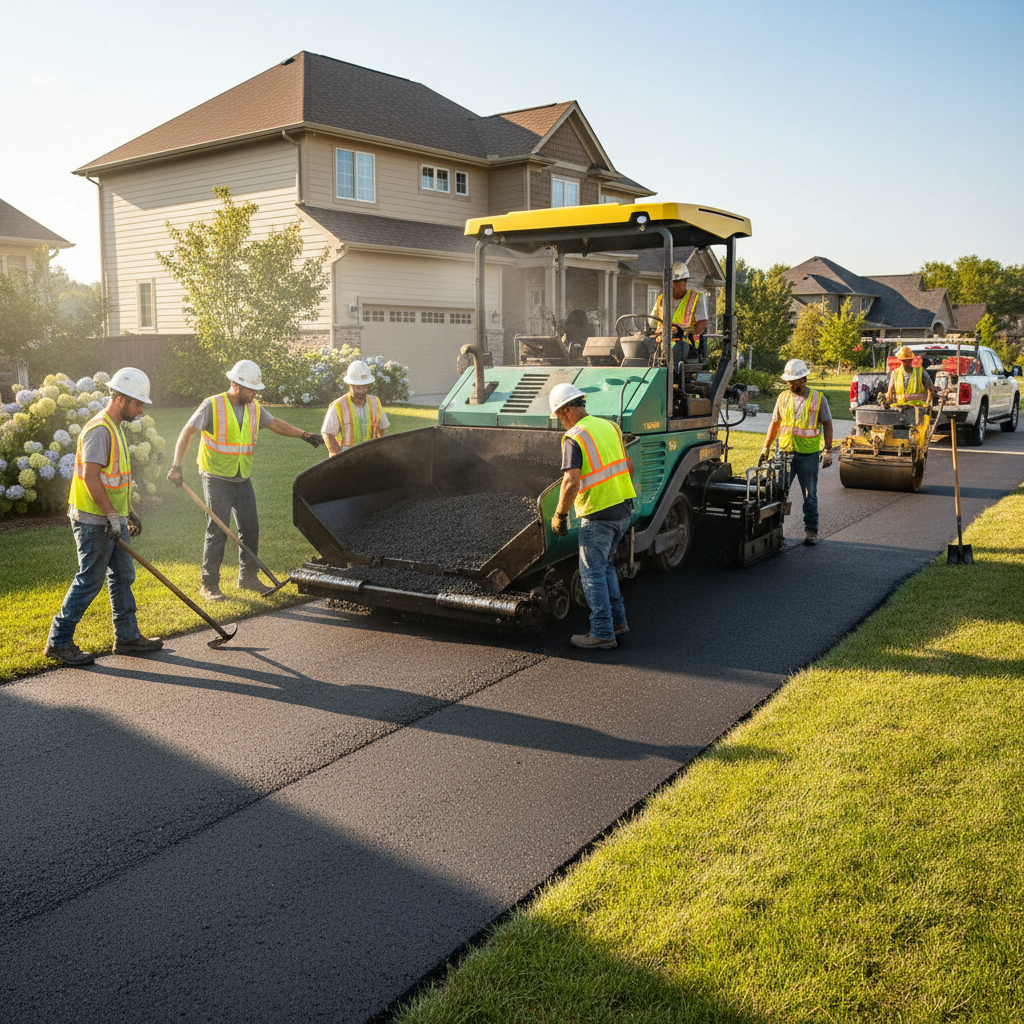
Driveway paving options and costs in Binbrook
Driveway paving in Binbrook is a practical upgrade for homeowners in a town of about 8,796 residents (Statistics Canada, 2021 Census). Most private driveways here are on single-family lots, so you’ll typically be choosing a system that can handle heavy winter stress and still look good after plowing, salt, and freeze–thaw cycles. In the Hamilton–Niagara Peninsula market, pricing is shaped by the same fundamentals: deeper frost penetration means you need a properly compacted granular base and reliable drainage to control heaving and cracking. In practice, base and drainage work can be a large slice of the budget—often around 35–45% of a quality driveway install—before you even get to the asphalt, pavers, or concrete surface.
That’s also why neighbourhood context matters. Areas with older lots, more mature clay/silty soils, or where driveways have settled (common in parts of Binbrook near residential growth corridors) tend to need extra excavation, regrading, and sub-base corrections. This can push you toward the mid-to-upper ends of Ontario pricing bands, especially during the short paving window (roughly April to October), when contractors and hot-mix asphalt schedules are in high demand. The upside is you can pick a material that matches your risk tolerance: asphalt usually costs less upfront, interlocking pavers emphasize curb appeal and section-level repairs, and concrete offers a solid finish when the base and joints are detailed correctly.
Use the table below to compare realistic lifespan expectations, upkeep, and price ranges for Binbrook driveways, then we’ll break down the cost drivers that explain quote-to-quote differences.
| Material |
Lifespan |
Maintenance |
Best For |
Price per sq ft |
| Asphalt (new installation, proper base) |
15–25 years |
Seal every 3–5 years (typical) |
Best balance of cost and flexibility under freeze–thaw |
$3.00 – $7.50 |
| Asphalt (overlay on existing gravel base) |
10–18 years |
Seal every 3–6 years; monitor edge/base performance |
Upgrading a less-damaged base without full tear-out |
$2.50 – $6.00 |
| Interlocking concrete pavers |
25–40 years |
Occasional re-leveling; replace individual stones as needed |
Curb appeal and easy localized repairs |
$7.50 – $15.00 |
| Poured concrete (broom finish) |
20–30 years |
Reseal selectively; manage de-icing and salt splash |
Clean, uniform look with strong load capacity |
$5.50 – $12.00 |
| Exposed aggregate concrete |
20–35 years |
Reseal as recommended for staining and moisture protection |
Slip resistance and premium appearance |
$7.50 – $14.00 |
| Gravel / crushed stone (budget option) |
3–8 years |
Re-top up, re-grade, and control weeds regularly |
Lowest upfront cost and drainage-friendly zones |
$1.50 – $3.50 |
Prices are estimates only and vary by project scope, site access and material selection.
What affects the price of paving in Binbrook
In Binbrook, it’s common to see quotes for the “same” driveway swing by 30–50% once you account for the details that actually control performance. A big reason is that contractors price to the in-ground conditions, not just the surface finish. Two installers might propose the same asphalt thickness, yet one may include deeper granular base, proper sub-drainage, and full-depth compaction—while the other tries to keep costs down by reducing excavation. That’s where the Hamilton–Niagara Peninsula climate becomes decisive: frost line depth and freeze–thaw cycles drive the need for a deeper compacted granular base (often 6–10 inches, and sometimes more depending on subsoil), plus drainage that prevents water from sitting under the slab or binder course.
Season timing also matters. Hot-mix asphalt production and compaction are temperature-dependent; asphalt typically needs workable air temperatures above about 10°C for consistent results. Because the effective paving season in this region is usually April–October, spring and early summer scheduling pressure can push pricing higher when calendars fill. On the concrete side, joints and air-entrainment design must accommodate freeze–thaw movement, and that can raise material costs compared with “basic” pours.
In Binbrook, costs commonly rise when older driveway bases are soft, when you need to correct ponding or drainage swales, or when you discover clay/silty subsoils that require extra base thickness and stabilization. Conversely, costs can be lower when the existing grade is stable, the driveway area is already close to final slope, and access is straightforward. As a quick example, one homeowner might be able to stay near an asphalt budget range of $3.00 – $7.50 per sq ft on a straightforward install, while a driveway needing significant base rebuild can move toward mid-to-upper Ontario pricing levels—sometimes approaching the point where pavers or concrete become competitive for long-term value.
| Price Factor |
Why It Matters |
Cost Impact |
| Driveway area in sq ft |
Most line items scale directly with surface area (excavation, stone, asphalt/concrete) |
Large: often the single biggest driver |
| Base depth required |
Frost penetration demands sufficient granular thickness and compaction for heave/crack resistance |
Medium-to-large; can change total cost substantially |
| Grading and drainage work |
Slope corrections and drainage improvements keep water from sitting under pavement |
Medium; can rise quickly with excavation |
| Tear-out of existing surface |
Breaking and hauling concrete or old asphalt adds labour and disposal |
Medium-to-large depending on thickness |
| Edge restraints and curbing |
Pavers need restraints to prevent lateral movement; asphalt may need mill/replace edges |
Small-to-medium; important for long-term stability |
| Sealing requirement |
Asphalt performance in winter relies on a maintenance seal after installation and thereafter |
Small-to-medium; adds cost but protects the surface |
| Site access |
Narrow lots slow equipment movement and can increase labour time |
Small-to-medium; can become medium on tight sites |
| Asphalt mix specifications |
Freeze–thaw-rated mixes can cost more but reduce premature raveling and cracking |
Small-to-medium; often worth it for longevity |
Permits & regulations in Ontario
For Ontario homeowners, paving a private driveway within your own property usually does not require a building permit. In most Binbrook driveway projects, you’re simply replacing or improving the hard surface on your lot—typically including asphalt, interlocking pavers, or concrete—and that’s generally handled under normal private-property work practices.
However, work that affects the municipal right-of-way is where approvals may be required. Examples that typically do need municipal approval include new or changed curb cuts, alterations to the boulevard, and any changes that impact storm drainage (for instance, connecting or redirecting drainage through the town’s area). Some municipalities also have lot-grading bylaws that restrict how close a hard surface can be to certain property lines or how water must drain. Because rules can vary by municipality and even by lot conditions, you should confirm the requirements with the Town of Binbrook or your local authority before excavation.
Before anyone digs, call for utility locates using Ontario One Call to mark buried services—this is both a safety and legal requirement in practice. Then verify your contractor: check an Ontario licensing/registration listing where applicable, request liability insurance (ask for the certificate of insurance), and confirm WSIB coverage for workers (or the correct WCB/clearance proof where applicable). Step-by-step, ask for: (1) insurance COI, (2) WSIB clearance letter or proof of coverage, (3) licence/registration details, and (4) the written scope and schedule.
Asphalt vs pavers vs concrete for Binbrook driveways
For Binbrook driveways, the choice usually comes down to upfront cost versus long-term maintenance in a moderate-to-cold Southern Ontario freeze–thaw climate. Asphalt is typically the lowest upfront option and performs well under temperature swings, but it needs surface care—most homeowners plan for sealing every 3–5 years to protect against oxidation and winter wear. Interlocking concrete pavers cost more initially, yet they’re often the most homeowner-friendly long-term: if a section settles or a base area needs correction, individual stones can be lifted, fixed, and reset without replacing the entire driveway. Poured concrete tends to land in the mid-range, with a clean look, but it can be more vulnerable to cracking if base preparation, joints, and air-entrainment aren’t done for freeze–thaw movement and the reality of Ontario de-icing.
Across the Hamilton–Niagara Peninsula, base and drainage design drive performance for all three options. With frost penetration in the 1.2–1.5 m range, you need a deeper, well-compacted granular base and proper slope so water drains away. On asphalt and pavers, the system is more forgiving to minor movement; on concrete, movement concentrates stress at joints and can telegraph problems if the base is uneven. For winter maintenance routines—plowing, salt, and sand—pavers generally handle localized wear well, asphalt benefits from sealing, and concrete requires careful de-icing use to protect the surface.
Where is the price difference justified? If your asphalt install is, for example, around $3.00 – $7.50 per sq ft but your site is prone to settling (older base, clay/silty soils, drainage issues), pavers may cost you more upfront—often in the $7.50 – $15.00 per sq ft range—but you gain easier repairs that can extend the driveway’s life without full resurfacing. If your base is stable and drainage is straightforward, asphalt can be the best value.
| Material |
Frost Resistance |
Curb Appeal |
Repair Method |
Lifespan |
Price Band |
| Asphalt (sealed regularly) |
Good with proper base and freeze–thaw-rated mix |
Medium |
Mill and patch localized areas; overlay if needed |
15–25 years |
$3.00 – $7.50 |
| Interlocking concrete pavers |
Excellent with correct edge restraints and bedding sand |
High |
Lift-and-replace individual stones or sections |
25–40 years |
$7.50 – $15.00 |
| Poured concrete (air-entrained) |
Good when base is stable and joints are detailed |
Medium-to-high |
Crack repair / patching; full resurfacing later |
20–30 years |
$5.50 – $12.00 |
| Exposed aggregate concrete |
Good with strong base and proper curing |
Very high |
Surface refinishing; localized patching varies by finish |
20–35 years |
$7.50 – $14.00 |
| Permeable pavers (drainage grid) |
Excellent for water control where drainage is challenging |
High (technical look) |
Lift and reset; clean/replace drainage media if needed |
25–35 years |
$8.00 – $16.00 |
| Chip seal / tar-and-chip |
Fair to good; performs best on stable bases |
Low-to-medium |
Spot re-chip or resurfacing |
8–15 years |
$3.00 – $6.00 |
How to choose a paving contractor in Binbrook
Choosing a paving contractor in Binbrook is mostly about verifying who will be working and what exactly is included. In Ontario, start by confirming licensing/registration where applicable, then request and review liability insurance—your certificate of insurance should name your property address or show coverage at the project level. Next, confirm WSIB coverage (for Ontario workers) and ask for a WSIB clearance letter or current proof of coverage. If the contractor uses subcontractors, ask how WSIB coverage and liability are handled for those workers as well. A reputable paving company will provide paperwork quickly because it’s part of how they operate, not something they hide.
For pricing, get 2–3 itemised written quotes that break labour and materials down line-by-line (excavation, granular base, asphalt paving, drainage corrections, tack coat, cutting/finishing, disposal, and any sealing). Avoid quotes that are “lump sum” without scope detail; in our market, the cost drivers are usually buried in the scope. Read the exclusions: is permit/approval support included if needed (for right-of-way changes), is disposal included, and who restores landscaping after excavation?
Warranty is another key differentiator. Ask for workmanship warranty length and whether product/manufacturer warranty applies to mixes or paver units (and whether it’s transferable to you as the homeowner). For payment schedule, never agree to more than about 10–15% upfront; hold back a portion until the job is complete, cleaned, and reviewed. Finally, require a start date and completion estimate in writing—Binbrook’s paving season is short, and scheduling slips can impact compaction and curing.
- Provide WSIB clearance/proof for workers (Ontario) before work starts.
- Provide a current certificate of liability insurance.
- Verify licensing/registration details and contact information matches the quote.
- Ask for an itemised quote (no vague lump sum).
- Confirm base design thickness and compaction testing expectations.
- Specify drainage/grading corrections included (slope to prevent ponding).
- List tear-out scope and disposal fees separately.
- Confirm edge restraints/curbing details (especially for pavers).
- For asphalt: confirm asphalt thickness, tack coat, and seal coat timing.
- Request product specs: asphalt mix design notes or concrete air-entrainment and joints.
- Get a workmanship warranty in writing (duration and what’s covered).
- Use a payment schedule with limited upfront payment and final holdback until completion.
Common red flags in Binbrook include: quotes that ignore base depth and drainage, refusal to share insurance/WSIB proof, “too good to be true” pricing without a detailed scope, pressuring you for large upfront payments, and work that doesn’t provide a written timeline or warranty terms.
Frequently asked questions — paving in Binbrook
What causes potholes and how are they repaired?
Potholes form when water gets into weak spots under asphalt—often where the base was thin, poorly compacted, or where drainage lets water sit. In the Hamilton–Niagara Peninsula freeze–thaw climate, that water expands and contracts, loosening the asphalt and accelerating raveling, which eventually turns into potholes. In older Binbrook areas with clay/silty subsoils or driveways that settled, this can happen faster because the subgrade doesn’t stay stable.
Repairs typically start with proper assessment: the contractor should core or excavate around the damaged area to find the underlying void or failing base, then remove loose material down to firm support. The fix is more than “patching on top”—it includes compacted granular base and a tack/bonding step before new asphalt. For a fair comparison, ask whether the repair is a shallow patch or a full-depth section repair. As a reference point for budgeting, a full new asphalt installation often lands in the $3.00 – $7.50 per sq ft range, so large pothole repairs can approach overlay-type costs if the base is compromised.
How do I prepare for a paving project?
Start by clearing the driveway area and marking any landscaping you want protected. Remove vehicles, grills, hoses, and planters so equipment has safe access for excavators, compactors, and paving gear. If you have edging, low fences, or decorative features, take photos and ask the contractor to note what will be protected or removed—scope matters. Next, check for any planned changes near the driveway, like new decks, drainage work, or garage/door replacements, because those can affect base elevation and slope.
On the homeowner side in Ontario, confirm you’ve arranged utility locates before excavation; contractors should do this through Ontario One Call as part of safe digging. Also verify lot-grading expectations with the local municipality if your project changes how water drains or affects the right-of-way (like curb cut changes). Finally, request itemised quotes and a written schedule. In Binbrook, work outside the typical April–October paving season is limited, so locking dates early helps avoid rushed installation and compaction issues.
How do I compare paving quotes fairly?
To compare quotes fairly in Binbrook, match apples to apples: compare the scope, not only the bottom-line price. Ask for an itemised breakdown that includes excavation/tear-out, granular base material type (Granular A/B where applicable), base depth, compaction steps, drainage/grading corrections, asphalt or concrete thickness, tack coat, edge restraints, and disposal. A quote that’s lower usually has fewer included items—often less base depth, no drainage correction, or minimal limits on sealing.
Look for specifics tied to freeze–thaw performance. For asphalt, confirm the mix design approach and whether sealing is included after installation (commonly after the driveway cures). For pavers, confirm bedding sand and restraints. For concrete, ask about air-entrainment, joint layout, and curing practices. If you’re comparing asphalt versus concrete, note that typical asphalt new installs sit around $3.00 – $7.50 per sq ft, while poured concrete often ranges around $5.50 – $12.00 per sq ft depending on finishing and base complexity. If the “cheaper” quote has less excavation or no drainage work, the savings are usually temporary.
Can asphalt be laid in cold weather in Binbrook?
In Binbrook, cold weather asphalt paving is where quality can suffer. Hot-mix asphalt relies on workable temperatures for placement and compaction; when air temperatures are too low, you can’t achieve consistent compaction, and the mat can cool before it’s properly rolled. In Ontario’s freeze–thaw climate, poor compaction and early cooling can lead to early raveling and cracking, especially around edges and joints.
Most reputable contractors will only pave when conditions meet the mix and compaction requirements—often when daytime temperatures and site conditions are supportive (commonly above about 10°C for reliable results). If you’re scheduling, ask the contractor how they handle borderline temperatures, whether they use temperature monitoring, and what their contingency plan is if weather drops. If a contractor proposes paving in genuinely cold or wet conditions to “fit the schedule,” that’s a major risk factor. It’s usually better to wait within the April–October paving window to protect long-term performance.
What is a driveway apron and do I need one in Binbrook?
A driveway apron is the section of paving that transitions from the driveway surface to the street side—often at the edge where drainage and elevation changes. In some cases it’s a municipal right-of-way feature; in others it’s the contractor’s term for the properly finished transition at the driveway approach. Whether you need one depends on the slope at the curb/sidewalk line, how water drains, and whether there’s a curb cut or grade difference.
In Binbrook, you may be dealing with municipal right-of-way considerations if the work ties into a curb cut or affects boulevard drainage. If that’s part of your scope, approvals may be required—so it’s important to confirm what’s municipal versus private property. Even when it’s on your property, an apron can be valuable because it reduces edge failure at the transition point, a common place where cracking starts from freeze–thaw movement and plowing impacts.
If you’re unsure, ask your contractor to show you the proposed grading profile and where the apron begins/ends, and confirm whether any part of the work is in the right-of-way before proceeding.
How do I maintain my driveway through Binbrook winters?
Winter maintenance in Binbrook is about minimizing water intrusion and reducing surface damage from salt and abrasion. Start with a practical routine: plow carefully to avoid scraping the surface, and keep sand/salt applications moderate. Excessive de-icing can accelerate surface wear, particularly on concrete, and high salt exposure can cause scaling over time if air-entrainment and surface finishing weren’t properly specified. For asphalt, sealing is your best long-term protection—many homeowners plan to seal after the driveway cures and then re-seal every few years depending on traffic and weather exposure.
After freeze–thaw cycles, inspect edges and low spots. If you see ponding, standing water, or areas that soften, don’t wait—address drainage and base issues early because water is what drives freeze–thaw damage. For budgeting perspective, sealing and repair commonly falls in ranges like $400 – $2,000 depending on extent, while full resurfacing or replacement is much higher. Keeping an eye on small issues before they grow is what keeps your driveway looking good through the season.