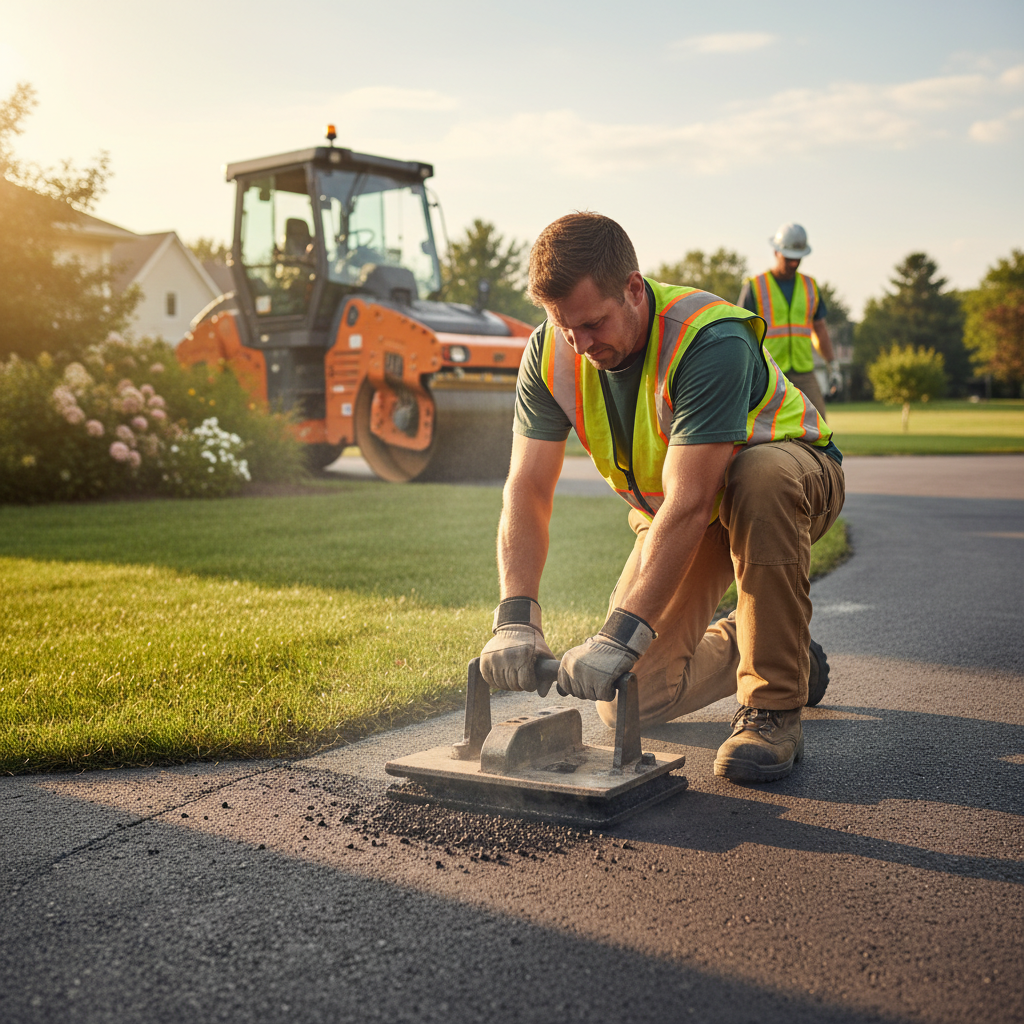
Driveway paving options and costs in Trinity-Bellwoods
Trinity-Bellwoods homeowners typically weigh asphalt, interlocking pavers, and concrete side-by-side, and the city’s housing mix makes driveway work more common than you might expect. With a population of 16,556 in 2021 (Statistics Canada, 2021 Census), the neighbourhood has a steady stream of owner-occupied repairs and upgrades rather than purely new builds. A lot of private driveways here serve detached and semi-detached properties, which means many projects are driveway-width replacements, overlays, or full base reconstructions to get ahead of winter damage.
In the Toronto economic region, frost depth and freeze–thaw cycles are primary cost drivers. Ground freezing to roughly 3–4 feet means the contractor has to build a deeper, well-compacted granular base and lock in proper drainage, otherwise water can sit under the pavement and cause heaving and cracking. In addition, the paving season is effectively compressed into late spring through early fall, so prime dates can carry a premium—especially when multiple crews are booked for neighbouring streets around Trinity-Bellwoods and the broader King–Queen corridor area.
Because of those factors, the same driveway size can price out very differently depending on base condition, tear-out needs, and whether you’re starting fresh or overlaying. Use the table below as a practical comparison before you request an itemised estimate.
| Material |
Lifespan |
Maintenance |
Best For |
Price per sq ft |
Price Range |
| Asphalt (new installation, proper base) |
10–20 years |
Seal every 3–5 years; crack-fill as needed |
Value-focused driveways with a long-term base build |
$9–$18 |
$3,500–$8,000 |
| Asphalt (overlay on existing gravel base) |
6–12 years |
Seal every 3–5 years; monitor joints and settlement |
Smaller budgets when the base is sound |
$8–$16 |
$3,200–$6,800 |
| Interlocking concrete pavers |
20–30 years |
Re-sand joints; periodic cleaning/sealing (optional) |
Curb appeal and repairability with minimal waste |
$16–$35 |
$9,000–$20,000 |
| Poured concrete (broom finish) |
20–30 years |
Minor crack repairs; reseal every 5–10 years (optional) |
Clean, low-maintenance look with correct mix design |
$15–$28 |
$6,000–$15,000 |
| Exposed aggregate concrete |
20–30 years |
Seal/maintain surface finish; crack repairs as needed |
Slip-resistant texture and premium curb appeal |
$18–$34 |
$7,500–$17,500 |
| Gravel / crushed stone (budget option) |
3–7 years |
Re-grade and top up annually; edging required |
Short-term solution or low-traffic areas |
$6–$12 |
$2,000–$4,500 |
Prices are estimates only and vary by project scope, site access and material selection.
What affects the price of paving in Trinity-Bellwoods
In Trinity-Bellwoods and across the Toronto economic region, you’ll often see driveway paving quotes swing by 30–50% for what looks like the “same” job. The difference is usually the hidden work: how much excavation is needed, how deep the granular base must be for frost protection, whether drainage is corrected, and how much of the existing surface has to be torn out rather than covered.
Frost line depth and freeze–thaw cycles are decisive cost factors in Ontario. When ground freezing reaches roughly 3–4 feet, the contractor typically needs a thicker, properly compacted granular base (often in the 6–12 inch range depending on design and soil conditions) to prevent heaving and cracking. On top of that, the paving season is shorter here: hot-mix asphalt placement generally needs air/road temperatures above about 10°C. That compression tightens contractor scheduling, increases labour demand in late spring and early fall, and can push pricing toward the higher end of the asphalt band—especially if you’re booking a mid-week start during peak periods.
Concrete cost is influenced by local winter loading and de-icing routines. For example, a driveway built with a non–air-entrained mix can chip or spall sooner under repeated freeze–thaw, forcing earlier repairs. Conversely, a well-prepared base and properly spaced joints can extend service life, helping keep you in the lower end of the concrete pricing band. In many Trinity-Bellwoods homes, you’ll also see base problems tied to older asphalt that “looked fine” until the first major spring thaw—then settlement appears as ruts or soft spots, and the scope expands from overlay to full rebuild (which is where the cost climbs toward the top end of the project range, whether asphalt or pavers).
| Price Factor |
Why It Matters |
Cost Impact |
| Driveway area in sq ft |
Labour and material quantities scale directly with surface area. |
Often the #1 swing factor (+/− 20–60% total cost) |
| Base depth required |
Frost protection depends on granular thickness and compaction quality. |
Deeper base can add major excavation/material costs (+$1,000–$4,000) |
| Grading and drainage work |
Correct slopes and subdrainage prevent water from sitting under pavement. |
Can add excavation, pipe and stone (+$800–$3,000) |
| Tear-out of existing surface |
Breaking and hauling concrete or old asphalt affects time and disposal. |
Often +$1,000–$5,000 depending on thickness/access |
| Edge restraints and curbing |
Restraints keep pavers/asphalt from spreading under winter expansion. |
+$400–$2,000 depending on existing perimeter |
| Sealing requirement |
Asphalt needs sealing after placement and periodically to resist oxidation and water intrusion. |
+$300–$1,500 over the first few seasons |
| Site access |
Narrow lots and limited staging slow equipment and increase labour hours. |
Typically +5–20% on labour |
| Asphalt mix specifications |
Freeze–thaw-rated mixtures and proper binder content improve durability in Ontario. |
Material premium can move you toward the higher asphalt band (+$300–$1,200) |
Permits & regulations in Ontario
In Ontario, paving a private driveway within your own property usually does not require a building permit when you’re simply replacing an existing hard surface and staying within your lot lines. Where permits and approvals typically enter the conversation is when the work affects the municipal right-of-way or city infrastructure.
For Trinity-Bellwoods homeowners, the items that usually require municipal approval include: creating or altering a curb cut/apron, changing boulevard grading, and modifying storm drainage (for example, relocating a catch basin lead, adjusting drainage slopes that tie into municipal systems, or changing how water leaves the property in a way that impacts the street). If you’re uncertain, ask your contractor to confirm whether the job triggers right-of-way approval or any lot-grading restrictions that limit how close a hard surface can be placed to property lines.
Regardless of permit needs, always call for utility locates before excavation—Ontario One Call (formerly 1 Call) is the right step. Then verify your paving contractor professionally: check the Ontario contractor’s registration/licensing status using the relevant provincial online registry where applicable, obtain a current certificate of liability insurance (minimum coverage should be stated on the COI), and confirm worker protection coverage (WSIB/WCB as applicable) before the crew starts. Finally, request written proof of coverage for your job (dates and job site address on the certificate) and keep it with your contract paperwork.
Asphalt vs pavers vs concrete for Trinity-Bellwoods driveways
For Trinity-Bellwoods, asphalt, interlocking pavers, and concrete are all viable—but the best choice depends on how you want to manage winter stress from salt, ploughing, and freeze–thaw. Asphalt is the lowest upfront option in the market and is often in the lower portion of the asphalt band (for many driveways, that’s roughly in the $3,500–$8,000 range when the base is done properly). The trade-off is that asphalt performs best when you seal it after installation and repeat sealing regularly every 3–5 years to slow oxidation and water penetration.
Interlocking concrete pavers deliver the highest curb appeal and excellent repairability. If a section becomes unstable after a tough winter, you can lift and rebuild that area without replacing the whole driveway—an advantage when you’re dealing with Toronto’s moving freeze–thaw environment. The upfront investment is higher, commonly falling in the $9,000–$20,000 range, but many homeowners find the lifecycle cost and appearance make it easier to justify.
Poured concrete is typically mid-range and can last decades when the mix is air-entrained, the base is engineered for frost, and control joints are properly placed. Concrete can still crack with Ontario’s expansion/contraction cycles, and it can be more sensitive to de-icing salt—so the wrong mix or insufficient base support can lead to earlier patchwork.
With Toronto’s frost line pressure, the base and drainage design matter as much as the surface material. A concrete driveway that’s built on a weak base can fail earlier than asphalt; likewise, a premium asphalt paving job on a sound, compacted base can outperform a “cheap concrete” job where drainage was overlooked. For example, spending an extra $1,500–$3,000 to rebuild base and improve drainage can be more valuable than choosing the next-material up if your subgrade is already pumping water.
| Material |
Frost Resistance |
Curb Appeal |
Repair Method |
Lifespan |
Price Band |
| Asphalt (sealed regularly) |
Good with proper base, drainage, and freeze–thaw-rated mix |
Medium |
Patch and re-seal localized areas; crack-fill |
10–20 years |
$3,500–$8,000 |
| Interlocking concrete pavers |
Very good when base is properly compacted and restrained |
High |
Lift-out and re-lay affected stones with sand re-screening |
20–30 years |
$9,000–$20,000 |
| Poured concrete (air-entrained) |
Good with air-entrainment, joints, and drainage |
Medium–High |
Crack repair and patching; slab replacement if widespread failure |
20–30 years |
$6,000–$15,000 |
| Exposed aggregate concrete |
Good with correct mix, base, and jointing |
High |
Surface patching and localized repairs; full replacement if structurally failed |
20–30 years |
$7,500–$17,500 |
| Permeable pavers (drainage grid) |
Very good where water management is engineered correctly |
High (modern/clean look) |
Targeted stone/underdrain repairs; periodic vacuuming depending on design |
15–25 years |
$10,000–$22,000 |
| Chip seal / tar-and-chip |
Moderate; performance depends heavily on base and binder |
Low–Medium |
Spot re-chipping; re-spray binder over time |
5–12 years |
$3,000–$6,500 |
How to choose a paving contractor in Trinity-Bellwoods
Choosing the right paving contractor is where Trinity-Bellwoods homeowners win or lose money. Start with verification. In Ontario, ask for proof of liability insurance (certificate of insurance with your address listed as the project/location), and confirm worker protection coverage (WSIB/WCB as applicable for their crews). You can usually check the contractor’s registration/licensing status through the appropriate provincial online resources, and you should be able to provide a clearance letter or coverage confirmation documents upon request. If they can’t produce current documents quickly, treat it as a red flag.
Next, get 2–3 itemised written quotes. “Itemised” matters: you want labour and materials broken out (excavation, granular base, asphalt/paver/concrete supply, disposal, compaction, edging/curbs, and sealing/curing). A fair quote also spells out exclusions—what won’t be done unless you approve a change order—and it should state whether disposal is included, whether utility locating is the homeowner’s or contractor’s responsibility, and how they handle unexpected soft subgrade.
Warranty should cover workmanship for a clear term (and specify what’s covered, such as settlement, joint failure, or cracking), plus the product/manufacturer warranty where relevant. Ask whether the warranty is transferable to future owners, since driveways can outlast your time in the home.
For payment, avoid large upfront amounts: never pay more than 10–15% at the beginning, and keep a holdback until completion and final grading/cleanup are done. Get the start date and estimated completion in writing—Toronto scheduling can shift, but your contract should still commit to a timeline.
- Request itemised quotes (labour, materials, disposal, compaction, and finishing/sealing).
- Confirm liability insurance with project address and expiry date.
- Verify WSIB/WCB coverage for all workers on site.
- Ask how they assess subgrade (probe/inspect) and what triggers a base rebuild.
- Ensure drainage plan is included (grading, slope, and any needed stone/subdrain).
- Get written frost-proofing details: base thickness, compacted lifts, and geotextile use if recommended.
- For asphalt, confirm sealing timing and the type/coverage rate of sealer.
- Confirm edge restraints/curbing specs and how they prevent spread.
- Ask how they protect landscaping and how they restore topsoil after excavation.
- Clarify permit/right-of-way responsibilities if you’re changing curb cuts or boulevard drainage.
- Review warranty terms in writing, including what qualifies as a workmanship defect.
- Use a payment schedule with a holdback until final inspection and cleanup.
Red flags I often see in Trinity-Bellwoods include contractors who won’t show insurance/WSIB documentation, only quote a lump sum without base/drainage details, skip utility locate confirmation, suggest overlaying over visibly failing base without a probe, or try to collect more than 30% upfront without any mobilization schedule or contract scope attached.
Frequently asked questions — paving in Trinity-Bellwoods
How do I prepare for a paving project?
Start by clearing the driveway completely and making sure any items—vehicles, planters, sheds or decorative stones—are removed from the work zone. If you have cameras, smart doorbells, or exterior wiring near the edges, flag them before excavation. For Ontario, also plan for utility locates: the best contractors will coordinate Ontario One Call marking before they dig, but you should still confirm who is responsible. Next, think about accessibility in Trinity-Bellwoods: narrow entries and on-street parking can affect staging and equipment movement, so ask the contractor for a practical access plan. Finally, gather photos of existing cracks/ponding and share them at quote time—those details help determine whether you need an asphalt overlay or a full granular base rebuild.
How do I compare paving quotes fairly?
To compare paving quotes fairly in Trinity-Bellwoods and the wider Toronto market, focus on scope and build quality—not just the bottom line. Ask each contractor for an itemised quote listing excavation, compacted granular base thickness, any geotextile, drainage corrections, disposal fees, and finishing (including asphalt sealer timing or paver jointing). Confirm how many square feet are included and whether the price assumes straight access or includes additional labour for tight staging. If one quote is much lower—say it’s sitting near the asphalt band while another is closer to the high end—verify whether the cheaper option is allowing an overlay where the other insists on base reconstruction due to frost-related settlement risk. The more transparent the breakdown, the easier it is to choose wisely.
Can asphalt be laid in cold weather in Trinity-Bellwoods?
In Ontario, you shouldn’t expect good asphalt results when temperatures are cold enough that the asphalt can’t be placed and compacted properly. Hot-mix asphalt placement typically needs air/road conditions above roughly 10°C, and it’s also sensitive to wind and overnight cooling. In Trinity-Bellwoods, late fall and early spring often bring freeze–thaw conditions that make placement risky—water in subgrade can freeze and later thaw, causing instability. A reputable crew will schedule around workable temperatures and protect the surface during cooling. If a contractor pressures you to pave outside the proper window, ask what they do to manage base temperature, compaction, and cold-weather curing—if they can’t answer clearly, that’s a concern. For best performance, plan for late spring through early fall.
What is a driveway apron and do I need one in Trinity-Bellwoods?
A driveway apron is the transition area where your driveway meets the curb line and usually ties into the municipal street surface and drainage. Whether you “need” one depends on your existing condition and what you’re changing. If your work involves a curb cut, changing the boulevard, or altering how water drains from the driveway area to the street system, municipal approval may be required. In practice, an apron improves the ride, reduces edge break-up from ploughing and vehicle turning, and helps manage water—key in Toronto’s freeze–thaw cycle where trapped moisture can lead to heaving and cracking. Many homeowners don’t realize how much the apron design matters until they see repeated edge failures. Ask your contractor to explain whether an apron is included in the scope and how it will be built to match existing drainage.
How do I maintain my driveway through Trinity-Bellwoods winters?
Winter maintenance is mostly about preventing water damage and avoiding excessive surface wear. For asphalt, crack-fill any early cracks when you first notice them (before spring moisture penetrates), and avoid blasting salt directly into joints and edges repeatedly—salt can accelerate surface deterioration. Use sand for traction when possible, and plough carefully: sharp blades and aggressive scraping can tear up edges and accelerate settlement. For pavers, keep joints clear so they don’t wash out, and re-sweep as needed; if you have localized movement, address it early to stop the surrounding area from loosening. For concrete, air-entrainment and good jointing help, but you still want to manage de-icing practices. Across Ontario, proper drainage and sealing schedules are what help your driveway tolerate freeze–thaw longer.
Is it worth sealing a new driveway right away in Trinity-Bellwoods?
In most cases, yes—but not immediately. Asphalt sealer must be applied after the asphalt has had time to cure and reach suitable conditions, and the timing is crucial for adhesion and long-term performance in Trinity-Bellwoods’ freeze–thaw climate. Sealing helps slow oxidation, reduces water infiltration, and can extend the service life between repairs. A typical asphalt plan is sealing after installation and then repeating every 3–5 years, depending on traffic and weather exposure. If you’re budgeting, you can think of sealing as part of the overall asphalt investment that often falls in the $3,500–$8,000 range for a properly built driveway. When sealing is skipped or rushed, homeowners usually pay later with more frequent crack repairs and faster surface wear.