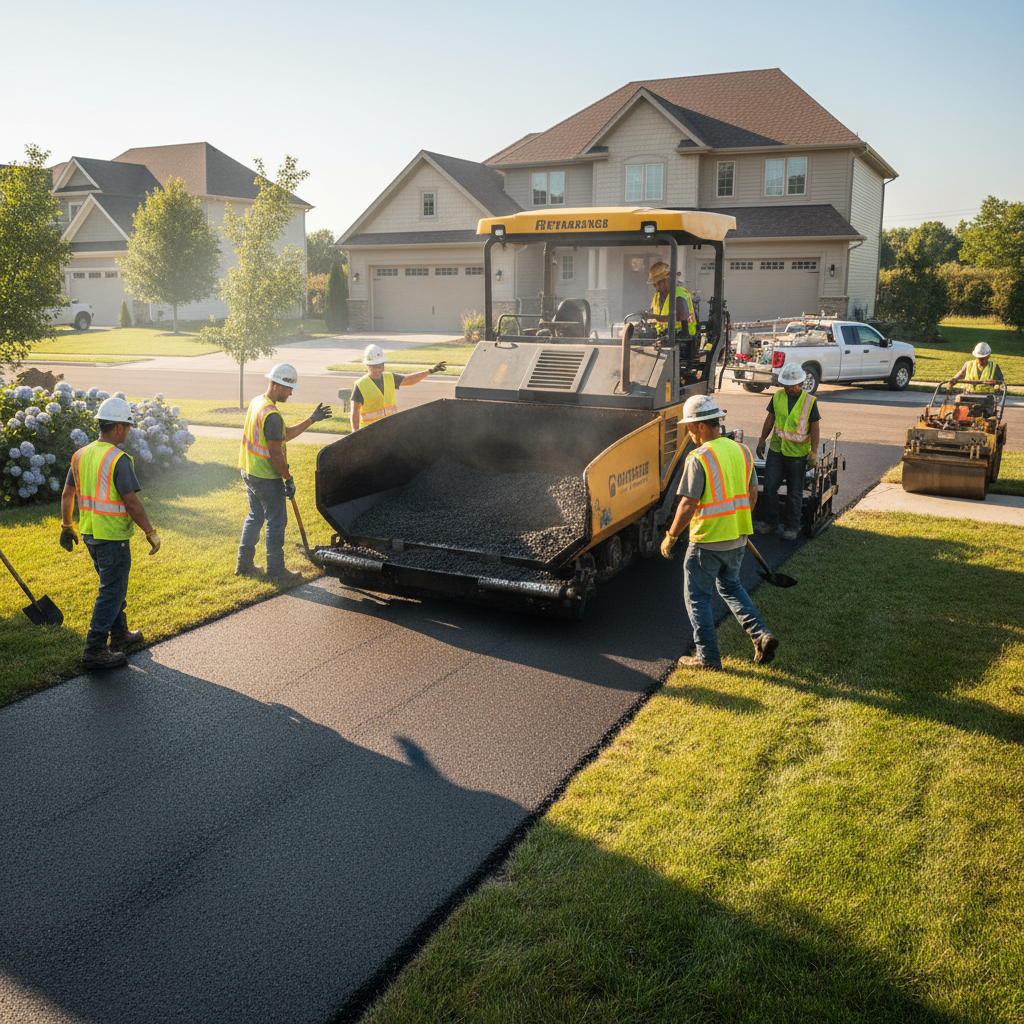
Driveway paving options and costs in Petawawa
Petawawa homeowners have a real choice when it comes to driveway paving, but the right material depends on how your lot drains, how deep frost goes, and what winter maintenance looks like on your street. With 70.4% of dwellings in the area being single-detached homes (Statistics Canada, 2021 Census), most local driveways are detached-house style approaches—meaning you’ll typically need solid base prep and dependable edge support to keep water from migrating into the driveway during spring melt.
In Petawawa’s Kingston–Pembroke economic region, the freeze–thaw rhythm is a major cost driver. Frost penetration is commonly about 4 feet (≈1.2 m) in much of Southern and Eastern Ontario, and the spring shoulder seasons are often wet. That combination makes excavation, imported granular materials to build below frost influence, and careful compaction a big part of the budget. It’s also why contractor scheduling can feel tighter: hot-mix asphalt generally needs air temperatures above 10°C, so paving windows shrink during cold snaps and wet springs. In practice, that can increase pricing when more homeowners are booking projects for the same short season.
You’ll see especially strong demand around older, established pockets such as the east-end residential areas off the Highway 17 corridor, where driveways built decades ago often need tear-out, drainage corrections, and upgraded base to stop surface deterioration. From there, the best way to compare is by upfront cost and expected maintenance, which is why the table below breaks down common options.
| Material |
Lifespan |
Maintenance |
Best For |
Price per sq ft |
Price Range |
| Asphalt (new installation, proper base) |
15–25 years |
Seal coating every 3–5 years; patching as needed |
Most cost-effective all-round option for stable base and good drainage |
$8–$14 |
$4,500–$9,000 |
| Asphalt (overlay on existing gravel base) |
10–18 years (depends on base condition) |
Seal coating; more frequent patches if base is uneven |
When you want lower initial disruption and the underlying base is sound |
$7–$12 |
$3,800–$7,800 |
| Interlocking concrete pavers |
25–40 years |
Re-sand joints as needed; individual stone replacement |
Curb appeal and easy localized repairs without redoing the whole driveway |
$12–$22 |
$6,500–$14,000 |
| Poured concrete (broom finish) |
25–35 years (with proper air-entrainment) |
Minor sealing optional; crack monitoring and patching |
Low maintenance look with clean lines and strong base prep |
$11–$20 |
$7,000–$15,000 |
| Exposed aggregate concrete |
25–35 years |
Sealer occasionally; repair to match texture is more involved |
Slip-resistant finish and a more premium appearance than standard concrete |
$13–$23 |
$8,500–$16,500 |
| Gravel / crushed stone (budget option) |
5–12 years (varies with drainage and grading) |
Top-ups; regrading; weed control |
Temporary solution or budget-constrained approach with good drainage |
$4–$8 |
$2,200–$5,200 |
Prices are estimates only and vary by project scope, site access and material selection.
What affects the price of paving in Petawawa
It’s common to see quotes for the “same” driveway vary by 30–50% across Kingston–Pembroke and other parts of Ontario, even before you compare materials. The biggest reasons are (1) how much excavation and imported aggregate is needed to get below frost influence and (2) whether drainage work is included. In Petawawa, frost penetration is commonly around 4 feet (≈1.2 m), and that pushes contractors to build a deeper, well-compacted granular base. If the base ends up too thin or drainage is left to chance, you typically pay later in the form of edge breakup, raveling, and more frequent repairs.
Freeze–thaw cycles also affect asphalt specifically. Hot-mix asphalt must be placed when conditions support proper compaction—often requiring air temperatures above 10°C—so Petawawa’s shorter paving window can concentrate demand and tighten schedules. On top of that, asphalt mix design has to be freeze–thaw rated for Ontario conditions, and that can raise material costs compared to a “generic” mix.
Concrete pricing can move quickly depending on foundation-like base prep: if your driveway slopes toward the house or you have clay pockets, base thickness and grading can add significant excavation and compaction time. Meanwhile, older homes built before 1981 make up 46.4% of dwellings locally (Statistics Canada, 2021 Census), and those yards often have existing buried services, outdated drainage patterns, or driveways that were never designed for modern heavier vehicles—so tear-out and rework can be a larger share of the budget.
As a reality check, a properly built asphalt driveway often lands in the $4,500–$9,000 band, while interlocking pavers commonly start higher because of restraints, bedding sand, and more labour—often $6,500–$14,000 depending on area and complexity. The “cheapest” quote is rarely cheapest once base, drainage, and disposal are clarified.
| Price Factor |
Why It Matters |
Cost Impact |
| Driveway area in sq ft |
Materials and base volume scale directly with square footage |
Major driver (often 50–70% of total) |
| Base depth required |
Frost line determines granular thickness needed to limit heaving and cracking |
Medium to major; can add several thousand dollars |
| Grading and drainage work |
Slope corrections, ditches, swales, or French drains control water movement |
Medium; omission later leads to premature failure |
| Tear-out of existing surface |
Breaking, hauling, and disposal for old asphalt or concrete |
Medium to major depending on thickness |
| Edge restraints and curbing |
Keeps pavers and asphalt from spreading over time |
Small to medium; critical for long-term performance |
| Sealing requirement |
Asphalt typically needs sealing after initial curing (often 6–12 months) |
Small to medium; adds ongoing value protection |
| Site access |
Narrow gates, long pushes, and steep grades slow equipment and increase labour |
Medium; can change the crew size/timing |
| Asphalt mix specifications |
Freeze-thaw-rated mix can cost more but performs better in Ontario winters |
Small to medium; improves durability |
Permits & regulations in Ontario
In Ontario, paving a private driveway within your own property typically does not require a building permit. For Petawawa homeowners, the common “no permit” scenario is straightforward resurfacing or rebuilding of the driveway surface and base on your lot—like asphalt replacement, interlocking installation, or pouring concrete—so long as you’re not changing municipal drainage infrastructure.
Where approvals are often required is the work that touches the municipal right-of-way or affects how stormwater is managed. Examples that usually do require municipal approval include: creating or changing a curb cut/access point where the driveway meets the boulevard, altering boulevard grading, and making changes that impact storm drainage (for example, redirecting water into/through municipal drainage systems). Some municipalities also have lot-grading or surface regulations that restrict how close hard surfaces can be to property lines or how they manage runoff.
Regardless of permits, you should follow a simple verification checklist before any excavation starts. First, confirm utility locates using Ontario One Call (Ontario-specific process) so underground services are marked before digging. Then verify the contractor’s Ontario compliance: ask for their proof of insurance (liability) and confirm their coverage is active for your project. For workplace safety, request proof of WSIB (or the applicable coverage for the contractor’s situation) before work begins. Finally, ask them to provide a clearance letter or certificate of coverage details showing they’re in good standing, then keep copies with your contract.
Asphalt vs pavers vs concrete for Petawawa driveways
In Petawawa’s freeze–thaw climate, all three materials can perform well when the base and drainage are designed for Ontario frost cycles—about 4 feet (≈1.2 m) commonly influences footing and driveway base design. Where homeowners differ is in upfront cost, appearance, and how they want repairs handled after winter impacts like ploughing, sand, and de-icing salts.
Asphalt is usually the lowest upfront option. With a properly compacted granular base and a freeze–thaw-rated asphalt mix, it can handle Ontario winters efficiently, but it does need sealing every 3–5 years to protect against surface oxidation and raveling. Interlocking concrete pavers cost more up front, yet they’re the most “repairable” because individual stones and localized areas can be lifted, re-bedded, and reset without tearing up the entire driveway—an advantage when you get a small settlement spot or an area disturbed by future utility work. Poured concrete sits mid-to-high on cost; it can look crisp and last decades, but it’s more sensitive to cracking if the base is off or if the concrete isn’t correctly air-entrained for freeze–thaw exposure.
Here’s a practical example: if your driveway paving scope fits the typical asphalt driveway band of $4,500 – $9,000 and pavers land in $6,500 – $14,000, the extra $2,000–$5,000 is often justified when you want curb appeal, easy future repairs, and strong edge control—especially on driveways near lawns, slopes, or areas prone to water pooling in spring melt.
For Petawawa specifically, drainage design matters as much as material. If water can’t escape via grading, ditches, swales, or a French drain where needed, even the best surface will struggle. That’s why the “best” option is usually the one paired with the right base depth and drainage plan for Kingston–Pembroke frost behaviour and local hauling/access realities.
| Material |
Frost Resistance |
Curb Appeal |
Repair Method |
Lifespan |
Price Band |
| Asphalt (sealed regularly) |
Good to very good with proper granular base and freeze-thaw rated mix |
Medium (smooth, dark finish) |
Patch and compact; spot resurfacing if needed |
15–25 years |
$4,500 – $9,000 |
| Interlocking concrete pavers |
Very good; joints and drainage bedding help manage movement |
High (variety of colours/patterns) |
Lift/replace individual pavers and re-sand joints locally |
25–40 years |
$6,500 – $14,000 |
| Poured concrete (air-entrained) |
Good when air-entrained and base/drainage are correct |
Medium to high (clean look) |
Crack patching and selective surface repairs; full replacement if severe |
25–35 years |
$7,000 – $15,000 |
| Exposed aggregate concrete |
Good to very good; surface texture can help traction in winter |
High (premium finish) |
Targeted repairs are possible but matching texture/colour is more complex |
25–35 years |
$8,500 – $16,500 |
| Permeable pavers (drainage grid) |
Very good where subgrade can accept infiltration; needs correct drainage planning |
High (design flexibility) |
Remove/replace units in affected cells; maintain joints |
20–35 years |
$8,000 – $17,000 |
| Chip seal / tar-and-chip |
Fair; performance depends heavily on base and application quality |
Low to medium (more utilitarian look) |
Maintenance overlays and reapplication more often |
8–15 years |
$4,000 – $8,500 |
How to choose a paving contractor in Petawawa
Choosing the right contractor in Petawawa is mostly about proof: proof they build correctly for Ontario’s freeze–thaw conditions, and proof they’re insured and ready to work. Start with Ontario compliance. Ask for their Ontario licence details if applicable through the appropriate online registry tools, then request liability insurance and confirm it covers your property and the scope being performed. For workplace coverage, ask for proof of WSIB (and the current status/clearance information). Where contractors use subcontractors, the general contractor should still provide documentation showing coverage is in place for the trades working on your driveway. Don’t accept “it’s coming”—ask for certificates before equipment arrives.
Next, get 2–3 written, itemised quotes. You want a breakdown that separates labour from materials and includes base build-up, compaction requirements, drainage/grading, tack coat (for asphalt), disposal/tipping fees, and removal/haul-away of existing surface. Avoid single lump-sum quotes that don’t state what’s included. Confirm whether a permit is being pulled (when work affects the boulevard/right-of-way) and whether site protection and clean-up are included.
For warranty, ask for (1) the workmanship warranty length, (2) the manufacturer/product warranty (for asphalt mix or paver systems, where relevant), and (3) whether the warranty is transferable if you sell your home. Payment should be structured responsibly: never pay more than 10–15% upfront, and hold a meaningful portion until the driveway is finished and any required curing/sealing steps are complete. Finally, get the start date and the completion estimate in writing, especially because Petawawa’s paving window can be weather-dependent.
- Ask for proof of liability insurance before scheduling equipment.
- Request WSIB coverage documentation and confirm it’s active.
- Verify their Ontario standing using the contractor’s provided credentials and any applicable public registry search.
- Get itemised quotes (labour + materials) rather than a single number.
- Confirm base depth, aggregate type, and compaction targets in writing.
- Ask how drainage will be handled (ditching, swales, or French drain if needed).
- Ensure disposal/tipping fees for old asphalt or concrete are included.
- Confirm edge restraint details (especially for pavers).
- For asphalt, clarify tack coat, placement temperature requirements, and sealing timing (often 6–12 months).
- Review the warranty: workmanship vs product, length, exclusions, and transferability.
- Agree to a payment schedule with a 10–15% deposit maximum and holdback until completion.
- Get a written schedule: start date, paving date (if applicable), and completion timeframe.
Concrete red flags in Petawawa: contractors who won’t discuss frost-depth-driven base thickness; quotes that don’t mention drainage correction or edge restraints; refusing to provide proof of insurance/WSIB before work starts; vague scope language like “asphalt supply and pave” without stating materials, thickness, or disposal; and pushing for a large upfront deposit or cash-only payments without a clear contract.
Frequently asked questions — paving in Petawawa
What base thickness do I need for pavers in Petawawa?
For paver driveways in Petawawa, base thickness isn’t a one-size number—it depends on subgrade stability, drainage, and the driveway slope. Because Southern and Eastern Ontario commonly sees frost influence around 4 feet (≈1.2 m), reputable contractors typically build a thicker, well-compacted granular system so the bedding and joint sand aren’t sitting on weak, moisture-prone soil. In practice, that often means excavating more than homeowners expect in clay pockets or spring-melt areas, then placing and compacting layered base (not just a thin crushed-stone layer). If your driveway has standing water or weak soil, drainage corrections (swales or sometimes French drains) may be required; otherwise, pavers can settle and lift. Your quote should state the base build-up layers and compaction method, not just the paver type.
How do I get the most accurate paving quote in Petawawa?
To get an accurate quote in Petawawa, start with a site visit where the contractor measures your driveway area, checks grade/runoff, and evaluates the existing base. Frost and freeze–thaw cycles make drainage and base condition decisive, so ask whether the quote includes tear-out, granular base replacement, and any ditching/swale work. Provide photos if you can, but insist on a walk-through so they can identify soft subgrade, water pathways, and access constraints that affect labour. Request itemised pricing for labour and materials, and confirm disposal/tipping fees. For asphalt, ask about freeze–thaw rated mix and the sealing plan (often after 6–12 months). For context, a typical asphalt driveway often falls within $4,500 – $9,000, while interlocking pavers can run higher in $6,500 – $14,000 depending on prep and complexity.
How much does it cost to pave a driveway in Petawawa?
In Petawawa, the total cost depends most on driveway square footage, how much excavation/base reconstruction is needed, and whether drainage issues must be fixed. For many residential projects, asphalt new installation with a proper granular base typically lands in the $4,500 – $9,000 band. Interlocking concrete pavers generally price higher—commonly $6,500 – $14,000—because of bedding sand, restraints, and more labour. Concrete (poured or exposed aggregate) usually sits in a similar upper tier, often $7,000 – $15,000. If you’re dealing with an older driveway built before 1981 (46.4% of local dwellings, Statistics Canada, 2021 Census), expect higher chances of drainage corrections and tear-out scope, which can move the price upward. To avoid surprises, make sure your quote lists base depth, tear-out, disposal, and (for asphalt) sealing requirements.
Asphalt vs interlocking pavers vs concrete — which is best in Petawawa?
In Petawawa, “best” depends on your priorities and how your yard drains during spring melt. Asphalt is usually the best value upfront and performs well when installed with a proper base and a freeze–thaw rated mix; you’ll want sealing every 3–5 years. Interlocking pavers are often the best choice if you care about curb appeal and want future-proof repairs—individual stones can be lifted and reset without replacing the entire driveway, which is helpful if you ever have a localized settlement. Poured concrete (with air-entrainment) can look great and last decades, but it’s more sensitive to base/drainage mistakes; poor drainage leads to cracking and deterioration sooner, especially with de-icing practices and winter ploughing. In the Kingston–Pembroke region, the freeze–thaw cycle makes base build-up and drainage non-negotiable for all materials. Budget-wise, compare asphalt at $4,500 – $9,000 against pavers at $6,500 – $14,000 and choose based on how long you want to keep the driveway looking sharp and how repairs would be handled.
How long does a paved driveway last in Petawawa?
When installed with proper base compaction and drainage planning, asphalt driveways in Petawawa often last around 15–25 years, with sealing helping extend service life. Interlocking concrete pavers commonly last 25–40 years because repairs can be localized without replacing the whole surface. Poured concrete (air-entrained) often reaches 25–35 years, though cracking can show up sooner if base thickness or slope/drainage isn’t right. The local climate matters: freeze–thaw cycles around frost influence (commonly about 4 feet in much of Southern/Eastern Ontario) can push moisture into weak subgrade areas and accelerate failure. That’s why projects in older neighbourhoods—where drainage was never designed for today’s runoff patterns—often need thicker base and sometimes extra drainage work. Regular maintenance also matters; for asphalt, sealing after curing (often 6–12 months) and patching small failures early tends to prevent larger freeze–thaw damage.
When is the best time of year to pave in Petawawa?
The best time to pave in Petawawa is typically mid-spring to early fall, when temperatures support asphalt placement and the ground can drain properly. Asphalt generally requires air temperatures above 10°C to place and compact properly, and wet spring conditions can delay excavation, base compaction, and paving schedules. In colder regions of Ontario and the Kingston–Pembroke area, the paving window is effectively shorter because shoulder seasons are wet and winter returns sooner, which can concentrate demand and raise pricing when many neighbours book at the same time. If you’re choosing pavers, they’re often less sensitive to temperature during install (still subject to weather and base moisture), but you’ll still need the base to be stable and properly compacted. Plan ahead: request a start date in writing, and ask your contractor what they consider “weather-ready” based on your site drainage and access conditions.