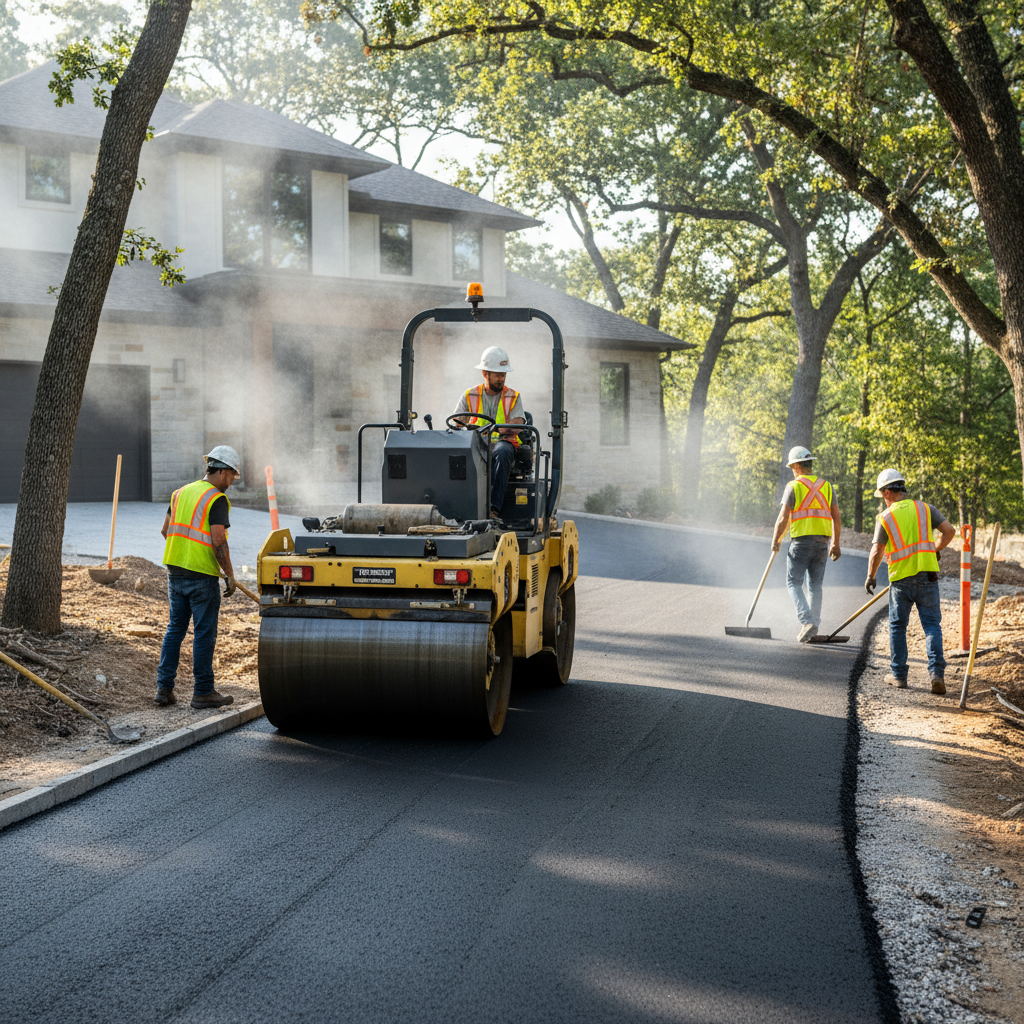
Driveway paving options and costs in Kitchener
Kitchener homeowners typically choose between asphalt, poured concrete, and interlocking pavers, and the right call depends on both budget and how your site handles water. In Kitchener, about 59.7% of households own their homes (Statistics Canada, 2021 Census), and the housing stock is dominated by single-detached properties—47.5% of dwellings—so private driveways are a major part of the local paving workload. Many of these homes were built before 1981 (48.6%), meaning older driveways often need more excavation and regrading than newer builds.
In the Kitchener–Waterloo–Barrie region, frost depth and freeze-thaw cycles are major cost drivers. To reduce heaving, settlement, and reflective cracking, contractors typically build a deeper, well-compacted granular base with reliable drainage. The paving season is also tighter here than in milder parts of Ontario, because hot-mix asphalt needs warm conditions to place and compact properly. That combination—more frost-resilient prep plus narrower scheduling—helps explain why driveway quotes can land toward the upper end of typical Ontario ranges, especially during spring ramp-up when crews and asphalt plants are busy.
Trade demand is especially strong around established family neighbourhoods such as Westmount and Uptown Waterloo Road corridors where lots are mature and driveway water management is often the difference between a long-lasting surface and an early return call. Once you decide on the material direction, the next step is comparing typical price bands and what each option includes—use the table below as a practical starting point.
| Material |
Lifespan |
Maintenance |
Best For |
Price per sq ft |
Price Range |
| Asphalt (new installation, proper base) |
15–25 years |
Seal every 3–5 years; crack-fill as needed |
Best balance of cost and performance for most homes |
$6.50–$10.00 |
$3,500–$7,000 |
| Asphalt (overlay on existing gravel base) |
10–20 years |
Seal every 3–5 years; monitor edge settlement |
Lower-cost option when base is stable |
$5.75–$9.00 |
$2,800–$5,500 |
| Interlocking concrete pavers |
25–40 years |
Replace individual units; re-sand periodically |
Curb appeal + easy repairs without full replacement |
$15.00–$22.00 |
$12,000–$22,000 |
| Poured concrete (broom finish) |
20–30 years |
Seal every 5–7 years; repair spalls/joints |
Low maintenance with a solid, continuous surface |
$12.00–$18.00 |
$9,000–$16,000 |
| Exposed aggregate concrete |
20–30 years |
Seal as recommended; maintain surface finish |
Decorative look with improved traction |
$14.00–$20.00 |
$10,500–$18,000 |
| Gravel / crushed stone (budget option) |
5–12 years (depends on grading) |
Top up 1–2 times per year; re-grade seasonally |
Temporary solution or overflow parking |
$4.00–$7.00 |
$2,000–$4,500 |
Prices are estimates only and vary by project scope, site access and material selection.
What affects the price of paving in Kitchener
In Kitchener–Waterloo–Barrie, the same driveway can come in 30–50% apart between quotes because the “foundation” work is where contractors differ most. One contractor may treat the driveway as asphalt-only, while another sizes excavation and granular depth for frost resilience, improves drainage, and adds the right edge restraints. That’s especially important locally because Kitchener’s freeze-thaw cycles push water through the pavement system, and even small subgrade moisture issues can translate into settlement and cracking.
Frost line depth is a decisive cost factor in Southern Ontario. In practical terms, deeper frost requires a thicker compacted granular base to prevent heaving and cracking—commonly 6–12 inches of granular material (depending on site conditions), not the lighter sections you might see in milder coastal climates where freeze-thaw forces are less severe. The paving season is also shorter in this corridor: hot-mix asphalt generally needs air temperatures above 10°C to be placed and compacted correctly. When crews and plants are tight on schedule, contractors may price projects higher because labour availability and paving windows compress.
Concrete costs can move up or down based on local conditions too. For example, a broom-finished poured concrete driveway often increases when the base must be rebuilt for proper jointing and drainage, which is common in lots built before 1981 (Statistics Canada, 2021 Census). Conversely, if your existing base is stable and access is easy, concrete can stay closer to the $9,000–$16,000 range; if the tear-out is significant and regrading is required, it can approach the top end. Asphalt is usually the lowest upfront option (often within $3,500–$7,000) but can climb if freeze-thaw-rated mix and heavier base prep are required.
| Price Factor |
Why It Matters |
Cost Impact |
| Driveway area in sq ft |
Most pricing is area-based: material, compaction, labour, and equipment time scale together. |
Typically 40–65% of the total |
| Base depth required |
Frost resilience depends on granular thickness and compaction; too thin = heaving and early failure. |
Often adds 10–25% |
| Grading and drainage work |
Correct slope and drainage prevent water from pooling under the surface, a common winter issue. |
Often adds 5–20% |
| Tear-out of existing surface |
Breaking/hau l-ing concrete or old asphalt increases labour, disposal, and equipment costs. |
Often adds 10–30% |
| Edge restraints and curbing |
Prevents asphalt rutting and paver spread; restraints stabilize the whole system. |
Often adds 2–15% |
| Sealing requirement |
Asphalt seals protect against moisture infiltration and oxidation; timing matters. |
Shortens failures; costs usually $300–$900 |
| Site access |
Narrow lots, steep grades, or limited staging slow equipment movement and raise labour time. |
Often adds 5–15% |
| Asphalt mix specifications |
Freeze-thaw-rated mix design and proper binder content cost more but improves performance locally. |
Often adds 3–12% |
Permits & regulations in Ontario
For most Kitchener homeowners, paving a private driveway within your own property typically does not require a building permit. The “permit trigger” is usually what happens in the municipal right-of-way (the boulevard area), or any work that alters storm drainage or existing municipal infrastructure. Examples of work that commonly does require municipal approval include installing or changing a curb cut (driveway apron work tied into the boulevard), modifying the boulevard grading in a way that affects runoff, or connecting/altering storm drainage patterns. If your plan includes any work that touches the street frontage, confirm the process before excavation.
Also, Ontario requires utility locates before you dig. Call Ontario One Call so underground services can be marked, and never assume where older lines run—especially on properties built before 1981 (48.6% locally). After locates, confirm lot-grading rules with the City of Kitchener, because some areas have restrictions on how close hard surfaces and grading can come to property lines, and they may want water directed away from neighbouring properties and foundations.
To verify a contractor, start with the Ontario licence status through the appropriate online registry used for general contractor credentials, then request proof of liability insurance and WSIB/WCB coverage. You should also ask for a certificate of insurance showing the insured parties and coverage limits, and a clearance letter where applicable. Only proceed after you see these documents—before the first shovel of excavation.
Asphalt vs pavers vs concrete for Kitchener driveways
For Kitchener’s freeze-thaw climate, base prep and drainage matter more than the brand of asphalt or the style of finish—but the material still affects upfront cost and how the driveway behaves with winter maintenance (salt, sand, and ploughing). Asphalt is usually the lowest upfront option. It performs well when it’s built on a properly compacted granular base and finished with correct thickness, but it needs regular sealing every 3–5 years to protect the surface from moisture intrusion. Interlocking concrete pavers cost more upfront because of labour intensity and base requirements, yet they’re among the easiest to repair: a failed section can be lifted, reworked, and reset without replacing the entire driveway. Poured concrete usually lands mid-range; however, it can crack if it isn’t properly jointed, air-entrained for freeze-thaw, and placed over a base designed to manage water and frost.
In Kitchener–Waterloo–Barrie, deeper frost resilience typically means building a thicker granular section (often 6–12 inches, depending on soil and site drainage) and ensuring the surface drains away from the house. If your lot has a slope, poor downspout discharge, or groundwater risk, you’ll pay more for drainage correction—regardless of material. That’s where the “cheaper” option can flip if a contractor underestimates base depth or drainage.
A real-world example: if asphalt for a typical residential driveway is priced around $3,500–$7,000, interlocking pavers can be priced around $12,000–$22,000. The difference is justified when you want long curb appeal, you anticipate localized repairs, or you have an irregular driveway footprint that benefits from a modular system. If your main priority is cost control and you’re comfortable with sealing, asphalt often wins in Kitchener.
| Material |
Frost Resistance |
Curb Appeal |
Repair Method |
Lifespan |
Price Band |
| Asphalt (sealed regularly) |
Good with proper base and sealing; sensitive to moisture without it |
Moderate (clean, uniform finish) |
Crack-fill and patch sections |
15–25 years |
$3,500–$7,000 |
| Interlocking concrete pavers |
Excellent when installed on the right bedding and base |
High (design options) |
Lift-and-reset individual units |
25–40 years |
$12,000–$22,000 |
| Poured concrete (air-entrained) |
Good if air-entrained, properly jointed, and well-drained |
Medium (broom or stamped styles) |
Patch spalls; manage joints |
20–30 years |
$9,000–$16,000 |
| Exposed aggregate concrete |
Good with proper air-entrainment and curing |
High (textured, decorative) |
Localized patching in selected areas |
20–30 years |
$10,500–$18,000 |
| Permeable pavers (drainage grid) |
Very good where you can control subgrade drainage |
High (modern look) |
Replace blocks; maintain infill/gravel layer |
20–35 years |
$13,000–$24,000 |
| Chip seal / tar-and-chip |
Moderate; performance depends heavily on prep and traffic |
Lower to moderate |
Top-up resurfacing; patching |
6–12 years |
$2,800–$6,000 |
How to choose a paving contractor in Kitchener
Choosing the right paving contractor in Kitchener is less about the brochure and more about proof. First, verify Ontario licensing credentials for paving/general contracting as applicable, then confirm liability insurance and WSIB/WCB coverage. You should ask for the certificate of insurance (showing the company name, effective dates, coverage limits, and that your property isn’t being left unprotected during work), and request confirmation of WSIB/WCB clearance for the crews that will be on your site. Don’t accept “we’re covered” verbally—ask for documents before scheduling.
Next, get 2–3 itemised written quotes (not lump-sum). A good quote lists excavation, disposal, base materials, compaction, drainage corrections, edge restraints, and the paving surface (including thickness). It should also say whether permits (if any municipal approvals are required due to curb cuts/boulevard changes) are included, and what disposal is included in—broken concrete hauling and tipping fees often change the total. Pay attention to warranty details: workmanship warranty length should be written, and you should know whether the product/manufacturer warranty is separate and if it transfers to you as the owner.
For payment, never pay more than 10–15% upfront. Use progress payments tied to milestones, and keep a holdback until the job is complete and final grading/sweeping is done. Finally, ask for a start date and a completion estimate in writing—Kitchener weather and the shorter paving window mean good scheduling is part of the quality.
- Ask what granular base depth they recommend for your soil and driveway slope.
- Confirm they will manage water: slope, outlets, and drainage corrections.
- Require a detailed itemized quote (line-by-line materials and labour).
- Check whether tear-out and disposal of old asphalt/concrete are included.
- Verify edge restraints/curbing or proper borders are part of the scope.
- Ask about compaction testing or how they document compaction.
- Confirm asphalt thickness and whether they use freeze-thaw-rated mix.
- For concrete, confirm air-entrainment and joint plan.
- Request interlocking paver bedding and polymeric sand specifications.
- Review the warranty in writing: start date, what’s covered, and how claims work.
- Ensure payment terms keep a holdback until final completion.
- Get start/completion dates and weather-related contingency plan in writing.
In my experience across Southern Ontario, the big red flags in Kitchener are: (1) “We’ll reuse the existing base” without checking stability and moisture conditions, (2) no written warranty terms or only verbal coverage, (3) refusing to provide WSIB/WCB and insurance documentation, (4) unclear disposal/tip-fee inclusion, and (5) a quote that doesn’t specify thickness, base type, or drainage/grade corrections.
Frequently asked questions — paving in Kitchener
Can asphalt be laid in cold weather in Kitchener?
In Kitchener, contractors generally avoid paving in truly cold conditions because hot-mix asphalt placement and compaction need suitable air temperatures and pavement surface conditions. Asphalt placement usually requires air temperatures above about 10°C, and the mix also has to cool slowly enough to get proper density. If you try to pave too early in spring or too late in fall, you risk poor compaction, which can show up as rutting, early cracking, or patch failures after the first freeze-thaw cycles. With Kitchener’s winter pattern and salt/sanding, those early weaknesses can worsen quickly. A solid contractor will schedule for weather windows and protect the surface during cool-down and curing.
What is a driveway apron and do I need one in Kitchener?
A driveway apron is the transition section at the street/curb area that connects your driveway to the boulevard and helps manage water and vehicle entry. In Kitchener, you may need an apron when your driveway connection to the curb is being newly created or significantly changed, especially if curb cut access or grading in the municipal right-of-way is involved. That’s where municipal approval can come into play. If your property already has a properly graded apron, you might only need resurfacing. The key is whether the work affects the boulevard/storm drainage or the curb cut area. A reputable contractor will measure the existing connection and explain what, if anything, must be handled through municipal approvals.
How do I maintain my driveway through Kitchener winters?
Maintenance in Ontario winters is mainly about limiting water and preventing surface damage from freeze-thaw. For asphalt, keep an eye on small cracks and fill them early—water gets in, expands when it freezes, and can accelerate base movement. During snow events, plough carefully and avoid scraping the surface with sharp metal edges; gentle blade technique helps. After storms and salting, sweep loose grit and sand away from edges so it doesn’t trap moisture against the pavement system. If you have an interlocking driveway, check that joints and edge lines don’t wash out after heavy melt cycles, and re-sand if needed. For concrete, watch for scaling or spalls and address them promptly so they don’t grow.
Is it worth sealing a new driveway right away in Kitchener?
Usually, sealing right away isn’t the goal—what you want is correct timing so the asphalt has cured. In Kitchener’s climate, many asphalt driveways are sealed after the surface has fully cured and moisture has dissipated, often after about 6–12 months, depending on the product and weather conditions. Sealing too early can trap moisture and reduce performance, while sealing too late can allow oxidation and water infiltration. When done at the right window, sealing is one of the most cost-effective maintenance steps and can help protect a driveway that would otherwise drift toward early cracking. If your driveway project is in the typical $3,500–$7,000 range, budgeting sealing as part of the long-term plan is usually money well spent.
What is a chip seal driveway and is it suited to Kitchener?
A chip seal driveway is a sprayed asphalt binder topped with aggregate chips, creating a textured surface. It can be a cost-conscious option, but it’s more sensitive to prep quality, base stability, and the ability to keep the surface uniform over time. In Kitchener, freeze-thaw cycles and winter maintenance can reduce chip seal’s lifespan compared with asphalt pavements built with a proper surface course and base thickness. It’s not always the best choice for high-traffic areas or driveways that see heavy turning loads, because patching can become a recurring maintenance task. If you’re considering chip seal, ask the contractor how they build the base and how they handle winter performance expectations; compare it against standard asphalt which often falls in the $3,500–$7,000 band.
How much does driveway crack repair cost in Kitchener?
Crack repair pricing depends on crack width, length, and whether there’s underlying base movement. For isolated hairline cracks, cleaning and sealing/crack-filling is usually a low-cost fix, while wider cracks, edge failure, or sections with settlement may require saw-cutting, patching, and sometimes base correction. In Ontario residential work, minor sealing and repair commonly falls around $250–$1,500, but larger localized fixes can go beyond that if the contractor finds frost-related movement that needs regrading or base reinforcement. If you’re dealing with multiple cracks or cracking that returns in the same spots, it’s usually a sign you should also look at drainage and base thickness—not just treat the surface.