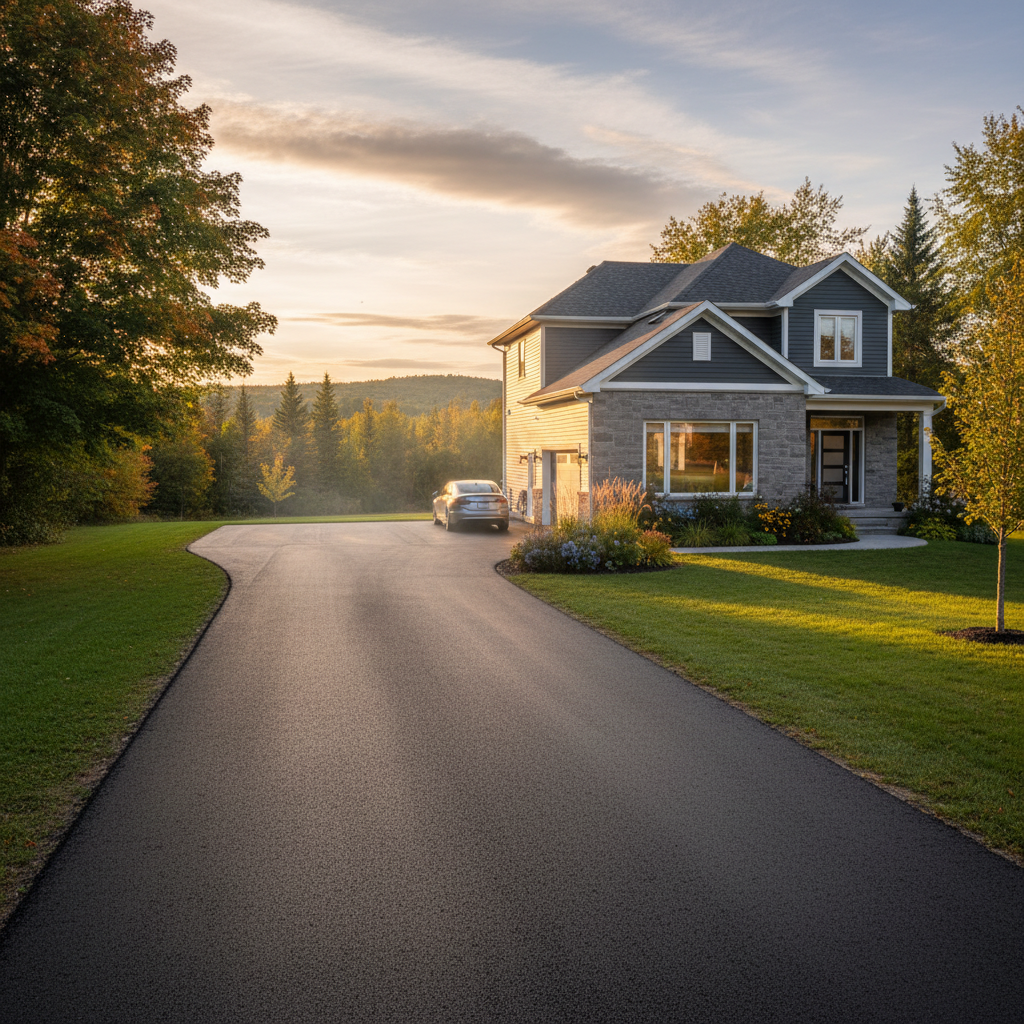
Driveway paving options and costs in Haliburton Village
Haliburton Village is a tight-knit community of about 1,149 residents (Statistics Canada, 2021 Census), and most private driveways are associated with single-detached homes, which tend to need long-lasting, winter-ready surfaces. In the Muskoka–Kawarthas region, pricing is shaped less by “style” and more by physics: frost depth, aggressive freeze–thaw cycles, and drainage. Local geotechnical practice commonly assumes frost penetration around 1.2 m (≈4 ft). That pushes contractors to build a thicker, well-compacted granular base and to set proper slopes and edge restraints—especially on north-facing or exposed lots.
Costs also move with the short paving season. Hot-mix asphalt work typically needs sustained warm weather (air temps above about 10°C), so late spring scheduling and limited production windows can tighten availability and raise labour and equipment rates. If you’re calling from the Wharf Street area and nearby lakeward streets, demand often peaks because driveways get used heavily in spring and early fall when residents start opening up the lots again.
Below is a homeowner-friendly comparison of common driveway materials and what you can generally expect to pay when the base is built correctly for the region’s freeze–thaw conditions. Use the table as a starting point, then match the material to your site drainage, vehicle traffic, and how much maintenance you’re willing to manage.
| Material |
Lifespan |
Maintenance |
Best For |
Price per sq ft |
Price Range |
| Asphalt (new installation, proper base) |
15–25 years |
Seal every 3–5 years |
Most value-focused driveways with good drainage |
$6.50–$12.00 |
$4,500 – $9,000 |
| Asphalt (overlay on existing gravel base) |
10–18 years |
Seal every 3–5 years; monitor edge settlement |
When you want asphalt look without full rebuild |
$7.50–$13.00 |
$5,000 – $10,500 |
| Interlocking concrete pavers |
25–40 years |
Weed control; occasional re-leveling |
High curb appeal and easy spot repairs |
$14.00–$22.00 |
$7,000 – $15,000 |
| Poured concrete (broom finish) |
25–35 years |
Seal every 5–7 years (optional but helpful) |
Simple, clean lines and solid winter performance |
$10.00–$18.00 |
$8,000 – $16,000 |
| Exposed aggregate concrete |
25–35 years |
Sealer every 4–7 years; stain management |
Slip-resistant texture and upgraded look |
$12.00–$20.00 |
$9,000 – $17,500 |
| Gravel / crushed stone (budget option) |
3–8 years (surface), longer with regrading |
Top up and regrade as needed |
Temporary or very low-budget solutions |
$4.00–$8.00 |
$2,500 – $6,000 |
Prices are estimates only and vary by project scope, site access and material selection.
What affects the price of paving in Haliburton Village
In Haliburton Village, it’s common to see two quotes for “the same driveway” differ by 30–50% across Muskoka–Kawarthas and other Ontario areas, even when the finished material looks identical. The biggest drivers are how each contractor handles frost protection, drainage, and what’s included in the scope (haul-away, base replacement, edge restraints, and disposal). Underbuild the base or miss a drainage fix, and you’ll pay later in rutting, cracking, or heaving—costs that show up fast in winter.
Frost line depth and freeze–thaw cycles are decisive cost factors here. Muskoka–Kawarthas projects commonly plan for roughly 1.2 m of frost influence. In practical driveway terms, that means thicker compacted granular base in frost-prone Central Ontario; you’re often dealing with 12+ inches of properly compacted granular for residential pavements when the subgrade is variable. In milder areas, you might get away with less, but here deeper frost and more water movement through the structure mean base and subgrade preparation cost more. Concrete and asphalt mix designs also matter—freeze–thaw-rated asphalt and correctly air-entrained concrete help, but they can increase material costs.
Two concrete examples from the neighbourhood level: if your driveway has a low spot that traps water after spring thaw, drainage corrections (grading and sometimes added subdrain) can add labour and rock/pipe material, but they also reduce the chance of winter heave. Conversely, a short, straight driveway with good existing base and easy access may land nearer the lower end of the regional asphalt band (for example, the $4,500–$9,000 range) rather than the higher end. Similarly, a paver project that needs extensive tear-out and edge containment will push toward the upper interlocking pavers band ($7,000–$15,000), while a straightforward job can sit closer to the middle.
| Price Factor |
Why It Matters |
Cost Impact |
| Driveway area in sq ft |
Surface area and base quantity scale directly with square footage |
Largest driver; commonly 50–70% of total cost |
| Base depth required |
Frost line determines granular thickness and compaction requirements |
Can add major excavation and material hauling costs |
| Grading and drainage work |
Slopes and drainage prevent water from entering the pavement structure |
Moderate to high; increases labour and materials |
| Tear-out of existing surface |
Breaking and hauling old asphalt/concrete adds disposal and equipment time |
Often pushes cost up by thousands if full rebuild is needed |
| Edge restraints and curbing |
Prevents paver spread and asphalt/concrete edge failure |
Moderate; essential for longevity |
| Sealing requirement |
Asphalt needs sealing after initial cure to resist water/oxidation |
Low-to-moderate; typically a mid-cycle added cost |
| Site access |
Narrow lots and long drives slow equipment and increase labour handling |
Moderate; can raise rates due to extra time |
| Asphalt mix specifications |
Freeze–thaw-rated mix and proper thickness reduce winter cracking |
Moderate increase versus basic mixes |
Permits & regulations in Ontario
In Ontario, paving a private driveway within your own property usually doesn’t trigger a building permit. For many Haliburton Village homeowners, the work that typically does not require a permit includes: removing your existing driveway surface, excavating and rebuilding a driveway on your lot, installing asphalt, concrete, or interlocking pavers on private property, and minor surface grading as long as it stays within your property boundaries and doesn’t change how stormwater flows onto neighbouring land.
Where you often do need municipal approval is when you touch the municipal right-of-way or alter drainage that affects the street/boulevard. Examples include: creating or changing a curb cut/driveway access from the road, changing the boulevard, installing catch basins or altering storm drainage connected to municipal infrastructure, or modifying ditches/culverts in the right-of-way. Some municipalities also have lot-grading rules that restrict how close hard surfaces can sit near property lines because of water and slope control.
Step-by-step, verify your contractor’s readiness: (1) confirm they check and mark utilities before excavation using Ontario One Call; (2) ask for a clearance or confirmation that locates are completed before digging; (3) check Ontario licensing where applicable for the nature of the work through the relevant provincial registry; and (4) request a Certificate of Insurance showing liability coverage and evidence of WSIB coverage (or the appropriate exemption documentation if applicable). For homeowners, never rely on verbal assurance—ask to see the certificates before work starts and confirm the expiry dates.
Asphalt vs pavers vs concrete for Haliburton Village driveways
For Haliburton Village’s freeze–thaw reality, the “best” driveway material depends on how much movement you can tolerate and how you want to handle winter maintenance. Asphalt is typically the lowest upfront option, and when it’s built on a thick, compacted granular base with proper slopes it performs well. The trade-off is maintenance: sealing every 3–5 years helps protect against water and oxidation, which matter a lot in a region where thawing and refreezing drive stress into the pavement.
Interlocking concrete pavers cost more to install, but they’re repairable. In Muskoka–Kawarthas, localized settlement or a drainage issue doesn’t force a full replacement—pavers can be lifted, corrected, and reinstalled. Pavers also handle curb appeal beautifully for cottage-style properties and year-round homes in areas like Lake-side or Wharf Street corridors. Poured concrete sits mid-range and can be durable, but it’s more sensitive to freeze–thaw cracking if it’s not air-entrained and if joints aren’t installed and sealed correctly. Exposed aggregate adds slip resistance but still needs proper base and curing.
Base preparation is the equalizer across all three: with frost influence around 1.2 m, you’re usually planning for a robust granular structure and excellent drainage. If you’re seeing winter issues from ploughing and meltwater, improving drainage and edge containment is often a better “fix” than switching materials alone. For a real-world dollar comparison: if asphalt lands near the $4,500–$9,000 band and pavers land in the $7,000–$15,000 band, the additional cost is justified when you want longer-term spot repairs and a premium finish—or when your site is prone to minor base movement that would otherwise require full asphalt overlay later.
| Material |
Frost Resistance |
Curb Appeal |
Repair Method |
Lifespan |
Price Band |
| Asphalt (sealed regularly) |
Good when base and drainage are correct |
Moderate |
Mill/overlay for larger failures; patch for small areas |
15–25 years |
$4,500 – $9,000 |
| Interlocking concrete pavers |
Excellent with restrained edges and stable base |
High |
Remove affected units, rebuild base, re-lay pavers |
25–40 years |
$7,000 – $15,000 |
| Poured concrete (air-entrained) |
Very good with air-entrainment and proper joints |
Moderate to high |
Patch or replace slabs in localized areas |
25–35 years |
$8,000 – $16,000 |
| Exposed aggregate concrete |
Very good with air-entrainment and curing |
High |
Localized repair varies; often patching with colour matching |
25–35 years |
$9,000 – $17,500 |
| Permeable pavers (drainage grid) |
Excellent when underdrain and grading are engineered |
High (modern look) |
Lift and reset for localized issues; clean and maintain joints |
20–35 years |
$8,500 – $16,500 |
| Chip seal / tar-and-chip |
Fair to good; sensitive to water management |
Low to moderate (function first) |
Spot chips and re-coat; patching is common |
6–12 years |
$3,500 – $6,500 |
How to choose a paving contractor in Haliburton Village
Choosing a contractor in Haliburton Village is mostly about verifying coverage and making sure the scope matches Muskoka–Kawarthas freeze–thaw needs. First, licensing and insurance: ask for proof of Ontario licensing relevant to their business activities and for a current Certificate of Insurance showing liability coverage. Confirm WSIB coverage by requesting evidence of clearance or exemption (depending on how the contractor operates). Don’t accept expired documents—check expiry dates and that the certificate lists the correct legal name for the company.
Next, get 2–3 itemised written quotes rather than lump sums. You want a breakdown that shows: excavation depth and granular type, compaction requirements, base thickness (especially frost protection), the paving/paver/concrete thickness, edge restraints, and whether disposal of removed material is included. Clarify exclusions up front—things like tree root removal, ledge/rock breaking, correcting drainage, or replacing subgrade that fails compaction tests. Ask if a permit is required for any right-of-way work and whether the contractor pulls it (when applicable) or leaves that to you.
Warranty matters: request the workmanship warranty length and what it covers (e.g., settlement or cracking due to base failure versus normal wear). Confirm whether the warranty is transferable to a future owner, since many Haliburton homes change hands seasonally. For payment, never pay more than 10–15% upfront; use holdback until completion and final grading is confirmed. Finally, get the start date and completion estimate in writing—winter scheduling delays are common, and dates should reflect the paving season constraints.
- Ask for proof of liability insurance and verify it covers driveway/foundation-adjacent work.
- Request WSIB clearance/exemption documentation and confirm the effective dates.
- Ensure utility locates are performed before excavation (Ontario One Call confirmation).
- Confirm base thickness in inches and the granular spec/type, not just “proper base.”
- Require a drainage plan: slopes, catch basins/subdrain if needed, and positive water control.
- Get a line item for edge restraints/curbing for pavers and a containment plan for asphalt.
- Confirm tear-out includes breaking, hauling, and disposal (and how far they haul).
- For asphalt: confirm paving thickness and the freeze–thaw-rated mix approach.
- For concrete: confirm air-entrainment, joint spacing, and curing details.
- Verify what’s excluded (rock/ledge, tree roots, subgrade replacement, re-grading).
- Ask for a workmanship warranty in writing and whether it’s transferable.
- Set a payment schedule with holdback until final brooming/compaction and cleanup are accepted.
Red flags I see around Haliburton Village include contractors who won’t put base thickness and drainage scope in writing, promise “cheap sealing-free asphalt” without a sealing plan, refuse to provide WSIB/insurance proof before work starts, quote only a lump sum with no haul/disposal details, or begin excavation without confirming utility locates and jobsite safety.
Frequently asked questions — paving in Haliburton Village
How long does a paved driveway last in Haliburton Village?
In Haliburton Village, driveway life is strongly tied to frost protection and drainage, not just the surface material. When asphalt is installed with a thick, well-compacted granular base and sealed on schedule, it commonly lasts about 15–25 years. If water can get into the structure during spring thaw, you can see earlier cracking, rutting, or edge failure regardless of how good the top lift looks on day one. Poured concrete, when properly air-entrained and jointed, often reaches 25–35 years, while interlocking pavers can last 25–40 years because they’re repairable without replacing the entire driveway. Homes here tend to experience freeze–thaw stress across multiple seasons, so maintaining sealing for asphalt (typically every 3–5 years) is one of the simplest ways to protect your investment.
When is the best time of year to pave in Haliburton Village?
The best time in Ontario is generally late spring through early fall, when the ground is workable and air temperatures stay high enough for asphalt placement and compaction. Hot-mix asphalt typically requires warm conditions—contractors often target days when air temperatures are consistently above about 10°C and the subbase isn’t saturated. Scheduling can be tighter in the Muskoka–Kawarthas region because the paving season is shorter, so the same contractor capacity is spread over fewer weeks. If you’re planning ahead, aim to book in spring so you’re not pushed into late-season weather risk. Concrete work also benefits from stable temperatures for curing, and paver installation is weather-tolerant but still depends on base stability and drainage completion before freeze weather arrives.
How deep should the base be for Haliburton Village's frost?
Because Haliburton Village is in a frost-prone part of Ontario, contractors typically design for frost influence around 1.2 m (about 4 ft). In driveway terms, that usually translates into building a thick, properly compacted granular base—often 12+ inches of compacted granular for residential asphalt or similar pavements—plus good subgrade prep and drainage. The exact depth should match your soil conditions and slope, because clay-rich or saturated areas need more attention than a firm, well-drained subbase. A common mistake is using a thin base “because it looks fine now,” but freeze–thaw cycles can pump moisture and stress upward, causing heaving and cracking later. The best way to confirm depth is to have the contractor explain their granular specs and compaction approach in the quote, then review what they’ll do if the subgrade can’t meet compaction.
How often should I seal my asphalt driveway?
For asphalt driveways in Ontario, sealing is usually done after the pavement has cured—often within the first year depending on weather and product—and then repeated on a cycle that protects it from water and oxidation. A typical guideline is every 3–5 years. If you’ve paid around the lower end of the asphalt driveway band (for example, near $4,500–$9,000 for an appropriately built driveway), sealing is a relatively small maintenance step compared to the cost of a full overlay later. In Haliburton Village, spring thaw and meltwater are real drivers, so if you see potholes forming at edges, dull surface texture, or water holding after rain, it’s a sign sealing and drainage attention may be overdue. A good contractor should include an expected sealing schedule in the discussion of long-term costs.
Why does my driveway crack and heave in winter?
Cracking and heaving in Haliburton Village usually come back to moisture and freeze–thaw movement within the pavement structure. If water penetrates the asphalt or concrete—through edges, surface wear, or poor slope—then it freezes, expands, and pushes the material upward. Common culprits include insufficient base thickness, inadequate compaction, weak edge containment, and drainage issues that let water pool during spring thaw. De-icing practices can also accelerate surface deterioration on concrete if the mix isn’t properly air-entrained and joints aren’t maintained. Another contributor is subgrade instability: if soil didn’t meet compaction targets or was left saturated before paving, the driveway may look fine initially but fail as freeze cycles repeat. The fix often isn’t just patching; it’s improving base structure and drainage so the freeze–thaw cycle has less water to act on.
Do I need a permit to pave my driveway in Ontario?
Often, no permit is required for paving a private driveway within your own property boundaries in Ontario. For most homeowners in Haliburton Village, work that typically does not need a permit includes resurfacing or rebuilding on private land (asphalt, pavers, or concrete) as long as you’re not changing municipal infrastructure. Where permits or approvals may be required is if the work touches the municipal right-of-way—such as changing a curb cut, altering boulevard/ditch conditions, or connecting to or modifying storm drainage that affects the street system. Because rules can vary by municipality, confirm the scope before starting. Also, regardless of permits, contractors should complete utility locates through Ontario One Call before any excavation. When you get quotes, ask whether the contractor includes approval/permit steps if the job affects anything in the right-of-way.