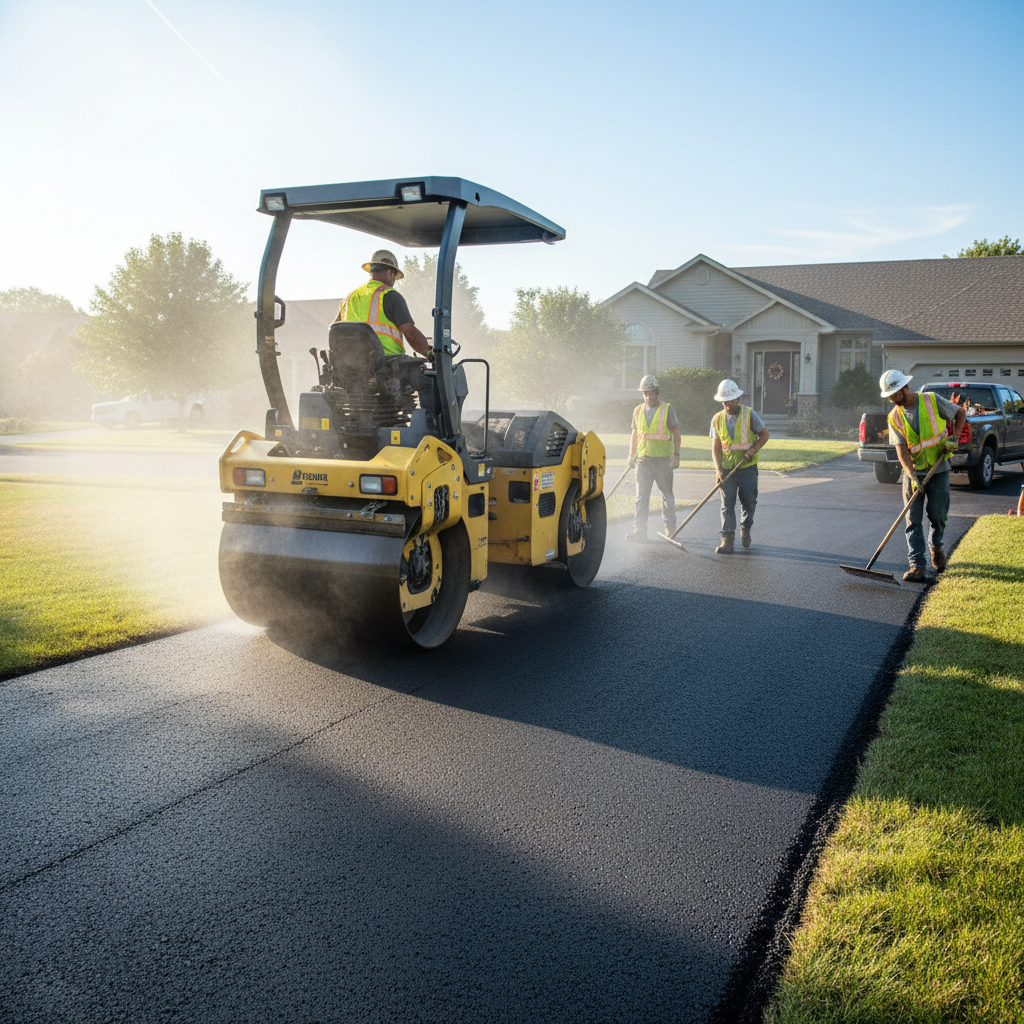
Driveway paving options and costs in Mount Albert
Mount Albert homeowners typically choose between asphalt, interlocking pavers, or concrete because each material handles the winter in its own way—and winter is a big deal here. With Mount Albert sitting at a population of 4,925 (Statistics Canada, 2021 Census), most private driveways are tied to detached housing, where driveways are commonly longer and more exposed to ploughing and salt. That matters because the Toronto economic region’s freeze–thaw cycles are a primary cost driver: ground freezing to roughly 3–4 feet means your base and drainage must be engineered to keep water from sitting under the pavement. When water freezes and expands, it can push up the surface and create cracking.
On top of the ground mechanics, pricing and availability swing with the season. Hot-mix asphalt placement depends on workable soil and air temperatures, so the effective paving season is late spring through early fall. In peak months, contractors in the Toronto area can be booked tighter, which can move quotes up—especially if you need fast scheduling or have restricted site access.
In Mount Albert—particularly around Yonge Street and the local corridor toward the 27 and 404 routes—driveway replacements and curb-adjacent upgrades are in steady demand because homeowners often want both curb appeal and winter-ready performance. Use the comparison below as a practical baseline for scoping your project and planning maintenance.
| Material |
Lifespan |
Maintenance |
Best For |
Price per sq ft |
Price Range |
| Asphalt (new installation, proper base) |
12–20 years |
Seal every 3–5 years; patch minor failures |
Best value with the right base and drainage |
$5.00–$12.00 |
$3,500–$8,000 |
| Asphalt (overlay on existing gravel base) |
8–15 years |
Seal after 6–12 months; more frequent patching |
Lower upfront cost when base is suitable |
$4.50–$10.00 |
$3,500–$7,000 |
| Interlocking concrete pavers |
20–30+ years |
Re-sand joints; lift-and-replace damaged sections |
Repairability and high curb appeal |
$10.00–$20.00 |
$9,000–$20,000 |
| Poured concrete (broom finish) |
25–35 years |
Crack monitoring; occasional patching and sealing |
Simple, solid surface with good snow-plow tolerance |
$8.00–$16.00 |
$6,000–$15,000 |
| Exposed aggregate concrete |
20–30 years |
Seal periodically; patch and re-seal affected areas |
Non-slip texture and premium look |
$10.00–$18.00 |
$8,000–$16,000 |
| Gravel / crushed stone (budget option) |
5–10 years |
Top-up and re-grade; weed control |
Lowest initial cost; fast turnaround |
$2.50–$6.00 |
$1,000–$4,000 |
Prices are estimates only and vary by project scope, site access and material selection.
What affects the price of paving in Mount Albert
In the Toronto economic region, it’s common for two quotes on “the same” driveway to land 30–50% apart. The biggest reason is that the visible surface is only a small part of the job: Toronto-area frost depth and freeze–thaw cycles force contractors to build a thicker, well-compacted granular base and a drainage system that can handle water movement year-round. With ground freezing to about 3–4 feet, the base depth and subgrade prep become decisive. In colder inland Ontario, that typically translates to a deeper engineered granular build-up than you’d see in milder climates—so materials, excavation, and compaction time can jump.
Schedule timing also matters. Hot-mix asphalt placement generally requires air/soil conditions above roughly 10°C, so demand concentrates into late spring through early fall. If your quote targets “prime dates” or you need work completed before a specific deadline, labour and equipment availability can push totals upward, even before you pick a material. For homeowners, this is why you might see asphalt driveway paving land from $3,500–$8,000 depending on base work, thickness, and tear-out complexity.
Concrete costs can move similarly. If your driveway ties into existing slabs, you might pay less when saw-cut lines are clean; you’ll pay more if the old surface needs heavy breaking, regrading, or doweling. In Mount Albert, older neighbourhoods near the main corridors often have settled subgrades—so you may see excavation and drainage corrections that add several hundred to a few thousand dollars. As a reality check, if you’re comparing pavers versus asphalt: interlocking often starts higher (commonly $9,000–$20,000) but can be cost-justified when the driveway will need targeted repairs without full replacement.
| Price Factor |
Why It Matters |
Cost Impact |
| Driveway area in sq ft |
Materials and labour scale directly with surface area. |
Large: often the single biggest driver. |
| Base depth required |
Frost line conditions require thicker compacted granular layers to reduce heaving/cracking. |
Medium to large; can add cost quickly on larger builds. |
| Grading and drainage work |
Proper slope and drainage channels keep water from pooling under the pavement. |
Medium; rises if subgrade is soft or poorly drained. |
| Tear-out of existing surface |
Breaking, hauling, and disposal are cost items—especially with concrete. |
Medium to large depending on thickness and accessibility. |
| Edge restraints and curbing |
Restraints prevent paver spread and help asphalt stay tight at the edges. |
Small to medium; essential for long-term performance. |
| Sealing requirement |
Asphalt needs sealing after curing (commonly 6–12 months) to protect from moisture and oxidation. |
Small upfront; meaningful value over time. |
| Site access |
Narrow drives and tight turning radii slow equipment and increase labour time. |
Small to medium; can become large on constrained lots. |
| Asphalt mix specifications |
Freeze–thaw-rated mixes help resist rutting and thermal cracking. |
Small to medium; impacts total if multiple layers are used. |
Permits & regulations in Ontario
For Mount Albert homeowners in Ontario, paving a private driveway within your own property usually does not require a building permit. In most cases, you can replace the surface and even rebuild the base on your lot without involving the municipality—as long as you are not changing items that affect municipal infrastructure. The work that typically does require municipal approval includes changes in the municipal right-of-way, such as new or modified curb cuts, alterations to the boulevard area, and any work that impacts storm drainage patterns (for example, rerouting runoff into the municipal system). If your project includes drainage adjustments near the road or ties into existing municipal services, plan on approval before excavation.
Before any digging, always call for utility locates through Ontario One Call (locates for buried services are mandatory for safety). Next, confirm lot-grading rules with your local municipality—some areas have restrictions on how close hard surfaces can be to property lines and how runoff must be handled. A contractor who can’t talk clearly about grading, slope, and drainage is a red flag in the Toronto freeze–thaw environment.
To verify your contractor: (1) confirm their Ontario business details and licensing status through the appropriate online registry and their customer-facing information; (2) ask for an up-to-date certificate of insurance showing general liability; (3) request proof of WSIB coverage (or applicable clearance/coverage documentation where required). Finally, verify the documentation dates match the project start window and keep copies for your records.
Asphalt vs pavers vs concrete for Mount Albert driveways
In Mount Albert’s freeze–thaw climate, the “best” driveway often depends on your tolerance for maintenance and your expectations for repairs. Asphalt is the lowest upfront option and can look sharp when installed over a properly compacted granular base. The trade-off is that asphalt needs sealing every 3–5 years to protect the surface from moisture intrusion and oxidation. In a region where water can repeatedly freeze and expand under the slab, sealing is not cosmetic—it’s part of keeping the pavement flexible and reducing permeability.
Interlocking concrete pavers cost more upfront, but they’re highly repairable. If a small section settles or a utility repair is needed, the contractor can lift the affected pavers, correct the base, re-sand, and reinstall without tearing out the entire driveway. That matters in winter-maintained driveways where ploughing and salt can be harsher along edges. Pavers are commonly selected for curb appeal because the layout can be customized and the surface remains visually consistent even after localized repairs.
Poured concrete sits in the middle cost range and can be very durable when it’s air-entrained and properly jointed. However, concrete is more sensitive to poor drainage, inadequate base preparation, and insufficient control joints—issues that become more expensive under freeze–thaw cycling. If de-icing salt is used heavily, surface wear can accelerate.
For example, if your driveway budget allows only one full replacement, asphalt at about $3,500–$8,000 can be justified when the base and drainage are corrected and you commit to sealing. If you want a long-term “repairable” approach and higher curb appeal, pavers at $9,000–$20,000 are often worth it—especially when you anticipate future landscape changes or utility work.
| Material |
Frost Resistance |
Curb Appeal |
Repair Method |
Lifespan |
Price Band |
| Asphalt (sealed regularly) |
Good with engineered base and proper slope/drainage |
Good (clean finish; limited pattern options) |
Mill and patch; overlay if needed |
12–20 years |
$3,500–$8,000 |
| Interlocking concrete pavers |
Very good when edge restraints and base are correct |
Excellent (custom colours/patterns) |
Lift-and-replace individual sections |
20–30+ years |
$9,000–$20,000 |
| Poured concrete (air-entrained) |
Good with control joints and drainage |
Good to premium (finish-dependent) |
Patch cracks; consider resurfacing for severe areas |
25–35 years |
$6,000–$15,000 |
| Exposed aggregate concrete |
Good to very good with correct air entrainment and finishing |
Premium (textured, slip-resistant look) |
Targeted patching and re-seal |
20–30 years |
$8,000–$16,000 |
| Permeable pavers (drainage grid) |
Very good when drainage design matches soils |
Good (clean, modern layout) |
Same as pavers; repairable by section |
20+ years |
$10,000–$22,000 |
| Chip seal / tar-and-chip |
Moderate; better for low-traffic areas |
Variable (texture finish) |
Spot rework; occasional re-seal |
6–12 years |
$2,500–$6,500 |
How to choose a paving contractor in Mount Albert
Choosing the right contractor matters more in Ontario than in many warmer markets because your driveway must survive freeze–thaw cycling and require correct base and drainage work—not shortcuts. Start by verifying licensing/registration information publicly available online (for Ontario business details) and confirm their liability insurance is active. Ask for WSIB coverage confirmation for workers; they should be able to provide current documentation, including proof of coverage or an applicable clearance letter where required. A contractor should also provide a clear certificate of insurance with your project named or at least the insured details legible.
Next, get 2–3 itemised written quotes, not lump-sum numbers. You want a breakdown showing labour and material line items (excavation, granular base, asphalt/paver/concrete supply, compacting, edging/curbs, and any reinstatement). Itemise what’s included for disposal (hauling/dump fees) and what’s excluded (for example, if landscaping restoration or extra stone top-up is not included, you need that in writing). Clarify whether a permit or municipal approval is included if your scope touches the right-of-way.
Warranty should be specific: workmanship warranty length, what it covers (and for how long), and whether product/manufacturer coverage is separate. Ask if the warranty is transferable to future homeowners.
Payment schedule: never pay more than 10–15% upfront. Use a holdback until the job is fully complete and the final grade/drainage and cleanup meet the contract.
Finally, require a written timeline with a start date and an estimated completion date. In Mount Albert’s short paving window, a clear schedule prevents delays from turning into expensive rush work.
- Confirm WSIB clearance/coverage documentation before work begins.
- Require a current certificate of insurance (liability) and verify dates.
- Ask whether they design for drainage slope and frost protection, not just the surface finish.
- Get 2–3 itemised quotes with labour and material breakdown.
- Confirm excavation depth and base thickness in inches (not “as needed”).
- Ensure disposal/hauling is included for tear-out materials.
- Clarify edge restraint/curbing requirements and who supplies them.
- For asphalt, confirm cure time and when sealing is recommended (often 6–12 months).
- For pavers, confirm joint sand type and compaction method.
- Confirm concrete air-entrainment and joint/control plan for freeze–thaw movement.
- Check warranty terms in writing for workmanship and materials.
- Use a payment schedule with a holdback; avoid large upfront payments.
In Mount Albert, red flags I commonly see include: vague scope statements (“we’ll do what’s needed” without base depth or drainage details), contractors who won’t provide insurance/WSIB paperwork on request, quotes that omit disposal and reinstatement, no written warranty terms, and crews starting without a utility locate plan.
Frequently asked questions — paving in Mount Albert
How often should I seal my asphalt driveway?
In Mount Albert and across Ontario, asphalt sealing is about managing moisture and oxidation so freeze–thaw doesn’t turn small surface issues into deeper failures. A typical schedule is sealing every 3–5 years, but the exact timing depends on how the asphalt was installed, the weather during curing, and whether it’s been patched. If your driveway is new, sealing is often done after it cures—commonly around 6–12 months—so the surface can lose excess moisture. If you’re seeing light raveling or a dull, faded surface, sealing can restore protection, but it’s not a substitute for fixing drainage problems. If you’re comparing options, budgeting for sealing is a key part of making asphalt work within the $3,500–$8,000 value range over the long run.
Why does my driveway crack and heave in winter?
Driveway cracking and heaving in Ontario usually come back to water and frost movement. When water enters the pavement edges, joints, or any weak spots in the base, it can freeze and expand as temperatures drop—pushing the surface upward (heave) and later stressing it as it contracts. Toronto-area freeze–thaw cycling is especially hard on driveways because workable asphalt placement and base preparation must be engineered correctly to limit water infiltration. Common causes include insufficient base thickness, poor compaction, low spots that hold water, and missing/incorrect drainage. Salt and sanding can also contribute to surface wear, but they don’t cause heaving by themselves. If the base wasn’t designed for the local frost conditions, repairs may be short-lived.
Do I need a permit to pave my driveway in Ontario?
In most Mount Albert cases, paving a private driveway within your own property typically does not require a building permit. You generally don’t need a permit for work confined to your lot, like replacing asphalt, rebuilding a base, or pouring a new slab on your property. Where permits or approvals usually come into play is if the work affects the municipal right-of-way—such as creating or changing a curb cut, modifying the boulevard, or altering storm drainage connections. Because rules can vary by municipality, confirm with the local office if any portion of the scope touches the road allowance or drainage infrastructure. Also, regardless of permits, you must call for utility locates through Ontario One Call before excavation, since hitting buried services is a safety and legal issue.
How long before I can drive on new asphalt?
New asphalt typically requires time to cool and cure before vehicles drive on it. As a general rule in Ontario, light traffic may be possible sooner than heavy loads, but crews usually control vehicle access for the first 24–48 hours depending on weather, mix type, and how the driveway was installed. In Mount Albert’s shoulder seasons, cooler or damp conditions can extend the waiting period. Avoid turning manoeuvres and parking heavy vehicles too early, because it can deform the surface and create permanent impressions. If your driveway includes a new base and binder layer, contractors may also recommend additional cure time before heavy traffic. Your contractor should provide a specific access schedule in writing.
What causes potholes and how are they repaired?
Potholes are usually the end result of water infiltration and repeated freeze–thaw stress. In Ontario, water seeps into the asphalt, softens the material during thaw periods, and then expands again when it freezes—loosening the base and breaking the surface. Traffic (including turning and braking) then accelerates the failure. Repairs depend on the size and depth: a proper fix typically involves cutting out the damaged section to sound material, cleaning the area, addressing any base instability, and then paving back with compacted asphalt layers. For isolated areas, a patch can work well. If potholes are widespread, an overlay may be more cost-effective than patching—especially when base performance is already compromised.
How do I prepare for a paving project?
Preparation makes the difference between a smooth install and costly delays. In Mount Albert, start by clearing the driveway of vehicles, planters, and portable items, and mark any buried service lines you know about. Confirm utility locates are scheduled before excavation (Ontario One Call). Discuss drainage: if you have low areas that pond after rain, bring it up—fixing grading and slope at the base level is where contractors control future heaving and cracking. If you have existing concrete or asphalt, ask how the tear-out will be handled and where waste will be hauled. Make sure the quote is itemised and confirms what’s included (base depth, edge restraints, disposal, and timing). Finally, align expectations on sealing/curing for asphalt—sealing may be recommended after 6–12 months, which affects your long-term cost planning within the $3,500–$8,000 driveway paving range.