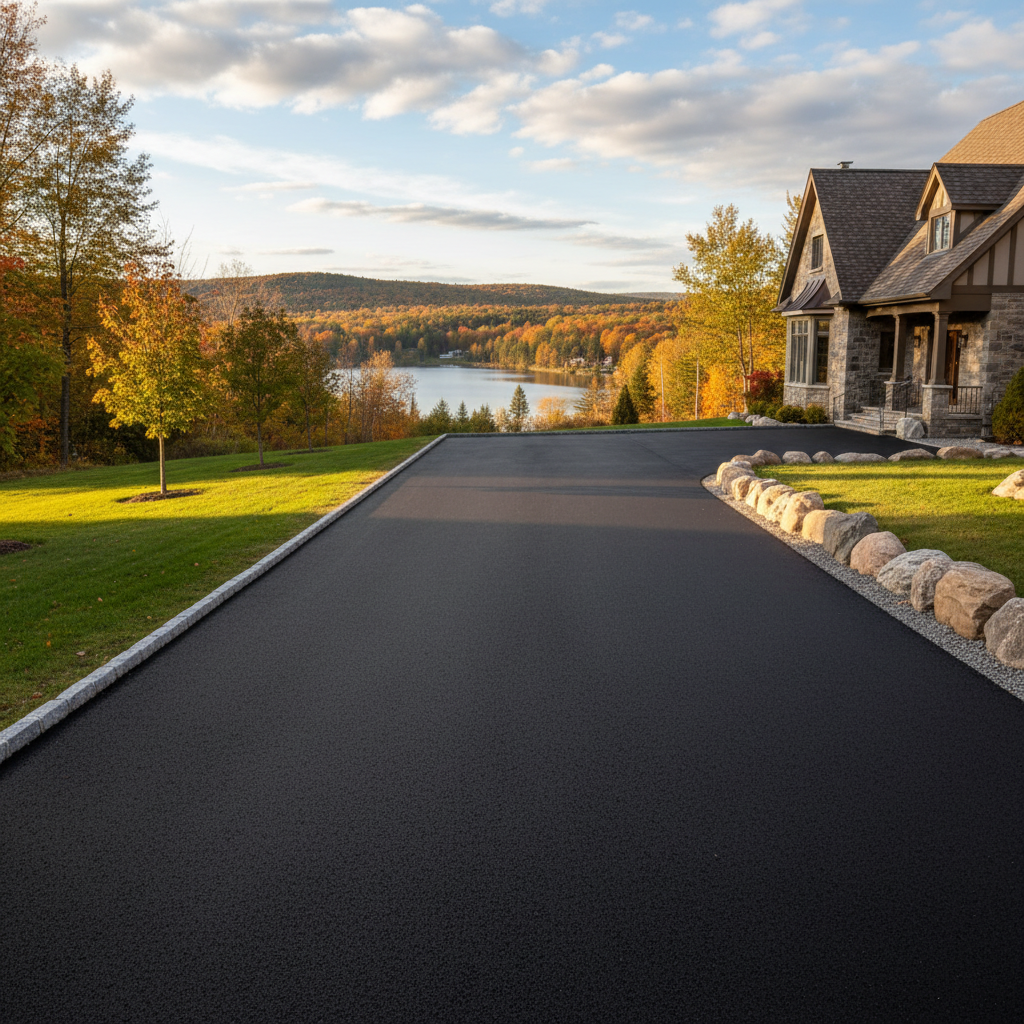
Driveway paving options and costs in Renfrew
Renfrew homeowners typically have three main choices for a longer-lasting driveway: asphalt paving, interlocking concrete pavers, and concrete. Renfrew’s housing profile matters—single-detached homes make up 62.2% of dwellings, and with 2,315 homeowner households (58.5% of households own) there’s steady demand for durable drive surfacing that can handle winter use. Also, 76.4% of homes were built before 1981, which often means older grades, mature trees near the driveway, and occasional drainage issues that need correction before any new surface goes down.
In the Kingston–Pembroke economic region, pricing is driven by climate and soil first. Frost penetration commonly reaches about 4 feet (≈1.2 m) in much of Southern and Eastern Ontario, and the freeze–thaw cycle is tough on thin bases. Contractors usually have a shorter paving window because hot-mix asphalt needs favourable air temperatures (commonly above 10°C), and spring shoulder seasons are wet. That affects availability and scheduling—especially around spring demand surges when excavation and base work ramp up.
You’ll notice the trade is especially active around residential clusters like Pembroke Street East and the broader downtown/river-adjacent areas, where access can be tighter and drainage details matter. From there, quotes usually land within the city tier price bands (depending on driveway size, base depth, and whether there’s tear-out). Use the table below to compare realistic expectations before you request your itemized estimate.
| Material |
Lifespan |
Maintenance |
Best For |
Price per sq ft |
| Asphalt (new installation, proper base) |
15–25 years |
Seal coating every 3–5 years; patching as needed |
Strong value with good drainage and a full granular base |
$6.50–$11.00 |
| Asphalt (overlay on existing gravel base) |
10–18 years |
Plan for more frequent patching; seal on schedule |
Lower upfront cost when existing material is stable |
$5.75–$9.50 |
| Interlocking concrete pavers |
25–40 years |
Resand joints; replace individual pavers if needed |
Repairability and curb appeal, especially on curved driveways |
$10.00–$18.50 |
| Poured concrete (broom finish) |
20–30 years |
Occasional crack filling; keep drainage functioning |
Low visual maintenance if concrete is properly air-entrained |
$11.00–$20.00 |
| Exposed aggregate concrete |
20–35 years |
Light cleaning; sealant as recommended by installer |
Improved texture for slip resistance and decorative look |
$13.00–$22.50 |
| Gravel / crushed stone (budget option) |
5–10 years (varies by grading) |
Regrade and add stone yearly; weed control |
Short-term solution or where paving is delayed |
$4.00–$7.50 |
Prices are estimates only and vary by project scope, site access and material selection.
What affects the price of paving in Renfrew
In Renfrew and the broader Kingston–Pembroke region, two contractors can quote the “same” driveway and still be 30–50% apart, mainly because the scope isn’t truly the same once you account for base thickness, drainage corrections, excavation volume, and disposal. Asphalt might look cheaper at face value, but if one quote includes deeper compacted granular base and robust ditching/swales while another cuts corners, the long-term outcome changes—and the pricing gap reflects that.
Frost line depth and freeze–thaw cycles are decisive cost factors here. When frost penetration is commonly around 4 feet (≈1.2 m), the granular base has to be thick and well-compacted to reduce heaving and cracking. As a practical rule in Ontario, contractors typically allow for a thicker base (often in the 6–12 inch range of granular layers above subgrade for driveways, depending on soil and design) than you’d see in milder or coastal climates. In addition, hot-mix asphalt crews compress work into a shorter season; air temperature targets (often above 10°C) mean more scheduling pressure in spring and summer, which can nudge pricing upward.
Concrete costs in Renfrew can rise when older lots have weak subgrade or poor drainage—mud pumping and standing water force more excavation and imported aggregate. Conversely, costs can come down when the existing grade is stable, utilities are already located and marked, and there’s easy access for a mini-excavator and dump truck. These variables often explain why a properly built asphalt driveway may land closer to the lower end of the $4,500–$9,000 band, while a drainage-corrected, deep-base rebuild can push it toward the higher end; pavers can similarly move within the $6,500–$14,000 interlocking range depending on how much base reconstruction is required.
| Price Factor |
Why It Matters |
Cost Impact |
| Driveway area in sq ft |
Material and labour scale directly with square footage |
Major driver; typically most of the variation between quotes |
| Base depth required |
Frost protection depends on thicker granular layers over weaker soils |
Higher base and compaction increase excavation and aggregate costs |
| Grading and drainage work |
Proper slope and water management prevent soft subgrade |
Can add labour/equipment days, plus ditching/swale or French drain |
| Tear-out of existing surface |
Breaking and hauling removes old failing material and any contaminated base |
Adds demo time, disposal fees, and replacement base |
| Edge restraints and curbing |
Pavers need confinement to resist spreading and asphalt needs stable edges |
Moderate add-on cost; prevents long-term edge failure |
| Sealing requirement |
Asphalt needs a seal coat to slow moisture and oxidation |
Recurring cost; typically scheduled after 6–12 months |
| Site access |
Narrow drives, slopes, and tight turns slow equipment movement |
Labour increases; sometimes smaller equipment and extra trips |
| Asphalt mix specifications |
Freeze–thaw-rated mix and correct thickness improves durability |
Higher mix/spec can raise material cost but reduces early raveling |
Permits & regulations in Ontario
In Ontario, paving a private driveway within your own property typically does not require a building permit. Where permits and approvals usually come into play is when the work affects the municipal right-of-way or storm drainage system. For Renfrew homeowners, that means you should plan for municipal approval if you’re doing things like creating or changing a curb cut, modifying the boulevard, relocating or altering catch basins/municipal drainage components, or changing storm water routing in the road allowance.
Some municipalities also enforce lot-grading and drainage rules through by-laws, which can limit how close a hard surface can be to property lines or how water must be directed away from foundations. Before excavation, call for utility locates (Ontario One Call) so the contractor can verify where gas, hydro, fibre, and water lines run. Even if you hire a licensed contractor, utility locating protects you and prevents costly surprises.
To verify your contractor properly, do it step-by-step: (1) confirm their Ontario licence/registration status using the applicable online registry information they provide and match it to the legal company name, (2) ask for a current certificate of insurance showing liability coverage limits and effective dates, and (3) verify WSIB/WCB coverage by requesting clearance documentation and/or coverage confirmation. If the contractor can’t provide documents promptly—or their insurance is expired—treat that as a serious risk flag before any work starts.
Asphalt vs pavers vs concrete for Renfrew driveways
Renfrew’s freeze–thaw climate rewards the option that pairs a strong base with good drainage, and that’s why base preparation depth matters as much as surface choice. Asphalt is typically the lowest upfront material cost and can look great for years when built over a properly compacted granular base. The trade-off is maintenance: asphalt should be sealed every 3–5 years to slow moisture penetration, especially in shoulder seasons where wet conditions linger.
Interlocking concrete pavers cost more upfront, but they shine for Ontario homeowners who want repairability. Individual stones can be lifted and reset if there’s a future drainage or utility issue, and pavers are less likely to fail “all at once” compared to a single large concrete slab. In winter, when plough marks and salt exposure are common, pavers also handle localised freeze movement better because the system can adjust at the joint level (assuming the bedding sand and edge restraint are correctly installed).
Poured concrete is mid-range and can be very durable if it’s air-entrained and finished properly to handle freeze–thaw. However, concrete is more sensitive to drainage problems; standing water and weak subgrade can lead to cracking over time. In Renfrew driveways—particularly older homes built before 1981 with established drainage patterns that may not match today’s wear—concrete cracking risk increases if drainage isn’t corrected.
A practical dollar example: if an asphalt driveway quote comes in near the $4,500–$9,000 band but the paver rebuild (including full base reconstruction and restraints) lands closer to the $6,500–$14,000 interlocking band, the extra cost is often justified when you expect long-term curb appeal, want easier spot repairs, or have a driveway layout that benefits from individual panel replacement. If you’re prioritizing lowest upfront cost and your subgrade/drainage is stable, asphalt often wins in value. If you want the best balance of durability and “future-proofing” against local repairs, pavers are usually the most homeowner-friendly.
| Material |
Frost Resistance |
Curb Appeal |
Repair Method |
Lifespan |
Price Band |
| Asphalt (sealed regularly) |
Good with deep base and strong drainage |
Medium (clean, dark finish) |
Patch and re-seal (spot repairs common) |
15–25 years |
$4,500–$9,000 |
| Interlocking concrete pavers |
Excellent (flexible system over base) |
High (wide style/colour selection) |
Remove and replace individual pavers |
25–40 years |
$6,500–$14,000 |
| Poured concrete (air-entrained) |
Good when properly air-entrained and drained |
Medium to high (can be decorative) |
Crack repair/seal; full replacement if widespread |
20–30 years |
$7,000–$15,000 |
| Exposed aggregate concrete |
Good (durable surface, still needs proper base) |
High (textured, premium look) |
Localized patching where possible |
20–35 years |
$8,000–$17,500 |
| Permeable pavers (drainage grid) |
Very good where subgrade allows infiltration |
High (clean look, modern drainage) |
Remove sections; maintain surface infiltration |
25+ years with correct maintenance |
$9,000–$19,000 |
| Chip seal / tar-and-chip |
Variable; best on well-prepped bases |
Low to medium (texture-driven) |
Periodic re-chipping; maintenance cycles |
7–12 years |
$4,000–$7,500 |
How to choose a paving contractor in Renfrew
Choosing a contractor in Renfrew is about proving capability, not just getting a number. First, verify Ontario licensing/registration status (use the legal company name and match it to documents they provide). Next, ask for a current certificate of liability insurance—confirm the effective dates and that the coverage is adequate for paving work. For work quality and worker safety, also verify WSIB/WCB coverage: request a clearance letter or proof of account status before the first shovel goes in the ground.
When you request quotes, get 2–3 itemised written estimates with a labour + materials breakdown. You want line items for excavation, granular base layers, compaction, drainage adjustments (ditch/swale/French drain if needed), forming/edge restraints, surface installation, and disposal/hauling. Avoid “lump sum” quotes that don’t specify what’s included. Carefully ask what’s excluded: is permit/admin work included if municipal approval is required, is debris disposal included, and who reinstates sod/landscaping? Also confirm how thick the base will be and how compaction will be handled.
Warranty matters too. Ask for the workmanship warranty length (and what defects it covers), the product/manufacturer warranty terms, and whether any warranty is transferable to future owners. For payment, a responsible schedule generally keeps upfront deposits to about 10–15% and holds back the remainder until the job is complete and cleanup is verified. Lastly, demand a start date and a realistic completion estimate in writing, especially given Renfrew’s shorter paving window and spring weather impacts.
- Provide Ontario licensing/registration details that match the quote and contract name.
- Show current liability insurance certificate (effective dates included).
- Provide WSIB/WCB clearance or coverage confirmation.
- Use itemised quotes (labour, materials, base layers, drainage, haul/disposal).
- Specify base depth and granular type—not “standard base”.
- Clarify drainage plan (slope, ditch/swale, French drain if needed).
- Confirm whether tear-out and disposal are included.
- Confirm edge restraints/curbing for pavers/asphalt perimeter stability.
- Include compaction method and equipment (roller type/requirements where possible).
- Ask about asphalt mix specification meeting freeze–thaw conditions.
- State warranty terms: workmanship length, exclusions, and transferability.
- Payment schedule: keep deposits to 10–15%, hold back until final completion.
Red flags in Renfrew: (1) they won’t provide insurance or WSIB/WCB proof, (2) they won’t clearly state base depth and drainage responsibilities, (3) they dismiss the frost-line issue or suggest “minimal excavation” on older/problem lots, (4) they quote without a site visit/photos or measurements, and (5) they pressure you for full payment upfront.
Frequently asked questions — paving in Renfrew
How much does it cost to pave a driveway in Renfrew?
In Renfrew, driveway paving commonly falls into region-based price bands because excavation, granular base depth, and drainage corrections are heavily influenced by freeze–thaw conditions. For asphalt, many projects land around $4,500–$9,000 depending on driveway size, how much tear-out is required, and whether the subgrade needs rebuilding. Interlocking pavers often fall around $6,500–$14,000, while concrete projects commonly price near $7,000–$15,000. If your lot has older drainage patterns (and many Renfrew homes were built before 1981), you may need additional grading, ditching/swales, or even a French drain—those scope items are often what move quotes up within the bands.
Asphalt vs interlocking pavers vs concrete — which is best in Renfrew?
There isn’t one “best” option for every Renfrew driveway, but there is a best fit. Asphalt is usually best when you want lower upfront cost and your drainage/subgrade are corrected properly—plan on seal coating every 3–5 years so the surface resists moisture and oxidation through wet spring periods. Interlocking concrete pavers are often the top choice for curb appeal and repairability; if something ever needs attention (utilities, localized settlement, drainage adjustment), you can lift and replace sections rather than replace the whole driveway. Poured concrete can be excellent if air-entrained and installed over a well-built granular base, but in Ontario’s freeze–thaw cycle, drainage mistakes can lead to cracking. If you’re comparing budgets, pavers typically sit higher than asphalt (often $6,500–$14,000 vs $4,500–$9,000).
How long does a paved driveway last in Renfrew?
With correct base prep and drainage, asphalt driveways often last around 15–25 years, especially when they’re sealed within the first year and then every 3–5 years afterward. Interlocking pavers commonly last 25–40 years because individual units can be reset if movement occurs, which is helpful in Ontario’s freeze–thaw climate. Poured concrete typically lasts 20–30 years when air-entrained and properly finished; however, concrete is less forgiving if water is allowed to pond or if subgrade is weak. The biggest determinant of lifespan is usually the “hidden” work—compaction, frost protection, and slope—rather than the visible surface choice alone.
When is the best time of year to pave in Renfrew?
For Renfrew, the best paving window is generally late spring through summer when temperatures and weather cooperate. Asphalt placement requires favourable air temperature conditions—commonly above 10°C—so crews avoid early spring cold snaps and long wet periods. Base work can sometimes start earlier if soil dries enough to excavate and compact without pumping, but the asphalt surfacing step is usually scheduled for stable stretches of warmer weather. For concrete, timing still matters because the curing process is temperature sensitive; contractors typically avoid paving during deep cold or rainy cycles. A reliable contractor will also coordinate around the shorter season in Eastern Ontario, so your start date and completion estimate should be stated in writing.
How deep should the base be for Renfrew's frost?
In Renfrew and across much of Southern and Eastern Ontario, frost penetration is commonly around 4 feet (≈1.2 m), which is why driveway design focuses on frost protection and drainage rather than just covering the top with asphalt or concrete. Base depth varies with soil conditions and the driveway’s thickness and material, but many builds incorporate a thicker, well-compacted granular base and subgrade preparation to prevent heaving and cracking through freeze–thaw cycles. As a homeowner question: don’t just ask for “standard base”—ask how deep the contractor will excavate, what granular layers they will install, and how they’ll compact each layer. If you have soft clay pockets or poor drainage, deeper excavation and imported aggregate may be necessary to keep the pavement stable.
How often should I seal my asphalt driveway?
For an asphalt driveway in Ontario, sealing is a straightforward maintenance step that helps protect against moisture and oxidation. In Renfrew, the common approach is to wait about 6–12 months after installation (or after an asphalt overlay) so the surface can cure and stabilize, then apply seal coat. After that, re-seal typically every 3–5 years depending on wear, sun exposure, and how much winter sanding/salting happens near your driveway. If you live on a route with heavy plowing or your driveway sees frequent tire/vehicle turning, sealing can move toward the shorter end of the range. The key is to seal on schedule; asphalt without sealing usually deteriorates faster even if the initial base was well built.