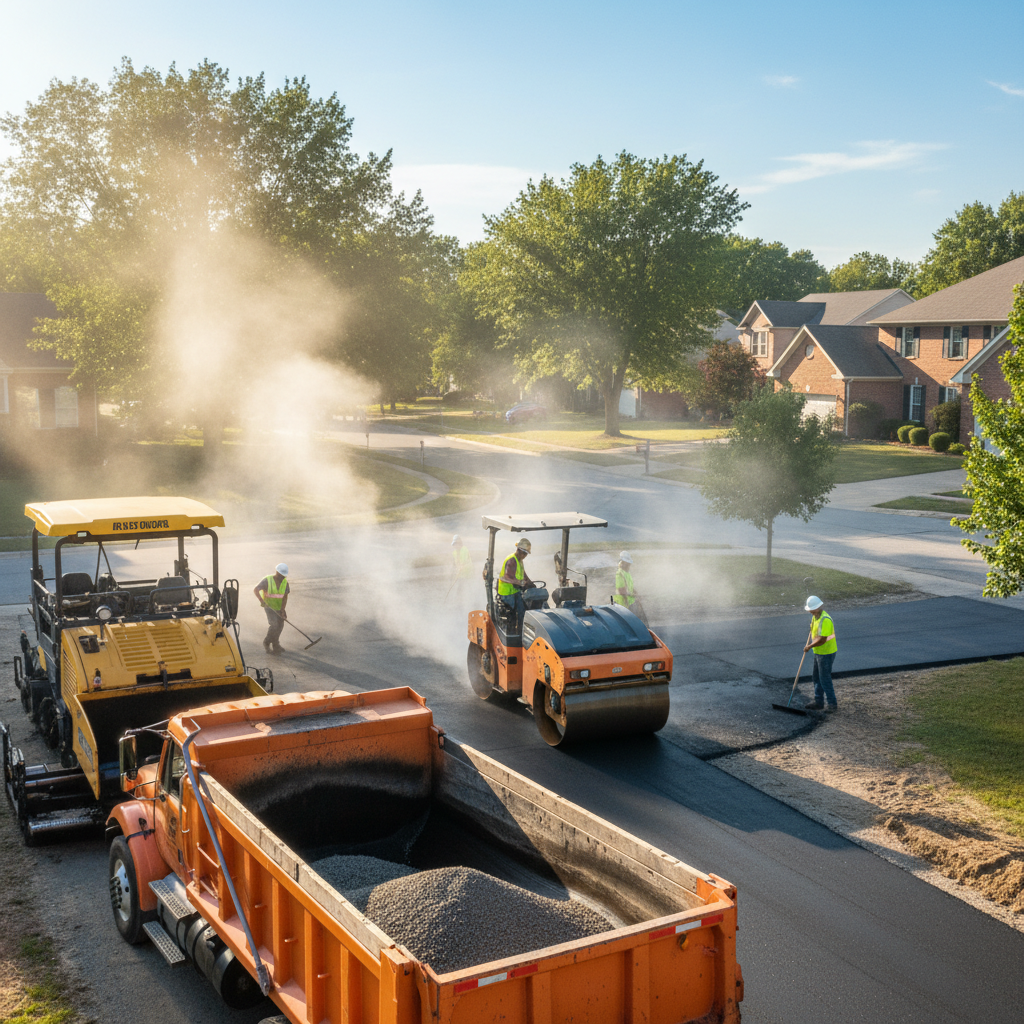
Driveway paving options and costs in Milliken
In Milliken, Ontario, homeowners usually need a driveway surface that can handle long winters and the freeze–thaw cycles that show up in late fall, winter, and early spring. With a population of 26,572 (Statistics Canada, 2021 Census), the Toronto economic region keeps contractors busy, especially around Markham and the nearby commercial stretch of Highway 7 where people update older driveways before peak winter. In most neighbourhoods, private driveways are commonly paired with detached homes, so crews see a steady stream of single-property re-paves and full replacements.
Pricing in the Toronto region is driven by frost depth and water control. Local frost line conditions mean you can’t “skip” base: driveways need deeper granular base, proper subgrade compaction, and reliable drainage so water doesn’t sit under the pavement and heave when it freezes. Also, the paving season is effectively compressed into late spring through early fall because hot-mix asphalt placement needs favourable temperatures (and demand spikes for prime dates), which can push costs toward the upper end of the bands—especially when you want a tight start window.
To help you compare apples-to-apples, review the cost ranges below. If you’re unsure which option fits your soil and drainage, start by matching the surface to your base plan—because that’s where most Ontario “price jumps” come from.
| Material |
Lifespan |
Maintenance |
Best For |
Price per sq ft |
Price Range |
| Asphalt (new installation, proper base) |
15–25 years |
Seal every 3–5 years |
Best value with smooth finish |
$7.50–$12.00 |
$3,500–$8,000 |
| Asphalt (overlay on existing gravel base) |
10–18 years |
Seal regularly; monitor for settlement |
Budget refresh when base is sound |
$6.50–$10.50 |
$3,000–$6,800 |
| Interlocking concrete pavers |
25–30+ years |
Occasional re-leveling; replace individual stones |
Curb appeal and easy repairs |
$14.00–$22.00 |
$9,000–$20,000 |
| Poured concrete (broom finish) |
20–30 years (with controls) |
Seal if desired; patch hairline cracks |
Low-maintenance, uniform surface |
$12.00–$18.50 |
$6,000–$15,000 |
| Exposed aggregate concrete |
20–30 years |
Reseal as recommended; patch spalls if needed |
Slip resistance and decorative look |
$13.50–$21.00 |
$7,000–$16,500 |
| Gravel / crushed stone (budget option) |
3–7 years (typical) |
Top up annually; grading every 1–3 years |
Short-term solution or side drive |
$4.00–$7.00 |
$1,800–$4,500 |
Prices are estimates only and vary by project scope, site access and material selection.
What affects the price of paving in Milliken
If you ask for quotes for the “same size driveway” in Milliken, it’s normal to see 30–50% variation across the Toronto area. That difference usually isn’t the surface material—it’s the hidden scope behind it: how deep they excavate, how they build the base for frost resistance, what drainage corrections are required, and how much labour is needed for traffic control and access. In a market where demand concentrates into a late-spring to early-fall window, contractors also price peak scheduling differently, particularly for new installations versus overlays.
In this region, frost depth and freeze–thaw cycles are decisive cost factors. Frost line conditions call for deeper compacted granular base so water can’t undermine your pavement and create heaving and cracking. In Ontario, that typically means roughly 6–12 inches of base thickness depending on the design and soil conditions (versus thinner approaches you’d see in milder coastal climates). The paving season is also shorter because hot-mix asphalt placement generally requires air temperatures above about 10°C, so crews get more selective about when they can mobilize. Asphalt mix design matters too: Ontario freeze–thaw-rated mixes cost more, but they reduce early rutting and surface fatigue.
Two concrete examples from Milliken: (1) if your driveway slope drains toward the garage instead of to a swale, you may pay extra for regrading and adding sub-drainage; (2) older homes with settled subgrade often need deeper excavation than expected, pushing a project from a typical $3,500–$8,000 asphalt band toward the upper end. Conversely, a straightforward tear-out with good underlying soils can keep concrete closer to the lower end of the $6,000–$15,000 concrete range.
| Price Factor |
Why It Matters |
Cost Impact |
| Driveway area in sq ft |
Labour and asphalt/concrete quantities scale with surface area. |
High |
| Base depth required |
Frost line conditions determine granular thickness to prevent heaving. |
High |
| Grading and drainage work |
Slope corrections and drainage gaps reduce water under the slab/pavement. |
Medium to High |
| Tear-out of existing surface |
Breaking, hauling, and disposal add time—especially with concrete. |
Medium |
| Edge restraints and curbing |
Prevents paver spread and asphalt migration at the sides. |
Medium |
| Sealing requirement |
Asphalt generally needs sealcoat after installation and then periodically. |
Low to Medium (over time) |
| Site access |
Narrow gates or long pushes slow equipment movement and increase labour. |
Medium |
| Asphalt mix specifications |
Freeze–thaw-rated mixes help resist rutting and surface fatigue. |
Medium |
Permits & regulations in Ontario
In Ontario, paving a private driveway on your own property typically doesn’t require a building permit. Where permitting becomes important is when the work touches municipal assets or changes how water is handled in the boulevard. For example, you usually need municipal approval if you’re creating or changing a curb cut, altering boulevard grading, or modifying storm drainage (such as adjusting catch basins, weeping tile connections, or redirecting runoff in a way that affects the municipal drainage pattern).
To stay compliant in Milliken, follow a practical sequence:
- Before excavation, order utility locates through Ontario One Call (there’s no point guessing where services are).
- Ask your contractor to confirm whether any portion of the work is in the municipal right-of-way (new curb cuts and drainage changes are the common “permit triggers”).
- Check lot-grading rules with the local municipality if your driveway ties into drainage patterns near property lines. Some municipalities restrict how close hard surfaces can be and require minimum drainage/overland flow considerations.
Then verify the contractor properly. In Ontario, you should request and review: (1) a valid business licence or registration as applicable, (2) liability insurance with a certificate of insurance naming you as additional insured where possible, and (3) WSIB/WCB clearance for workers involved in the project. Where to look: the insurer’s certificate documentation, WSIB/WCB clearance letters or status confirmations, and the contractor’s online business listing and credentials. Don’t sign anything until you’ve received those documents in writing.
Asphalt vs pavers vs concrete for Milliken driveways
For Milliken’s freeze–thaw climate, your driveway material choice should match how you expect the base to behave under winter moisture. Asphalt is usually the lowest upfront cost and provides a smooth finish, but it relies on good sealing habits to protect against oxidation and surface wear. In Ontario, that typically means sealing every 3–5 years after installation—otherwise you’ll see faster surface aging, especially where salt and snowplough abrasion are common.
Interlocking concrete pavers cost more at the start, but they’re repair-friendly. In Toronto-area winters, if a spot settles or a frost pocket forms, you can lift and re-lay individual sections rather than replacing the whole driveway. That “modular” repair approach is a big advantage where you know your soil or drainage may need future correction. Pavers also look sharp on detached-home driveways and help maintain curb appeal, particularly in neighbourhoods with higher owner pride.
Poured concrete often lands in the mid-range, but it must be properly air-entrained and detailed with joints and careful drainage. Without correct mix design and joint timing, concrete can crack from freeze–thaw movement and from de-icing salt exposure. Exposed aggregate offers traction, while permeable drainage grid approaches can help manage runoff if engineered correctly—but they add design requirements and should match your lot drainage plan.
Base matters across all three. Toronto frost conditions generally require deeper compacted granular base and disciplined drainage so water can’t sit beneath the surface. As a rough example of where price differences can be justified: if an asphalt install is around $3,500–$8,000 but pavers come in near $9,000–$20,000, pavers make sense when you value easy spot repairs and long curb appeal, or if you’ve had settlement problems that would otherwise repeat over time.
| Material |
Frost Resistance |
Curb Appeal |
Repair Method |
Lifespan |
Price Band |
| Asphalt (sealed regularly) |
Good with engineered base and drainage |
Moderate (clean and smooth) |
Patch the damaged area; re-seal as needed |
15–25 years |
$3,500–$8,000 |
| Interlocking concrete pavers |
Very good when properly restrained and compacted |
High (premium look) |
Lift/re-lay individual pavers; re-level locally |
25–30+ years |
$9,000–$20,000 |
| Poured concrete (air-entrained) |
Good with joints and drainage planning |
Moderate to high |
Patch/re-surface; larger cracks may require partial replacement |
20–30 years |
$6,000–$15,000 |
| Exposed aggregate concrete |
Good with proper mix, air entrainment and control joints |
High (textured decorative finish) |
Patch carefully; finish-match can be limited |
20–30 years |
$7,000–$16,500 |
| Permeable pavers (drainage grid) |
Good when the sub-drain system is designed for your soil |
High (modern look) |
Localized re-fit; may need periodic cleaning to prevent clogging |
20–30 years (system-dependent) |
$10,000–$22,500 |
| Chip seal / tar-and-chip |
Moderate; best for low-traffic or budget applications |
Lower (function-first) |
Spot patch; re-chip periodically |
7–12 years |
$3,000–$7,500 |
How to choose a paving contractor in Milliken
Choosing the right contractor in Milliken is mostly about documentation and clarity. First, verify Ontario licensing/registration as applicable to their business, then confirm liability insurance and WSIB/WCB coverage for their workers. To check: ask for a certificate of insurance (you can confirm the policy is active, the coverage amounts, and whether you’re listed as additional insured). For WSIB/WCB, request a clearance letter or current status confirmation before work starts—don’t accept a “we’ll get it later” explanation.
Next, get 2–3 written quotes that are itemised. You want a breakdown showing labour and materials, and the intended base build-up (excavation depth, granular layers, compaction method) rather than a single lump sum. Ask whether the quote includes tear-out, disposal, edging/curbs, and any drainage corrections. If you’re paving in a busy time window, ask if permit work (if any) and utility locates are included in scheduling and pricing.
Warranty matters. Look for a workmanship warranty length and how it’s handled for settlement, premature cracking, or base failures. Product/manufacturer warranties typically cover materials; workmanship coverage is where you find true accountability. Confirm whether warranties are transferable if you sell your home.
Finally, the payment schedule should be conservative. Avoid paying more than about 10–15% upfront; hold back the balance until the job is complete and cleaned up. Get a start date and a completion estimate in writing—Ontario’s freeze–thaw cycle doesn’t pause because a schedule slip happens.
- Ask for insurance COI and WSIB/WCB clearance before signing.
- Confirm the crew includes people who can show job references from Ontario projects.
- Require a detailed scope: excavation depth, base thickness, and drainage plan.
- Make sure disposal/haul-away is included if tear-out is required.
- Check whether the quote includes edge restraints/curbing.
- For asphalt: confirm tack coat, compaction specs, and sealing plan.
- For pavers: confirm bedding sand thickness and jointing material type.
- For concrete: confirm air-entrainment and control joint plan.
- Ask how they’ll protect neighbouring landscaping and prevent settlement.
- Get delivery and paving date assumptions tied to temperature constraints.
- Confirm warranty terms in writing and what triggers a warranty call-back.
- Use a payment schedule with a holdback until final walk-through.
In Milliken, the most common red flags I see are: (1) vague scope documents that don’t specify base thickness or compaction, (2) no proof of active insurance/WSIB/WCB before mobilization, (3) “cheap” pricing that relies on an overlay without assessing settlement, (4) refusal to put sealing timelines or joint details in writing, and (5) asking for large upfront payments with no completion holdback.
Frequently asked questions — paving in Milliken
How do I maintain my driveway through Milliken winters?
In Milliken and the broader Toronto region, the goal is to limit water intrusion and avoid mechanical damage during freeze–thaw. Keep the surface clean and remove heavy snow loads with care—frequent scraping with plough blades can ravel asphalt edges. Use sand rather than aggressive salt where possible; de-icing salt can accelerate asphalt oxidation and contributes to concrete deterioration if not properly air-entrained. If you have asphalt, stay on schedule with sealing (typically every 3–5 years) because a sealed surface sheds meltwater better. For pavers, maintain firm edge restraints so stones don’t loosen from freeze expansion. During spring melt, watch for low spots—if water pools, call a pro to address drainage early, because trapped moisture is what causes heaving and premature cracking.
Is it worth sealing a new driveway right away in Milliken?
Usually, yes—but only after the asphalt has cured properly. Sealing too early can trap moisture and compromise adhesion, leading to early failures instead of protection. In Ontario conditions, most contractors recommend waiting after paving until the asphalt has cooled and cured sufficiently, then applying sealcoat so it can bond to the surface. A good rule of thumb is to plan sealing within the first season (commonly around 6–12 months after installation), not immediately day one. If your quote is around the typical $3,500–$8,000 asphalt band, ask whether the sealcoat is included now or as a planned allowance. Regular sealing is often the difference between a driveway that performs for decades versus one that looks grey and rough much sooner.
What is a chip seal driveway and is it suited to Milliken?
Chip seal (tar-and-chip) is a surface treatment where asphalt binder is sprayed, then topped with stone chips that lock in after compaction. It can be a budget-friendly option and can work on low-to-moderate traffic driveways, but it’s not the smooth finish most homeowners expect from new asphalt or concrete. In Milliken’s freeze–thaw climate, chip seal can be more vulnerable to stone loss or surface wear where ploughing is aggressive. If your priority is lowest upfront cost, chip seal can be considered—often coming in around the lower end of driveway paving pricing (for example, within the general range of $3,000–$7,500). For longer-term appearance and a more predictable winter performance, new asphalt or properly built pavers are typically a better fit, especially if drainage and base depth aren’t straightforward.
How much does driveway crack repair cost in Milliken?
Crack repair costs depend on whether you’re dealing with hairline shrinkage cracks or larger, widening cracks related to base movement and water problems. For smaller, controlled cracks, sealing and crack filling is usually the first step; for more serious cracking, you may need localized patching, additional base work, or in some cases partial replacement. In practical Milliken terms, minor asphalt crack filling often falls within the “sealing & repair” band, typically around $300–$1,500, while repairs that include saw-cutting, removing failed material, and re-compacting will push toward the higher end. The key is diagnosis: if water is the root cause, sealing over the crack without fixing drainage tends to bring the problem back after the next winter freeze–thaw cycle.
What base thickness do I need for pavers in Milliken?
In Milliken, the base thickness for pavers depends on frost protection needs and your subgrade conditions. Because Ontario experiences repeated freeze–thaw cycles, a properly engineered base is critical to prevent heaving and uneven settlement. A typical approach uses deeper excavations and compacted granular layers so water can’t sit under the pavers. Many projects end up with a total base build-up often comparable to the deeper Ontario frost-safe designs (commonly in the realm of 6–12 inches of granular base, adjusted for soil and load conditions). Bedding sand thickness is also important (it must be consistent so pavers lock in properly). If you’ve had dips or standing water before, you may need drainage corrections—those can change the base design and cost. A good contractor will measure and design, not guess.
How do I get the most accurate paving quote in Milliken?
For the most accurate quote in Milliken, treat your first site visit as a measurement and drainage assessment, not just a price estimate. Provide the contractor with driveway dimensions (or let them measure) and tell them about issues you’ve seen—puddling, settlement near the garage, or cracking patterns. Ask for an itemised proposal that lists excavation depth, granular base build-up, compaction approach, and whether drainage corrections are included. Make sure tear-out and disposal are specified if you’re replacing existing asphalt or concrete. Confirm whether permits are needed if any work affects municipal right-of-way features (like curb cuts or storm drainage changes). Finally, request proof of active liability insurance and WSIB/WCB clearance, and request a clear warranty term in writing. Avoid lump-sum “mystery scopes” that hide the frost-related base work.