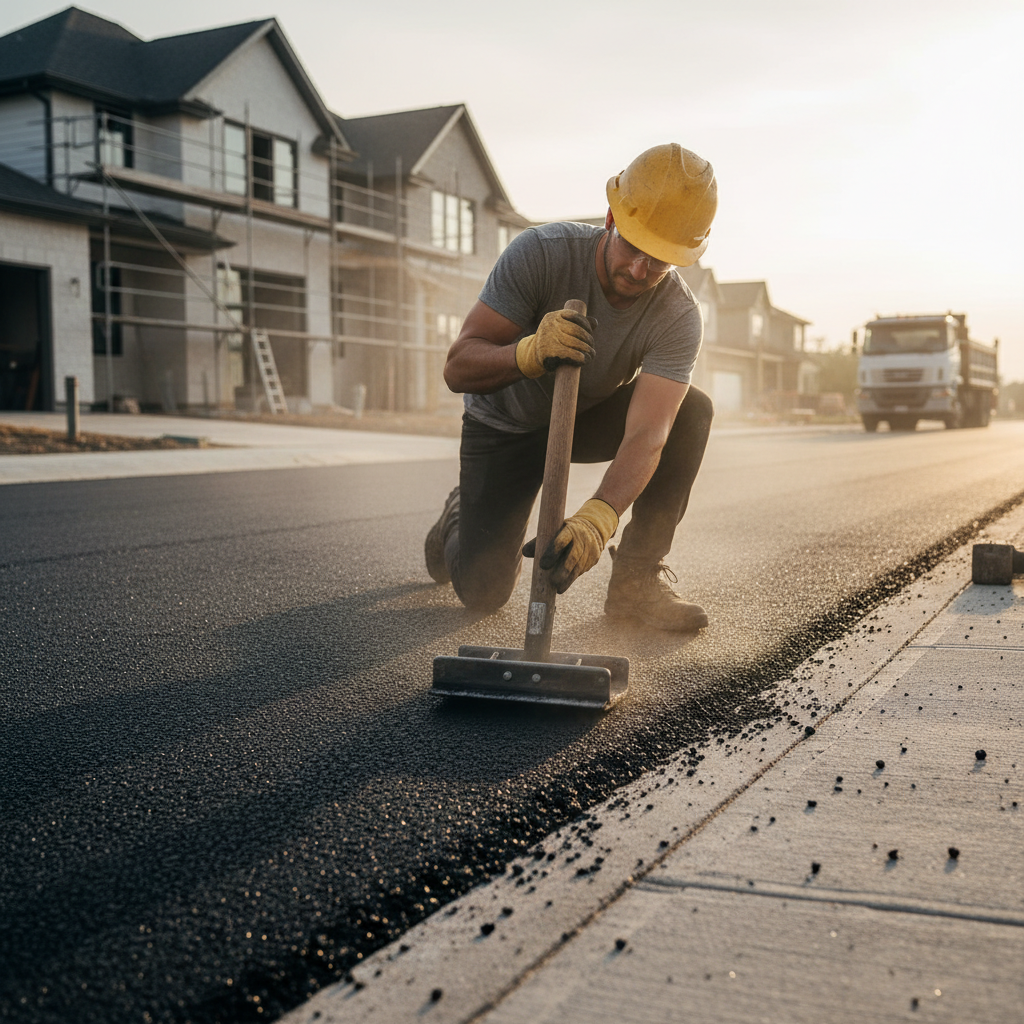
Driveway paving options and costs in Caledon
Caledon homeowners have a lot of choices for driveway paving, but the “right” option usually comes down to how your site drains and how well the base is built for winter conditions. Caledon’s housing profile is dominated by single-detached homes—about 80.7% of dwellings—so most driveways are attached to detached properties, and demand is steady in established neighbourhoods like Palgrave and Bolton. With a population of 76,581 (Statistics Canada, 2021 Census), you’ll also find plenty of older streets where homes were built before 1981 (30.0%), which often means existing base materials and drainage may need upgrading before any new asphalt or paving goes down.
In the Toronto economic region, costs are driven by frost depth and freeze–thaw cycles. Ground freezing to roughly 3–4 feet means the granular base, compaction, and drainage details need to be engineered to reduce water sitting under pavement—water becomes a problem when it freezes and expands. On top of that, the paving season is essentially late spring through early fall, so prime scheduling can raise pricing for rush work and tighter timelines. That’s why two driveways that look similar on paper can still land different total bids: base preparation and drainage changes can swing the project scope quickly.
Use the cost ranges below to compare materials for a typical installed driveway, then match the option to your goals (budget, curb appeal, and long-term maintenance) and your site conditions.
| Material |
Lifespan |
Maintenance |
Best For |
Price per sq ft |
| Asphalt (new installation, proper base) |
15–25 years |
Sealcoat every 3–5 years; patch minor cracks |
Lowest upfront cost with good performance when base is right |
$4.50–$9.50 |
| Asphalt (overlay on existing gravel base) |
10–18 years |
Sealcoat every 3–5 years; pothole/edge repairs as needed |
Budget refresh when base drainage and grading are verified |
$5.00–$10.50 |
| Interlocking concrete pavers |
25–40 years |
Re-leveling of a few units as needed; joint sand upkeep |
Repairable, high curb appeal, easier spot fixes |
$9.50–$18.00 |
| Poured concrete (broom finish) |
20–30 years |
Seal (optional but helpful); crack monitoring and filling |
Clean look and strong surface where joints and drainage are done well |
$8.00–$14.50 |
| Exposed aggregate concrete |
20–30 years |
Seal periodically; minor repairs at joints |
Premium finish without the full paver cost |
$10.00–$18.50 |
| Gravel / crushed stone (budget option) |
3–7 years |
Top up annually; re-grade and weed control |
Short-term solution or low-traffic access |
$1.50–$4.00 |
Prices are estimates only and vary by project scope, site access and material selection.
What affects the price of paving in Caledon
In Caledon and across the wider Toronto area, it’s common to see paving quotes for the “same driveway” differ by 30–50%. The reason isn’t the asphalt or concrete itself—it’s what has to happen underneath and around it to survive freeze–thaw. In this region, frost depth and freeze–thaw cycles are primary cost drivers. With ground freezing to roughly 3–4 feet, driveways need a deeper, well-compacted granular base and reliable drainage. That usually means more excavation, more stone, and more labour than you’d see in milder markets.
Toronto’s winter pattern also compresses the workable season into late spring through early fall. Hot-mix asphalt placement generally needs air temperatures above about 10°C, so contractors prioritize prime dates. Shorter seasons tighten schedules, increasing costs during peak months, especially for larger projects or when weather causes delays. Asphalt mix design must be freeze–thaw rated to help limit early cracking, and that can shift material pricing within the $3,500–$8,000 asphalt driveway band.
Concrete pricing can move as well depending on the prep and jointing plan. For example, a driveway poured without properly planned joints and drainage may crack earlier, driving more repairs later. If your site already drains well and the subgrade is stable, concrete can come in closer to the $6,000–$15,000 driveway band; if not, you may end up paying for extra undercutting, base rebuild, and possibly re-grading.
In Caledon specifically, homes built before 1981 often face unexpected subgrade surprises. Where older fill or poor drainage is present, contractors may need to increase base thickness and rebuild slopes to prevent water from sitting under the pavement—water plus freezing is what drives heaving and cracking.
| Price Factor |
Why It Matters |
Cost Impact |
| Driveway area in sq ft |
Materials and labour scale directly with surface size |
Major increase; doubling area roughly doubles cost |
| Base depth required |
Frost line dictates granular thickness to reduce heaving and cracking |
Often the biggest swing factor (more excavation and stone) |
| Grading and drainage work |
Correct slope and outlets keep water from sitting under pavement |
Can add $800–$3,000+ depending on corrections needed |
| Tear-out of existing surface |
Breaking, hauling, and disposal add labour and equipment time |
Commonly adds 10–30% to total install cost |
| Edge restraints and curbing |
Prevents paver spread and helps asphalt stay square |
Often adds $300–$1,500+ depending on layout |
| Sealing requirement |
Asphalt performance improves when sealed after cure and on a schedule |
Budget for $300–$1,500 per application (project dependent) |
| Site access |
Narrow drives and obstacles slow placement and increase setup time |
May add $250–$1,000+ |
| Asphalt mix specifications |
Freeze–thaw-rated mixes and correct binder content cost more |
Can add material cost within the asphalt price band |
Permits & regulations in Ontario
In Ontario, paving a private driveway within your own property usually does not require a building permit. In most Caledon cases, the driveway is considered site work on private land, provided you’re not altering municipal infrastructure. However, permits and approvals may be required when the work affects the municipal right-of-way—this includes new curb cuts, changes to the boulevard, or alterations that connect to or modify storm drainage systems managed by the municipality.
Some municipalities in the region also enforce lot-grading or stormwater management rules that restrict how close a hard surface can be to property lines and how drainage must be handled to avoid directing runoff onto neighbouring properties. That’s why your contractor should confirm drainage outlets before excavation begins.
Step-by-step, here’s how a homeowner in Caledon can verify a contractor properly. First, ask for proof of Ontario licensing for the relevant trades (as applicable to paving/excavation scope) and ensure their contact info matches the business name on documents. Next, request a current certificate of liability insurance with your address or property listed as an additional interest if offered. Finally, confirm Workers’ Safety and Insurance Board (WSIB) coverage (or a valid clearance letter if they’re exempt/registered differently): ask for the clearance letter number and check it against the insurer/clearance documentation provided. Before any digging, ensure utility locates have been called through Ontario One Call so excavation doesn’t hit buried services.
If your proposal includes cutting asphalt near an existing municipal connection or re-working storm drainage, make sure the quote clearly identifies whether municipal approval is required and who will coordinate it.
Asphalt vs pavers vs concrete for Caledon driveways
For Caledon driveways, asphalt, interlocking pavers, and concrete each fit a different homeowner priority, and the freeze–thaw climate in the Toronto region makes your base prep and drainage plan the real deciding factor. Asphalt is the lowest upfront option in the $3,500–$8,000 band, but it performs best when it’s sealed after installation and kept up with periodic resealing every 3–5 years. Without sealing, binder oxidation accelerates and you’ll see early surface aging, especially with winter salt and sand.
Interlocking concrete pavers usually cost more (commonly in the $9,000–$20,000 range), but they shine in this climate because they’re repairable. If a section settles or needs service access later, you can lift and reset only the affected units rather than replacing an entire slab. That “partial repair” advantage matters in older Caledon neighbourhoods where subgrade conditions can vary after years of freeze–thaw movement.
Poured concrete sits in between—often $6,000–$15,000—and can last 20–30 years when it’s air-entrained, jointed correctly, and paired with good drainage. The weak point in our winters is cracking due to movement: concrete needs the right mix design and control joints so the pavement can accommodate expansion and contraction without uncontrolled cracking.
Base depth is typically engineered deeper for Toronto’s frost conditions, and that cost shows up across all materials. In most cases, the base build is what you’re really paying for, not the top finish. For example, if asphalt comes in at the low end of its band and pavers are 20–40% higher, the difference can be justified if curb appeal is important to you or if you want the ability to repair small sections without full replacement.
| Material |
Frost Resistance |
Curb Appeal |
Repair Method |
Lifespan |
Price Band |
| Asphalt (sealed regularly) |
Good when base/drainage are correct; sealcoat slows oxidation |
Medium (clean, smooth finish) |
Mill/patch or overlay small failures |
15–25 years |
$3,500–$8,000 |
| Interlocking concrete pavers |
Very good; movement is accommodated through joints and resettable units |
High (variety of colours/patterns) |
Lift-and-replace individual units |
25–40 years |
$9,000–$20,000 |
| Poured concrete (air-entrained) |
Good with proper air-entrainment and joints; still sensitive to drainage |
Medium to high (depends on finish) |
Crack repair and patch; full replacement for major slab issues |
20–30 years |
$6,000–$15,000 |
| Exposed aggregate concrete |
Good when mix design and joints control movement |
High (premium texture and look) |
Limited patching; often partial repairs or resurfacing depending on damage |
20–30 years |
$8,000–$17,000 |
| Permeable pavers (drainage grid) |
Good to very good; relies on a designed stone reservoir and drainage outlet |
High (modern look) |
Lift-and-replace grid/pavers; serviceable if reservoir maintained |
25–40 years (with proper maintenance) |
$10,000–$22,000 |
| Chip seal / tar-and-chip |
Fair; thinner surface and more maintenance cycles |
Low to medium |
Spot re-chip/patches |
6–12 years |
$3,000–$7,000 |
How to choose a paving contractor in Caledon
Choosing the right contractor in Caledon means verifying credentials and matching the quote to the climate realities of the Toronto region. Start with Ontario coverage: ask for proof of liability insurance (current certificate of insurance) and confirm WSIB coverage with either a WSIB clearance letter or documentation showing they’re registered and in good standing. If a company can’t provide a clear insurance/WSIB answer, that’s a serious problem—especially when excavation and heavy equipment are involved.
Then, require 2–3 itemised written quotes. You want line items for excavation, disposal, base material quantities, compaction, formwork/curb restraints (if needed), surface course (asphalt thickness or concrete thickness), and any sealing allowance. Avoid lump-sum bids that don’t show what’s included. Ask whether permit coordination is included if work touches municipal right-of-way (for example, curb cut or drainage changes). Confirm disposal of old asphalt/concrete and whether topsoil replacement or landscaping restoration is included.
Warranty matters in freeze–thaw climates. Ask for the workmanship warranty length and what it covers (for example, settlement, edge failures, or premature cracking) and whether it’s tied to maintenance (asphalt sealing schedule). Also ask about product/manufacturer warranty and whether coverage is transferable to future owners.
For payment, a safe schedule keeps risk on the contractor: never pay more than about 10–15% upfront. Hold back a portion until the work is complete and you’ve received final documentation. Get the start date and estimated completion date in writing, and make sure weather-impact contingencies are clear for spring and early fall.
- Ask for Ontario licensing details relevant to their work scope, and confirm the business name matches public listings.
- Request a current certificate of liability insurance before any site work starts.
- Confirm WSIB coverage via clearance letter (or WSIB documentation) and keep a copy.
- Get 2–3 itemised quotes with labour and materials separated—no “all-in” mystery pricing.
- Confirm excavation and base thickness numbers in writing (don’t accept “typical” only).
- Require a drainage plan: slope direction, outlets, and how water won’t sit under the surface.
- Clarify tear-out scope: what is removed, what’s reused, and where disposal is handled.
- For pavers, confirm edge restraints, bedding sand, and joint sand spec.
- For asphalt, confirm asphalt thickness, binder/gradation, and cure timing before sealcoat.
- For concrete, confirm air-entrainment, reinforcement plan (if any), and joint/control plan.
- Ask about warranty terms: workmanship length, exclusions, and whether it’s transferable.
- Use a payment schedule with a holdback until final cleanup and quality checks are completed.
Red flags I see too often around Caledon include: (1) quotes that don’t specify base thickness or drainage corrections, (2) no written scope for tear-out and disposal, (3) refusing to provide WSIB clearance and insurance documents, (4) “sealcoat is optional” promises for new asphalt, and (5) demanding a large deposit upfront with no completion milestones in writing.
Frequently asked questions — paving in Caledon
How much does it cost to pave a driveway in Caledon?
In Caledon, the installed cost depends mostly on driveway size, how much base excavation is required, and whether drainage corrections are needed for freeze–thaw. For asphalt, a typical installed driveway often lands in the $3,500–$8,000 range when the base is rebuilt properly. If you need significant tear-out and grading, that number can move toward the top end, especially with the Toronto-region compressed paving season. For interlocking pavers, costs commonly fall in the $9,000–$20,000 range because of deeper bedding, edging restraints, and labour-intensive placement. Concrete usually sits in the $6,000–$15,000 band depending on thickness, finish, and jointing. Always ask for an itemised quote so you can see base, drainage, and disposal included—not just the surface material.
Asphalt vs interlocking pavers vs concrete — which is best in Caledon?
If you want the lowest upfront cost and you’re comfortable maintaining it, asphalt is a practical choice in Caledon—especially when the contractor builds the granular base and drainage correctly for Toronto’s frost depth and freeze–thaw cycles. If curb appeal and repairability are top priorities, interlocking pavers are often the best “long game” because you can lift and replace only affected areas instead of replacing the entire surface. Poured concrete can be a strong option when it’s air-entrained and jointed properly, but it still relies heavily on subgrade drainage to control cracking in Ontario winters. As a simple comparison: if asphalt is quoted near the middle of the $3,500–$8,000 band and pavers are quoted near the low-to-mid of the $9,000–$20,000 band, pavers may be worth the difference if you expect future spot repairs or you’re after a premium finished look. The “best” one is the material with the best base and drainage plan for your specific site.
How long does a paved driveway last in Caledon?
Longevity in Caledon is less about the surface name and more about base engineering, drainage, and maintenance through winter. With proper installation and sealing, asphalt commonly lasts about 15–25 years in the Toronto region; without sealing, you can see faster surface wear. Interlocking pavers often reach 25–40 years because they’re modular—if a section settles, it can be corrected without redoing the whole driveway. Air-entrained concrete typically performs around 20–30 years when joints and curing are done properly and water is managed. What shortens lifespan locally is water under the slab or trapped moisture in the base, which freezes and expands during late fall, winter, and early spring freeze–thaw cycles. Homes built before 1981 (30.0% in Caledon, Statistics Canada, 2021 Census) can have older subgrade and drainage patterns that require extra attention to get the full lifespan out of any material.
When is the best time of year to pave in Caledon?
For Caledon/greater Toronto, late spring through early fall is the practical paving window. Asphalt placement generally needs warm enough air temperatures (often above 10°C), so early-season work can wait until conditions are reliable. The upside of doing it in the warmer window is better compaction, smoother finishing, and fewer weather-related delays; the downside is demand is high, which can affect pricing for prime dates. If you’re planning concrete, crews still prefer steadier weather for curing and to reduce risk from temperature swings. A good contractor will schedule around forecast and moisture conditions and explain how they’ll protect the driveway during curing. If you’re working around tight access or a slope to a drainage outlet, earlier in the season can be an advantage because there’s more time to correct base and drainage before the hotter placement days are booked.
How deep should the base be for Caledon’s frost?
In the Toronto economic region, frost depth is a key reason we design thicker, well-compacted granular bases—local studies indicate freezing to roughly 3–4 feet. The exact depth depends on subgrade condition, soil type, groundwater/drainage, and whether you’re starting from gravel, removing old asphalt, or rebuilding over weak fill. That’s why quotes should list base thickness in inches, not just “standard base.” In general, deeper granular layers are used than in coastal climates to prevent heaving and cracking when water freezes under the driveway. If the site has poor drainage or older fill (common in properties built before 1981), base replacement often needs to be increased and slopes corrected so water can’t sit under the surface. Ask your contractor how they measured or assessed the subgrade and what drainage outlets they plan to use. A properly engineered base is what keeps your paving lasting through Ontario winters.
How often should I seal my asphalt driveway?
For new asphalt in Caledon, sealing is usually done after the pavement has cured (commonly after about 6–12 months), then planned on a cycle every 3–5 years depending on traffic, weather exposure, and how much de-icing salt and sand it gets. The Toronto-region freeze–thaw pattern accelerates wear when oxidation isn’t managed, so a consistent sealcoat schedule helps protect the binder and reduce surface cracking. Your contractor should specify the seal type and application timing. If you’ve been quoted something like the broader asphalt budget range ($3,500–$8,000), sealing is one of the small recurring costs that can keep the driveway closer to its longer lifespan. If you skip it, it’s not unusual to see earlier repairs, especially at edges where water can collect. Always keep the drainage area clean and ensure downspouts don’t dump directly onto the driveway surface.