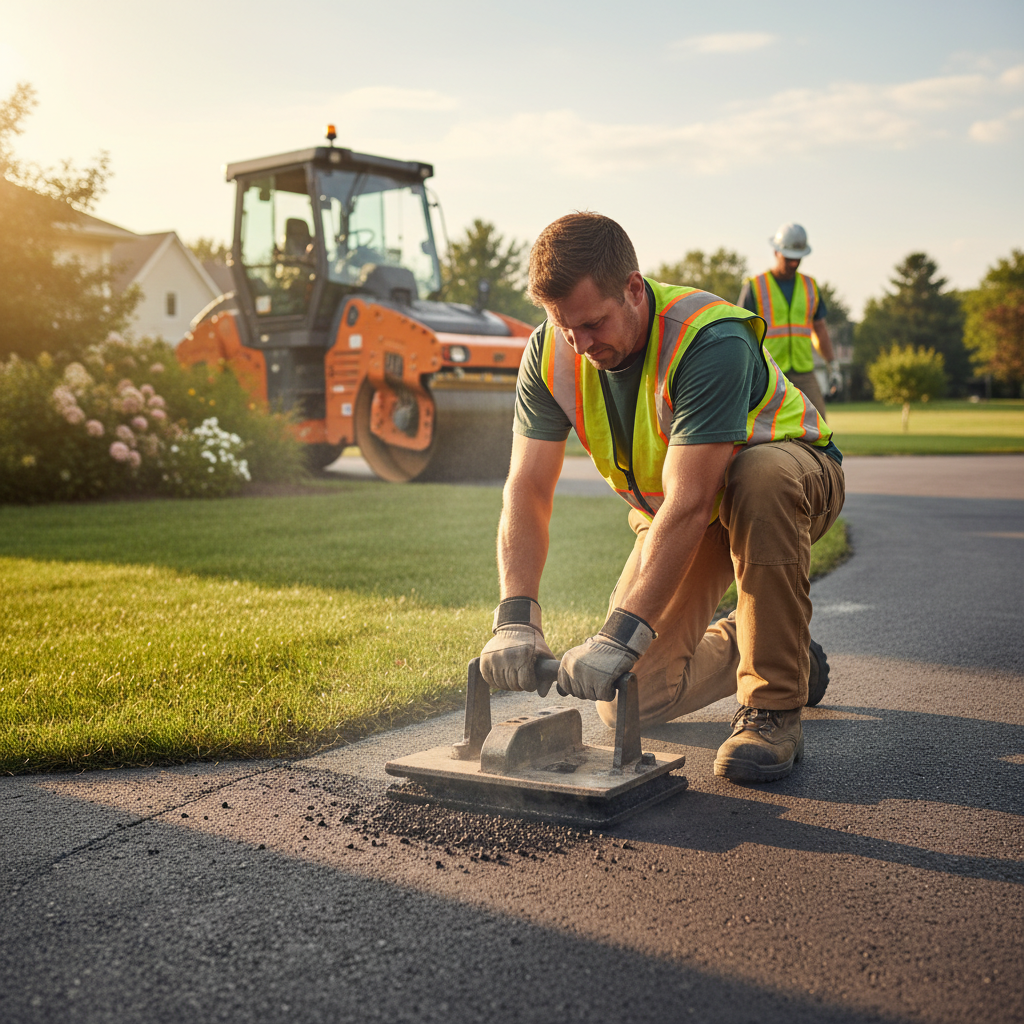
Driveway paving options and costs in Mississauga
Mississauga homeowners typically choose between asphalt, interlocking pavers, and concrete because each works differently with Ontario’s freeze–thaw winters. With a population of 717,961 and roughly 172,225 homeowner households (Statistics Canada, 2021 Census), there’s a steady demand for private driveway work—especially in the older housing stock, where 37.9% of dwellings were built before 1981 (Statistics Canada, 2021 Census). That matters because many driveways in established areas have weaker base layers or drainage issues that show up as cracking and heaving after winter.
In the Toronto economic region, pricing is heavily influenced by frost depth and freeze–thaw cycles. Ground freezing of roughly 3–4 feet means contractors must excavate and build a deeper, well-compacted granular base and keep water from sitting under the pavement. On top of that, the paving season is effectively late spring through early fall, so peak scheduling (and rush dates) can push prices toward the higher end of the bands.
Demand is especially strong in mature, high-turnover neighbourhoods such as Erin Mills and around Meadowvale Village, where older driveways are being replaced before they damage garage slabs or complicate drainage. The right option depends on how long you want the surface to look new, how much maintenance you’re willing to do, and whether you need sections repaired without a full replacement. Use the ranges below as a starting point, then we’ll help narrow the budget to your driveway size and site conditions in Mississauga.
| Material |
Lifespan |
Maintenance |
Best For |
Price per sq ft |
Price Range |
| Asphalt (new installation, proper base) |
12–20 years |
Seal after 6–12 months, then every 3–5 years |
Value-focused driveways with a solid base |
$5.50–$10.00 |
$3,500–$8,000 |
| Asphalt (overlay on existing gravel base) |
8–15 years |
Seal every 3–5 years; patching as needed |
Shorter budget projects where base is already solid |
$4.50–$8.50 |
$3,200–$7,000 |
| Interlocking concrete pavers |
20–30 years |
Minimal; sand top-up and occasional leveling |
Curb appeal and easy spot repairs |
$12.00–$22.00 |
$9,000–$20,000 |
| Poured concrete (broom finish) |
20–30 years (when properly designed) |
Crack monitoring; occasional sealing |
Clean look, straightforward maintenance |
$9.50–$16.00 |
$6,000–$15,000 |
| Exposed aggregate concrete |
20–30 years |
Light cleaning; sealing sometimes used for longevity |
Upgraded finish with better slip resistance |
$12.00–$20.00 |
$7,500–$17,500 |
| Gravel / crushed stone (budget option) |
2–7 years (varies by traffic) |
Regrading and top-ups; weed control |
Short-term solution or low-budget access |
$3.00–$6.00 |
$1,800–$4,500 |
Prices are estimates only and vary by project scope, site access and material selection.
What affects the price of paving in Mississauga
In Mississauga, two quotes for what looks like the “same” driveway can still land 30–50% apart because the differences are usually in the ground work: excavation volume, base thickness, drainage corrections, and the size of the crew and equipment needed for a tight lot. The Toronto area also experiences intense seasonal demand—contractors want to complete asphalt and base preparation within a short window—so prime dates can command higher labour rates. When you compare Toronto’s market to milder or longer-season regions, the shorter workable paving season plus deeper frost demands more materials and more time on site.
Frost depth and freeze–thaw cycles are decisive cost factors for paving in the Toronto economic region. Ground freezing to roughly 3–4 feet requires a thicker compacted granular base and careful edge containment so water can’t move under the surface and create heaving and cracking. As a rule of thumb in Ontario/Alberta-like frost conditions, base thickness often lands around 6–12 inches (depending on soil and design), which is why a “cheap” asphalt price can turn into a higher installed cost once drainage and base corrections are included. Asphalt mix design also has to be freeze–thaw-rated; higher-spec mixes cost more, even though the driveway surface looks similar.
Concrete can cost more up front, but it might be the better long-term value if your layout is well drained and the contractor designs joints properly. In Mississauga, older properties often have drainage that pushes water toward the driveway apron, increasing the need for swales, subdrainage, or a corrected slope. Meanwhile, newer builds may have cleaner subgrade and less underlying deterioration, helping keep concrete or paver projects closer to the middle of their bands (for example, asphalt installation is commonly within $3,500–$8,000 and pavers often within $9,000–$20,000).
| Price Factor |
Why It Matters |
Cost Impact |
| Driveway area in sq ft |
Most materials and labour scale directly with surface area |
Can swing the total by 40–70% |
| Base depth required |
Frost requires thicker, well-compacted granular layers to prevent heaving |
Often adds 10–30% |
| Grading and drainage work |
Proper slope and water management reduce freeze–thaw damage |
Often adds 5–25% |
| Tear-out of existing surface |
Hauling and breaking up old asphalt/concrete is labour-intensive |
Often adds 10–25% |
| Edge restraints and curbing |
Prevents paver spread and asphalt edge failure |
Often adds 3–15% |
| Sealing requirement |
Asphalt needs sealing after curing (commonly 6–12 months), then periodically |
Can add 1–8% annually over time |
| Site access |
Narrow driveways or soft shoulders can slow equipment movement |
Often adds 2–12% |
| Asphalt mix specifications |
Freeze–thaw-rated mixes improve durability in Ontario winters |
Often adds 5–18% |
Permits & regulations in Ontario
In Ontario, most private driveway paving done within your own property typically does not require a building permit. Where you do need municipal approval is when your project touches municipal infrastructure or affects how water drains off the property. That means permits/approvals are commonly required (or at minimum trigger a clearance/approval process) for work in the municipal right-of-way, such as new or modified curb cuts, changes to boulevard grading, or alterations to storm drainage that connect to municipal systems. If you’re planning regrading that changes how runoff flows at the curb, always confirm what your municipality requires before excavation.
Step 1 for Mississauga homeowners: call for utility locates before a contractor digs. Ontario One Call is the right starting point for marking buried utilities, and it helps prevent costly damage and delays. Step 2: verify the contractor’s Ontario licensing (where applicable for the work they’re doing), then check liability coverage and WSIB coverage. You can do this by requesting a certificate of insurance (confirm the policy is active and names you correctly as a certificate holder when appropriate), then asking for WSIB clearance or proof of registration/coverage. Step 3: confirm lot-grading rules with the City—some municipalities restrict how close hard surfaces can be to property lines and how drainage must be handled to avoid water problems on neighbours’ properties.
Asphalt vs pavers vs concrete for Mississauga driveways
For Mississauga, asphalt usually wins on upfront cost and speed of installation, but it needs a disciplined sealing schedule to resist Ontario’s wet winters and road-salt conditions. With freeze–thaw cycles, the real “make-or-break” is base design and drainage. For asphalt, a properly built compacted granular base and tight edge containment help prevent water movement that leads to cracking and rutting. When homeowners keep up with sealing every 3–5 years after the initial cure period, asphalt can stay neat and serviceable through many winters.
Interlocking concrete pavers cost more upfront, but they’re the most forgiving for spot repairs. If a section settles or a utility issue arises later, individual units can be lifted, corrected, and reset—without tearing out the whole driveway. That’s a practical advantage in older Mississauga neighbourhoods where drainage upgrades or future landscaping changes are more common. With proper bedding sand and edge restraints, pavers also handle minor movement better than rigid surfaces in freeze–thaw climates.
Poured concrete and exposed aggregate are mid-to-high in cost, with a clean appearance and long service life when designed correctly (air-entrainment, proper jointing, and drainage). Without correct air-entrained mix design and joint spacing, freeze–thaw can trigger cracking—especially where water sits near the surface or downspouts discharge toward the driveway.
A real-world budget example: if asphalt is quoted at about $3,500–$8,000 for your driveway size and pavers come in around $9,000–$20,000, the extra cost is justified when curb appeal matters, you want easier repairs, or your site has a higher risk of localized base issues. If your subgrade is stable and drainage can be corrected, asphalt or concrete may give better value.
| Material |
Frost Resistance |
Curb Appeal |
Repair Method |
Lifespan |
Price Band |
| Asphalt (sealed regularly) |
Good when base is engineered and sealed |
Moderate (clean black surface) |
Patch areas; re-seal, mill and overlay if needed |
12–20 years |
$3,500–$8,000 |
| Interlocking concrete pavers |
Very good with proper base + edge restraints |
High (variety of colours and patterns) |
Lift-and-reset for spot repairs |
20–30 years |
$9,000–$20,000 |
| Poured concrete (air-entrained) |
Good when air-entrained and jointed properly |
Moderate (depends on finish) |
Crack repair/patching; sometimes section replacement |
20–30 years |
$6,000–$15,000 |
| Exposed aggregate concrete |
Good with correct mix, drainage and joints |
High (textured premium look) |
Patch and blend or section replacement |
20–30 years |
$7,500–$17,500 |
| Permeable pavers (drainage grid) |
Very good for water management and freeze–thaw reduction |
High (modern systems) |
Remove grid/pavers for maintenance of infiltration layer |
20+ years with upkeep |
$10,000–$22,000 |
| Chip seal / tar-and-chip |
Fair to good; performance depends heavily on prep and grading |
Low to moderate |
Spot re-chip and surface refresh |
6–12 years |
$3,000–$7,500 |
How to choose a paving contractor in Mississauga
Choosing a paving contractor in Mississauga is mostly about verifying the basics—then confirming details in writing—because the quality differences show up in base prep, compaction, drainage, and sealing schedules (not just in the top layer). Start by requesting proof of Ontario work coverage: get their liability insurance certificate (active policy, correct dates, and your job listed or covered) and confirm WSIB/WCB coverage. Ask for WSIB clearance or proof of registration/coverage, and keep copies for your records. If a contractor can’t provide documents quickly, treat that as a warning.
Next, get 2–3 itemised written quotes. You want line-by-line scope: excavation depth, base materials, compaction method, whether drainage work is included, disposal/hauling, and the final surface. A common pitfall is a quote that excludes tear-out, curbs/edge restraints, or any municipal coordination if work affects how water drains at the curb line. Make sure the quote clearly states what’s included and what’s excluded—especially permit pull and disposal. For warranties, separate the workmanship warranty from the product/manufacturer warranty, and ask whether it’s transferable to a future owner.
Payment schedule matters too: never pay more than about 10–15% upfront. Holdback should be released only after the job is complete and meets the agreed standard. Finally, insist on a written timeline: planned start date and a completion estimate, including weather-related contingencies for asphalt placement in Ontario’s short season.
- Verify liability insurance is active and jobsite coverage is appropriate.
- Confirm WSIB coverage and request clearance/proof in writing.
- Ask if they’re licensed/registered for the specific scope they’re doing.
- Require itemised quotes (labour + materials) rather than one lump-sum.
- Confirm excavation depth and granular base spec (and whether they test-compacted).
- Check that drainage correction is explicitly included if needed.
- Make sure edge restraints/curbing are included for pavers and for asphalt edge durability.
- Require tear-out scope: breaking, hauling, and disposal (not “assumed”).
- For asphalt, confirm sealing timing (after cure, commonly 6–12 months) and future options.
- Confirm the asphalt mix meets freeze–thaw requirements for the GTA climate.
- Get a written warranty length for workmanship and product, and ask about transferability.
- Keep payment terms conservative (10–15% max deposit; hold back until completion).
In Mississauga, red flags I see often include: vague quotes with no excavation/base depth; refusing to list drainage scope; “we don’t need edge restraints” for pavers; claiming universal repair solutions without site assessment of subgrade; and pushing for large upfront payments before base prep and scheduling are finalized.
Frequently asked questions — paving in Mississauga
How deep should the base be for Mississauga's frost?
For Mississauga, base depth is driven by Toronto-area frost and freeze–thaw cycles (ground freezing can reach roughly 3–4 feet). That’s why driveway projects usually require a thicker, well-compacted granular base and correct drainage so water doesn’t sit under the pavement and freeze. In Ontario, a common design range is about 6–12 inches of compacted granular base, but the exact number depends on your soil conditions and whether drainage needs correction. A reputable contractor will excavate to the proper depth, confirm subgrade condition, and build in layers with compaction so the driveway performs through winter and spring. Avoid “thin base” shortcuts—those are the jobs that come back with cracking and heaving.
How often should I seal my asphalt driveway?
In Mississauga, sealing is one of the simplest ways to protect asphalt from moisture intrusion during Ontario winters. Typically, asphalt should be sealed after it has cured—often after 6–12 months—so the surface is dry enough for proper bonding. After that, most homeowners plan for a seal coat every 3–5 years, depending on sun exposure, traffic, and how aggressively salt and snow tools contact the surface. If you seal too early, the sealer can fail; if you skip sealing for many years, oxidation increases and you’ll see surface raveling that leads to patches. Sealing fits most budgets: it’s far less costly than a full replacement later.
Why does my driveway crack and heave in winter?
Cracking and heaving usually point to water movement under the pavement combined with freeze–thaw action. In the Toronto economic region, repeated winter cycles expand and contract moisture in the subgrade. If the driveway base is too thin, not compacted properly, or drainage/slope isn’t right, water can sit under the surface and freeze, pushing it upward. Another common cause—especially in older Mississauga homes (37.9% built before 1981, Statistics Canada, 2021 Census)—is deterioration of existing base materials or poor grading that directs runoff toward the driveway. Potholes and localized failures can also show up if edge restraints aren’t installed, letting edges deform and water infiltrate.
Do I need a permit to pave my driveway in Ontario?
Usually, paving a private driveway within your own property in Ontario doesn’t require a building permit. Where permitting/approvals often come in is when the work affects municipal right-of-way or storm drainage—such as new/modified curb cuts, changes to boulevard grading, or alterations that impact how runoff enters the municipal system. In Mississauga, you should also check lot-grading rules because some municipalities limit how close hard surfaces can be to property lines and how drainage must be managed to prevent nuisance water to neighbours. Before excavation, ensure utilities are located through Ontario One Call. A good contractor will tell you up front whether your scope is “on-property only” or whether municipal approval may be needed.
How long before I can drive on new asphalt?
After asphalt placement, driving access timing depends on the mix temperature, weather, and whether the surface is opened to traffic at early stages. In Mississauga’s late spring through early fall conditions, crews often aim to allow light foot traffic relatively soon and then controlled vehicle access shortly after rolling and cooling. In colder mornings or damp conditions, contractors may extend the waiting time to protect the surface from rutting. Your contractor should provide a specific “open to traffic” time in writing for your job. To plan around it, many homeowners schedule near the end of the curing window; note that sealing is typically not immediate—sealing generally happens later (commonly 6–12 months), and that’s separate from when you can drive.
What causes potholes and how are they repaired?
Potholes in driveway asphalt usually come from water intrusion and base failure. Once water gets in—through cracks, weak edges, or thin base—it can soften subgrade material. Freeze–thaw cycles then expand that moisture, enlarging voids until the asphalt breaks down. In Mississauga, the same freeze–thaw pattern that affects the whole driveway can concentrate damage at low spots where water collects or where snowplow traffic scours the surface near the edges. Repair typically involves saw-cutting/undercutting to stable material, removing failed asphalt to reach a sound base, rebuilding with compacted granular layers (if needed), then patching with asphalt. For recurring issues, a contractor may recommend a broader patch program or an overlay instead of repeated small fixes.