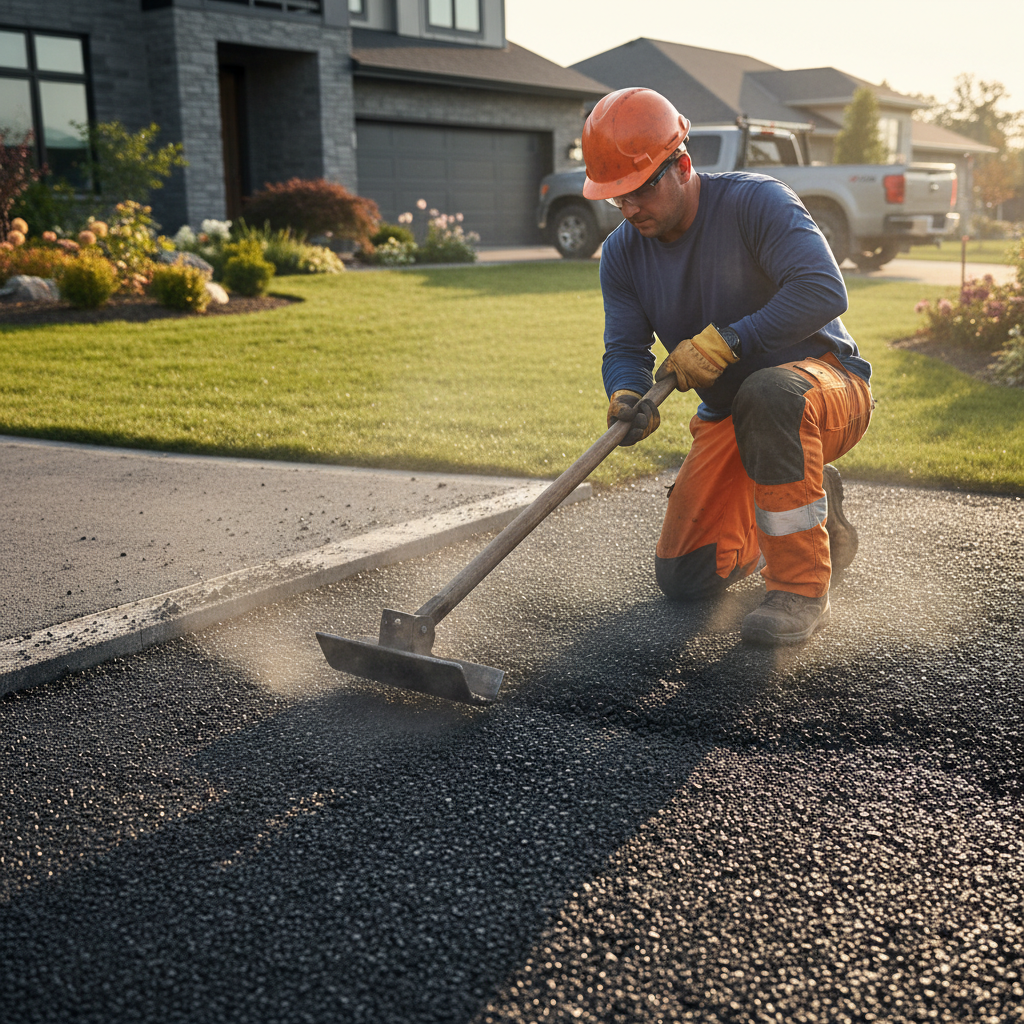
Driveway paving options and costs in Terrace
Terrace homeowners typically choose from asphalt, interlocking pavers, and concrete—mainly because most private driveways sit behind single-detached houses (60.0% of dwellings), and the region’s winter wear is relentless. With 3,415 homeowner households in Terrace (70.1% of households own), there’s steady demand for durable surfaces that can handle freeze–thaw cycling and heavy moisture. North Coast conditions also influence cost: persistent rainfall and a high groundwater demand push contractors to build thicker, better-drained granular bases and to plan positive drainage so water doesn’t sit under the pavement. In practice, that can mean additional crushed gravel, geotextiles, and more extensive grading than you’d see in milder parts of BC.
Freeze–thaw drives the schedule, too. Asphalt production and placement depend on workable air temperatures, and winter cold in Terrace regularly dips below freezing—so the paving season compresses into late spring through early fall. Crews often have fewer weather windows, and delays carry real cost risk (mobilization, labour time, and plant scheduling). That’s why you may see Terrace pricing land near the upper end of provincial bands, especially for driveways that need tear-out, improved base thickness, or drainage corrections.
In Terrace, work is especially common in older, established areas like Uplands, where many homes were built before 1981 (58.1% of dwellings) and existing approaches may need upgrades before new surfacing goes down. Once the base and drainage plan are confirmed, the material choice drives the remaining range—see the comparison table below.
| Material |
Lifespan |
Maintenance |
Best For |
Price per sq ft |
Price Range |
| Asphalt (new installation, proper base) |
15–20 years |
Seal every 3–5 years; patch as needed |
Good value with strong drainage and base prep |
$2.50–$4.25 |
$18–$28 |
| Asphalt (overlay on existing gravel base) |
10–15 years |
Seal when warranted; more frequent patching |
When grade is mostly set and base is serviceable |
$2.35–$4.00 |
$16–$26 |
| Interlocking concrete pavers |
25–30 years |
Weed control, occasional re-leveling of sections |
Curb appeal and repairability without full replacement |
$3.75–$6.50 |
$25–$40 |
| Poured concrete (broom finish) |
20–30 years |
Seal occasionally; patch spalls; maintain joints |
Smooth, clean look and straightforward snow plowing |
$3.25–$5.50 |
$20–$35 |
| Exposed aggregate concrete |
20–30 years |
Seal as recommended; keep joints maintained |
Slip-resistant surface and premium curb appeal |
$3.75–$6.25 |
$24–$40 |
| Gravel / crushed stone (budget option) |
3–7 years |
Re-grade and top up; weed control |
Temporary driveway or lowest upfront cost |
$1.00–$2.25 |
$8–$18 |
Prices are estimates only and vary by project scope, site access and material selection.
What affects the price of paving in Terrace
In Terrace, two quotes for the “same sized driveway” can differ by 30–50% because the cost drivers aren’t just surface material—they’re what happens below it and how quickly crews can work around weather and access constraints. In the North Coast, persistent moisture and freeze–thaw cycles are decisive. That means contractors often specify deeper, well-compacted granular base and improved drainage to prevent water accumulation, frost heave, and early cracking. Your quote may also include different asphalt mix specifications designed to better handle repeated temperature swings.
Frost line depth and freeze–thaw cycles directly affect base thickness. Where frost protection needs are more demanding, a thicker compacted granular base is required to stabilize the subgrade. In practice, that can translate into more crushed gravel and more compaction passes. Even though coastal BC generally has milder frost requirements than the interior or Prairies, Terrace still sees repeated freeze–thaw conditions, and that drives base and mix design choices. At the same time, the paving season is shorter in colder regions—hot-mix asphalt placement generally needs warm enough air temps (above about 10°C) to ensure proper compaction—so spring and summer scheduling pressure can raise unit pricing.
Concrete can be affected, too. For example, poor subgrade drainage can raise concrete repair costs because water can undermine support and encourage cracking. Conversely, choosing an air-entrained concrete mix (typical for cold-climate performance) can lower freeze-related damage over time. In older neighbourhoods like Uplands, homes built before 1981 often have existing grades that drain poorly, so the quote may swing upward once drainage corrections and tear-out are included.
To ground it in the price bands: a properly built asphalt driveway often lands in the $18–$28 per sq ft range, while interlocking pavers can push higher in the $25–$40 per sq ft band mainly due to base layers, bedding sand, and labour. The key is that your final number should reflect base preparation, drainage, and the real site conditions—not just the material on top.
| Price Factor |
Why It Matters |
Cost Impact |
| Driveway area in sq ft |
Materials, base, and labour scale directly with surface area |
Largest driver; often 40–70% of total cost |
| Base depth required |
Freeze–thaw resistance relies on stabilized, well-compacted granular base |
More depth and compaction increases cost; can move pricing by 15–30% |
| Grading and drainage work |
Positive drainage keeps water from saturating the base and subgrade |
Common add-on; can add 10–25% depending on how off-grade it is |
| Tear-out of existing surface |
Breaking and hauling concrete or old asphalt takes equipment time and disposal |
Often adds 8–20% and can be higher on thick slabs |
| Edge restraints and curbing |
Prevents paver spread and maintains consistent thickness and lines |
Can add 5–15% depending on layout complexity |
| Sealing requirement |
Asphalt needs sealing after placement/curing to slow oxidation and water ingress |
Small annual cost; but missing it shortens lifespan and increases repairs |
| Site access |
Narrow drives or tight turns slow equipment movement and increase labour time |
Can add 5–20% with longer carry distances or extra spotters |
| Asphalt mix specifications |
Freeze-thaw-rated mixes and binder selection improve long-term performance |
Typically modest per-sq-ft increase; often 2–8% but protects durability |
Permits & regulations in British Columbia
In British Columbia, paving a private driveway within your own property usually does not require a building permit, as long as the work stays on-site and doesn’t change municipal infrastructure. However, if your project affects anything in the municipal right-of-way—such as creating or changing a curb cut, altering the boulevard, or modifying storm drainage tied to the roadway—then you typically need municipal approval before you start.
Some areas also have lot-grading bylaws that restrict how close hard surfaces and drainage patterns can be to property lines. In Terrace, with the North Coast’s wet conditions, drainage control matters: if runoff management changes, the municipality may require specific grading and discharge details. Before excavation, always arrange utility locates (BC 1 Call) so contractors can verify where services run.
To verify your contractor in Terrace, confirm they have a valid British Columbia licence where applicable for the work scope (for many paving/contracting activities, the right classification matters), plus liability insurance and proof of worker coverage through provincial work coverage arrangements (WSBC/WCB). Step-by-step: (1) ask for their licence details (and check the registry online if available), (2) request a certificate of insurance showing liability coverage amounts and expiry date, and (3) request confirmation of worker coverage (often provided as clearance documentation). If anything is missing or “sent later,” treat it as a risk before signing.
Asphalt vs pavers vs concrete for Terrace driveways
For Terrace driveways, the three most common materials behave differently under freeze–thaw cycling and the heavy moisture typical of the North Coast. Asphalt is usually the lowest upfront cost and gives a smooth plow-friendly surface, but it needs consistent maintenance—most importantly sealing after the driveway has cured. Without sealing, water infiltration and oxidation can shorten life, and you’ll see more patching in high-traffic wheel lanes.
Interlocking concrete pavers cost more to install, but they’re highly repairable. If a section settles or a small area fails, you can remove and re-lay only that portion instead of replacing the entire surface. That’s a big advantage in a region where drainage or subgrade moisture can sometimes show up as movement after the first few winters. Poured concrete sits in the middle on cost, but it can crack if air-entrainment and proper curing aren’t handled correctly; joints and subgrade preparation are critical in cold-climate exposure. For all three, base prep and drainage design are non-negotiable: a well-draining, properly compacted granular base reduces frost heave and helps keep the structure stable.
Which performs best with Terrace winter routines (plowing, sand, occasional de-icing, and wet freeze–thaw)? Generally, pavers and properly built asphalt both handle plowing well, while concrete depends heavily on mix design (air-entrainment) and jointing to control cracking. Where pavers shine is curb appeal and targeted repairs; where asphalt can be justified is when you want strong value and are willing to budget sealing in the near term.
A practical example: if a similar-sized asphalt driveway comes in around $18–$28 per sq ft and pavers are $25–$40 per sq ft, the extra can be worth it if you expect drainage improvements to be ongoing over time or you want the option to fix localized failures without a full replacement.
| Material |
Frost Resistance |
Curb Appeal |
Repair Method |
Lifespan |
Price Band |
| Asphalt (sealed regularly) |
Good with proper base and sealing in place |
Medium (clean, dark finish) |
Cut out and patch localized areas |
15–20 years |
$18–$28 |
| Interlocking concrete pavers |
Very good with stabilized base and restraints |
High (varied styles, crisp edges) |
Remove and re-lay individual stones/sections |
25–30 years |
$25–$40 |
| Poured concrete (air-entrained) |
Good when air-entrained and properly jointed |
Medium to high (broom finish or textured) |
Patch spalls; repair cracks/joints as needed |
20–30 years |
$20–$35 |
| Exposed aggregate concrete |
Good with correct mix and finishing |
Very high (premium texture) |
Localized patching; usually more visible than standard concrete |
20–30 years |
$24–$40 |
| Permeable pavers (drainage grid) |
Very good where drainage is managed correctly |
High (eco-focused look) |
Re-level grid sections; repair targeted areas |
20–30 years (system-dependent) |
$28–$45 |
| Chip seal / tar-and-chip |
Fair to good; depends on prep and maintenance |
Low to medium (functional finish) |
Re-seal/patch; surface renewals more frequent |
8–12 years |
$14–$22 |
How to choose a paving contractor in Terrace
Choosing the right paving contractor in Terrace starts with verifying the basics you can’t see once the driveway is finished. First, confirm British Columbia licensing (where the work requires it for the contractor’s trade/classification). Next, request liability insurance and check the certificate of insurance for coverage amount and expiry date. Finally, ask for proof of provincial work coverage (WSBC/WCB) and a clearance-style document where provided—this is especially important when crews are working on excavation, hauling, and compaction equipment.
Then get 2–3 itemised written quotes that break down labour and materials. You want to see line items for: tear-out/disposal (if needed), granular base and compaction, geotextile (if specified), drainage/grading corrections, asphalt/concrete/pavers and bedding sand, edge restraints, and any sealing allowance. Compare apples to apples—if one quote excludes disposal, permits, or drainage corrections, that “low” price can quickly disappear.
Warranty matters in a freeze–thaw market. Ask for the workmanship warranty length and whether it covers labour and materials for settlement, base issues, and surface failures—not just cosmetic defects. Confirm if product/manufacturer warranties apply and whether they’re transferable to future homeowners. For payment, plan to pay no more than 10–15% upfront, with progress payments tied to completed milestones and a holdback until final inspection. Get a start date and completion estimate in writing, and include weather-delay language so you understand what happens when Terrace weather shuts down paving.
- Use a written scope that lists the exact material type and thickness (base and surface).
- Confirm drainage/grading plan: slope direction, ditch tie-ins, and how runoff is handled.
- Ask whether geotextile is included for saturated soils and soft areas.
- Check compaction requirements and how the contractor verifies density.
- Ensure tear-out is defined (limits of demolition, hauling route, disposal fees).
- Require edge restraints/curbing for pavers to prevent spread.
- For asphalt, confirm when sealing is recommended (after curing/within the first year).
- Ask for the concrete mix type (air-entrained) and joint plan.
- Request proof of insurance and work coverage before work begins.
- Verify licensing/classification is appropriate for the contract scope.
- Confirm warranty terms in writing and what triggers a warranty claim.
- Agree on payment schedule with a holdback until final completion and cleanup.
Red flags I commonly see in Terrace: contractors who won’t provide a clear, itemised scope; quotes that don’t address drainage/base depth; pressure for large upfront payments; missing insurance/work coverage; and “guarantees” that aren’t written or that exclude work related to frost-related movement or settlement.
Frequently asked questions — paving in Terrace
How do I prepare for a paving project?
Preparation starts before your contractor mobilizes. In Terrace, move vehicles away from the work zone and plan parking so crews aren’t rushed due to tight access. If you have landscaping, ask for clear protection or removal of shrubs and edging so the contractor can set correct grades and install proper base layers. For older homes (many in Terrace date back before 1981), expect that existing grades and drainage may be off—so review any downspout discharge and where water currently flows. Arrange utility locates through BC 1 Call so excavation can proceed safely. Finally, confirm what the quote includes: tear-out limits, disposal, and whether any permit approval is needed if municipal right-of-way is affected.
How do I compare paving quotes fairly?
Compare quotes line-by-line, not just by the total price. Make sure each estimate specifies the same base preparation: granular type and thickness, compaction requirements, and whether drainage/grading corrections are included. For asphalt, confirm the sealing allowance—most driveway work is followed by sealing after curing, and skipping that step shortens the life of your surface. Ask what happens if the subgrade is soft: does the quote include geotextile, additional base depth, or localized subgrade repair? If one bid is in the lower end (for example, asphalt often lands in the $18–$28 band) but excludes key base/drainage items, it may not be equivalent. If differences exist, require them to be explained in writing.
Can asphalt be laid in cold weather in Terrace?
Asphalt placement in Terrace is limited by temperature and moisture conditions. Hot-mix asphalt generally needs air temperatures above about 10°C for proper compaction and performance, and it can be unsafe or ineffective to place material when the ground is damp, frozen, or near-freezing. On the North Coast, persistent rainfall can also delay production and placement even when temperatures look workable. A reputable Terrace contractor will schedule based on weather, keep the base in suitable condition, and adjust timing if compaction isn’t achievable. If you’re comparing quotes, ask whether the contractor allows for weather delays and how they protect the base during downtime. Work quality matters more than rushing to “finish by a date.”
What is a driveway apron and do I need one in Terrace?
A driveway apron is the section at the bottom near the road or sidewalk/boulevard that connects your driveway to the street edge. Whether you need one depends on the existing curb, the driveway approach, and whether your work changes municipal infrastructure. If your project involves a curb cut or changes to drainage in the municipal right-of-way, municipal approval is usually required before you start. In many Terrace cases, upgrading the apron helps manage water and reduces the chance of break-up at the transition point where plows and vehicle tires concentrate impact. Your contractor should show you where the apron starts/ends and how it ties into drainage so water doesn’t run under the driveway. Ask for photos/examples from similar Terrace installs.
How do I maintain my driveway through Terrace winters?
Terrace winters usually mean freeze–thaw cycles, plowing, and a wet freeze period that can stress any surface. For asphalt, plan on sealing after the driveway has cured and then topping up with patching where needed. Keep an eye on edges and low spots: if water pools after storms, it can undermine the base and lead to premature failure. Use de-icing thoughtfully—salt and heavy chemical exposure can accelerate surface wear, especially on concrete, so follow manufacturer guidance where possible. After plowing, promptly remove excess sand build-up that can trap moisture. For pavers, re-sweep joints if any sediment moves, and watch for minor shifting. In all cases, document problem areas early so repairs are targeted before water reaches deeper layers.
Is it worth sealing a new driveway right away in Terrace?
In most cases, yes—but “right away” has a timing window. Asphalt needs to cure first so the surface can properly bond and the sealcoat can penetrate rather than trap moisture. Your contractor should recommend a schedule based on weather and curing conditions for Terrace’s coastal climate. If you’re sealing within that first-year window, you’re essentially protecting against water ingress and oxidation—two major enemies in freeze–thaw conditions. If you skip sealing or delay too long, you can see earlier raveling and more frequent patching, which can make the driveway costlier over time. When budgeting, remember sealing and repair planning often falls in a range of about $3–$6 depending on the scope and product. Ask your contractor to specify the exact timing and coverage rate.