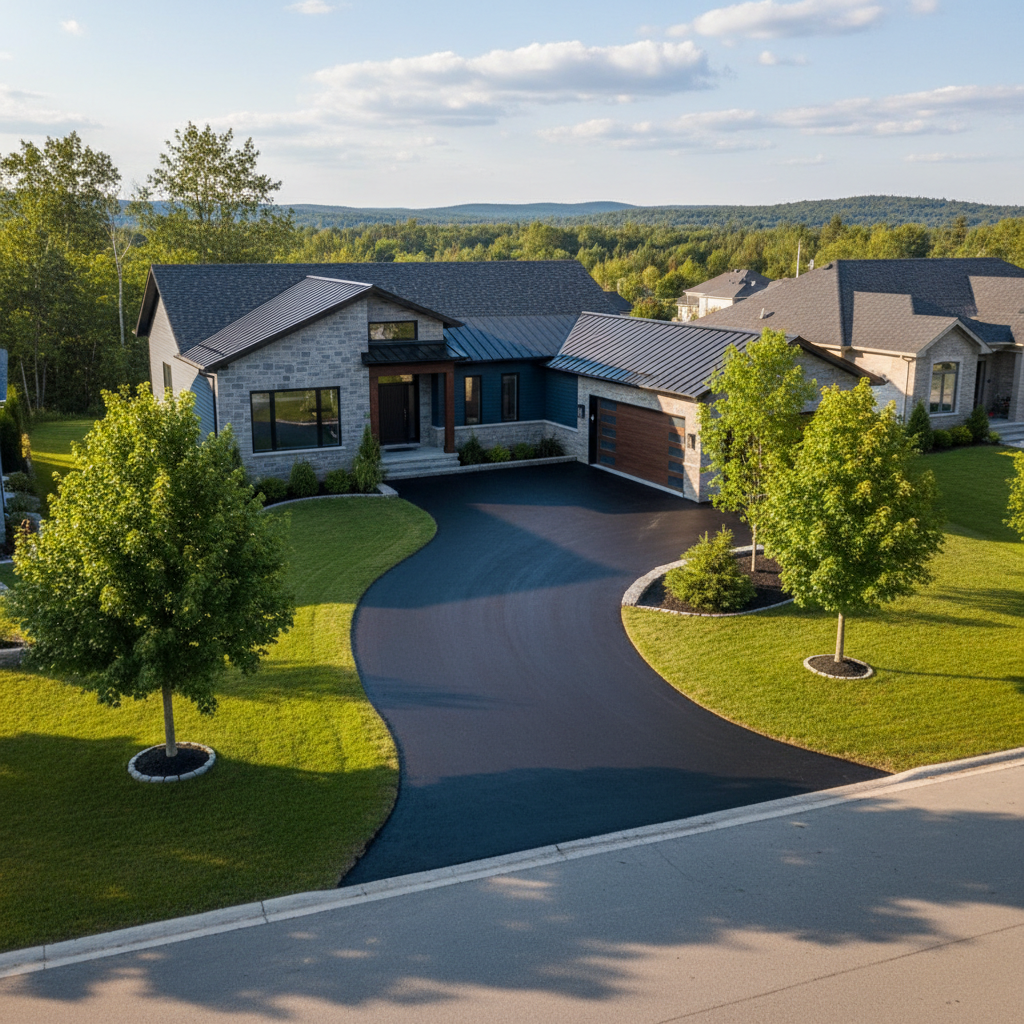
Driveway paving options and costs in Sooke
Sooke homeowners have a lot of driveway choices, but the “right” one usually comes down to freeze-thaw durability, how you maintain the surface, and how much landscaping disruption you can live with. In Sooke, most homes are single-detached (62.3% of dwellings), and with homeowner households making up 80.3% of all households, a large portion of driveways are long-term residences—not rental turnover—so buyers tend to value predictable performance and manageable maintenance. That context matters when comparing asphalt, interlocking pavers, and concrete.
On Vancouver Island and the Coast, we work in a mild coastal climate, yet frost and drainage still govern long-term success. Repeated freeze-thaw cycles around the Sooke area can heave weak subgrades and crack poorly drained edges, especially where driveways meet landscaping or where water runs downhill toward the property line. Pricing on the Island also reflects shorter, more schedule-sensitive paving windows during shoulder seasons, plus trucking and local labour demand. In practical terms, two driveways with the same square footage can land in different price brackets depending on excavation depth, base quality, and how hard it is to haul materials in and out—common issues in older neighbourhoods like East Sooke and parts of Sooke Village.
Below is a realistic cost comparison by material and typical workmanship assumptions (proper excavation and compaction where required). Use it as a baseline before comparing your site conditions and access details with contractors.
| Material |
Lifespan |
Maintenance |
Best For |
Price per sq ft |
Price Range |
| Asphalt (new installation, proper base) |
15–25 years |
Seal coat around year 2–3, then every 3–5 years |
Value and smooth driving surface; good for most Sooke lots |
$12–$18 |
$10,000–$28,000 |
| Asphalt (overlay on existing gravel base) |
10–20 years |
Seal coat and monitor edges/low spots |
When you have usable existing grades but need a smoother driveway |
$10–$15 |
$8,500–$22,000 |
| Interlocking concrete pavers |
25–35 years |
Occasional re-leveling; replace individual stones if needed |
Curb appeal and easy repairs without full replacement |
$25–$38 |
$18,000–$45,000 |
| Poured concrete (broom finish) |
25–35 years (if detailed correctly) |
Light cleaning; consider crack seal as needed |
Clean look and straightforward, low visual maintenance |
$18–$28 |
$16,000–$38,000 |
| Exposed aggregate concrete |
25–35 years |
Gentle wash; manage minor surface cracking with sealants |
Textured, slip-resistant finish for wet coastal conditions |
$22–$35 |
$20,000–$42,000 |
| Gravel / crushed stone (budget option) |
3–10 years (varies by drainage and traffic) |
Top-up annually; re-grade and control washouts |
Temporary solution or low-budget rural access |
$6–$10 |
$6,000–$14,000 |
Prices are estimates only and vary by project scope, site access and material selection.
What affects the price of paving in Sooke
In Sooke and across Vancouver Island and the Coast, it’s not unusual for the same driveway scope to vary by 30–50% between quotes. The drivers are usually not “random contractor pricing”—it’s differences in base engineering, how much excavation is required, and what’s included in labour mobilization and disposal. On the Island, materials and trucking costs add up, and labour capacity can tighten when the weather window is ideal, especially in spring and early summer when hot-mix asphalt scheduling gets compressed.
Frost and freeze-thaw cycles are decisive cost factors here. Even with a relatively shallow frost line compared with inland provinces, repeated freezing around drainage points can lift weak base material. If frost protection is underspecified, the base may need additional granular depth and proper compaction to prevent heaving and cracking; in colder regions we often see 6–12 inches of compacted granular base as a rule of thumb, while coastal BC projects often land closer to 4–6 inches when drainage and subgrade are strong—but never “by default.” Asphalt mix design also has to be freeze-thaw rated for local performance; a better mix costs a bit more but reduces early breakdown.
Concrete examples from typical Sooke jobs: (1) Driveways with older, poorly drained fill often require extra excavation and re-building the base, which can push a driveway from the lower end of paving ranges (like asphalt in the $10–$20 per sq ft band) into higher-cost territory once hauling and base materials increase. (2) A narrow, sloped lot in areas like East Sooke or near wooded edges can slow equipment movement and force more manual detailing at edges and transitions—labour goes up even when square footage stays the same. (3) If you’re sealing asphalt, budgeting the maintenance rhythm matters: after installation, sealing every 3–5 years helps preserve your initial investment rather than paying for early repairs.
| Price Factor |
Why It Matters |
Cost Impact |
| Driveway area in sq ft |
Most materials and paving time scale directly with square footage. |
Often the largest single driver; can swing the total by thousands. |
| Base depth required |
Frost protection and stability depend on subgrade and localized drainage. |
More excavation and granular base can add significant cost. |
| Grading and drainage work |
Correct slopes and water management prevent washouts and heaving at edges. |
Can increase labour and hauling, especially where regrading is needed. |
| Tear-out of existing surface |
Breaking, loading, disposal, and disposal fees affect total budget. |
Concrete/old asphalt removal can add days of work and disposal costs. |
| Edge restraints and curbing |
Pavers and asphalt need strong edges to stop movement and cracking. |
Materials and formwork/installation increase cost, but extend service life. |
| Sealing requirement |
Asphalt requires sealing after installation (often year 2–3) for protection. |
Sealing costs are smaller than premature rework; plan for it. |
| Site access |
Narrow drives, slope, and landscaping affect how fast crews can work. |
Slower equipment movement increases labour and equipment time. |
| Asphalt mix specifications |
Freeze-thaw rated mix performs better in coastal winter conditions. |
Typically higher per-ton cost, but helps reduce early failures. |
Permits & regulations in British Columbia
For most Sooke homeowners, paving a private driveway within your own property typically does not require a building permit. The common exception is when you’re working in the municipal right-of-way—this is where you may be altering the boulevard area, changing or creating a new curb cut, or modifying storm drainage patterns that affect how water leaves the street and roadside.
Some municipalities also have lot-grading or surface-water expectations that restrict how close you can place a hard surface to property lines or how you manage runoff. The safest approach is to confirm driveway drainage details and grading expectations before work begins, particularly on older lots where grades may already be marginal.
Step-by-step, here’s how a homeowner should verify a contractor in British Columbia:
- Utility locates: arrange for utility locates before excavation (BC 1 Call). This protects the public and prevents costly delays.
- Contractor licence: check the contractor’s registration/licence status through the appropriate provincial online resources for their trade category (ask the contractor for their registration details if you can’t find it easily).
- Liability insurance: request a current Certificate of Insurance showing general liability coverage; verify it’s active for the dates of your project.
- WCB/WSIB-style coverage: confirm they carry required workers’ compensation coverage for their workers (ask for proof/clearance documentation).
- Written scope alignment: ensure the scope states who obtains permits (if any), and what is included for disposal and restoration.
If the work touches the road edge or alters drainage, ask early whether municipal approval is required so you’re not blocked mid-schedule.
Asphalt vs pavers vs concrete for Sooke driveways
Choosing between asphalt, interlocking pavers, and concrete in Sooke is really a trade-off between upfront cost, repair flexibility, and how well the material handles freeze-thaw plus wet coastal winters. Asphalt is usually the lowest upfront option and can look good for years when it’s built over a properly compacted base and sealed regularly. In our area, sealing every 3–5 years is where homeowners protect their investment; skipping it can accelerate surface oxidation and raveling.
Interlocking concrete pavers cost more upfront, but they’re the most forgiving when the subgrade settles or when drainage is slightly less than perfect. Individual stones can be lifted, re-leveled, and reset without replacing the whole driveway—handy if you ever have to adjust drainage or run utility repairs later. For curb appeal, pavers tend to win on “first impression,” which is a big deal in established Sooke pockets where driveways are visible and landscaped.
Poured concrete sits mid-range to higher than asphalt and can be excellent with the right mix and detailing. However, concrete can be susceptible to cracking during freeze-thaw if expansion joints, thickness, and air entrainment aren’t handled correctly. In coastal BC, de-icing and winter moisture can be hard on poorly planned slabs, so the base preparation and joint layout are key.
A local dollar example: if your asphalt quote lands around the $10–$20 per sq ft band, a paver driveway can easily be higher—often around the $25–$45 per sq ft band. The difference is justified when you want the ability to repair sections (or you’re expecting future drainage/landscaping changes). If you want the cleanest “set it and forget it” look and you’re confident about base engineering and joints, concrete can be a strong option.
| Material |
Frost Resistance |
Curb Appeal |
Repair Method |
Lifespan |
Price Band |
| Asphalt (sealed regularly) |
Good with proper drainage and freeze-thaw-rated mix |
Medium (clean, smooth finish) |
Mill and patch small failed areas; seal/maintain |
15–25 years |
$10–$20 per sq ft |
| Interlocking concrete pavers |
Very good with engineered base and edge restraint |
High (variety of colours/patterns) |
Lift/replace individual pavers or sections |
25–35 years |
$25–$45 per sq ft |
| Poured concrete (air-entrained) |
Good when air-entrained and joints are properly detailed |
Medium-high (sleek broom finish) |
Crack repair/patch; small sections only if feasible |
25–35 years |
$18–$35 per sq ft |
| Exposed aggregate concrete |
Good when base and drainage are engineered |
High (textured, slip-resistant surface) |
Patch repairs; may be more visible than asphalt/pavers |
25–35 years |
$22–$38 per sq ft |
| Permeable pavers (drainage grid) |
High (designed for water infiltration with proper base) |
Medium-high (sporty look; depends on pattern) |
Replace affected units; inspect drainage layer |
20–30 years (site-dependent) |
$28–$50 per sq ft |
| Chip seal / tar-and-chip |
Variable; can be suitable for low-speed driveways |
Low-medium (textured surface) |
Re-chip/tar top-ups when worn |
7–15 years |
$8–$16 per sq ft |
How to choose a paving contractor in Sooke
In British Columbia, you want a paving contractor who can prove they’re set up to work safely and legally before you sign anything. Start by asking for their current general liability insurance (request the Certificate of Insurance and confirm it’s active), and proof they carry required workers’ compensation coverage for their crew. For licensing/registration, don’t rely on verbal confirmation—ask for their licence/registration details and verify them through the appropriate provincial online resources. If they can’t produce paperwork quickly, that’s a red flag in itself.
Next, get 2–3 itemised written quotes—not a lump sum with no details. Look for a breakdown that separates labour and materials, base preparation (excavation depth and compaction plan), disposal, edge restraints, and the asphalt mix type or concrete specification. Carefully read the scope: what is excluded (for example, rock excavation, tree/root removal, major drainage corrections), and is permit pull included if work touches the road edge or boulevard? Make sure the quote states whether disposal and site restoration are included.
Warranty matters too. Confirm the workmanship warranty length, whether there’s a product/manufacturer warranty, and if any warranties are transferable to future homeowners. For payments, avoid large upfront deposits—generally keep initial payment to 10–15% and use progress/holdback until completion. Finally, request a written start date and a completion estimate, especially because Vancouver Island schedules tighten when conditions are ideal.
- Request insurance and workers’ compensation proof before any work starts.
- Verify licensing/registration details using the contractor’s name/company number.
- Ask for an itemised quote: base materials, excavation, compaction, and restraints.
- Confirm what happens if excavation finds poor subgrade (rebuild plan and pricing).
- Check whether traffic control and cleanup are included.
- Confirm disposal fees are included for asphalt/concrete removed.
- Ensure edge restraints are specified (especially for pavers and asphalt edges).
- For asphalt, confirm sealing timing and whether a first seal is included or recommended.
- Ask for an engineering-style drainage note: slopes, swales, and transition details.
- Ask for sample timelines: start date, curing/settling periods, and completion date.
- Read the warranty terms in writing, including exclusions (de-icing misuse, grading changes).
- Make sure the contractor names a foreman/contact for day-to-day coordination.
Red flags I commonly see around Sooke include: “too-good-to-be-true” pricing that skips base depth or compaction details, quotes that don’t mention drainage or edge restraints, willingness to start without utility locates or with vague insurance coverage, and warranties that are only verbal or don’t specify workmanship duration and repair process.
Frequently asked questions — paving in Sooke
What is a chip seal driveway and is it suited to Sooke?
A chip seal (also called tar-and-chip) is a method where asphalt binder is sprayed and covered with aggregate chips, creating a textured wearing surface. In Sooke and along Vancouver Island and the Coast, it can be suitable for low-speed driveways when the base and drainage are done correctly, but it’s not as smooth or “premium-looking” as asphalt or pavers. The lifespan is typically shorter than properly installed asphalt—often around 7–15 years depending on traffic and maintenance. It also needs periodic top-ups as the surface wears.
Cost-wise, chip seal is often positioned near the lower end of driveway paving budgets compared with asphalt—commonly around the $8–$16 per sq ft band—so it can make sense if you want a budget-friendly solution. If you’re dealing with standing water or slope issues on your property, ask contractors how they’ll correct drainage first; chip seal won’t fix base problems.
How much does driveway crack repair cost in Sooke?
Crack repair pricing in Sooke depends on how the crack formed (shrinkage, freeze-thaw movement, edge settlement) and whether it’s a narrow hairline crack or wider, moving pavement. For typical asphalt crack sealing and small repairs, homeowners often see pricing that aligns with the local sealing/repair band—about $1,000 – $4,000 for common repair scopes, subject to minimum mobilization charges and driveway size. Larger, actively moving cracks may require localized patching (cut and replace) rather than just sealing.
Because Vancouver Island winters bring repeated freeze-thaw cycles, repairs that only “fill the crack” without addressing drainage or base stability usually come back sooner. If your driveway is near older homes built before 1981 (31.4% of Sooke homes are in that age group), the subgrade variability can be higher, and it may be worth confirming base condition before committing to a small repair.
What base thickness do I need for pavers in Sooke?
For interlocking pavers in Sooke, base thickness isn’t one-size-fits-all—it’s driven by subgrade conditions, how water moves across the driveway, and how freeze-thaw affects your specific low spots. In general, coastal BC projects often use a compacted granular base closer to 4–6 inches when the subgrade is stable and drainage is well-engineered; deeper, thicker base build-ups are needed if soils are weak or moisture-prone. In colder regions, you’ll frequently see 6–12 inches of compacted granular thickness, but Sooke’s frost line is relatively shallow compared with inland zones, so we focus on correct drainage and compaction first.
Your contractor should include the compaction plan and specify the material layers (for example, base aggregate plus joint sand). A good quote will show you the thickness and not just the paver price. If someone won’t explain base depth and drainage details, treat that as a warning—pavers can be lifted later, but a poor base will keep pushing problems back into the surface.
How do I get the most accurate paving quote in Sooke?
To get an accurate paving quote in Sooke, start by providing clear driveway measurements (length, width, and any apron areas) and photo documentation of the current surface, edges, and drainage flow. Ask for site access considerations in the quote because access affects labour time and equipment movement. Most importantly, make sure the contractor includes a scope that covers excavation depth, base preparation, drainage corrections, edge restraints, and disposal. Quotes should also state what happens if excavation reveals unsuitable soil.
Request 2–3 itemised quotes where labour and materials are broken out. For asphalt, confirm that the mix is appropriate for freeze-thaw and that sealing timing is addressed; asphalt sealing costs should be planned separately even if the driveway looks great right after install. As a simple budgeting anchor, typical asphalt driveway paving budgets fall roughly in the $10–$20 per sq ft band, while pavers often land around the $25–$45 per sq ft band. If a quote wildly undercuts those bands without explaining base and drainage, it’s usually because something is missing.
How much does it cost to pave a driveway in Sooke?
Driveway paving costs in Sooke depend heavily on square footage, excavation and base rebuild needs, and site access. Asphalt is commonly the budget-friendliest option, while pavers and concrete typically cost more because of forming, detailing, and labour intensity. As a practical guide, asphalt driveway paving is often quoted in the $10–$20 per sq ft band, concrete driveway work commonly falls around the $18–$35 per sq ft band, and interlocking pavers frequently price in the $25–$45 per sq ft band for Vancouver Island markets.
For sealing and repairs, homeowners should expect smaller repair budgets to commonly align with about $1,000 – $4,000 depending on scope and minimum mobilization. If your driveway requires tear-out, hauling, and drainage corrections due to freeze-thaw damage, that can shift the final total noticeably even when square footage stays the same. The biggest “sleeper cost” is base depth and drainage—Sooke’s repeated freeze-thaw cycles punish driveways where water can sit or where the edge restraint isn’t tight.
Asphalt vs interlocking pavers vs concrete — which is best in Sooke?
In Sooke, the “best” material depends on what you want most: lowest upfront cost, curb appeal, or the easiest repair path. Asphalt is usually the lowest upfront option and performs very well when built on a properly compacted base, engineered drainage, and a freeze-thaw-suitable mix. The trade-off is maintenance: sealing is typically needed every 3–5 years to protect the surface, and you may need smaller patching over time.
Interlocking pavers are the strongest choice for homeowners who want curb appeal and repair flexibility. If a section settles or a drainage issue arises, you can lift and reset a localized area rather than replacing an entire slab. Pavers usually cost more—often in the $25–$45 per sq ft band—but they can be cheaper over time if repairs are needed. Poured concrete is mid-range to higher and can last a long time if it’s air-entrained and detailed for freeze-thaw, but it’s less forgiving than pavers when the base or joints aren’t engineered well.