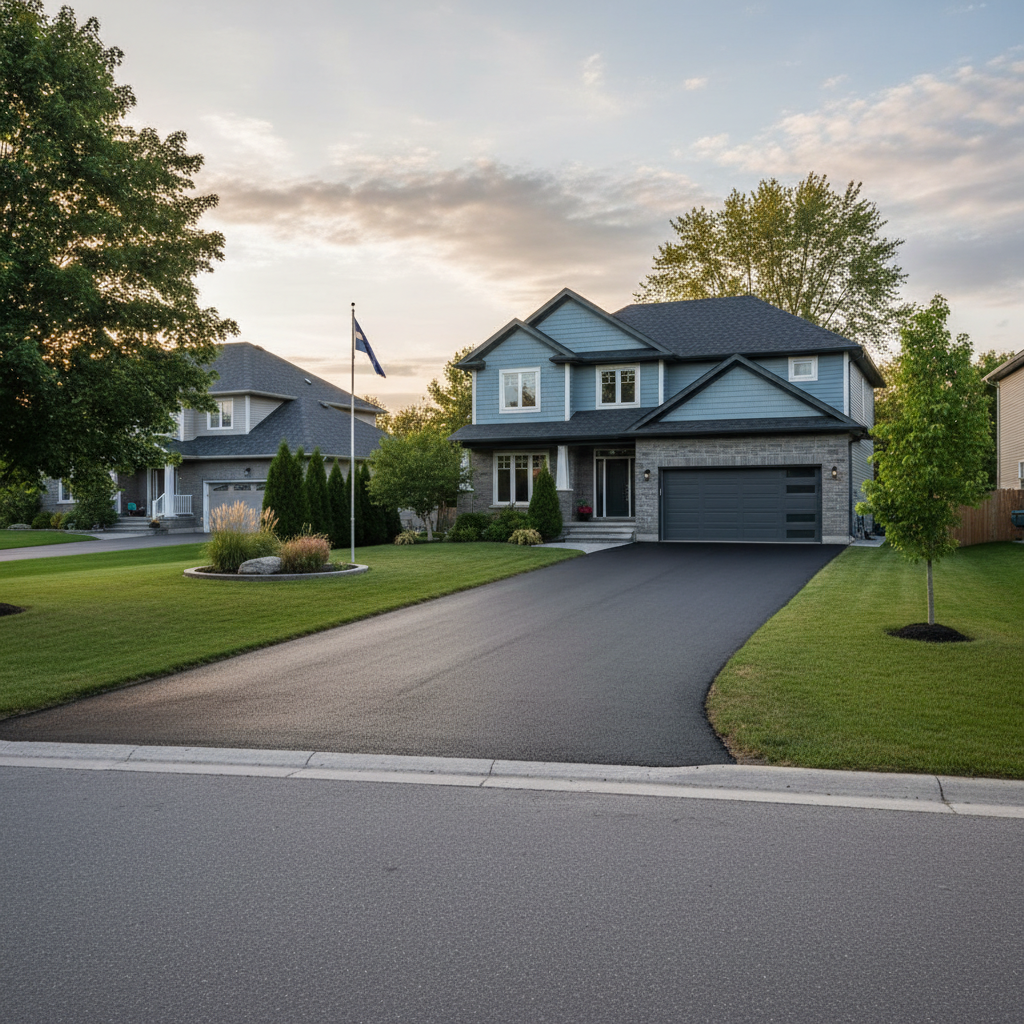
Driveway paving options and costs in Sidney
Sidney driveway paving choices usually come down to four things: how much you want to spend up front, how you maintain it, how your site drains, and how your base is engineered for Vancouver Island and the Coast. In Sidney, most private driveways belong to single-detached homeowners—single-detached houses account for 34.8% of dwellings—so it’s a busy market with lots of attached driveways and transitions to landscaping and sidewalks. With 76.8% of households owning their homes (Statistics Canada, 2021 Census), many residents also plan their paving upgrades as longer-term property improvements rather than short-term patching.
Pricing is shaped by our mild coastal climate, but you still get frost and repeated freeze-thaw cycles around Saanich Peninsula and nearby corridors, which can heave edges and crack weak bases. That’s why “cheap asphalt” quotes often miss excavation depth, proper compacted road base, and drainage detailing. We also see spring scheduling pressure because conditions that allow compaction and paving are seasonal; when crews are booked, turnaround time can affect total project coordination costs.
In Sidney proper—especially around the downtown/harbour corridor and older neighbourhood blocks with mature trees—driveways often have more grading issues, tighter access, and older gravel or failing asphalt. Those site realities are exactly what your quote should reflect.
Use the table below as a practical comparison for common driveway materials and typical outcomes in Sidney, then we’ll refine pricing after we review access, existing base condition, and drainage.
| Material |
Lifespan |
Maintenance |
Best For |
Price per sq ft |
| Asphalt (new installation, proper base) |
15–25 years |
Seal 3–5 years after install, then every 3–5 years as needed |
Homeowners wanting the smoothest finish with lower upfront cost (with proper base) |
$10 – $20 |
| Asphalt (overlay on existing gravel base) |
10–18 years |
Seal 3–5 years after overlay, plan for spot repairs as needed |
When the existing base is sound enough to support a lift without full tear-out |
$12 – $24 |
| Interlocking concrete pavers |
25–35 years |
Occasional re-leveling/edge resets; polymeric sand re-topping as required |
Premium curb appeal and easier localized repair without full replacement |
$25 – $45 |
| Poured concrete (broom finish) |
20–30 years |
Minimal; watch for cracking and keep joints/edges maintained |
Busy households wanting a durable, low-effort surface |
$18 – $35 |
| Exposed aggregate concrete |
20–30 years |
Low; seal occasionally depending on binder/finish |
More traction and a textured look (often chosen for ramps and sloped drives) |
$22 – $42 |
| Gravel / crushed stone (budget option) |
3–10 years |
Re-grade and top up annually; manage washouts and weed growth |
Temporary solution or low-budget base layer before paving |
$6 – $14 |
Prices are estimates only and vary by project scope, site access and material selection.
What affects the price of paving in Sidney
In Sidney and across Vancouver Island and the Coast, two driveways that “look the same” can still come back with quotes that differ by 30–50%. The main reason is that paving price isn’t just asphalt or concrete—it’s excavation, base engineering, drainage corrections, haul distance, and how efficiently crews can work with the site conditions. Labour and material costs on the Island can run higher than some mainland pricing because of trucking and local demand; when paving season tightens, scheduling pressure can also add coordination cost.
Frost line depth and freeze-thaw cycles are decisive in this region. Even though our frost line is relatively shallow compared to Ontario/Alberta, localized freezing and repeated freeze-thaw around Victoria and Saanich can still heave and crack poorly drained subgrades. For that reason, deeper or wet-prone native soils often require thicker compacted granular base (commonly 4–6 inches in coastal BC projects where appropriate, versus 6–12 inches in colder zones elsewhere) plus careful water management. Asphalt mixes also need to meet freeze-thaw performance expectations; those mix design differences can shift the job closer to the higher end of the typical asphalt band.
For concrete, Sidney’s older housing stock—43.7% of homes built before 1981 (Statistics Canada, 2021 Census)—often means buried service surprises, old footings, or drainage patterns that don’t match today’s driveway grades. A driveway that needs significant tear-out can push concrete toward the upper portion of the $18–$35 band. On the other hand, a straightforward site with good existing drainage may let you stay closer to the lower end.
Material choice still matters: asphalt can start around the $10–$20 per sq ft band when base conditions are solid, while pavers and textured finishes typically price higher because of forming, base detailing, and edge restraint work.
| Price Factor |
Why It Matters |
Cost Impact |
| Driveway area in sq ft |
Most paving materials and labour are area-based, including base excavation and asphalt/concrete placement |
Major: can double or triple total cost |
| Base depth required |
Frost and freeze-thaw performance depends on compacted granular thickness and support |
High: increasing thickness often adds excavation, aggregate, and compaction time |
| Grading and drainage work |
Fixing slope, redirecting surface water, and addressing wet spots reduces heaving and edge failure |
Medium to high: adds labour, haul, and sometimes drainage hardware |
| Tear-out of existing surface |
Removal and disposal of old asphalt/concrete is labour- and equipment-intensive |
High for failing old slabs or full-depth asphalt |
| Edge restraints and curbing |
Proper restraints prevent paver migration and asphalt edge raveling |
Medium: materials plus forming/restraint labour |
| Sealing requirement |
Asphalt performance in wet/coastal freeze-thaw climates depends on timely sealing |
Low to medium: adds a future maintenance line item (and sometimes early prep cost) |
| Site access |
Narrow lots, steep driveways, landscaping obstacles, and distance from street affect equipment efficiency |
Medium: more time for handwork, smaller equipment, and additional labour |
| Asphalt mix specifications |
Freeze-thaw-rated mix designs and proper gradations can cost more but reduce long-term cracking risk |
Medium: shifts unit pricing toward the upper asphalt band |
Permits & regulations in British Columbia
In British Columbia, paving a private driveway within your own property usually does not require a building permit. However, the moment your work touches the municipal right-of-way, involves storm drainage, or changes how water is managed between your property and the street, municipal approval is commonly required. In practical terms for Sidney homeowners, that typically includes work like new curb cuts, changing the boulevard, altering ditching, modifying catch basins or storm connections, or any reconfiguration that affects municipal drainage.
Even when a permit isn’t required, rules can still apply through lot-grading and drainage bylaws. Some municipalities restrict how close a hard surface can be to property lines and may require you to manage runoff so it doesn’t move onto adjacent properties.
Before excavation, you should always require utility locates through BC 1 Call. A professional contractor should schedule this and document the locate marks before digging. To verify a contractor’s British Columbia compliance, ask for three things: (1) their business licence and contractor registration information (as applicable for the work), (2) a current certificate of liability insurance showing sufficient coverage, and (3) coverage for worker protection—WSIB/WCB coverage confirmation for their crews and subcontractors. Where to check: request the certificate and clearance letter in writing, and verify any posted registration details using online registries or the province/agency links provided by the contractor.
Asphalt vs pavers vs concrete for Sidney driveways
For Sidney driveways, asphalt, interlocking pavers, and concrete all work—but they’re “right” for different homeowners and different site conditions. Asphalt typically has the lowest upfront cost and gives a smooth finish, but it relies on good base preparation and timely sealing (usually every 3–5 years) to handle our wet coastal winters and freeze-thaw cycles. Interlocking concrete pavers cost more initially, yet they’re highly repairable: if a localized settlement or utility issue occurs, you can lift and re-lay sections without tearing out the whole driveway. Poured concrete sits in the middle on price and can be very durable when properly air-entrained and constructed with joints and good drainage; without correct air entrainment and curing, freeze-thaw cycles can accelerate surface cracking.
On Vancouver Island and the Coast, the base depth needs to support localized freezing and water movement rather than only “how deep the frost line is on paper.” In many coastal BC applications, an engineered compacted base in the 4–6 inch range is workable when drainage is correct; if the subgrade is wet-prone, you’ll see thicker, more aggressive base and improved drainage, which pushes total cost toward the higher end of the asphalt band and can affect concrete and pavers too.
Which holds up best to winter maintenance? With plowing and occasional sand/de-icing, pavers typically tolerate traffic and localized impact well (and stay visually consistent). Asphalt tolerates plowing too, but edges and water control must be right, or you can get raveling and cracking over time. Concrete can handle plowing, but salt and temperature swings increase the need for proper mix design and jointing.
A real-world way to justify the difference: if asphalt is roughly $10–$20 per sq ft and pavers are $25–$45 per sq ft, the extra $15–$25 per sq ft can be worth it when you expect repairs, want strong curb appeal for a long driveway run, or have a driveway with drainage transitions that benefit from flexible, re-layable surface sections.
| Material |
Frost Resistance |
Curb Appeal |
Repair Method |
Lifespan |
Price Band |
| Asphalt (sealed regularly) |
Good when base and drainage are engineered |
Low to medium (smooth and clean look) |
Patch and re-seal localized areas |
15–25 years |
$10 – $20 |
| Interlocking concrete pavers |
Very good; performs well with settlement risk |
High (strong driveway curb appeal) |
Lift/re-lay pavers for targeted repairs |
25–35 years |
$25 – $45 |
| Poured concrete (air-entrained) |
Good with air entrainment, joints, and drainage |
Medium to high (depending on finish) |
Partial patching or resurfacing; full replacement if severe |
20–30 years |
$18 – $35 |
| Exposed aggregate concrete |
Good to very good when properly designed |
High (textured, upscale appearance) |
Localized repairs are possible but less “invisible” than pavers |
20–30 years |
$22 – $42 |
| Permeable pavers (drainage grid) |
Very good where you need water management control |
High (clean, modern layouts) |
Remove and replace affected blocks or graded layers |
25–35 years with proper maintenance |
$30 – $55 |
| Chip seal / tar-and-chip |
Variable; best as a surface treatment on prepared bases |
Low to medium |
Spot repairs and re-seal cycles |
8–15 years |
$8 – $16 |
How to choose a paving contractor in Sidney
Choosing a paving contractor in Sidney is mostly about proof: proof of coverage, proof of workmanship, and proof that their scope matches your site. In British Columbia, confirm liability insurance (ask for the certificate and ensure it matches the contractor name that will be on your contract). For worker protection coverage, request evidence of WSIB/WCB coverage for their crews and any subcontractors—don’t accept verbal confirmation. Ask for the clearance letter in writing and keep it with your contract paperwork.
Next, get 2–3 itemised written quotes. You want a breakdown that separates excavation, base material and compaction, asphalt/concrete/pavers supply, installation labour, disposal, and any sealing. A lump sum number that doesn’t show scope is where homeowners get surprised later. Confirm what’s excluded: permit pulling (if required for right-of-way work), utility locating, protection of landscaping, saw cutting/jointing, and whether haul/disposal is included.
Warranty matters too. Ask for the workmanship warranty length and whether it’s tied to proper maintenance (for asphalt, sealing is often required after curing). Also confirm whether manufacturer warranties (for materials and paver products) are transferable to future owners.
Payment schedule should be conservative: never pay more than 10–15% upfront for typical residential paving, and hold back a portion until the job is complete and defects (like edge settlement or surface ponding) are corrected. Finally, lock down a start date and completion estimate in writing, including weather contingencies that are realistic for coastal BC scheduling.
- Ask for BC-specific documentation: liability insurance certificate and WCB/WSIB coverage proof.
- Verify contractor details match the quote and the contract (company name, address, and contact).
- Request an itemised quote (excavation/base/sealers/materials)—not just a total price.
- Confirm whether utility locate calls and marking are included.
- Ask who disposes of removed concrete/asphalt and where it goes.
- Check whether grading and drainage corrections are included or quoted separately.
- For asphalt: confirm when sealing is scheduled (and the expected curing time).
- For pavers: ask about edge restraints, polymeric sand, and jointing details.
- For concrete: ask about air-entrainment, joints, and reinforcement approach.
- Ensure the contract states site protection (walks, landscaping, fences, and lawn edges).
- Review warranty terms in plain language: coverage period, exclusions, and repair process.
- Confirm payment milestones and retainage (holdback) before you sign.
Red flags I see in Sidney include: contractors who won’t provide insurance/WCB/WSIB evidence; quotes with no base depth or drainage notes; “too good to be true” pricing that skips tear-out and proper compaction; vague warranty language (no workmanship terms); and pressure to take a large deposit before excavation and protection measures are planned.
Frequently asked questions — paving in Sidney
How much does it cost to pave a driveway in Sidney?
In Sidney, driveway paving costs typically track both square footage and how much base and drainage work your site needs. As a starting point, asphalt driveway paving commonly lands in the $10–$20 per sq ft range when you have a reasonably stable existing base or when excavation and a proper compacted road base are engineered correctly. Interlocking pavers are usually higher at $25–$45 per sq ft because of the paver material, base detailing, and edge restraints. Concrete and exposed aggregate typically fall around $18–$35 per sq ft depending on finish and forming. The biggest pricing shifts in coastal BC are whether we need full tear-out, whether subgrade is wet and needs drainage corrections, and how tight access is for equipment around older neighbourhood properties. (Statistics Canada, 2021 Census: Sidney has 76.8% homeowner households, so many upgrades are planned rather than rushed.)
Asphalt vs interlocking pavers vs concrete — which is best in Sidney?
The “best” choice for Sidney depends on how you want to handle maintenance and potential future repairs in a freeze-thaw environment. Asphalt is a good fit when you want the lowest upfront cost and you’re comfortable with regular sealing (typically every 3–5 years) and careful edge/drainage detailing. Interlocking concrete pavers are often the top choice for curb appeal and for homeowners who value repairability—if a section settles or utilities need work, pavers can be lifted and re-laid without replacing the whole driveway. Poured concrete (especially air-entrained) is durable for many homes, but it needs correct jointing and drainage to reduce cracking risk under freeze-thaw and winter wetting. If your driveway has drainage transitions or older subgrade, pavers can be the most forgiving. If you’re targeting a budget approach, asphalt in the $10–$20 per sq ft band can be the most economical route when the base is right.
How long does a paved driveway last in Sidney?
In Sidney and the Vancouver Island and Coast region, lifespan is strongly driven by base preparation and water management—not just the surface material. With a properly engineered installation, asphalt is commonly expected to last about 15–25 years, assuming you seal on schedule and fix minor drainage issues early. Interlocking concrete pavers often reach 25–35 years because they can tolerate localized movement and can be repaired without redoing everything. Poured concrete typically lasts around 20–30 years when it’s air-entrained, properly finished, and constructed with appropriate joints. Concrete exposed aggregate can be similar, but matching the look after repairs can be more challenging. Your housing age can matter too: many Sidney properties have older construction (43.7% built before 1981 per Statistics Canada, 2021 Census), and older drainage patterns can shorten life unless corrected.
When is the best time of year to pave in Sidney?
The best paving window in Sidney is typically late spring through summer, when temperatures are stable and compaction is reliable. For asphalt, crews need workable conditions and air temperatures high enough for hot-mix asphalt placement—generally above 10°C—so early spring and cold/wet weeks often get skipped. Coastal BC weather is mild, but the shoulder seasons can still be cooler and wetter, which can tighten scheduling and increase cost when projects must wait for the right days. Concrete can be done in cooler weather with proper controls, but freezing risk and curing conditions must be managed carefully. Pavers are more flexible since installation doesn’t rely on asphalt curing, yet base preparation still needs stable conditions to ensure compaction and drainage performance. If you want the best pricing and availability, book during early summer rather than waiting for the fall weather shift.
How deep should the base be for Sidney's frost?
For Sidney, base depth is determined less by a single “frost line number” and more by engineered support and drainage for localized freeze-thaw. Coastal BC generally needs a relatively shallow frost accommodation compared with interior or northern regions, so many well-designed coastal projects use an engineered compacted granular base commonly in the 4–6 inch range where subgrade is stable and drainage is corrected. If the subgrade is wet-prone, poorly compacted, or we find weak soils during excavation, we may need additional thickness and improved drainage, which increases total cost. The goal is to keep water out and prevent the freeze-thaw cycles from pumping water into the base and causing heave or edge cracking. A contractor should document what they find on-site (subgrade condition, moisture, grading) and explain the recommended base build-up rather than using a “one depth fits all” assumption.
How often should I seal my asphalt driveway?
In Sidney, sealing is one of the simplest ways to extend the life of asphalt in our coastal conditions. Typically, asphalt should be sealed after it has cured—often after the first 6–12 months—then re-sealed every 3–5 years depending on sun exposure, traffic, and how much water sits on or near the driveway. If your driveway edges are vulnerable due to drainage or poor base transitions, you’ll likely need more attention even if you seal on schedule. A properly installed asphalt surface with good slope and drainage can see the longer end of that cycle; a driveway that sees frequent wetting, standing water, or heavy plowing impact often needs earlier or more frequent sealing. Many homeowners budget sealing and minor repairs rather than waiting for full surface replacement, and it can keep your asphalt closer to the original performance expectations that justify the initial $10–$20 per sq ft range.