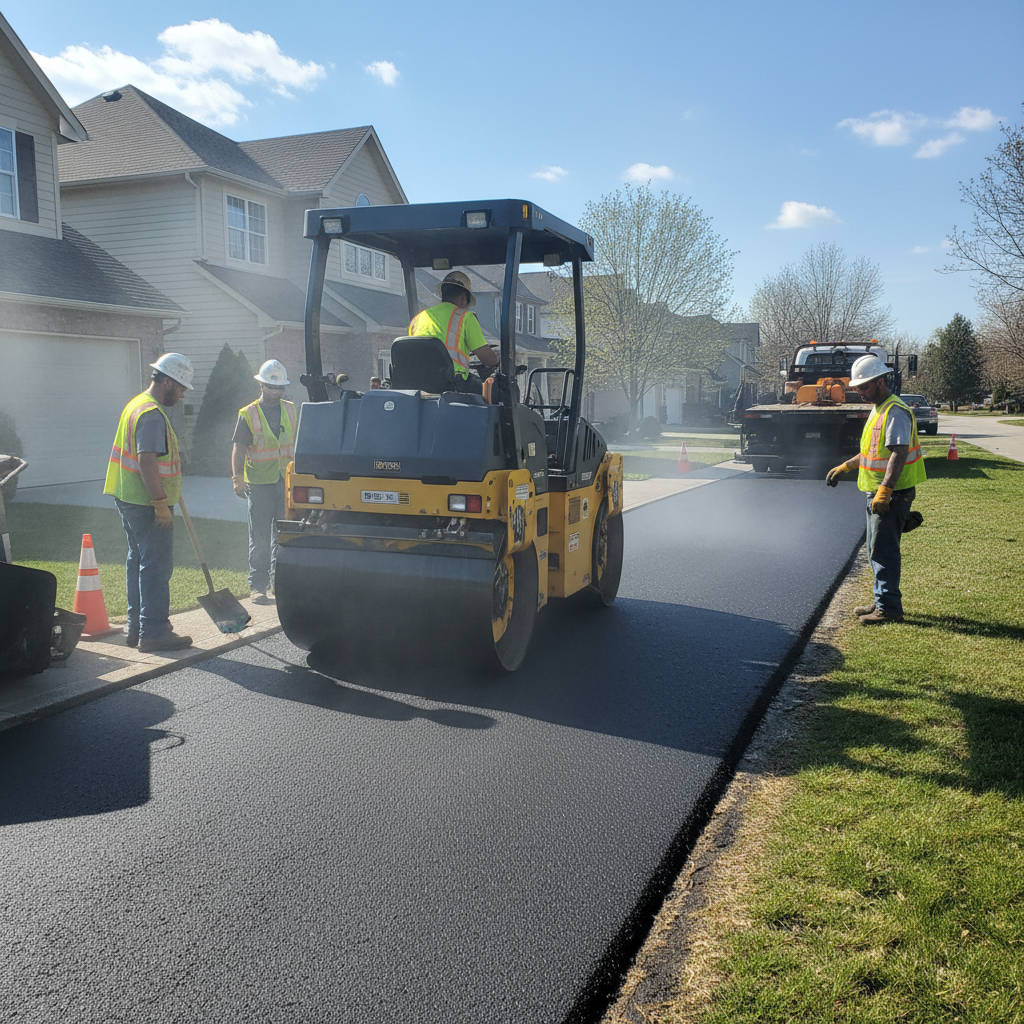
Driveway paving options and costs in Salmo
Salmo residents typically face a tight, short paving season in the Kootenays, plus tough freeze–thaw cycles that punish thin slabs and poorly drained base. With 71.9% of dwellings being single-detached homes (Statistics Canada, 2021 Census), most driveways in town tie directly to detached properties—so asphalt, pavers, and concrete are in steady demand. Salmo also has older housing stock: 65.5% of homes were built before 1981 (Statistics Canada, 2021 Census), which often means existing driveways have older gravel or patched asphalt that needs more than a simple refresh.
In the Kootenay region, frost penetration commonly sits around the 45–60 inch range depending on elevation and micro-climate. That drives the need for deeper, well-compacted granular base and reliable drainage on driveways and walk ramps—costs that are usually higher than in milder coastal areas. On top of that, hot-mix asphalt placement generally requires air temperatures above 10°C, so contractors concentrate work into late spring through early fall. It’s a real scheduling and pricing factor—especially on busy streets around the downtown core and the nearby residential areas off Hwy 3A, where access can be tighter.
Below is a practical comparison of common options and typical price ranges you’ll see for driveway work in Salmo. Your final number depends on excavation depth, base thickness, site access, and whether you’re overlaying or tearing out an existing surface.
| Material |
Lifespan |
Maintenance |
Best For |
Price per sq ft |
Price Range |
| Asphalt (new installation, proper base) |
15–25 years |
Seal coat every 3–5 years; patch as needed |
Most budget-friendly “long service” option with good base |
$7.50–$12.50 |
$7,000–$13,000 |
| Asphalt (overlay on existing gravel base) |
10–18 years |
Seal; monitor and spot-patch early |
When excavation is limited and existing base is stable |
$6.50–$11.00 |
$6,500–$11,500 |
| Interlocking concrete pavers |
25–35 years |
Re-sand joints; clean and re-level sections if needed |
Curb appeal and repairs without full replacement |
$12.00–$18.00 |
$9,000–$16,000 |
| Poured concrete (broom finish) |
20–30 years |
Minimal; protect joints, seal if needed |
Clean look and simple maintenance |
$11.00–$16.50 |
$11,000–$18,000 |
| Exposed aggregate concrete |
20–30 years |
Low; periodic cleaning |
Slip resistance and decorative finish |
$14.00–$20.00 |
$13,000–$22,000 |
| Gravel / crushed stone (budget option) |
3–8 years (depends on base and drainage) |
Re-grade and top up annually or as needed |
Cheaper short-term surfacing or steep budget constraints |
$3.00–$6.50 |
$3,000–$7,500 |
Prices are estimates only and vary by project scope, site access and material selection.
What affects the price of paving in Salmo
In Salmo and across the Kootenay region, it’s common to see quotes for what looks like the “same driveway” vary by 30–50%. The biggest reason isn’t just the surface material—it’s how deeply contractors must build a frost-resistant base, how much grading/drainage correction is required, and how tight the access is for hauling and compacting. Asphalt, pavers, and concrete also respond differently to winter maintenance in British Columbia; sand/ploughing, spring melt water, and occasional de-icing can all change the long-term outcomes and the scope of work included in your price.
Frost line depth and freeze–thaw cycles are decisive cost factors in Salmo. When frost needs to be managed through thicker, compacted granular layers, contractors often adjust base depth upward to prevent heaving and cracking. In colder interior zones, that typically means more material and more labour than in coastal BC. Even if the frost depth seems “similar” on paper, micro-drainage differences can force deeper excavation or additional road base and geotextile to keep water from pumping upward during thaw.
Concrete examples in Salmo: an older driveway built over weaker fill may require full tear-out to reach competent subgrade—otherwise, you risk early cracking in spring. Conversely, if your grade already sheds water well and the existing base is stable, a smaller section replacement can keep concrete costs down within the $11,000–$18,000 band. For asphalt, a proper granular base and compaction can support the $7,000–$13,000 asphalt range, but an overlay where the existing base is saturated can push repairs sooner—making the “cheaper now” choice costlier later.
| Price Factor |
Why It Matters |
Cost Impact |
| Driveway area in sq ft |
Most materials and labour scale directly with square footage |
High—often the biggest single line item |
| Base depth required |
Frost management depends on granular thickness and compaction |
High—extra excavation and base adds cost |
| Grading and drainage work |
Slope, swales, and downspout tie-ins prevent spring melt water pooling |
Medium to High—can add materials and machine time |
| Tear-out of existing surface |
Breaking/hauling concrete or old asphalt affects disposal and equipment time |
Medium to High—varies with thickness and access |
| Edge restraints and curbing |
Pavers spread if edges aren’t properly restrained; asphalt needs stable edges |
Medium—necessary for long-term performance |
| Sealing requirement |
Asphalt needs sealing after initial cure and then on a cycle |
Low to Medium—adds a future maintenance cost |
| Site access |
Narrow lanes or steep approaches slow equipment movement and delivery |
Medium—more time, more labour |
| Asphalt mix specifications |
Freeze-thaw rated mix can cost more but resists early deterioration |
Medium—material cost increases |
Permits & regulations in British Columbia
In British Columbia, paving a private driveway within your own property generally does not require a building permit. Typically, you can replace or resurface the driveway surface itself (asphalt, concrete, or pavers) without a permit, as long as you’re not changing drainage in a way that affects neighbouring drainage patterns or municipal infrastructure.
Where approvals often become necessary is if the work touches the municipal right-of-way. Examples that usually require municipal approval include creating or changing a curb cut, altering the boulevard, modifying storm drainage tied into municipal infrastructure, or doing work that affects the condition of the ditch/road drainage. Some municipalities also have lot-grading bylaws that restrict how close a hard surface can be to property lines and how surface water must be directed.
Before excavation, the homeowner should always ensure utility locates are done through BC 1 Call (and confirm no additional permits or site conditions are required). Then, to verify your contractor, do three checks: (1) British Columbia licensing—look up the contractor in the appropriate provincial licensing registry and confirm it matches the scope of work; (2) liability insurance—request a current certificate of insurance naming you (or the property) as additional insured if your contract requires it; and (3) worker coverage—ensure they carry WSBC/WCB coverage as applicable for their trades and provide proof on request. Finally, ask for a clearance letter or documentation showing their account is in good standing, and keep copies with your contract.
Asphalt vs pavers vs concrete for Salmo driveways
Choosing a driveway surface in Salmo is mostly about balancing upfront cost with freeze–thaw performance and how you maintain the driveway through winter. Asphalt is usually the lowest upfront option, and when it’s built on a properly compacted granular base it performs well in the Kootenays. The trade-off is maintenance: asphalt needs sealing regularly (often every 3–5 years) to protect it from moisture ingress and oxidation, especially through spring melt.
Interlocking concrete pavers cost more upfront but shine in this climate because repairs are section-based. If frost action or a drainage issue affects one area, pavers can be lifted, corrected, and reset without ripping out the whole driveway. In a town where many properties date back decades (and subgrades can vary), that repairability is a real advantage for homeowners who want predictable long-term fixes.
Poured concrete sits in the middle to upper range and can last decades when air-entrained and properly constructed with joints. However, concrete is more sensitive to subgrade moisture and jointing; without good drainage and proper base preparation, freeze–thaw can translate into cracking. Salt isn’t as heavy a factor for driveways as it is for highways, but sand and occasional de-icing still influence surface wear. For most Salmo driveways, all three options require the same foundation discipline: correct base depth, drainage grading, and edge stability to resist heave and pumping.
Where the price difference makes sense: if your quote for concrete lands around $11,000–$18,000 and pavers are in the $9,000–$16,000 band, pavers may justify the cost when you anticipate future repairs (older base, drainage corrections, or changing access patterns). If your goal is lowest upfront and you’re comfortable with sealing, asphalt is often the most practical path within the $7,000–$13,000 range.
| Material |
Frost Resistance |
Curb Appeal |
Repair Method |
Lifespan |
Price Band |
| Asphalt (sealed regularly) |
Good when base is deep/compacted and drainage is right |
Medium (clean black finish) |
Cut and patch; seal again |
15–25 years |
$7,000–$13,000 |
| Interlocking concrete pavers |
Excellent due to segmented structure and reset ability |
High (wide colour/style selection) |
Lift/replace affected units and re-sand joints |
25–35 years |
$9,000–$16,000 |
| Poured concrete (air-entrained) |
Good when air-entrained and jointed over proper base |
Medium to High (clean and modern) |
Spall/joint repairs; sometimes partial slab replacement |
20–30 years |
$11,000–$18,000 |
| Exposed aggregate concrete |
Good with correct mix, curing, and drainage |
Very High (texture and slip resistance) |
Limited spot repairs; often partial replacement |
20–30 years |
$13,000–$22,000 |
| Permeable pavers (drainage grid) |
Very good when subgrade and base are designed for infiltration |
High (engineered look/options) |
Re-sand and reset; grid remains serviceable |
25–35 years |
$10,000–$19,000 |
| Chip seal / tar-and-chip |
Moderate—depends on base and maintenance cycle |
Low to Medium |
Spot repairs and re-chip/overlay |
7–12 years |
$6,000–$10,000 |
How to choose a paving contractor in Salmo
For Salmo homeowners, the contractor you choose matters as much as the material. Start by verifying British Columbia licensing for the scope being quoted, then request proof of liability insurance (a current certificate of insurance) and confirm they have worker coverage through WSBC/WCB where applicable. Ask for the certificate and/or clearance documentation before work begins—don’t rely on verbal assurances. If your contractor can’t provide paperwork promptly, that’s a strong warning sign.
Next, get 2–3 itemised written quotes that break out labour, excavation/disposal, base materials, compaction testing approach (if included), and the surface course. Avoid “lump sum only” quotes where the scope is vague. Read exclusions closely: is tear-out disposal included? Are geotextile and proper base depth included? Is permit/approval handling included if the job touches municipal right-of-way? In Kootenay winters, drainage corrections are often the difference between a driveway that lasts versus one that heaves early.
Warranty should be in writing: confirm workmanship duration, whether it covers edge failures, settlement, or cracking, and whether manufacturer warranties are transferable to you. Keep payment controls tight: never pay more than about 10–15% upfront; use holdback until the surface is completed and cleanup/demobilization is verified. Finally, ask for a start date and completion estimate in writing—weather risk is real in BC, but good contractors still plan staging and communicate reschedules clearly.
- Check licensing for the exact trade/scope quoted.
- Request liability insurance certificate before signing.
- Confirm WSBC/WCB coverage and ask for clearance documentation.
- Get 2–3 itemised quotes (labour + materials breakdown).
- Make sure base depth and granular spec are written into the quote.
- Confirm drainage/grading work is included (not assumed).
- Ask whether geotextile is included and when it’s used.
- Verify tear-out and disposal are included if you have existing asphalt/concrete.
- Confirm edge restraints/curbs are included for pavers and stability.
- For asphalt, ask about cure time and when sealing is recommended.
- Confirm warranty terms and what qualifies as workmanship vs materials.
- Use a payment schedule with a holdback until final inspection.
Red flags I see in Salmo include contractors who quote without confirming base depth or drainage, crews who skip proper edge restraints, “overlay only” advice without checking existing base stability, vague warranty language, and asking for large upfront payments before any excavation or base work starts.
Frequently asked questions — paving in Salmo
How often should I seal my asphalt driveway?
In Salmo (and across interior BC), asphalt sealing is typically done on a cycle of every 3–5 years, assuming the driveway was built with a proper compacted base and the surface is clean and dry before sealing. The harsh part of the Kootenay winter isn’t just cold—it’s the moisture exposure during spring melt followed by freeze–thaw, which can accelerate raveling and let water get into small voids. If your driveway is heavily plowed, receives lots of sand, or gets frequent standing water due to grading, you may need to seal a bit sooner. Budgeting for sealing is often important; sealing and repair work commonly runs about $600–$3,000 depending on driveway size and condition. A good contractor will recommend timing based on surface condition, not just the calendar.
Why does my driveway crack and heave in winter?
Cracking and heaving usually come from a moisture and frost problem: water gets into the base or subgrade, then expands when it freezes and pushes the surface upward. In Salmo’s Kootenay climate, frost depth and repeated freeze–thaw cycles are decisive cost drivers, so shallow base or weak drainage can lead to early movement. Cracks can also be worse when edges aren’t restrained; asphalt can spread slightly, and that movement concentrates stress at weak points. Older driveways (many in town were built before 1981) may have fill that doesn’t drain well. If your contractor only resurfaced the top without addressing base depth, geotextile, or grading toward a swale/appropriate outlet, you often see renewed cracking and pumping in the next freeze season. Proper excavation and a deeper, well-compacted base generally prevent this.
Do I need a permit to pave my driveway in British Columbia?
Usually, paving within your own property in British Columbia doesn’t require a building permit—so resurfacing your driveway surface with asphalt, concrete, or pavers is commonly treated as private property work. In Salmo, the point that changes the answer is whether the work affects the municipal right-of-way or municipal drainage: creating/changing a curb cut, altering the boulevard, or modifying storm drainage tied into municipal infrastructure typically needs municipal approval. Some areas also enforce lot-grading rules that limit how surface water is directed near property lines. Before excavation, always complete utility locates through BC 1 Call. When you hire a contractor, ask whether they handle municipal approvals if your scope touches the right-of-way, and confirm it in the written scope so there’s no surprise after work starts.
How long before I can drive on new asphalt?
For new hot-mix asphalt placed in Salmo, you can generally drive on it once it has cooled sufficiently and the surface is stable—often within 24 to 48 hours, depending on thickness and weather conditions. Cold, damp mornings can extend cure time, while warmer afternoons help. If the crew uses tack coat and multiple lifts, the timetable may differ slightly. The key is avoiding turning vehicles or heavy loads too early; that can cause rutting or displacement before compaction fully “locks in.” Your contractor should tell you a safe opening time in writing and explain any temporary traffic restrictions. If you’re also planning sealing, remember that asphalt sealing usually isn’t done immediately—it’s timed after the surface has cured and dried properly. For context, sealing and repair projects in the region often fall around $600–$3,000 depending on scope.
What causes potholes and how are they repaired?
Potholes usually form when water enters existing asphalt voids or cracks, undermining the base. In Salmo, freeze–thaw cycles widen small failures: water freezes, expands, and breaks up the mix, and then thaw periods allow the weakened area to crumble under tire loads. Poor base drainage, inadequate compaction, or a delayed seal coat can accelerate this. Repair methods typically depend on the size: small potholes are cut to sound edges, the damaged material is removed, the base is checked and compacted, then a binder tack coat is applied before patching with hot mix. If the base is compromised over a larger area, a larger patch—or in some cases an overlay—may be recommended. A reputable contractor will inspect for drainage and avoid simply “filling” the surface without correcting the cause, especially in Kootenay conditions.
How do I prepare for a paving project?
Preparation helps everything go smoother in Salmo, particularly because access and weather windows are tight in the Kootenays. First, clear the driveway area: move vehicles, bikes, planters, and anything that would be in the way of excavation and compacting. Mark utility locations you know about and ask for confirmation that utility locates were completed before digging. Discuss grading and drainage in advance so the contractor can plan where water will flow during spring melt. If you have existing asphalt or concrete, ask whether tear-out and disposal are included in the quote. Then review the written scope and payment schedule—don’t pay more than about 10–15% upfront and keep holdback until completion. If you’re choosing asphalt, ask about when sealing is due and plan for it. For budgeting, driveway projects are commonly within bands like $7,000–$13,000 for asphalt or $11,000–$18,000 for concrete, depending on size and base work.