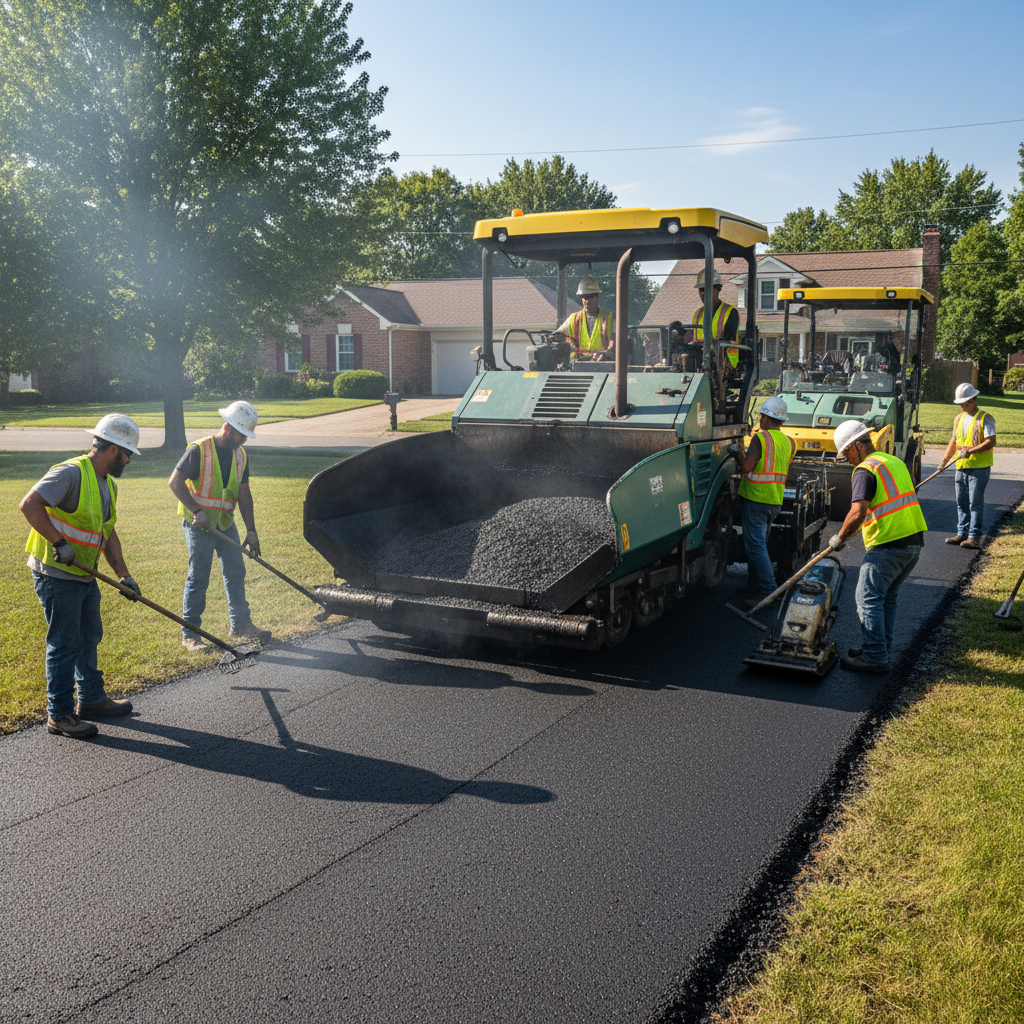
Driveway paving options and costs in North Cowichan
In North Cowichan, driveway paving choices usually narrow to asphalt, interlocking pavers, and concrete—because most driveways here serve single-detached homes (62.5% of dwellings) and homeowners tend to want a long-lasting, good-looking surface. With 10,575 homeowner households (76.9% of households own), there’s a strong local demand—especially in areas like Duncan and the surrounding Chemainus corridor where older homes meet busier road access and repeated winter freeze-thaw.
On Vancouver Island and the Coast, the climate is mild, but it’s not “no-freeze.” Frost is relatively shallow compared with inland Canada, yet localized freezing and repeated freeze-thaw cycles still drive heaving, settlement, and surface cracking when base and drainage aren’t engineered right. That’s why costs aren’t just about square footage: we typically budget more for excavation to remove weak soils, a properly compacted road base, and water management at transitions to the street (and at driveway edges where meltwater collects). Asphalt also responds to shoulder-season scheduling—when the surface is damp, you pay for better weather windows and sometimes slower production.
If you want a quick apples-to-apples, use the table below to compare typical material outcomes. After that, your exact price comes down to base depth, site access, and how much tear-out is needed.
| Material |
Lifespan |
Maintenance |
Best For |
Price per sq ft |
Price Range |
| Asphalt (new installation, proper base) |
15–25 years |
Sealcoat every 3–5 years |
Best all-around value with clean, smooth ride |
$10–$20 |
$6,500 – $14,500 |
| Asphalt (overlay on existing gravel base) |
10–18 years |
Sealcoat as needed; monitor ruts |
Lower upfront cost when base is still stable |
$10–$18 |
$5,500 – $12,500 |
| Interlocking concrete pavers |
25–40 years |
Re-sand and occasional panel-level repairs |
Curb appeal and easy localized repairs |
$25–$45 |
$8,500 – $22,500 |
| Poured concrete (broom finish) |
20–35 years |
Crack monitoring; reseal only if specified |
Low-maintenance look and straightforward upkeep |
$18–$35 |
$7,000 – $18,500 |
| Exposed aggregate concrete |
20–35 years |
Less slip risk; periodic cleaning |
Better skid resistance and premium appearance |
$22–$40 |
$8,000 – $21,000 |
| Gravel / crushed stone (budget option) |
5–12 years |
Top-up annually; re-grade and weed control |
Quick driveway improvement before paving |
$3–$8 |
$3,000 – $7,500 |
Prices are estimates only and vary by project scope, site access and material selection.
What affects the price of paving in North Cowichan
In North Cowichan, two quotes for what looks like the same driveway can differ by 30–50% across Vancouver Island and the Coast because the “hidden” work—excavation, drainage correction, and proper base thickness—varies a lot from lot to lot. Even when the driveway area is similar, a contractor may be dealing with different base conditions (native clay vs. imported granular fill), different access constraints (tight turns off the street in older neighbourhoods), and different amounts of tear-out. Labour availability can also tighten in peak paving windows, and Island trucking adds premium to aggregates and asphalt materials—especially when schedules line up poorly with shoulder-season weather.
Frost and freeze-thaw cycles are decisive cost factors here. While the frost line is relatively shallow compared with colder provinces, Vancouver Island still sees localized freezing in spring and fall. If deeper freezing happens at a site, a thicker compacted granular base (commonly 4–6 inches in coastal BC, and thicker where needed) helps prevent heaving and cracking. In colder regions we’d be talking about 6–12 inches, but coastal BC often still needs “more than you think” when soils hold water. Asphalt costs also depend on mix design that’s rated for local freeze-thaw—plus air temperature requirements (hot-mix needs warm placement conditions, typically above 10°C), so scheduling pressure can affect labour and productivity.
Concrete can be either cheaper or more expensive depending on how the driveway is built. For example, a broom-finish slab might stay in the $18–$35 per sq ft range if reinforcing and joints are straightforward, but concrete can jump in price when we have to rebuild slopes, add drainage, or deal with old settlement near the garage apron. In North Cowichan, homes built before 1981 (42.6% of the housing stock) often have older drainage patterns and shallower foundations at the driveway approach—meaning more base rebuild work and hauling. That’s also where asphalt at $10–$20 per sq ft can look attractive, but only if your base is truly ready for a new installation rather than an “overlay” that’s covering weak material.
| Price Factor |
Why It Matters |
Cost Impact |
| Driveway area in sq ft |
Most material and most labour scale with square footage. |
High |
| Base depth required |
Frost and freeze-thaw protection depends on granular thickness and compaction. |
High |
| Grading and drainage work |
Slope correction and drainage channels reduce water pooling—major cause of failure. |
Medium to High |
| Tear-out of existing surface |
Concrete/asphalt removal adds saw-cutting, breaking, disposal, and cartage. |
Medium to High |
| Edge restraints and curbing |
Prevents paver movement and asphalt edge slump; improves longevity. |
Medium |
| Sealing requirement |
Asphalt sealing protects against oxidation and surface wear, especially on Island weather swings. |
Low to Medium (over time) |
| Site access |
Narrow driveways, gates, steep grades, and overhead obstructions slow equipment. |
Medium |
| Asphalt mix specifications |
Freeze-thaw-rated mix and locally appropriate gradation can add cost. |
Low to Medium |
Permits & regulations in British Columbia
In British Columbia, paving a private driveway within your own property usually doesn’t require a building permit. Where rules change is when the work affects the municipal right-of-way. In North Cowichan, that typically includes things like creating or changing a curb cut, altering the boulevard area, connecting or modifying storm drainage, or changing how water routes to the street. Those items generally require municipal approval so the town can confirm safe vehicle sightlines and proper drainage.
Even when a permit isn’t required for the paving surface itself, you still need to manage compliance. Many municipalities also have lot-grading bylaws that restrict how close hard surfaces can be to property lines and how stormwater must be directed. That matters on Vancouver Island because meltwater and rainfall can sit near edges and trigger freeze-thaw issues in winter. The practical step is to confirm lot-grading rules with the municipality before digging deep, especially if your driveway approach slopes toward the street.
Before any excavation, always arrange utility locates: in BC this is done through BC 1 Call. Then, when hiring a paving contractor, verify three things: (1) their business licence/registration and any applicable provincial trade eligibility via the contractor listings they provide or their business registration; (2) liability insurance with a current certificate of insurance showing coverage limits; and (3) coverage for workers—commonly referenced as WSBC/WCB coverage for workers’ compensation. Ask for copies and confirm the expiry dates. If you’re uncertain, request a clearance letter or current account status documentation and keep it in your project file.
Asphalt vs pavers vs concrete for North Cowichan driveways
For North Cowichan driveways, asphalt, interlocking pavers, and concrete each “fit” different homeowner priorities, mainly because freeze-thaw and water management behave differently under each surface. Asphalt is usually the lowest upfront option and gives a smooth ride, but it’s a surface system that needs regular sealing—typically every 3–5 years—to slow oxidation and keep water from penetrating the binder. Interlocking concrete pavers cost more up front, but they’re highly repairable: if a section moves, we can lift and reset pavers without tearing out the entire driveway. Poured concrete often lands mid-range on cost, but it can crack if it’s not properly air-entrained and detailed for Vancouver Island moisture and temperature swings, especially near the garage apron and driveway edges.
On Vancouver Island, base preparation is the foundation of performance. Even with a relatively shallow frost line, frost heave can still happen when soils are saturated or poorly drained. That’s why we focus on properly excavating weak material, building a compacted granular base, and shaping slopes so water sheds away from the driveway. With asphalt and pavers, edging and restraint are critical—water and lateral movement often start at the perimeter. For pavers, joint sand and edge restraints help keep the system stable through freeze-thaw. For concrete, air-entrainment and proper joint spacing reduce freeze-thaw damage, but salt from winter maintenance (if applied) can accelerate wear if the surface isn’t designed for it.
Here’s a practical pricing example: say you have a driveway around 400 sq ft. Asphalt often fits the $10–$20 per sq ft band, while pavers commonly land in the $25–$45 per sq ft band. If your property has challenging drainage or you expect to want easy spot repairs, that additional $6,000 to $10,000 difference can be justified—especially if you’d otherwise be facing full-surface replacements. If the base is engineered well and drainage is corrected, asphalt can be the best value because it’s fast to install and cost-effective to maintain.
| Material |
Frost Resistance |
Curb Appeal |
Repair Method |
Lifespan |
Price Band |
| Asphalt (sealed regularly) |
Good when base and drainage are engineered |
Medium (clean black finish) |
Mill and resurface or patch |
15–25 years |
$10–$20 per sq ft |
| Interlocking concrete pavers |
Very good with stable base and joint sand |
High (textured, premium look) |
Lift/reset affected units |
25–40 years |
$25–$45 per sq ft |
| Poured concrete (air-entrained) |
Good with air entrainment and joints |
Medium to High (finish-dependent) |
Crack repair/patching; slab-level repairs |
20–35 years |
$18–$35 per sq ft |
| Exposed aggregate concrete |
Good with proper mix and drainage |
High (decorative texture) |
Patch/repair with matching finish |
20–35 years |
$22–$40 per sq ft |
| Permeable pavers (drainage grid) |
Very good where soils allow infiltration |
High (and functional design) |
Localized replacement of affected grid/pavers |
25+ years (design-dependent) |
$30–$55 per sq ft |
| Chip seal / tar-and-chip |
Moderate (maintenance matters) |
Low to Medium |
Spot repairs and re-chip as needed |
8–15 years |
$8–$15 per sq ft |
How to choose a paving contractor in North Cowichan
Choosing the right contractor in North Cowichan starts with verification. In British Columbia, ask for proof of their working credentials (business registration information) and, most importantly, their liability insurance with a certificate of insurance that names you (or covers residential customers) and shows current dates and adequate limits. Next, confirm coverage for workers under the provincial workers’ compensation system (commonly referred to as WSBC/WCB). You can check by requesting documentation directly from the contractor; reputable paving firms provide current clearance status or similar proof without hesitation. Don’t rely on “we’re insured” verbal answers—get the paperwork.
Then, get 2–3 itemised written quotes. The best quotes break down labour and materials separately and clearly list excavation depth, base type, compaction plan, drainage/grading scope, and removal/disposal of the existing surface. Watch for exclusions: is permit coordination included (if needed for right-of-way work), is haul-off/disposal included, and are saw-cutting and reinstatement part of the scope? A low price often appears when tear-out, trucking, or drainage fixes are missing.
Warranty matters, too. Ask for the workmanship warranty length and whether the manufacturer warranty transfers to you (especially with specialty products like pavers). Payment schedule should be conservative: never pay more than 10–15% upfront, and hold back until the job is complete and clean. Finally, insist on a start date and a realistic completion estimate in writing, since weather on the Island affects production windows.
- Confirm liability insurance and ensure the certificate is current.
- Confirm WSBC/WCB coverage for workers; request clearance documentation.
- Get itemised quotes (labour vs. materials) rather than a single lump sum.
- Ask for the proposed base depth and compacted road base specification.
- Make drainage plans explicit: slopes, ditches, and where water goes.
- Require clear tear-out scope (what’s removed and where the disposal goes).
- Confirm edge restraints/curbing details for pavers and asphalt boundaries.
- Check whether sealing is included for asphalt (and the expected timing window).
- Ask about downtime: how they’ll manage access for your vehicles and garage.
- Request a written timeline with start and completion targets.
- Verify warranty terms in writing and what triggers warranty service.
- Agree on a payment schedule with a holdback until final inspection.
Local red flags we see in North Cowichan: contractors who won’t provide insurance/coverage paperwork, quotes that ignore drainage corrections, “overlay only” recommendations without explaining base conditions, no written scope for tear-out and disposal, and schedules that rely on vague “we’ll pave when it dries” timelines. If you can’t get answers in writing, keep looking.
Frequently asked questions — paving in North Cowichan
How long does a paved driveway last in North Cowichan?
Paved driveway lifespan in North Cowichan mainly depends on base preparation, drainage, and maintenance—not just the surface type. With a properly built asphalt driveway and routine sealcoat maintenance, a typical range is about 15–25 years. Interlocking concrete pavers usually last longer (often 25–40 years) because localized repairs are feasible if a section settles. Poured concrete can land in the 20–35-year range when it’s air-entrained, detailed with joints, and built on compacted granular base. Because Vancouver Island sees freeze-thaw cycles even with a shallow frost line, poorly drained driveways can fail sooner (heaving or cracking), regardless of material.
When is the best time of year to pave in North Cowichan?
For asphalt in British Columbia, the best paving windows are generally late spring through summer when air temperatures are reliably warm for placement and compaction—often when daily conditions support hot-mix requirements (commonly above 10°C). Early fall can also work for some projects, but cool, wet days increase the risk of workmanship issues and can compress scheduling. For interlocking pavers and concrete, we still prefer dry weather to protect base preparation and curing conditions. On Vancouver Island, shoulder-season dampness is common, so a contractor that accounts for weather windows and sequencing (base work first, then surface) tends to deliver better results.
How deep should the base be for North Cowichan's frost?
There isn’t one “magic” depth for every driveway in North Cowichan. The driveway base depth is chosen based on soil conditions, moisture risk, grading, and how water behaves after rain. In coastal BC, frost is relatively shallow compared with colder regions, so base thickness is often commonly around 4–6 inches of compacted granular base (and thicker where soils are weak or saturation is likely). If you have standing water, soft spots, or clay that holds moisture, deeper excavation and more granular replacement may be required to reduce freeze-thaw heaving. The right way to estimate depth is an on-site assessment of existing materials and drainage.
How often should I seal my asphalt driveway?
For asphalt driveways in North Cowichan, plan on sealcoating after installation and then every few years as the surface weathers. A common rule of thumb is sealing about 6–12 months after the new asphalt goes down (to allow curing and avoid trapping moisture), then resealing roughly every 3–5 years depending on traffic, sun exposure, and winter wear. If you’re seeing small surface oxidation, light raveling, or faded black colour, it’s usually time to discuss sealing. Skipping sealcoat can raise long-term costs because surface voids and water infiltration increase the chance of cracking in freeze-thaw cycles.
Why does my driveway crack and heave in winter?
Cracking and heaving in North Cowichan are usually tied to water and base performance during freeze-thaw cycles. When water gets into the base (from drainage issues, low spots, or poor edge containment), it freezes, expands, and can lift sections of the driveway. As temperatures warm and melt, that material can shift again, causing settlement and cracking. Older homes (and older driveway builds) often have drainage patterns that no longer match today’s rainfall runoff and soil conditions. Even in coastal BC where the frost line is relatively shallow, repeated localized freezing around the driveway approach and edges can create the “worst” failure points.
Do I need a permit to pave my driveway in British Columbia?
In British Columbia, paving a private driveway within your own property typically doesn’t require a permit. However, work in the municipal right-of-way can require approval. Examples include new or changed curb cuts, alterations to boulevard areas, and modifications that affect storm drainage or how water routes to the street. In North Cowichan, it’s also worth checking any lot-grading bylaws that affect how close hard surfaces can be to property lines and how drainage must be handled. Regardless of permits, make sure your contractor arranges utility locates through BC 1 Call before excavation, and confirm the scope clearly in writing.