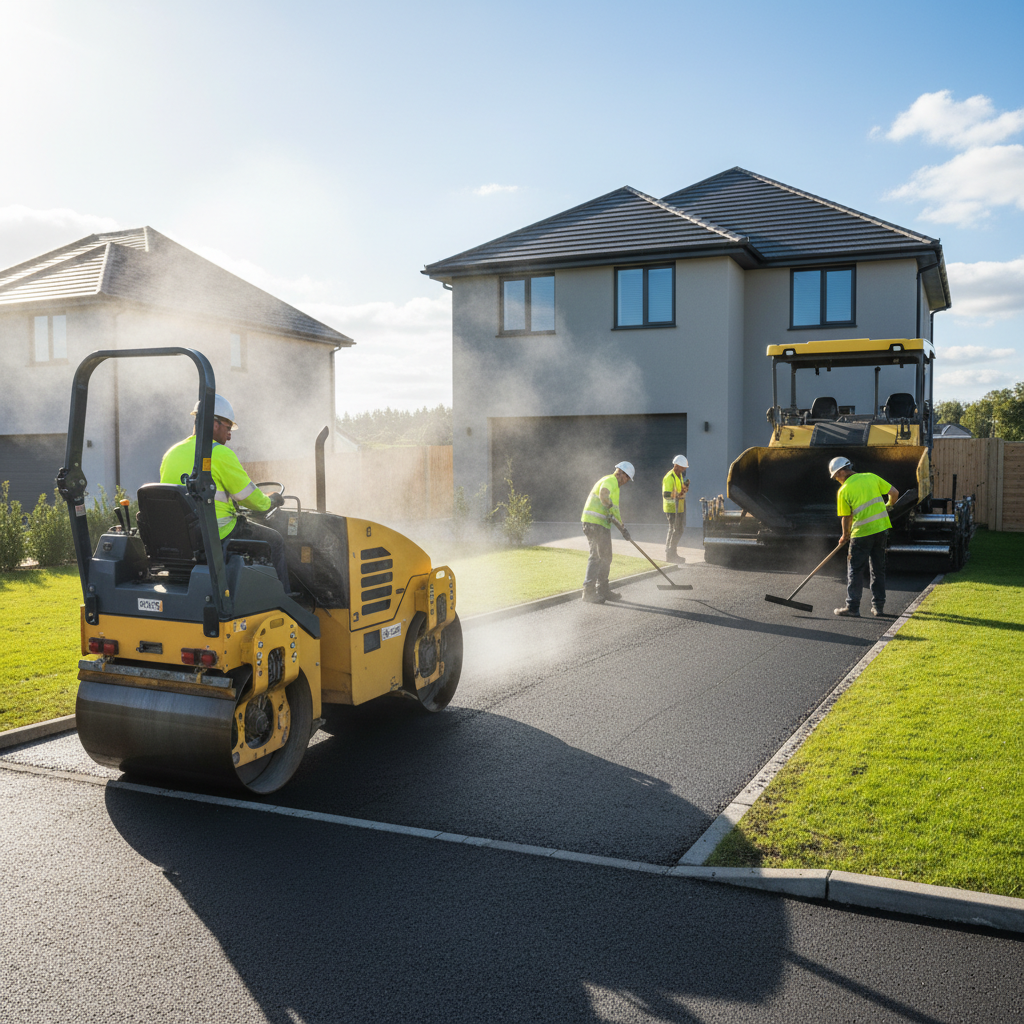
Driveway paving options and costs in Lions Bay
Lions Bay driveway paving decisions usually start with a simple question: which surface best fits how you live—and what the Lower Mainland–Southwest climate does to materials. With 95.0% of dwellings in the community being single-detached homes (Statistics Canada, 2021 Census), most paving work is private driveway upgrades on properties where vehicle access, drainage, and long-term appearance matter. You’ll also see many older homes—65.3% were built before 1981—which often means existing driveways were installed with shallower base and older drainage patterns, making preparation and excavation more than “just pave over it.”
In Lions Bay, pricing is shaped less by deep frost and more by intense rainfall, saturated soils, and repeated freeze–thaw at the shallow coastal frost line. Contractors in this part of the Lower Mainland also need to manage longer scheduling windows than Northern BC, yet shoulder-season storms still compress workdays and can increase protective measures and rehandling. Expect quotes to reflect solid granular base thickness (often around the typical residential standard of 6" compacted base) plus correct grading and drainage, especially on clay-heavy areas.
Because this area is compact and access can be tight on the North Shore, trades are especially busy around the West Lions Bay / Eagle Ridge area where driveways are frequently upgraded for curb appeal and better runoff control. Use the table below to compare the typical options and budget ranges before you request a quote.
| Material |
Lifespan |
Maintenance |
Best For |
Price per sq ft |
| Asphalt (new installation, proper base) |
15–25 years |
Seal every 3–5 years; patch as needed |
Best value for most residential driveways |
$12 – $20 |
| Asphalt (overlay on existing gravel base) |
10–18 years |
Seal every 3–5 years; more frequent patching if base is weak |
When excavation is limited and base is still firm |
$9 – $16 |
| Interlocking concrete pavers |
25–35 years |
Re-sand joint lines; occasional panel resets |
Highest curb appeal and easy localized repairs |
$20 – $40 |
| Poured concrete (broom finish) |
25–30 years |
Minimal; seal if desired; monitor for cracking |
Low maintenance with clean, modern look |
$18 – $35 |
| Exposed aggregate concrete |
25–30 years |
Occasional sealing; routine joint/edge checks |
Texture for slip resistance and premium appearance |
$22 – $40 |
| Gravel / crushed stone (budget option) |
5–10 years |
Top up annually; re-grade as needed |
Temporary solution or low-budget access |
$4 – $10 |
Prices are estimates only and vary by project scope, site access and material selection.
What affects the price of paving in Lions Bay
Even for the “same” driveway, Lions Bay quotes can vary by 30–50% across the Lower Mainland–Southwest—and across broader British Columbia—because the real work is in the prep. Two contractors may both call for “asphalt,” but one includes full tear-out, haul-off, granular base, and drainage corrections, while another is assuming the existing base is sound. In older neighbourhoods with 65.3% of homes built before 1981 (Statistics Canada, 2021 Census), that assumption often fails after excavation, especially where subgrade becomes saturated during extended rain periods.
Frost line depth and freeze–thaw cycles are decisive cost factors in coastal BC. While coastal frost penetration is relatively shallow, design still assumes a frost zone on the order of about 18" for sensitive infrastructure and exposed applications. That means your compacted granular base and drainage must be sized and built to prevent heaving and cracking. As a reference point for how this changes by climate: Ontario/Alberta projects often require more base (commonly 6–12 inches) to manage deeper frost, while in coastal BC the typical exposed driveway base is frequently on the thinner end (around 4–6 inches) only when soils and drainage are excellent. Where Lions Bay sites have heavier soils or poor runoff, contractors will move toward thicker, well-compacted base and more granular replacement—pushing costs toward the higher end of the $12 – $20 asphalt band and the $20 – $40 interlocking band.
Concrete examples in Lions Bay that commonly raise cost include: removing old concrete that’s broken and lifting hard to reach areas with machinery; regrading to fix ponding after storms; and adding edge restraints/curbing so pavers or asphalt can’t “spread” over time. Conversely, cost can be lower when the driveway is already square, accessible for equipment, and the base is firm enough to stabilize without full rebuild.
| Price Factor |
Why It Matters |
Cost Impact |
| Driveway area in sq ft |
Directly determines material quantities and production time |
High (often the largest portion of the total quote) |
| Base depth required |
Base thickness is your defence against frost-zone heave and cracking |
High when increased due to weak/saturated subgrade |
| Grading and drainage work |
Rainfall-driven runoff control prevents softening and edge failures |
Medium to high (can add significant excavation and re-compaction) |
| Tear-out of existing surface |
Concrete/asphalt removal requires breaking, loading and disposal |
Medium to high (especially with old, reinforced concrete) |
| Edge restraints and curbing |
Edges keep surfaces square and prevent movement over wet seasons |
Medium (more for pavers; also needed for longer-lived asphalt) |
| Sealing requirement |
Asphalt needs sealing to resist water infiltration in wet winters |
Low to medium (timing matters—usually after 6–12 months) |
| Site access |
Narrow lots slow skid-steer/excavator workflow and may require smaller hauling |
Medium (can raise labour and equipment costs) |
| Asphalt mix specifications |
Freeze–thaw rated mix improves durability in coastal rain + winter cycles |
Medium (higher-spec mix can be a noticeable upcharge) |
Permits & regulations in British Columbia
In British Columbia, paving a private driveway typically does not require a building permit when you’re working entirely within your own property and not altering municipal infrastructure. That said, the moment your project touches the municipal right-of-way—such as installing or changing a curb cut, modifying the boulevard, or making changes that affect municipal storm drainage—municipal approval is usually required. Some municipalities also have lot-grading bylaws that restrict how close a hard surface can be to property lines and how surface water must be directed or handled. Because Lions Bay sites can be shaped by drainage realities, you should treat grading and runoff as part of the compliance picture, not an afterthought.
Here’s a homeowner-friendly step-by-step verification process for Lions Bay:
- Ask the contractor what portions of the work require approval (e.g., curb cut changes, drainage tie-ins, or right-of-way excavation).
- Call BC 1 Call (utility locate) before any excavation so buried services are marked.
- Confirm the contractor’s current British Columbia licence/registration status via the appropriate public contractor directory (your contractor should provide the reference number).
- Request a certificate of liability insurance and ensure it covers your address/job scope (and is not expired).
- Ask for proof of coverage for workers through the required workers’ compensation framework (often provided as a clearance letter or coverage document).
- Keep copies in writing: insurance certificate, coverage document, and any permit/approval paperwork if applicable.
What typically does not require a permit: resurfacing/repaving strictly on private driveway area, replacing worn asphalt or pavers on your lot, and general base reconstruction within the property boundaries—provided you’re not changing municipal drainage or right-of-way elements.
Asphalt vs pavers vs concrete for Lions Bay driveways
In Lions Bay, asphalt, interlocking pavers, and concrete all work—but they perform differently under wet winters, freeze–thaw around a shallow coastal frost line, and the way driveways are maintained (ploughing, sand, and de-icing practices). Asphalt usually wins on upfront cost and speed of installation. With proper granular base (often around the residential standard of 6" compacted base plus correct asphalt thickness of roughly 2.5–3"), a sealed asphalt surface typically holds up well. The tradeoff is maintenance: asphalt needs sealing about every 3–5 years to reduce water infiltration.
Interlocking concrete pavers are the highest upfront option, but they’re highly repairable. If a section settles because of a drainage issue or utility work, you can lift and re-set individual blocks without replacing the full driveway. That durability story matters in the Lower Mainland–Southwest because drainage mistakes show up quickly during prolonged rains. Pavers in this region commonly land in the $20 – $40 range per sq ft, especially when edge restraints and proper bedding are included.
Poured concrete is a middle ground on price and can look excellent when properly finished. However, concrete is more sensitive to mix and curing details. In British Columbia winters, air-entrainment and appropriate curing help manage freeze–thaw stress; otherwise hairline cracking can become a maintenance problem. Concrete also needs good drainage away from the slab to prevent subgrade softness.
For a concrete dollar example: if an asphalt driveway quote comes in near $12 – $20 per sq ft but a paver quote is closer to $20 – $40, the price gap is usually justified when you want premium curb appeal, expect future maintenance access, or want an easy “replace a section” repair path rather than full-surface resurfacing.
| Material |
Frost Resistance |
Curb Appeal |
Repair Method |
Lifespan |
Price Band |
| Asphalt (sealed regularly) |
Good with proper base and sealing; relies on drainage |
Medium (clean blacktop look) |
Cut/patch localized areas; resurface later |
15–25 years |
$12 – $20 |
| Interlocking concrete pavers |
Very good; block-by-block flexibility with correct bedding |
High (many colour/pattern options) |
Lift and reset individual pavers |
25–35 years |
$20 – $40 |
| Poured concrete (air-entrained) |
Good when air-entrained and properly cured; cracks can form |
Medium to high (finish dependent) |
Slab repairs/patching; larger issues may require resurfacing |
25–30 years |
$18 – $35 |
| Exposed aggregate concrete |
Good with correct base and drainage |
High (textured premium look) |
Limited; patching is possible but less seamless than pavers |
25–30 years |
$22 – $40 |
| Permeable pavers (drainage grid) |
Excellent when designed for site drainage; reduces water pooling |
High (modern stormwater-friendly look) |
Replace pavers/blocks as needed |
20–30 years |
$26 – $45 |
| Chip seal / tar-and-chip |
Moderate; best as a short-to-mid-term surface |
Low to medium |
Rechip/resurface when aggregate wears |
5–12 years |
$8 – $15 |
How to choose a paving contractor in Lions Bay
Choosing the right contractor matters in Lions Bay because the success of asphalt and pavers is mostly decided during excavation, base prep and drainage. Start by verifying British Columbia licensing/registration status: ask the contractor for their licence/registration details and check it against the relevant public directory. Next, request proof of liability insurance—your certificate of insurance should match the company name and your job address or project description. For workers’ compensation, ask for current documentation such as a clearance letter or proof of coverage under the appropriate BC workers’ compensation framework; don’t proceed without it.
Get 2–3 itemised written quotes. You want a breakdown that separates labour, excavation/haul-away, base materials, compacting, asphalt/paver/concrete supply, edges/curbs, and any sealing (for asphalt). Avoid “lump sum only” quotes unless the scope is extremely detailed. Read the scope for exclusions: is disposal included? Is contaminated soil handled? Are permit or approval tasks included when the job affects municipal drainage or curb cut changes?
Warranty should be clear and in writing: workmanship warranty length (often 1 year), product/manufacturer coverage (if any), and whether any coverage is transferable to future owners—important for resale in a community where driveways influence curb appeal. Payment schedule: never pay more than 10–15% upfront. Hold back a portion until you have final grading confirmation and a complete site clean-up. Also insist on a start date and completion estimate in writing so weather delays and material lead times don’t become “floating timelines.”
- Confirm licence/registration is current for the company bidding.
- Review liability insurance certificate (expiry date and coverage limits).
- Request BC workers’ compensation clearance/proof of coverage.
- Ask for a site plan: where drainage improvements will be made.
- Ensure base specs are written (compaction requirements and thickness).
- Get disposal/haul-away details for removed asphalt or concrete.
- Confirm edge restraints/curbs are included (especially for pavers).
- For asphalt: verify asphalt thickness and freeze–thaw appropriate mix.
- Ask when sealing is recommended (typically after 6–12 months).
- Verify who provides utility locate coordination (BC 1 Call marks).
- Check warranty terms for labour and materials separately.
- Payment schedule: small deposit only; hold back until final walkthrough.
Concrete red flags in Lions Bay: (1) a quote that skips base thickness and drainage but still promises “crack-free” results; (2) reluctance to provide insurance/coverage documents; (3) vague wording like “asphalt will be installed to code” without thickness or mix details; (4) no written start/completion timeline; and (5) requesting large upfront payments (well over 10–15%).
Frequently asked questions — paving in Lions Bay
Do I need a permit to pave my driveway in British Columbia?
In most cases in British Columbia, repaving or replacing a private driveway within your own property does not require a building permit. However, in Lions Bay you may need municipal approval if your project affects the municipal right-of-way—for example, changing a curb cut, altering the boulevard, or modifying storm drainage tie-ins. Some municipalities also have lot-grading rules that can restrict how you shape runoff and how close hard surfaces are to property lines. Before work starts, always request utility locates through BC 1 Call for any excavation. The most reliable approach is to ask your contractor to specify exactly what requires approval in writing and confirm what they are responsible for versus what you need to apply for.
How long before I can drive on new asphalt?
After asphalt paving, you can usually drive on the surface relatively soon—often within 24–48 hours depending on weather, temperature, and how the mix was placed. In Lions Bay, rainy spells can slow curing, so contractors may extend the waiting period if the surface stays cool or damp. Avoid turning heavy vehicles or pivoting steering immediately after placement, because the asphalt can be prone to tracking while it’s still gaining strength. If you’re planning a move-in or event, schedule the paving early in the week so there’s time for adequate cure before weekend traffic. Your contractor should specify a “drive-on” time window and confirm how they protected the surface during curing.
What causes potholes and how are they repaired?
Potholes are usually the symptom of a deeper issue: water getting under a weak spot in the asphalt, then freeze–thaw expanding the damaged area. In coastal British Columbia, prolonged rainfall and saturated subgrade can soften the base, and the shallow frost zone can accelerate breakdown near edges, seams, and areas with poor drainage. Another common cause is settlement where base wasn’t compacted uniformly. Repairs typically involve cutting out to sound material, stabilizing or replacing any failed granular base, then installing patch asphalt and compacting it properly. A good contractor will also address the drainage or grading problem so you’re not just repeating the same repair in a different season.
How do I prepare for a paving project?
Preparation in Lions Bay is mainly about site readiness and reducing surprises. Clear the driveway and adjacent work area of vehicles, trailers, planters and loose materials, and mark any sprinkler heads or landscaping you want protected. If you have existing fencing or gates that affect equipment access, tell your contractor in advance so they can plan the smallest safe workflow. Plan for excavation noise and temporary changes to access—shoulder-season storms can also create short delays while the base dries and is re-compacted. Before the first bucket hits the ground, ensure utilities are located through BC 1 Call and confirm disposal/haul-away is included for old asphalt or concrete. For asphalt, ask when you should plan the later seal coat—commonly after 6–12 months.
How do I compare paving quotes fairly?
Compare quotes as if you’re comparing building plans, not just prices. Start by checking whether each quote includes the same scope: tear-out volume (if any), excavation depth, granular base thickness, compaction, drainage/grading corrections, edge restraints, and disposal. For asphalt, confirm asphalt thickness and whether the mix is appropriate for freeze–thaw conditions; in Lions Bay that performance depends heavily on water control, not just the top layer. The per-square-foot numbers should land in the local bands—for example, asphalt typically falls around $12 – $20 and interlocking pavers around $20 – $40. Watch for quotes that are “cheaper” because they skip base rebuild or drainage work.
Can asphalt be laid in cold weather in Lions Bay?
Asphalt placement is possible only when conditions allow proper compaction and drying. Hot-mix asphalt generally requires air temperatures above about 10°C for reliable workability and compaction, and it also needs adequate surface conditions to bond well. In Lions Bay, cool rainy stretches can reduce that workable window, which can lead to poor mat density if crews rush. If the weather is borderline, reputable contractors will reschedule rather than compromise. When delays happen, base and subgrade can be rechecked and re-compacted to ensure the drainage-and-base system is ready for paving. Ask the contractor what minimum conditions they use and how they protect fresh asphalt from rain before it cures.