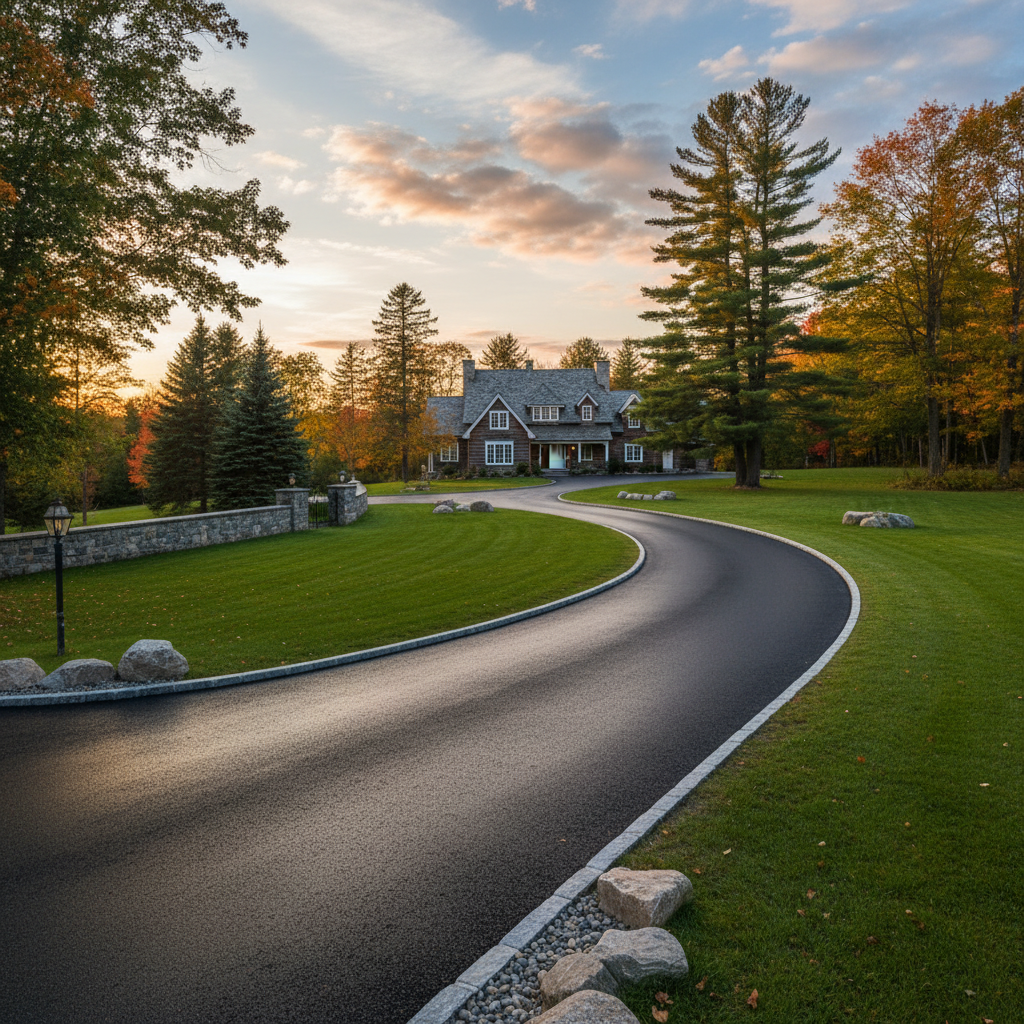
Driveway paving options and costs in Deep Cove
Deep Cove is a beautiful spot to live in, but driveways here take a beating from heavy rain, wet soils, and the freeze–thaw action that forms near a relatively shallow frost line. With Deep Cove’s population at 2,251 (Statistics Canada, 2021 Census), the town is small enough that scheduling with reputable crews can matter, especially during the busiest shoulder-season months. Most private driveways serve single-detached homes, and that means homeowners typically want a balance of curb appeal, traction, and predictable maintenance costs rather than a “set it and forget it” finish.
In the Lower Mainland–Southwest, paving costs are shaped less by extreme cold and more by drainage and granular base performance. Contractors typically excavate to stable material, install well-compacted base (often around 6" compacted granular base for residential asphalt when soils are typical), and add proper asphalt thickness (commonly 2.5–3" for new installation). While frost penetration is generally shallower in coastal BC than in places like Ontario or Alberta, local practice still assumes a frost-line depth of roughly 18" for exposed sensitive areas and drainage must be detailed to prevent heaving, rutting, and early cracking.
This is why paving demand tends to spike in areas like the Deep Cove village corridor and along the more established residential lanes where access is tight and stormwater routing is critical. If your current driveway is already failing, the base condition and tear-out scope will largely determine your final price. Use the comparison table below to estimate what each finish typically costs per square foot in Deep Cove.
| Material |
Lifespan |
Maintenance |
Best For |
Price per sq ft |
Price Range |
| Asphalt (new installation, proper base) |
15–25 years |
Seal every 3–5 years; patch cracks as needed |
Most value-focused homeowners; smooth, quiet ride |
$12–$18 |
$6,500–$10,500 |
| Asphalt (overlay on existing gravel base) |
10–18 years |
Seal 3–6 years after placement; monitor edges and low spots |
When the existing base is stable and well-drained |
$10–$15 |
$5,500–$9,000 |
| Interlocking concrete pavers |
25–40 years |
Re-seat/replace individual stones; periodic joint sand refresh |
High curb appeal; easy localized repairs |
$20–$35 |
$9,000–$18,000 |
| Poured concrete (broom finish) |
20–30 years |
Seal when recommended; joint/edge maintenance |
Clean look, simple plowing/vehicle access |
$18–$28 |
$8,000–$15,000 |
| Exposed aggregate concrete |
25–35 years |
Seal 3–7 years after placement; patching as needed |
Slip resistance and a more premium finish |
$22–$35 |
$10,500–$19,500 |
| Gravel / crushed stone (budget option) |
3–10 years |
Top up annually; re-grade; weed control |
Short-term budget or drainage-only areas |
$8–$12 |
$3,500–$7,500 |
Prices are estimates only and vary by project scope, site access and material selection.
What affects the price of paving in Deep Cove
In Deep Cove and the broader Lower Mainland–Southwest region, two driveways that look identical from the street can end up 30–50% apart once you price the site prep and the base/drainage details. In British Columbia overall, labour and equipment costs (plus longer booking lead times during rainy shoulder seasons) can also push totals higher compared with some inland regions. Where your quote lands depends on how much excavation, base replacement, and drainage correction your driveway actually needs—not just the final asphalt or paver surface.
Frost line depth and freeze–thaw cycles are still decisive cost factors in coastal BC, even when frost penetration is typically less severe than in Interior or Northern parts of the province. The difference is that the damage can show up as heaving around shallow sensitive zones and pump-out in areas that drain poorly after rain. If base sits too shallow or the granular material isn’t compacted to spec, you’ll get cracking and rutting that doesn’t wait for winter. In exposed applications, contractors often design the excavation and compacted granular thickness around that roughly 18" frost-line assumption for sensitive infrastructure, and that means additional base work versus a “quick fill and pave.”
Concrete pricing shifts too. For example, adding air-entrainment and properly detailing joints can raise the per-square-foot cost, but it reduces freeze–thaw cracking risk. Asphalt mix design can also cost more when a freeze–thaw-rated mix is required for durability. If your driveway is small, the mobilization and disposal portion of the job can outweigh the material portion; if it’s larger, base and surface thickness dominate.
As a practical guide, many Deep Cove homeowners see asphalt new installation fall closer to the $12–$18 per sq ft band (and totals commonly land in the $6,500–$10,500 range), while pavers often step into the $20–$35 per sq ft band because of excavation depth, bedding sand, and restraint detailing along edges.
| Price Factor |
Why It Matters |
Cost Impact |
| Driveway area in sq ft |
The surface area drives material quantity and crew time |
Highest impact; can swing total by 40%+ on similar sites |
| Base depth required |
Granular thickness protects against heaving and early cracking |
Typically adds 10–30% when extra base excavation/replacement is needed |
| Grading and drainage work |
Slope, sub-drainage, and storm tie-ins prevent water pooling |
Often 5–25% depending on how far drainage must be corrected |
| Tear-out of existing surface |
Breaking and hauling concrete or old asphalt adds labour and disposal |
Commonly 10–35% if full-depth removal is required |
| Edge restraints and curbing |
Pavers need rigid restraint to prevent lateral spread |
Can add 3–15% depending on layout complexity |
| Sealing requirement |
Asphalt sealed after 6–12 months protects binder and slows oxidation |
Small line item but adds value; usually 2–6% of total budget if included |
| Site access |
Narrow/tight lots slow equipment movement and increase handling time |
Can add 5–20% for extra labour and smaller lifts |
| Asphalt mix specifications |
Freeze–thaw-rated mix improves long-term durability |
Often 3–12% more than basic mix, depending on design requirements |
Permits & regulations in British Columbia
In British Columbia, paving a private driveway within your own property typically does not require a building permit. The work usually falls under routine private servicing—think asphalt, pavers, or concrete placement on your lot. However, work in the municipal right-of-way generally does require municipal approval. That includes new curb cuts, changes to the boulevard, modifications that affect storm drainage, or altering how water flows from your property into the street area.
Because rules can vary by municipality, your safest path is to confirm whether your specific driveway location triggers lot-grading or drainage bylaw requirements. Some areas also regulate how close a hard surface can be to property lines where drainage can impact neighbouring lots.
No matter what material you choose, call for utility locates before excavation. In BC, use BC 1 Call prior to digging so you don’t hit buried services.
To verify your contractor in Deep Cove, homeowners can do it step-by-step: first, ask for their British Columbia licence information and confirm it through the appropriate provincial registry. Second, request a current certificate of liability insurance showing adequate coverage for driveway excavation and paving operations. Third, confirm workers’ coverage (WSIB/WCB) with documentation or clearance letter—then keep it in your file. A reputable contractor will provide these items before mobilizing and will also list who is responsible for disposal and any permit-related tasks.
Asphalt vs pavers vs concrete for Deep Cove driveways
Choosing between asphalt, interlocking concrete pavers, and concrete in Deep Cove comes down to upfront cost, how you maintain the surface through rainy winters, and how your driveway handles freeze–thaw and moisture. In the Lower Mainland–Southwest, drainage and base performance are the real “make or break” factors, because heavy rainfall can saturate soil and lead to base softening. Once you get pump-out or settlement, any finish will struggle—but some recover better than others.
Asphalt is usually the lowest upfront option, especially when your base is sound and you’re placing new material with proper compacted granular base and correct slope. Asphalt’s trade-off is maintenance: sealing in the first 6–12 months and then every 3–5 years helps protect the binder from moisture damage. Interlocking concrete pavers cost more at the start, but they’re the most repair-friendly—individual units can be lifted, the base corrected, and then reinstalled without replacing the whole driveway. That’s a big advantage in Deep Cove where localized low spots or drainage issues can appear over time.
Poured concrete typically sits mid-pack on cost and looks crisp, but freeze–thaw cracking risk rises if it isn’t air-entrained and properly jointed. Exposed aggregate can improve traction for winter conditions, while permeable or drainage-grid pavers can help manage water—if your subgrade supports it and the drainage plan is designed correctly.
For a concrete dollar example: if asphalt is around the $12–$18 per sq ft range and a similar paver layout is commonly $20–$35 per sq ft, the $8–$17 per sq ft difference is justified when you want long-term curb appeal and a repairable system—especially if your driveway sees frequent plowing access points and you’re likely to adjust drainage or address minor settling later.
| Material |
Frost Resistance |
Curb Appeal |
Repair Method |
Lifespan |
Price Band |
| Asphalt (sealed regularly) |
Good when base is compacted and drainage is corrected |
Moderate (clean black surface) |
Patch and re-seal; localized milling/overlay |
15–25 years |
$12–$18 |
| Interlocking concrete pavers |
Very good; performs well with correct base and restraints |
High (variety of patterns/colours) |
Lift and replace individual pavers; re-lay bedding sand |
25–40 years |
$20–$35 |
| Poured concrete (air-entrained) |
Good to fair; depends heavily on air-entrainment and joints |
Moderate to high |
Crack repair/seal; sometimes patching with matching mix |
20–30 years |
$18–$28 |
| Exposed aggregate concrete |
Good when properly finished and sealed; traction advantage |
High (premium look) |
Targeted patching; surface re-seal as needed |
25–35 years |
$22–$35 |
| Permeable pavers (drainage grid) |
Very good where subgrade drainage is adequate |
High (engineering-forward look) |
Replace affected sections and maintain stone storage bed |
20–35 years |
$24–$42 |
| Chip seal / tar-and-chip |
Fair to good; sensitive to rutting if base is weak |
Low to moderate (more utilitarian) |
Re-chip/spot overlay and occasional re-surface |
7–15 years |
$10–$16 |
How to choose a paving contractor in Deep Cove
Start by verifying contractor basics in British Columbia: ask for their BC business licence/eligibility details (as applicable), current certificate of liability insurance, and proof of workers’ coverage. To check liability coverage, request a certificate that lists your contractor’s name and policy limits, and ensure it’s active for the dates of work. For workers’ compensation (WSIB/WCB), ask for a clearance letter or current proof of coverage and confirm it applies to the workers assigned to your job site. If they can’t provide these, that’s usually a sign to look elsewhere.
Then get 2–3 itemised written quotes—not a single lump-sum number. A proper quote breaks down labour and materials (excavation, base gravel, bedding sand if pavers, asphalt thickness, compaction, tack coat if applicable, disposal, and surface finishing). Read exclusions carefully: ask whether permit approval steps (if required for right-of-way impacts), utility locate costs, and disposal are included. If they’re not included, request line-item pricing so you can compare apples to apples.
For warranty, confirm workmanship warranty length and what it covers (for example, settlement, workmanship-related cracking, or paver movement). Also note whether product/manufacturer warranties transfer to you. Keep payment schedules tight: never pay more than 10–15% upfront, and hold back the remainder until the job is complete and deficiencies are corrected. Ask for a start date and realistic completion estimate in writing—Deep Cove scheduling can shift with wet weather and the broader Lower Mainland–Southwest paving calendar.
- Confirm they reviewed your site drainage plan, not just the surface.
- Request a site-specific base design (depth and compaction method), especially in wetter zones.
- Ask what thickness they’ll place and how they’ll verify it (string line, check loads, and testing practices).
- Ensure they include tack coat for asphalt overlays when needed.
- Verify paver restraint details (edges/curbing) to prevent spreading.
- Ask whether they’ll slope the driveway for positive drainage away from the house.
- Confirm utility locate and excavation safety steps are in their scope.
- Check that disposal and haul-away are included for tear-out.
- Get a written timeline, including weather-dependent contingencies.
- Ask what the sealing schedule is for asphalt and whether it’s recommended 6–12 months after.
- Confirm warranty is in writing and includes workmanship, not just “materials.”
- Verify payment terms and holdback process in the contract.
Common Deep Cove red flags: “we’ll pave over anything” without discussing base condition; vague warranty language; quotes that omit tear-out and disposal; no proof of insurance/workers’ coverage; and a schedule that ignores rain-window realities for asphalt and concrete placement.
Frequently asked questions — paving in Deep Cove
What is a driveway apron and do I need one in Deep Cove?
An apron is the portion of your driveway that transitions at the curb/sidewalk area—often where vehicles move between the road surface and your private drive. In Deep Cove, whether you need an apron depends on your driveway geometry and whether the work touches the municipal right-of-way (for example, curb cuts or changes to boulevard and drainage). If your plan requires right-of-way alterations, you’ll typically need municipal approval before construction. If you’re paving entirely within your lot and simply improving an existing approach, a contractor may still recommend an apron-style transition to reduce edge breakdown from turning loads and wet weather. Ask your contractor to show you how they’ll detail the transition and confirm whether any right-of-way approvals are required.
How do I maintain my driveway through Deep Cove winters?
For Deep Cove winters, the goal is to protect your surface and prevent water from staying trapped near the edges. For asphalt, plan for crack patching when cracks appear and consider sealing after the first 6–12 months, then typically every 3–5 years. Avoid aggressive scraping that gouges the surface; if you use de-icers, keep salt application reasonable—concrete and some joint materials can degrade faster with heavy salt and repeated thawing. Keep drainage clear around the driveway so runoff doesn’t pond and saturate the base. In wet, shoulder-season weeks, small puddles often signal slope or drainage corrections needed before the surface fails. A properly compacted base with correct drainage usually holds up much better than “more salt and ploughing.”
Is it worth sealing a new driveway right away in Deep Cove?
Usually, sealing too early isn’t ideal. For asphalt in British Columbia, most contractors recommend sealing after the asphalt has had time to cure—often within the 6–12 month window after placement—so moisture and oils can stabilize. Sealing too soon can trap volatiles and reduce binder performance. In Deep Cove’s rainy climate, sealing is still worthwhile because it helps slow oxidation and improves resistance to water penetration, which is crucial where freeze–thaw movement can start around shallow frost zones. If you’re comparing options, asphalt totals commonly land in the $6,500–$10,500 range for new installation with proper base, and adding scheduled sealing can extend the useful life. Ask for the exact sealing date and the product type included in your quote.
What is a chip seal driveway and is it suited to Deep Cove?
Chip seal (tar-and-chip) is a surface treatment where a binder is sprayed and stone is broadcast and compacted. It can be economical for certain rural or low-access areas, and it’s sometimes used where homeowners want a faster, lower-cost surface. In Deep Cove, it can work when the base is properly prepared and drainage is correct, but it’s generally less forgiving than asphalt if the underlayer is weak or water pools. Because Lower Mainland–Southwest winters include frequent wetting, you may see more maintenance over time compared to a well-designed asphalt driveway. Chip seal often sits around the $10–$16 per sq ft band depending on site prep and stone selection. If your driveway experiences tight turning and repeated loads, asphalt or pavers may protect better long-term.
How much does driveway crack repair cost in Deep Cove?
Crack repair costs vary with crack width, length, and how deep water may be infiltrating below the surface. For small, clean cracks, contractors often do crack sealing with a compatible sealer after surface preparation; for wider cracks or areas with slight movement, they may recommend patching/milling and re-laying a small section. In British Columbia, sealing and repair is often quoted in the $2–$6 range per sq ft for surface-level work, but full patch sections can raise the total depending on access and disposal. The real driver is whether the crack is “surface only” or a symptom of base drainage or settlement issues. If the base is pumping water, sealing alone won’t stop recurrence. The best approach is to have a contractor identify whether the crack is tied to slope, edge restraint, or saturation.
What base thickness do I need for pavers in Deep Cove?
For paver driveways in Deep Cove, a common residential design is about 6" of compacted granular base plus bedding sand and then the pavers themselves (often 2.5–3.5" total for paver thickness depending on the unit). If soil is saturated, clay-heavy, or the driveway experiences heavy vehicle loads, contractors may need to excavate deeper and replace more base gravel for stability. Lower Mainland–Southwest frost considerations still drive the need for correct base and drainage even when frost is shallower than in inland BC—water and freeze–thaw around the frost zone can cause heaving if base depth and compaction aren’t right. Your contractor should confirm base depth based on site conditions, not just a one-size-fits-all number. A well-detailed base helps pavers stay level and reduces joint sand loss.