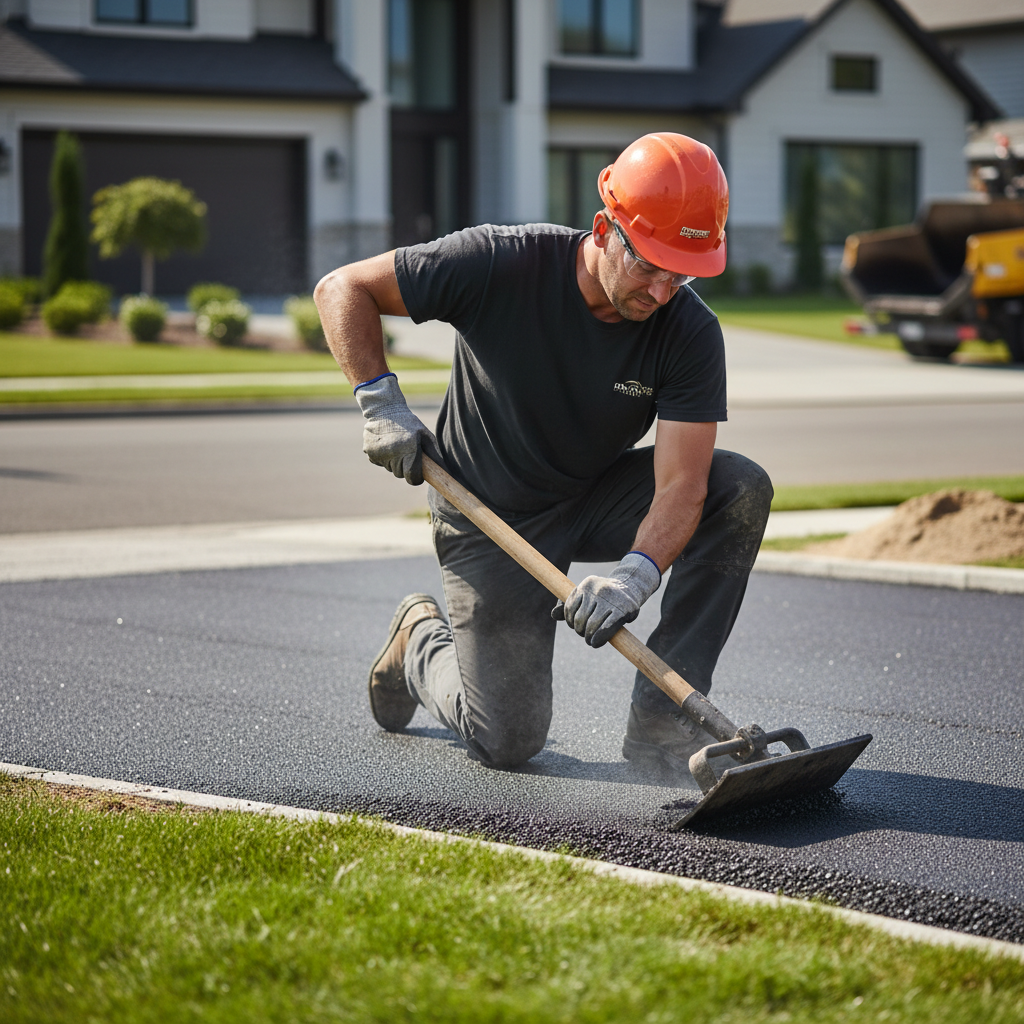
Driveway paving options and costs in Newton
Newton, British Columbia, is a strong market for driveways, especially where most homeowners are in single-attached or attached housing forms that create frequent demand for durable entrances to garages and laneway access. With Newton’s population at 159,390 (Statistics Canada, 2021 Census), contractor availability is generally good in the Lower Mainland–Southwest, but pricing still reflects the realities of intense rainfall, wet shoulder seasons, and the need to build the right granular base for freeze–thaw movement. While coastal BC typically has a shallower frost profile than Interior regions, local practice still assumes meaningful freeze depth for exposed edges and lightly insulated areas, so underbuilds and drainage mistakes can show up quickly as heaving or cracking.
In neighbourhoods like Newton Exchange and the Ledgeview area, driveways often see regular vehicle loads, tight site access, and frequent water management challenges near downspouts and front yard drainage. That’s why quotes can look different even when the driveway looks the same: excavation depth, base compaction, and how the contractor handles slopes and runoff often matter more than the surface material itself.
Use the table below as a realistic starting point for Newton projects—from new asphalt to pavers and concrete—then we’ll break down what drives the cost in British Columbia.
| Material |
Lifespan |
Maintenance |
Best For |
Price per sq ft |
| Asphalt (new installation, proper base) |
15–25 years |
Seal every 3–5 years |
Cost-effective, smooth finish |
$12 – $20 |
| Asphalt (overlay on existing gravel base) |
10–20 years |
Seal every 3–5 years |
When the base is sound and drainage is addressed |
$10 – $18 |
| Interlocking concrete pavers |
25–35 years |
Resand, occasional panel reset |
Maximum curb appeal and easy localized repairs |
$20 – $40 |
| Poured concrete (broom finish) |
20–30 years |
Crack monitoring; sealing optional |
Low maintenance, clean modern look |
$18 – $35 |
| Exposed aggregate concrete |
20–30 years |
Sealing optional; clean as needed |
Texture and traction with higher visual appeal |
$22 – $38 |
| Gravel / crushed stone (budget option) |
5–15 years |
Top-ups and grading as needed |
Temporary or lowest upfront cost |
$8 – $14 |
Prices are estimates only and vary by project scope, site access and material selection.
What affects the price of paving in Newton
In Newton and the wider Lower Mainland–Southwest region, it’s common to see driveway quotes for a similar size job differ by 30–50% across British Columbia. The gap usually comes down to base preparation, drainage corrections, and how much excavation is truly required—not the surface finish alone. Contractors also price differently depending on scheduling demand; even though the region’s paving season is longer than Northern BC, heavy winter rains and wet shoulder seasons can tighten workable windows and increase labour pressure.
Frost line assumptions and freeze–thaw cycles are decisive cost factors in the Lower Mainland–Southwest. Even if frost penetration is relatively shallow, repeated movement around a shallow frost line—especially where clay-heavy soils hold moisture—can produce heaving, rutting, and cracking if the granular base is too thin or poorly compacted. As a rule of thumb, deeper frost regions often call for 6–12 inches of compacted granular base, whereas coastal BC projects frequently start around 4–6 inches when conditions are ideal; in Newton, we often need the higher end of that range where drainage is weak or the soil is saturated.
Concrete examples: if your driveway approaches a curb cut with standing water after rain, grading and subdrain work can add significant cost—while a site with well-drained soil and good fall to the street may keep the total closer to the “typical” asphalt band of $12–$20 per sq ft. If you’re tearing out 4" of old concrete or removing failing asphalt and hauling debris, that tear-out can push the project toward the upper end. Asphalt mix design also matters; freeze–thaw-rated asphalt mix generally costs more than generic supply, but it helps the surface hold up during wet winters and spring freeze movement. For homeowners, a driveway built 1–2 inches deeper than planned (because the soil turned out worse) can swing the quote by hundreds to thousands depending on area.
| Price Factor |
Why It Matters |
Cost Impact |
| Driveway area in sq ft |
Most labour and materials scale directly with square footage |
Highest impact; biggest driver of total cost |
| Base depth required |
Frost line assumptions determine how much compacted granular thickness is needed |
Major swing if excavation must increase |
| Grading and drainage work |
Slope correction and managing runoff prevents saturation and freeze–thaw movement |
Can add moderate to significant cost |
| Tear-out of existing surface |
Concrete breaking, hauling, and disposal increase crew time and equipment needs |
Often adds a noticeable per-sq-ft surcharge |
| Edge restraints and curbing |
Prevents paver spread and asphalt edge breakdown under vehicle loads |
Moderate cost; improves long-term performance |
| Sealing requirement |
Asphalt performs better with sealcoat applied after curing (typically within 6–12 months) |
Adds cost in the first year; protects surface longevity |
| Site access |
Narrow lots, steep driveways, or limited turning space slows equipment and increases labour |
Can raise labour and equipment rental costs |
| Asphalt mix specifications |
Freeze–thaw-rated mixes are designed for local winter performance |
Moderate to major impact on materials cost |
Permits & regulations in British Columbia
In British Columbia, paving a private driveway within your own property typically does not require a building permit, as it’s considered maintenance or improvement on private land. However, permits and approvals can be required when your project affects anything in the municipal right-of-way. That includes new or modified curb cuts, changes to the boulevard, driveway widening that ties into municipal features, or any work that alters storm drainage or leads to changes near catch basins and culverts.
Some municipalities also have lot-grading or drainage bylaws that restrict how close to property lines a hard surface can be and how runoff must be handled. If your driveway ties into a swale, drains toward a ditch, or changes how water crosses the lot line, confirm the grading rules before work starts.
Before excavation, always arrange utility locates through BC 1 Call (and follow the instructions provided by the utility markings). Then, to verify a Newton contractor meets provincial expectations: ask for their business licence (if applicable), certificate of liability insurance, and proof of workers’ compensation coverage (WCB) for the crew. For licensing and compliance, check the relevant provincial contractor information/registry online for the company and responsible person. Also request a current clearance letter or WCB account confirmation as applicable. Finally, ensure the insurance is active for the job and that it lists you as a certificate holder if the contractor offers that option.
Asphalt vs pavers vs concrete for Newton driveways
For Newton driveways, the “best” surface depends on how you expect to maintain it and how well the subgrade and drainage are handled. Asphalt is usually the lowest upfront option and gives a smooth, quiet ride, but it needs sealing every 3–5 years to protect against moisture damage and to keep the surface flexible through repeated wet winters. In the Lower Mainland–Southwest, that flexibility matters because intense rainfall can saturate base materials, and then freeze–thaw movement near the shallow frost zone can telegraph weak spots to the surface.
Interlocking concrete pavers cost more upfront, but they’re the easiest to repair locally: if a utility trench settles or a small section fails, panels can be lifted and reset without replacing the whole driveway. That’s a big advantage in neighbourhoods with older drainage connections. Poured concrete sits in the mid-range on price and can last long, but it’s more susceptible to cracking when the base isn’t properly compacted and when freeze–thaw plus de-icing practices stress the slab. If you choose concrete, ensure air-entrainment is specified and the base is built correctly.
In Newton, we typically target granular base prep consistent with local frost movement and drainage risk, often around 4–6 inches in good, well-drained conditions, with more excavation where soils are clay-heavy or water cannot drain away. As for winter maintenance: plowing and sand can be easier on pavers than asphalt if edges are properly restrained, while asphalt usually benefits from sealing and careful plow practices. A realistic dollar example: for a 400 sq ft driveway, asphalt at about $12–$20 per sq ft can come in around approximately $4,800–$8,000, while pavers at $20–$40 per sq ft can land around $8,000–$16,000—worth it when you value curb appeal and want repairability without full replacement.
| Material |
Frost Resistance |
Curb Appeal |
Repair Method |
Lifespan |
Price Band |
| Asphalt (sealed regularly) |
Good when base is well-compacted and drainage is corrected |
Good, clean black finish |
Patch and compact; re-level localized depressions |
15–25 years |
$12 – $20 |
| Interlocking concrete pavers |
Very good with proper base and edge restraints |
Excellent; high-end street look |
Lift and replace affected units; re-sand joints |
25–35 years |
$20 – $40 |
| Poured concrete (air-entrained) |
Good with air-entrainment and correct base prep |
Good to excellent (finish options) |
Spot repairs for small cracks; larger issues may require sections |
20–30 years |
$18 – $35 |
| Exposed aggregate concrete |
Good when sealed/finished correctly and base is stable |
Excellent texture and traction |
Limited spot repair; often patch-and-match or section repair |
20–30 years |
$22 – $38 |
| Permeable pavers (drainage grid) |
Excellent for managing rainfall when underdrain is designed |
Good (drainage pattern look) |
Replace individual paver units; maintain edge and inlet areas |
20–30 years |
$28 – $45 |
| Chip seal / tar-and-chip |
Fair to good; best for specific site conditions and acceptance |
Moderate |
Surface maintenance and re-seal; limited repair compared to asphalt |
8–15 years |
$10 – $18 |
How to choose a paving contractor in Newton
When you’re hiring a paving contractor in Newton, British Columbia, start by verifying three things: licensing/registration (where required), liability insurance, and workers’ compensation coverage (WCB) for the crew. Ask for a copy of the company’s insurance certificate—confirm the policy is active and that it matches the work being done at your address. Next, request WCB proof (often as a clearance letter or account verification) and make sure the workers on site are covered. If the contractor uses subcontractors, require that subcontractors provide their own insurance and WCB confirmation.
Then get 2–3 itemised written quotes, ideally with a breakdown that shows labour, excavation, base material, asphalt/pavers/concrete, compaction, disposal, and any drainage upgrades. Avoid a quote that only states “driveway paving” as a single line item—ask what’s included and what’s excluded (for example: permit pull in affected work areas, temporary protection, saw-cutting, and disposal). For warranty, clarify workmanship coverage length and what it applies to (settlement? edge failures? cracking?). Also ask whether the warranty is transferable if you sell the home.
For payment, a safe schedule keeps your exposure low: never pay more than 10–15% upfront, and hold back the remainder until the job is fully completed and cleaned. In scheduling, insist on a start date and completion estimate in writing—Newton weather can shift quickly with wet periods, so you want clear milestones.
- Verify WCB coverage for the exact crew that will work at your site.
- Provide a current certificate of liability insurance before excavation.
- Ask for at least two local project references in Surrey/Newton area.
- Require an itemised quote: excavation, granular base, compaction, surface course, disposal.
- Confirm the drainage plan: slope, underdrains (if needed), and how water will be managed.
- Get the base thickness in writing (and what happens if soils are weaker than expected).
- Ask about edge restraints/curbing and jointing details (especially for pavers).
- Ensure asphalt mix specifications are stated (freeze–thaw rated if applicable).
- Clarify whether sealing is included for asphalt and when it should be applied (typically after curing, within 6–12 months).
- Confirm saw-cut lines, tie-ins, and whether existing surfaces will be properly removed.
- Ask about cleanup: dust control, sweeping, and hauling of all waste materials.
- Review the warranty details and exclusions in plain language before signing.
Newton-specific red flags: a contractor who refuses to provide WCB proof or insurance documents; quotes that skip base thickness and compaction details; “too-good-to-be-true” pricing that doesn’t include drainage corrections; starting asphalt/pavers immediately after rain without moisture-handling steps; or a warranty that only covers the surface material and not workmanship.
Frequently asked questions — paving in Newton
How long does a paved driveway last in Newton?
In Newton, the lifespan of a paved driveway depends heavily on the base and drainage, not just the surface. Asphalt done with proper granular base prep typically lasts 15–25 years, while pavers with correct edge restraint and jointing often reach 25–35 years. Poured concrete can last 20–30 years when air-entrainment is used and the slab sits on a stable, compacted base. Because Lower Mainland–Southwest winters bring heavy rainfall and frequent wetting, saturated subgrades and clay-rich soils can shorten service life if drainage isn’t addressed. As a homeowner baseline, asphalt is commonly budgeted around $12–$20 per sq ft, but the “real” durability usually improves when the contractor builds the base deeper where soils demand it and applies sealing within the first year.
When is the best time of year to pave in Newton?
The best window in Newton is typically late spring through summer when weather is drier and crews can reliably achieve correct compaction and curing conditions. Although the paving season is longer in coastal BC than in colder parts of the province, intense rainfall in fall can disrupt scheduling and delay projects—wet base layers and poor compaction are a fast path to early rutting or surface failure. For asphalt, hot-mix placement requires adequate air/ambient conditions (commonly above 10°C), so many contractors prefer warm, stable stretches. If you’re planning pavers or concrete, you still want a stretch of workable weather and time for proper curing and drainage setup. If you’re estimating project timelines, ask your contractor for a weather-based start date and a contingency plan.
How deep should the base be for Newton's frost?
Newton projects are influenced by freeze–thaw movement around a shallow frost line and by how easily your soil holds water. In good, well-drained conditions, many coastal BC driveways can start with about 4–6 inches of compacted granular base. However, in areas with clay-heavy soil, poor fall, or signs of saturation, the safer approach is to excavate deeper—often moving toward the higher end of coastal practice or increasing base thickness and adding drainage measures as needed. The goal is to keep water from sitting under the asphalt or concrete and to prevent heaving and cracking during repeated freeze–thaw cycles. Your contractor should assess drainage on site and explain, in writing, why they chose a specific base depth rather than using a one-size number.
How often should I seal my asphalt driveway?
For asphalt in Newton, sealing is usually recommended every 3–5 years after the driveway has fully cured. Many contractors plan for the first seal coat after the initial installation and curing window—often within 6–12 months, depending on weather and mix conditions—so the surface is protected before winter moisture loads start to accumulate. Sealing helps reduce water penetration and can slow aging from rain and traffic wear. If you notice fading, surface drying, or small raveling, sealing may be prioritized. A practical budgeting approach is to treat sealing as part of your asphalt ownership cost over the driveway’s life. If your driveway is in the $12–$20 per sq ft asphalt range, ask whether your quote includes sealing guidance or whether you’ll be scheduling a separate sealcoat later.
Why does my driveway crack and heave in winter?
The most common reasons for cracking and heaving in British Columbia driveways are moisture, weak or inconsistent base, and drainage that doesn’t move water away from the subgrade. In Newton, intense rainfall can saturate clay-heavy soils, and then freeze–thaw movement near the shallow frost zone can expand and contract the material. If the granular base is too thin, poorly compacted, or separated from the asphalt by fines, you can get localized movement that turns into edge breakdown, rutting, or cracks. De-icing practices can also accelerate surface aging on concrete, especially if the slab isn’t properly air-entrained. If you’re experiencing heaving, fix the drainage and base problem first—patching the surface alone often just postpones the failure.
Do I need a permit to pave my driveway in British Columbia?
In Newton and across British Columbia, paving within your own property (for example, replacing or paving the driveway surface where it sits entirely on private land) typically doesn’t require a building permit. Where permits or municipal approvals come into play is when the work affects the municipal right-of-way—such as new or modified curb cuts, changes to the boulevard, or alterations to storm drainage connections. Some municipalities also regulate lot grading and how runoff is handled near property lines. Before you start, confirm utility locates through BC 1 Call to avoid service strikes. Then ask your contractor whether any portion of your scope touches the boulevard or drainage infrastructure and, if so, whether they’ll handle approval steps or provide documentation you need to submit.