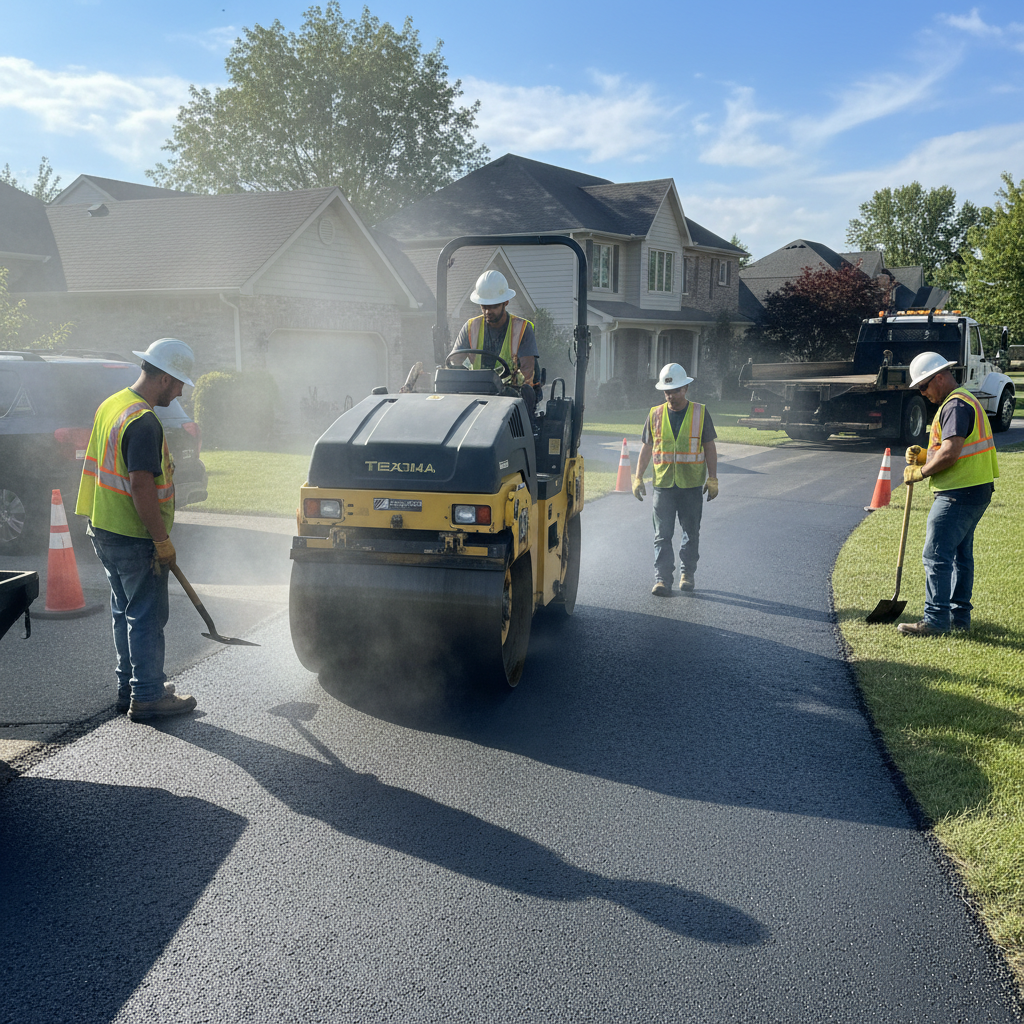
Driveway paving options and costs in Coquitlam West
Coquitlam West homeowners have a few proven ways to upgrade a driveway—primarily asphalt, interlocking pavers, or concrete—each with a different balance of upfront cost, longevity, and how easy it is to refresh the surface later. With 25,656 residents in Coquitlam West (Statistics Canada, 2021 Census), it’s a steady, year-round market supported by a lot of private homes where driveways see daily vehicle traffic and frequent rain exposure. In this Lower Mainland–Southwest climate, long wet seasons and intense rainfall matter as much as frost: the wrong base thickness or drainage detail shows up as rutting, edge breakdown, and reflective cracking. Even though coastal BC has a shallower frost penetration than Interior regions, local practice still assumes a frost line on the order of 18 inches for sensitive infrastructure, so granular base preparation and compaction are the difference between a driveway that lasts and one that needs early repair.
We especially see demand around Coquitlam West’s older, more established pockets and hillside-adjacent streets, where grades and drainage patterns are more variable. In those areas—like near routes that lead toward the Lake City Way corridor—contractors often spend extra time on excavation depth, shaping slopes, and adding proper subdrainage before paving. That’s why two quotes for “the same driveway” can still differ: the base and water management work is usually the real cost driver, not the surface material alone.
Here’s a realistic comparison of typical price ranges homeowners budget for in Coquitlam West, followed by what drives those differences by site.
| Material |
Lifespan |
Maintenance |
Best For |
Price per sq ft |
| Asphalt (new installation, proper base) |
15–25 years |
Seal every 3–5 years; patch as needed |
Good value, fast installation, smooth ride |
$12 – $20 |
| Asphalt (overlay on existing gravel base) |
10–18 years |
Seal and monitor; plan for future full replacement if base fails |
Upgrading without full tear-out (when existing base is sound) |
$10 – $17 |
| Interlocking concrete pavers |
25–40 years |
Re-leveling and re-sand as needed |
Curb appeal and easy localized repairs |
$20 – $40 |
| Poured concrete (broom finish) |
20–30 years |
Occasional crack repair; surface cleaning |
Low maintenance and a solid monolithic finish |
$18 – $35 |
| Exposed aggregate concrete |
20–30 years |
Sealing typically every few years; crack monitoring |
Slip resistance and upgraded appearance |
$22 – $38 |
| Gravel / crushed stone (budget option) |
3–8 years |
Top up annually; weed control; re-grade |
Lowest upfront cost, short-term solution, drainage-first sites |
$6 – $12 |
Prices are estimates only and vary by project scope, site access and material selection.
What affects the price of paving in Coquitlam West
In Coquitlam West and the broader Lower Mainland–Southwest, you’ll often see quotes for what sounds like the same driveway swing by 30–50%. The reason is that contractors aren’t just pricing “asphalt vs concrete”—they’re pricing excavation, drainage correction, base thickness, compaction, and the surface thickness required to handle the local wet season. Two driveways with identical dimensions can land in different price bands if one site has unstable clay, poor downspout discharge, or an uneven grade that needs re-building.
Frost line depth and freeze–thaw cycles are decisive cost factors even on the coast. Local practice still assumes a frost line on the order of 18 inches for exposed applications, so the base and granular layers must be installed thick enough to prevent heaving and cracking around that zone. In colder parts of Ontario/Alberta you may see deeper granular bases (commonly 6–12 inches), while coastal BC often trends closer to 4–6 inches in less sensitive areas. The key in Coquitlam West is that drainage governs how water behaves near that frost line; persistent saturation makes materials expand/contract more during seasonal transitions.
Seasonality also matters. Asphalt mix placement depends on warm air temperatures (hot-mix asphalt typically requires above 10°C), and in spring/fall the window narrows because of rain and shoulder-season conditions. That concentration of demand can push labour pricing toward the higher end of the $12 – $20 asphalt band. For concrete, air-entrainment and proper subbase design affect labour effort and material selection—concrete in the $18 – $35 band can be more cost-effective than pavers when your site doesn’t need extensive drainage upgrades.
Concrete examples we commonly run into: a driveway with downspout runoff already ponding at the garage apron usually requires added slope correction and subdrain work, which raises cost for any surface. Conversely, a level lot with good existing drainage can keep costs closer to the low end of the range because excavation and base rebuild are minimal. If your home has older paving and the base is already failing, tear-out and disposal can also push the job closer to a full replacement scenario.
| Price Factor |
Why It Matters |
Cost Impact |
| Driveway area in sq ft |
Most material and equipment time scales directly with surface area |
Usually the largest swing in total cost |
| Base depth required |
Frost line assumptions and site saturation drive granular thickness and compaction |
More depth can add significant excavation and aggregate cost |
| Grading and drainage work |
Slope corrections prevent standing water and reduce freeze–thaw stress |
Can add labour for shaping, subdrain, and re-profiling |
| Tear-out of existing surface |
Breaking/hauled loads and disposal are time-consuming, especially with concrete |
Often adds a major one-time cost |
| Edge restraints and curbing |
Prevents paver spread and asphalt edge failure during wet winters |
Raises materials and installation labour |
| Sealing requirement |
Asphalt needs sealing after it cures to slow moisture and oxidation |
Small additional cost now; helps protect lifespan |
| Site access |
Narrow driveways and tight turns slow excavation and limit equipment |
May increase labour hours and staging cost |
| Asphalt mix specifications |
Freeze-thaw-rated mix design can cost more but improves durability |
Can move pricing toward the higher asphalt band |
Permits & regulations in British Columbia
In British Columbia, paving a private driveway within your own property typically does not require a building permit. Where permits and approvals come into play is usually around any work that affects the municipal right-of-way or public infrastructure. That includes new curb cuts, changes to boulevard areas, modifications near sidewalks/lanes managed by the municipality, or any alteration that changes storm drainage patterns. Also pay attention to lot-grading bylaws: some municipalities restrict how close a hard surface and drainage discharge can be to property lines, or require specific grading and drainage outcomes to prevent water from being pushed onto neighbouring lots.
Before excavation, have utility locates done. Even in Coquitlam West—where your driveway seems “simple”—there can be buried services near the street line, including gas, hydro, telecom, and service laterals. In practice, this is done through the provincial one-call system (BC 1 Call) before any digging.
To verify a contractor before you sign, ask for three things and check them directly: (1) the contractor’s valid British Columbia business/licensing information from the appropriate online registry used for contractor verification, (2) a current certificate of liability insurance naming you as an additional insured where applicable, and (3) proof of coverage for workplace injury protection (WSIB/WCB equivalent coverage) that matches their trade and crew. Then request a clearance/coverage letter if they provide it, and keep it with your contract paperwork.
Asphalt vs pavers vs concrete for Coquitlam West driveways
For Coquitlam West driveways, the right material is less about “which is best everywhere” and more about which one you can maintain through our wet winters and shoulder-season storms. Asphalt usually wins on lowest upfront cost and quick installation, but it performs best when you seal on schedule—typically every 3–5 years after it cures. In the Lower Mainland–Southwest, repeated heavy rainfall and freeze–thaw near the assumed frost zone means drainage and a properly compacted granular base are non-negotiable; with those done well, asphalt commonly fits homeowners who want a smooth ride and straightforward patch repairs.
Interlocking concrete pavers have the highest upfront price in most cases, but they’re the most forgiving for localized repairs. If a section settles due to a drainage or subbase issue, pavers can be lifted, re-compacted, re-sanded, and reinstalled without tearing up the entire driveway. That’s a big advantage in Coquitlam West where older lots may have uneven grades or changing runoff paths. Poured concrete sits in the middle on cost and gives a clean, monolithic look, but concrete can crack if it’s not air-entrained and properly jointed for freeze–thaw movement. For coastal BC, you still need the concrete designed for seasonal temperature cycling and the base built to control moisture.
As a dollar example, a driveway in the asphalt band of about $12 – $20 per sq ft can look cheaper than pavers at $20 – $40 per sq ft, but the difference is justified when you expect future repairs or want maximum curb appeal near the garage approach. Where the site is simple and drainage is already solid, asphalt or broom-finish concrete is often the more cost-effective route. Where runoff is complex or the driveway grade is tight, pavers commonly become “cheaper over time” because repairs are targeted rather than total replacements.
| Material |
Frost Resistance |
Curb Appeal |
Repair Method |
Lifespan |
Price Band |
| Asphalt (sealed regularly) |
Good when base is well-compacted and drainage is corrected |
Medium (clean, dark finish) |
Cut out and patch; re-seal localized areas |
15–25 years |
$12 – $20 |
| Interlocking concrete pavers |
Very good; movement is absorbed at joint lines with proper base |
High (upgrade look and colour options) |
Lift/replace specific paver sections |
25–40 years |
$20 – $40 |
| Poured concrete (air-entrained) |
Good with air-entrainment, proper joints, and drainage |
Medium to high (clean modern surface) |
Crack repair and patching; occasional slab correction |
20–30 years |
$18 – $35 |
| Exposed aggregate concrete |
Good; texture holds up when base and sealing are maintained |
High (designed finish, slip resistant) |
Patch with matching finish or targeted surface repair |
20–30 years |
$22 – $38 |
| Permeable pavers (drainage grid) |
Excellent for water control; reduces saturation-related stress |
Medium to high (depends on pattern/product) |
Replace individual units; maintain infiltration system |
20–35 years |
$28 – $50 |
| Chip seal / tar-and-chip |
Moderate; best for specific applications and maintained edges |
Low to medium (textured appearance) |
Routine maintenance; spot re-application |
6–12 years |
$8 – $16 |
How to choose a paving contractor in Coquitlam West
Choosing a contractor in Coquitlam West is about verifying credentials and then confirming the scope is truly comparable. Start with British Columbia licensing/registration where applicable to the contractor’s business operations, then verify liability insurance: ask for a current certificate of insurance and confirm it covers paving/contracting work. Next, request proof of workplace coverage (WSIB/WCB equivalent coverage) for their crews—have them provide the coverage information you can reference in case of an incident. You should also be able to provide a clearance letter if they use one, and you should keep a copy with your contract paperwork.
Get 2–3 itemised quotes, not lump sums. You want a breakdown that shows excavation depth, base material type and thickness, compaction testing approach (if they discuss it), asphalt/concrete thickness, and what’s included for haul-off and disposal. Confirm whether permits or municipal approvals (if needed for curb/boulevard work) are included or the homeowner must obtain them. Ask whether site protection, clean-up, and restoration near landscaping are part of the scope.
Warranty matters in a wet climate. Ask for the workmanship warranty length and whether it covers base issues or only surface defects. Also clarify the difference between the contractor’s workmanship warranty and the product/manufacturer warranty for asphalt mix or paving materials, and whether warranties are transferable to future owners. For payment, never pay more than about 10–15% upfront; hold back a portion until the job is complete and you’ve received as-built documentation and final inspection sign-off. Finally, get a written start date and completion estimate—rain can compress schedules in shoulder season, so you want clear expectations if weather delays occur.
- Ask for an itemised quote: excavation, base thickness, asphalt/concrete thickness, and any geotextile/subdrain.
- Confirm disposal/haul-off is included (not “by others”).
- Check liability insurance dates and coverage limits on the certificate.
- Verify workplace injury coverage (WSIB/WCB equivalent) for the crew.
- Use a signed scope that states what edges/curbs are included.
- Clarify compaction method and how they verify base density.
- Ensure drainage corrections are explicitly in the scope if ponding is present.
- Confirm asphalt thickness and whether freeze-thaw-rated mix is specified.
- Ask when sealing is required for asphalt and who schedules it (timing is critical).
- Check warranty in writing: length, what’s covered, and exclusions.
- Set payment terms: keep 10–15% upfront max and hold back until completion.
- Get a written timeline and weather delay plan before work starts.
Red flags in Coquitlam West: contractors who won’t show insurance/coverage paperwork on request, quotes that skip base thickness or drainage notes, “too good to be true” pricing that indicates minimal excavation, no written warranty terms, or crews starting without utility locates where excavation is required.
Frequently asked questions — paving in Coquitlam West
How long does a paved driveway last in Coquitlam West?
In Coquitlam West, driveway lifespan depends heavily on base preparation and drainage, not just the surface material. Asphalt driveways typically last about 15–25 years when installed over a properly compacted granular base and sealed on schedule (often every 3–5 years). Interlocking concrete pavers often last 25–40 years because you can lift and repair small problem areas without replacing the whole driveway. Poured or exposed-aggregate concrete commonly targets 20–30 years, provided it’s air-entrained, properly jointed, and not installed over saturated or unstable fill. With coastal rain and seasonal cycling, moisture management is the difference between “looks great for a few years” and long-term performance.
When is the best time of year to pave in Coquitlam West?
The best time is late spring through summer when days are consistently warm and rain can be scheduled around. Asphalt is especially time-sensitive: hot-mix placement generally requires air temperatures above about 10°C, so early spring and late fall can compress scheduling and increase the risk of poor compaction or premature surface issues. That said, in British Columbia’s Lower Mainland–Southwest, the paving season is longer than in colder parts of Canada, but intense rainfall can still disrupt work. A good contractor will plan for weather windows, protect the base during construction, and schedule sealing after the asphalt has fully cured rather than “sealing immediately.”
How deep should the base be for Coquitlam West's frost?
Even though coastal BC has shallower frost penetration than many Interior regions, local practice still plans around a frost line on the order of 18 inches for sensitive infrastructure. For residential driveways in the Lower Mainland–Southwest, typical asphalt builds often use about 6 inches of compacted granular base plus roughly 2.5–3 inches of asphalt, with deeper excavation if the subgrade is weak or saturated (clay-heavy areas can be more challenging). The base thickness and layer design should be based on your site’s current soils and how water drains—not on a one-size-number. If you have ponding near the garage or downspout discharge into the driveway area, expect the contractor to recommend additional drainage/grading work before topping with asphalt or concrete.
How often should I seal my asphalt driveway?
For asphalt in Coquitlam West, sealing is usually recommended after the driveway has cured and then periodically to slow moisture and oxidation. A common practice is to seal every 3–5 years, with the exact timing depending on how quickly the surface shows wear and how much rainfall exposure it gets. If you’re planning a new asphalt install, ask the contractor for the curing timeline and whether they’ll coordinate the seal coat as a follow-up. Budgeting for sealing is part of getting value out of asphalt priced in the $12 – $20 per sq ft band; skipping seal coats often leads to faster surface raveling and may push you toward patching sooner.
Why does my driveway crack and heave in winter?
Cracking and heaving in British Columbia most often come from moisture moving into the base and then experiencing seasonal temperature cycling. Even without deep frost, repeated expansion/contraction around the frost-affected zone can stress an undersized or poorly drained base—especially on clay soils or where downspouts and surface runoff feed the driveway edge. Other common causes include inadequate compaction, missing edge restraints (for pavers), or asphalt/concrete placed over an uneven or saturated subgrade. If you see cracking near the garage apron or at the driveway edge, it’s usually drainage or base-related. A proper repair typically addresses the water path and rebuilds the base where it failed—not just a cosmetic patch.
Do I need a permit to pave my driveway in British Columbia?
In most cases, paving a private driveway within your own property in British Columbia does not require a building permit. However, approvals are typically needed when the work affects the municipal right-of-way or storm drainage—examples include new curb cuts, changes to boulevard areas, or alterations that impact how surface water is handled. Coquitlam West homeowners should also consider lot-grading bylaws that can restrict how hard surfaces are built and how drainage discharge is managed near property lines. Before excavation, ensure utility locates are completed (BC 1 Call). Finally, when hiring a contractor, confirm they understand whether any municipal approval is required and whether that step is included in the scope or your responsibility.