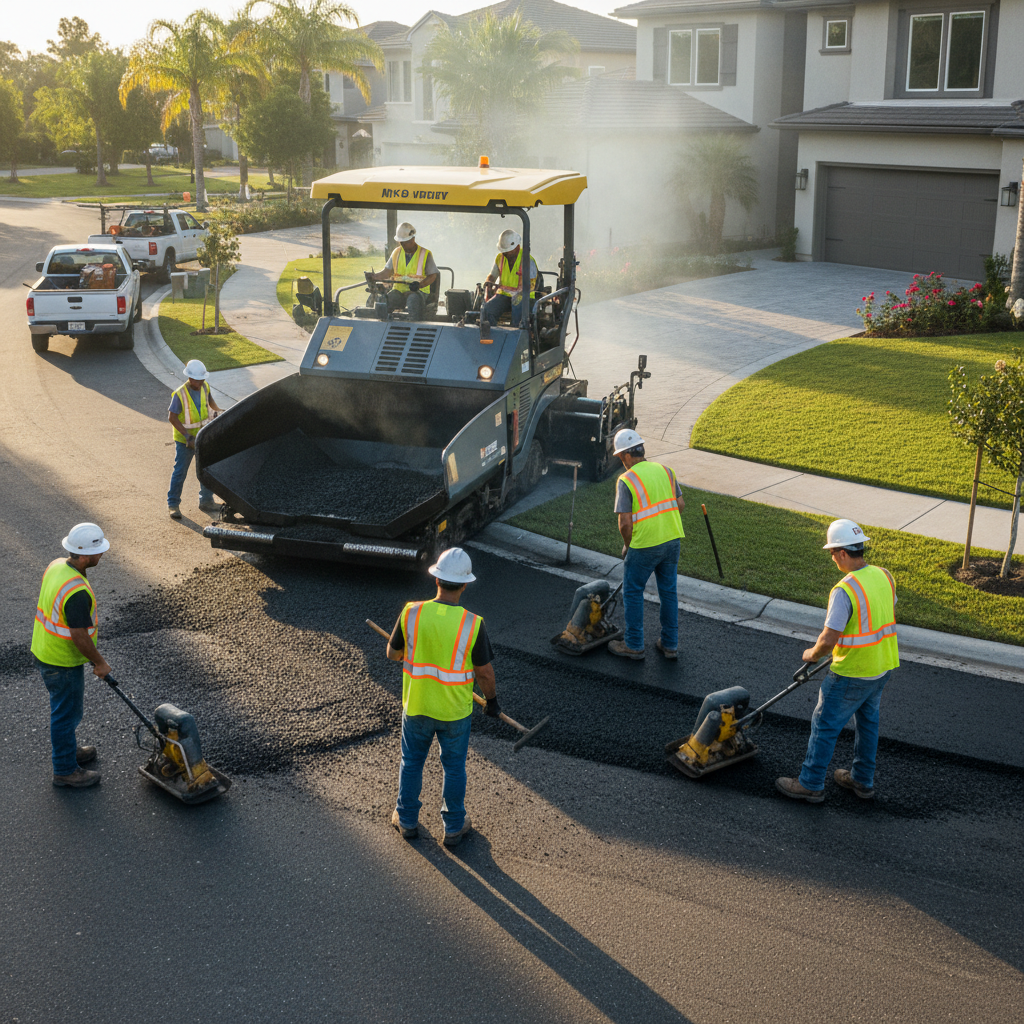
Driveway paving options and costs in Willoughby
Willoughby, British Columbia is a fast-growing community near the Lower Mainland, and that growth shows up in driveway work—especially for the typical detached-home lots where a private driveway apron and parking pad are part of daily life. With a population of 31,305 in 2021 (Statistics Canada, 2021 Census), demand is steady and contractor scheduling can be tight in spring and early summer. In this part of the Lower Mainland–Southwest, pricing is driven less by deep, penetrating frost and more by intense rainfall, drainage control, and the freeze–thaw action around a relatively shallow frost line. That means the biggest cost differences usually come from how much excavation, granular base thickness, and underdrain/drainage correction the site needs—not just the surface material.
Crews are busiest in areas around Fraser Highway / 8th Avenue and the newer residential pockets where older driveways are being upgraded for better curb appearance and longer service life. Because wet seasons limit compaction windows, reputable contractors build flexibility into the schedule and often recommend sealing and maintenance to protect your asphalt through shoulder-season storms.
Below is a practical cost comparison for homeowners planning a new installation or an upgrade. Use it to sanity-check quotes, then compare the base depth, drainage plan, and disposal/tare-out details—those are what typically move projects up or down in price.
| Material |
Lifespan |
Maintenance |
Best For |
Price per sq ft |
| Asphalt (new installation, proper base) |
15–25 years |
Seal every 3–5 years (typical) |
Smooth ride, solid value when base/drainage are done right |
$12–$20 |
| Asphalt (overlay on existing gravel base) |
8–15 years |
Seal every 3–5 years; monitor edge raveling |
When existing base is already stable and graded correctly |
$10–$16 |
| Interlocking concrete pavers |
25–35 years |
Occasional re-leveling of a few stones as needed |
High curb appeal and repairs without replacing the whole driveway |
$20–$40 |
| Poured concrete (broom finish) |
20–30 years |
Minimal; keep surface clean and seal if desired |
Low maintenance and a clean, continuous finish |
$18–$35 |
| Exposed aggregate concrete |
20–30 years |
Seal selectively; regular cleaning to prevent staining |
Slip resistance and premium appearance |
$22–$40 |
| Gravel / crushed stone (budget option) |
3–7 years (depends on grading and traffic) |
Top up annually; re-grade as it migrates |
Short budget window or interim driveway while you plan an upgrade |
$6–$12 |
Prices are estimates only and vary by project scope, site access and material selection.
What affects the price of paving in Willoughby
In Willoughby and across the Lower Mainland–Southwest, it’s common to see quote swings of 30–50% for what looks like the same driveway. The difference usually comes down to how each contractor addresses the “invisible” work: excavation, granular base depth, drainage correction, and proper compaction. Contractors also price in local scheduling realities—rain can shrink workable windows and can force crews to move equipment and crews more often, which shows up in unit rates.
Frost and freeze–thaw cycles are decisive cost factors even when the region is milder than Interior or Northern BC. Local practice still assumes a frost line for sensitive infrastructure, and that’s why base thickness matters: deeper frost demands a thicker compacted granular base (in exposed applications), often moving you from a minimal build-up toward the more durable 6–12 inch range depending on soil conditions. In addition, asphalt mix design has to meet local freeze–thaw expectations; a mix that’s not built for that performance can fail faster, which is why reputable projects still land in the typical $12–$20 per sq ft asphalt band when the base is properly prepared.
Concrete pricing can also jump in Willoughby for practical reasons. If your driveway ties into existing slabs or you need thicker reinforcement/air-entrainment for durability, you may drift toward the $18–$35 per sq ft concrete band. Likewise, paver pricing can be higher where soils are clay-heavy or saturated—more undercutting and more bedding/base gravel are required to prevent settlement. On the other hand, costs come down when a driveway is already well-graded with stable base, good drainage, and easy equipment access—fewer hours of excavation and less extra base gravel.
| Price Factor |
Why It Matters |
Cost Impact |
| Driveway area in sq ft |
Labour and materials scale mostly by square footage |
High (often the largest component) |
| Base depth required |
Base thickness controls heaving/cracking risk near the frost line |
High (can change the build-up by 20–40%) |
| Grading and drainage work |
Slope, ditch tie-ins, and subdrain fixes prevent water pooling |
Medium to high (especially on clay) |
| Tear-out of existing surface |
Breaking, hauling, and disposing old asphalt or concrete adds cost |
Medium (varies with thickness and access) |
| Edge restraints and curbing |
Prevents paver spread and holds asphalt edges to grade |
Medium (often overlooked in lowball quotes) |
| Sealing requirement |
Asphalt needs sealing after proper cure for protection |
Low to medium (often a separate line item) |
| Site access |
Narrow gates/drive approaches slow equipment movement |
Medium (labour premium/time premium) |
| Asphalt mix specifications |
Freeze–thaw-rated mixes perform better in local conditions |
Medium (material cost difference) |
Permits & regulations in British Columbia
In British Columbia, paving a private driveway within your own property usually does not require a building permit, as long as you’re not changing how water is managed off-site and you’re staying within existing site footprints. However, work that affects the municipal right-of-way does require approval. That commonly includes creating or altering a curb cut/driveway apron in the boulevard, changing storm drainage patterns, or adjusting boulevard grading that can direct runoff toward neighbouring properties. Some municipalities also have lot-grading bylaws that can restrict how close a hard surface can be to property lines or how stormwater must be handled.
Before anyone digs in Willoughby, ensure utility locates are called for—BC 1 Call. This is a step many homeowners miss because it can be “one phone call,” but it matters for safety and scheduling.
To verify a contractor in BC, ask for three things and check them in writing:
- Licence: confirm their provincial registration and business details on the appropriate provincial registry website.
- Liability insurance: request a current Certificate of Insurance naming you as an additional insured where applicable, and check the coverage level matches driveway scope.
- Work coverage: confirm WSIB/WCB-equivalent coverage for the trades involved (ask them for proof/clearance letter or coverage confirmation).
Finally, confirm lot-grading and any right-of-way conditions with your municipality before construction—this helps avoid stop-work delays once excavation starts.
Asphalt vs pavers vs concrete for Willoughby driveways
Choosing between asphalt, interlocking pavers, and concrete in Willoughby usually comes down to upfront cost versus long-term maintainability in a wet, drainage-sensitive climate. Asphalt is typically the lowest upfront option; when installed over a properly compacted granular base and sealed after cure, it performs well through Lower Mainland shoulder-season rain and the freeze–thaw cycle around a shallow frost line. The tradeoff is maintenance: most homeowners should budget sealing every 3–5 years to slow oxidation and reduce water penetration.
Interlocking concrete pavers cost more up front, but they’re the most repair-friendly. If you have localized settlement or need access to buried services, individual stones can be lifted and reset without replacing the whole driveway—important in areas where drainage corrections or subgrade remediation may be needed. Pavers also deliver the strongest curb appeal, which matters in neighbourhoods where drive aesthetics drive buyer interest.
Poured concrete is mid-range. With air-entrainment and proper finishing, it can be durable and low maintenance, but it’s more susceptible to cracking patterns if the base is poorly drained or the slab isn’t detailed for movement. Exposed aggregate offers better traction and appearance, but it still relies on good base and drainage.
For a real-world dollar comparison: if a 500 sq ft driveway is quoted at $12–$20 per sq ft for asphalt (=$6,000–$10,000), a paver driveway might come in closer to $20–$40 per sq ft (=$10,000–$20,000). That extra cost can be justified if you value curb appeal or anticipate future service access, or if the subgrade needs more robust base and edge restraint detailing.
| Material |
Frost Resistance |
Curb Appeal |
Repair Method |
Lifespan |
Price Band |
| Asphalt (sealed regularly) |
Good with proper base and drainage |
Medium |
Mill/patch potholes; crack repairs and resurfacing |
15–25 years |
$12–$20 |
| Interlocking concrete pavers |
Excellent when base is stable and edges are restrained |
High |
Remove/re-level affected stones; re-sand and reset |
25–35 years |
$20–$40 |
| Poured concrete (air-entrained) |
Good with air-entrainment and proper joints |
Medium to high |
Patch/patch panels; full replacement if severely settled |
20–30 years |
$18–$35 |
| Exposed aggregate concrete |
Good when detailed for movement and drainage |
High |
Targeted patching where possible; panel repair |
20–30 years |
$22–$40 |
| Permeable pavers (drainage grid) |
Very good for wet sites with designed subdrain |
High (modern look) |
Replace individual units; clean/rejuvenate joints |
20–30+ years (system-dependent) |
$25–$45 |
| Chip seal / tar-and-chip |
Moderate; performance varies by base prep |
Low to medium |
Spot patching; re-chip or resurfacing later |
7–15 years |
$10–$18 |
How to choose a paving contractor in Willoughby
Start by confirming coverage and eligibility in British Columbia. Ask for (1) their business licence/registration details, (2) current liability insurance with a Certificate of Insurance, and (3) proof of work coverage (WSIB/WCB-equivalent) for the workers on site. In practice, the fastest way to verify is to request documents before signing: check the certificate dates and job description match driveway paving work, and confirm the coverage letter is current and includes subcontractors if they’re used.
Next, get 2–3 itemised written quotes rather than one lump sum. You want line items for excavation/haul, granular base quantity and depth, compaction, asphalt/paver/concrete supply, surface thickness, edge restraints, forms (for concrete), and disposal. Confirm what’s excluded: is permit/right-of-way work included if needed, is hydro excavation used for utilities, and is disposal of removed materials included in the price?
Warranty should be specific. Ask for the workmanship warranty length, whether the surface material has a separate manufacturer warranty, and whether warranties are transferable to future owners—important if you sell. For payment, never pay more than 10–15% upfront; ask for a holdback until final grading, cleanup, and any warranty items are completed. Finally, require a written timeline: planned start date, weather-dependent milestones, and completion estimate. In Willoughby, rain can shift scheduling—good contractors spell out how they protect the base during storms.
- Verify licence/registration before booking excavation
- Confirm liability insurance and job-scope coverage limits
- Request proof of work coverage (and subcontractor coverage if applicable)
- Get itemised quotes (labour vs materials vs disposal)
- Ask for base thickness and compaction method (not just “proper base”)
- Confirm drainage plan and whether grading corrects ponding
- Check included edge restraints/curbing for pavers
- For asphalt, confirm tack coat and cure/seal schedule (sealing after cure)
- Ask how they handle existing utilities, ties, and transitions
- Clarify what happens during rain: base protection and re-compaction
- Get warranty terms in writing (workmanship + product)
- Use a payment schedule with a holdback until final acceptance
Red flags in Willoughby include: promises of “no need to seal” on asphalt, skipping drainage/grading corrections while blaming “weather” later, vague quotes that don’t list base depth and haul/disposal, refusing to provide insurance/coverage documentation, or pressuring you for full payment before the job starts.
Frequently asked questions — paving in Willoughby
Why does my driveway crack and heave in winter?
In Willoughby and the Lower Mainland–Southwest, winter issues are usually about drainage plus shallow freeze–thaw cycles, not deep Interior-style frost. If water can’t drain away—often due to low spots, inadequate slope, or missing underdrain—moisture saturates the base. Then, when temperatures cycle around freezing, that moisture expands and contracts near the frost line, which can cause heaving, edge lifting, and cracking. Clay-heavy soils in parts of the Fraser Valley can make this worse if excavation and granular base thickness aren’t sufficient. A driveway that was paved over weak or uneven gravel commonly fails sooner, even if the surface looks fine initially. Fixes typically require correcting grade, rebuilding the base to the right depth, and sealing (for asphalt) after proper cure.
Do I need a permit to pave my driveway in British Columbia?
Usually, paving within your own property footprint in British Columbia does not require a permit for a typical residential driveway. Where permits/approvals often come into play is when the work touches the municipal right-of-way—such as creating or altering a curb cut/driveway apron, changing boulevard drainage, or modifying stormwater flow. Some areas also enforce lot-grading bylaws that can restrict how hard surfaces sit near property lines or how runoff must be managed. In Willoughby, the best approach is to ask your contractor what portion is within your lot versus boulevard area, then confirm the applicable requirements with the municipality before excavation. Also, always ensure utility locates are called (BC 1 Call). If there’s any right-of-way involvement, don’t start grading until the approval is in place.
How long before I can drive on new asphalt?
For new asphalt in British Columbia, the wait time depends on temperature, thickness, and whether tack coat was used on a stabilized base. Typically, light traffic may be allowed sooner on small residential pads, but homeowners should plan to keep vehicles off the surface until it’s fully cooled and cured enough to prevent surface pickup or rutting. Your contractor will tell you a specific window in writing. A conservative homeowner plan is often “no driving for at least 24–48 hours,” with full driveway use after the material has cooled and compacted properly. Also remember that sealing is not immediate—most contractors recommend sealing after the asphalt has cured, commonly within 6–12 months. Budget-wise, the paving itself is commonly in the $12–$20 per sq ft asphalt band when base prep is done properly.
What causes potholes and how are they repaired?
Potholes in Willoughby usually start underneath the surface. Water gets into small voids or weak spots in the granular base, often around edges or where water drains poorly. In freeze–thaw conditions, moisture expands, pushing the asphalt up and breaking the mat. After traffic and plowing impacts, the damaged area grows into a pothole. Repairs depend on the cause: a simple surface patch that doesn’t remove the failing base will re-fail. A proper repair typically includes saw-cutting the perimeter, removing unstable asphalt, re-compacting granular base (and adding base depth if needed), then placing asphalt in lifts and compacting to match existing grade. For bigger recurring failures, the long-term solution may be milling and overlay. In the meantime, quick patching prevents water infiltration and limits further base loss.
How do I prepare for a paving project?
Preparation makes a big difference in cost and schedule. First, clear the driveway area of vehicles, trailers, and stored items so crews can work safely and efficiently—site access affects labour time. Next, mark any landscaping or sprinkler heads you don’t want disturbed, and identify where downspouts discharge so the contractor can tie drainage correctly (this is critical in the Lower Mainland–Southwest). If there’s any chance of right-of-way involvement, ask your contractor whether a municipal approval is needed before excavation. Arrange for utility locates through BC 1 Call if digging will occur. Finally, review the written scope: confirm tear-out/disposal, edge detailing, and whether sealing is included for asphalt. For many asphalt projects that land in the $12–$20 per sq ft range, sealing timing is a key part of getting long-term performance.
How do I compare paving quotes fairly?
To compare paving quotes fairly in Willoughby, focus on “apples-to-apples” scope. Ask for itemised line items, not only a total price: base excavation and granular base depth, compaction method, drainage corrections, surface thickness, tack/bonding steps (asphalt), and disposal of removed materials. Confirm edge restraints/curbing details for pavers and joint/finishing specifications for concrete. A quote that’s far below others may be skipping base depth, drainage upgrades, or proper asphalt mix requirements for freeze–thaw performance. Compare warranty terms too—workmanship warranty length and whether product coverage applies. As a general guideline, asphalt often aligns with the $12–$20 per sq ft band and concrete commonly falls in the $18–$35 per sq ft band, but the “why” matters: correct build-up and drainage explain the best value. If a contractor can’t clearly explain the scope, that’s a warning sign.